What it takes to make the problem go away | Pascal Finette
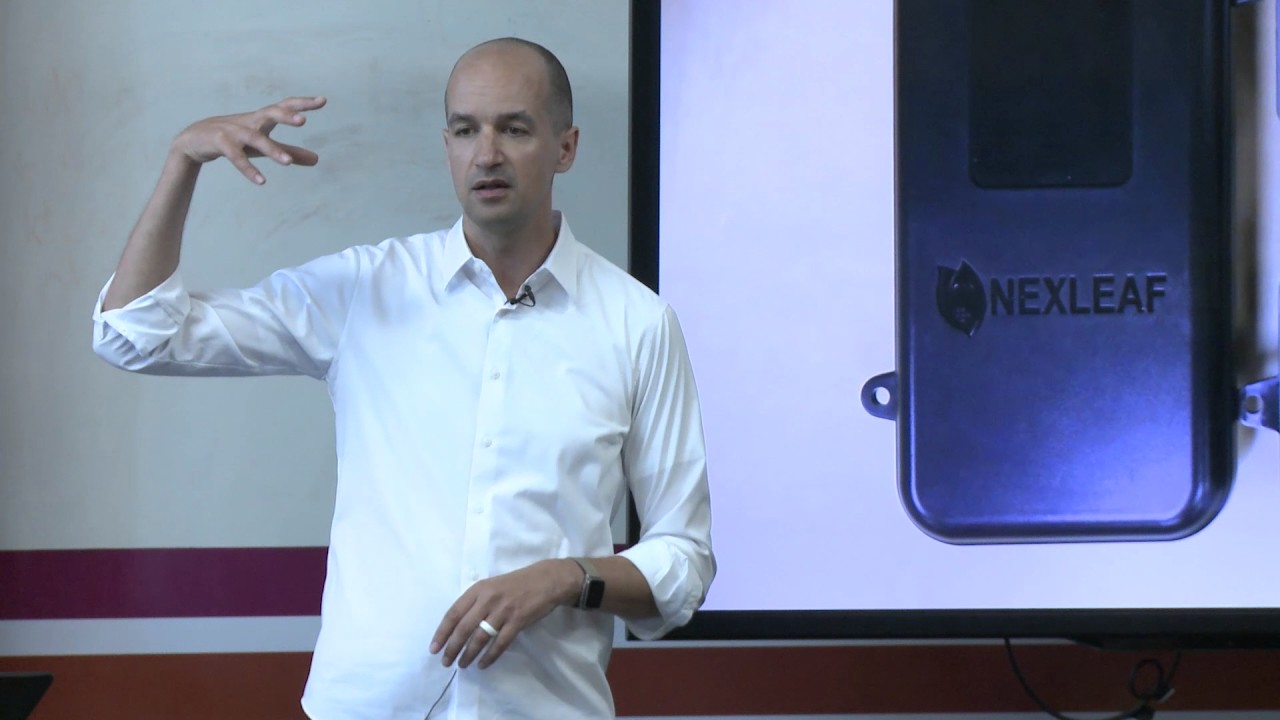
Pascal Finette argues that solving humanity's biggest challenges requires a 10x mindset, not incremental thinking. He points to Nexleaf's low-cost temperature-monitoring device that eliminated vaccine spoilage in developing countries, and the British rowing team's 1% daily gains philosophy, as proof that focused, technology-enabled solutions can actually make problems disappear.
Chapters
Here's a second insight. This is a question I love to ask. So I was a VC in a former life. I love to ask as a venture capitalist, how does 10x look like? So moonshot thinking, right? Like Google's moonshot thinking. Here's how you apply this. Who's raising capital at the moment? How much capital do you raise? Right now? Yeah. It's pre-seed round. Yeah. How much? $750,000. $750,000? OK. So you would come to me and you'd present me a plan. And you typically have a really good idea what you do with the $750,000. Better do. Otherwise, you should not pitch me. OK? What I did as a VC was I like that. I'm like, I like what you're doing. I like your plan. I'm like, OK, that's great. I give you $7.5 million. What do you do? And I can guarantee you, 99% of Most entrepreneurs have no clue. They stumble around. They're like, well, we hire a few more people. We go into a few more countries. We accelerate. That's never the answer. The best entrepreneurs say, oh, that's an interesting question. Let me think about it. And then they come back. Because once you start thinking in 10x, you think in a very different way. You think on a whole different sphere in how do you actually build the company. And then what we did was we said, okay, great. Now you have that plan. Let's now work it backwards, because I don't want to give you $7.5 million, right? I want to probably give you $1 million or even like your $750,000. But now you have a different view of the world of how you actually get to where you want to get. So really think about this. Like when you're raising your money, really think about like, if I had 10 times the money, how would my company look different? How would my product look different? It's one of the most powerful questions you can ask yourself. So let's get to the last part. Why does this matter? Technology for the sake of technology is intellectually stimulating, but it's largely meaningless. It matters because of this. It matters because there's a big picture at play. About 15 years ago or so in my life, I discovered this quote from Albert Einstein, which is, we shall require a substantially new manner of thinking if mankind is to survive. And it really shook me. Because there's a thing in there which is survival of mankind, right. And I was like, wow, that's crazy. And granted, our lives are all getting better. Like we live longer. There's less diseases on the planet. There's less people dying in wars, et cetera. And yet I think we have our work cut out for us. So for example, you take something like climate change. Global warming, sea levels will rise by 2 meters by the end of the century. That's kind of like the current consensus. The challenge with global warming is that most people understand global warming and they see global warming as what is called climate weirding. So like places get warmer and colder and you get these weird climate patterns. And that surely is a problem. The bigger problem is the 2 meters. There's large swaths of land where people live today which will be underwater. Take Manhattan Island, New York City. Manhattan Island, if we have 2 meters of sea level rise, Manhattan Island is flooded. It's gone. What this leads to is something called mass displacement. All these people need to now live somewhere else. If you want to get a sense of how that looks like, look at the Syrian refugee crisis in Europe, which is hitting Europe. That is 1 million people on the road. Manhattan Island itself is 8 million people. NASA brings out these interesting time lapses This is weather temperatures data in comparison to the year before. So blue means it gets colder in comparison to the year before. Yellow and orange means it gets warmer. So you see the planet's in pretty good shape until somewhere around the '70s and '80s. And then it gets a little warmer. And then you see as we're getting into the '80s and the '90s and the 2000s, we're effectively just following the We're fucked. So this comes out of NASA Ames, which is literally like in our back— on our back door. Every time, every year they update this. Every year for the last couple of years they use the same headline when they release the report, which is, this year was the hottest year on record. It's pretty devastating. We need to do something about this because otherwise like we're in really bad shape. Take something like population. There's 9 billion people who will live on this planet by 2050 according to the United Nations. Food today is a distribution problem. There's enough food on this planet, enough calories on this planet to feed 7.2 billion people. It's just in the wrong places. And that's a hard problem to solve in itself. If you want to feed 9 billion people, we need to grow our agricultural output by 2% annually. We're currently growing by 1%. We're not growing fast enough to feed these people by the end of 2050. You take employment or unemployment. The World Bank came out with a report saying that we need to create 600 million new jobs to sustain globally our current employment rate in the next 15 years, I can guarantee you that's not going to happen. If you have any idea of like how like Spain, for example, looks like, Spain's youth unemployment rate is 55%. So every second person in Spain is unemployed. We're moving rapidly into a world where we need to redesign our society. Currently our society is built on this idea that everybody has a job. And we take our satisfaction and our our well-being out of the fact that we have a job. Now this is not going to happen in the future. We need to figure out how do we support these people and make them feel valued in our society. You take literacy or illiteracy. There's literally 757 million people who cannot read this sentence in the world. You take poverty. There's 3 billion people who live on less than $2.50 a day. You cannot drink a cup of coffee at Starbucks here in Silicon Valley for less than $2.50 a day. Sanitation. There's 2.5 billion people who have no access to proper sanitation, making diarrhea the number one killer in the world. Water, 800 million people don't have access to clean drinking water. Malnutrition, a child dies every 6 seconds in a world where we have obesity. Now here's the thing. I don't want to leave you on a downer because I'm an extremely positive and optimistic person. I think we can change that. And the reason why I think we can change it, because I'm seeing it. I want to introduce you to a friend. This is Nithya. Hi. Nithya runs a company called Nexleaf. What they're doing is they're tackling an interesting problem. The problem is that 20% to 30% of vaccines in developing countries spoil because of a break in the cold chain. So you need to keep vaccines cold from the manufacturing to the deployment. This affects literally millions of children all around the world in developing countries. The challenge is in the best cases the vaccine has a little— like the vial has a little marker and you see that the vial— the vaccine got too warm and you can throw it away. In the good cases, you administer vaccines which are ineffective. In the worst case, you actually make even the child sick based on that vaccine. Nissia developed this little black box. When you open the black box, what you'll find inside is a $25 Chinese-manufactured Android smartphone, a 20-cent little piece of electronics she developed, and then a temperature sensor. What you do is you put this all together. You put this black box bolted on the fridge so it's stays with the fridge basically from day one till the deployment. And it measures temperature continuously. Now this is a connected device, so it does 2 things. The first is it sends the nurse in the field a text message to let the nurse know if the vaccine worked or didn't work or if there was a break in the cold chain. Secondly, it sends the data up into the cloud so that the health ministry or the health authorities can see where those breaks happen because they typically happen in the same places. You know, this one hospital where they forget to plug them in or this one trucking company which cranks them up too high and they freeze. When we started working with Nithya, she had this as a prototype. This is 3 years ago. She has raised a couple million dollars for this. She's now in 6 African countries as well as India. By the end of this year, she's going to be in every single fridge in India. She's currently deploying 25,000 additional devices in India. In every single country she's in, the problem doesn't exist anymore. It's gone. She has made the problem go away. Now, that makes me very proud because I happen to work with her, and it makes me really happy because we are tackling a problem. But here's the reason why I'm telling you this. The reason why I'm telling you this is because you can do this. And this is the reason why I'm so optimistic about the future, because every single person in this room can do this. There's no question you can do this. And even if you can't like build the software because you're not a software engineer, you know someone who can. I fundamentally believe that if we put our hearts and minds behind these problems, we should solve them. It's just a matter of us wanting to solve them. The question I ask people all the time is, you might have heard like Steve Jobs said like we want to make a dent in the universe. I fundamentally believe that the time to make dents is over. Like we don't have the time to make little dents anymore. What we need to do is we need to make the problems go away. And I believe, fundamentally believe, particularly because technology plays into our hands, that we have all the tools we need to make the problems go away. Anyone here is interested in rowing? What does rowing mean? Rowing. Boats. Ah. Fantastic. It's always one, like amazing, 4 people. That's awesome. Like typically I only have one person. For some reason. Let me share a short story with you. The British rowing team. So if you know anything about rowing, like rowing is huge in Britain. The British rowing team, the men's 8 rowing team, so 8 people in a boat, had an abysmal, abysmal Olympic record. So they lost like Olympic Games for decades, which is a real shame for Britain because again, it's like it's their national— it's one of their national sports. Yeah. So they got a new trainer in the run-up for the Sydney Olympics. And instead of going out and saying, oh, we need to train to win the Olympics, this trainer did one thing. He basically said, forget everything else. The only question we're asking ourselves every day with every decision is, will it make the boat go faster? So when they designed the hull for the boat, they asked themselves, will it make the boat go faster? When they started training the specific way, like weightlifting, they said, will it make the boat go faster? When they picked the people for the boat, they asked themselves, will it make the boat go faster? When they went out to drinks in the evening, they asked themselves, will it make the boat go faster? Lo and behold, they won the Olympics and are undefeated since then. And the reason for that is simple. It's really hard to change the world in one big sweep. It's really hard to build this billion-dollar company, to do this big thing, it's really easy to do a tiny little improvement every single day. It's really easy to ask yourself every single day with every single decision, will it make the boat go faster? And here's the math behind this. If you improve by just 1% every day, 1%, it's nothing, it's tiny. If you improve 1% every day for just 1 year, for 365 days, You end up with a 37.8 times improvement over where you are today. The way you change the world is not in one big sweeping move. The way you change the world is by doing a tiny thing every day. I have the great pleasure and fortune to work with the U.S. Navy SEALs, which is the most badass military unit on the planet, which is funny because I'm a pacifist. They have a handbook which they give every Navy SEAL. On the first page of the handbook, you'll find a formula which is this. Your rate of growth, meaning your personal rate of growth, you as a person. And what do you as an entrepreneur care more about than growing? Right? Like the reason why you're here is because you want to grow. The energy you get, like the challenges you tackle, you tackle because you ultimately want to grow. So your rate of growth equals the magnitude of the challenge multiplied by the intensity of the attack. If you hold this for— hold this true, and I fundamentally believe this is true, why wouldn't you take the hardest problem you can find and attack it as hard as you possibly can? Because that's how you grow as a person, as a human being. I want to leave you with one last quote. This is George Bernard Shaw who said that the reasonable man Adapts himself to the world. The unreasonable one persists in trying to adapt the world to himself. Therefore, all progress depends on the unreasonable man and woman. If I have a wish for you, if I can really wish something from you from the bottom of my heart, it's like you have to be unreasonable. Like we have to have you be unreasonable in this world. Because that is how you change the world. Don't forget, in a lot of these technologies, we're really at this interesting intersection. Like, we live in the most amazing, inspiring, crazy times. Everything is possible today. You get the slides there. Thank you.
More from Tim


He Sold His Car to Build This Startup, Then Pitched It for $1M 😳 #Startups #AI

This Startup Moves Your Crypto BEFORE Hackers Can Steal It 😳 #Crypto #Cybersecurity




15 Months Without Refrigeration?! This Startup Thinks It Can Go Global 🥥 #FoodTech #Startups



