What it's worth to the customer | Michael Rothschild
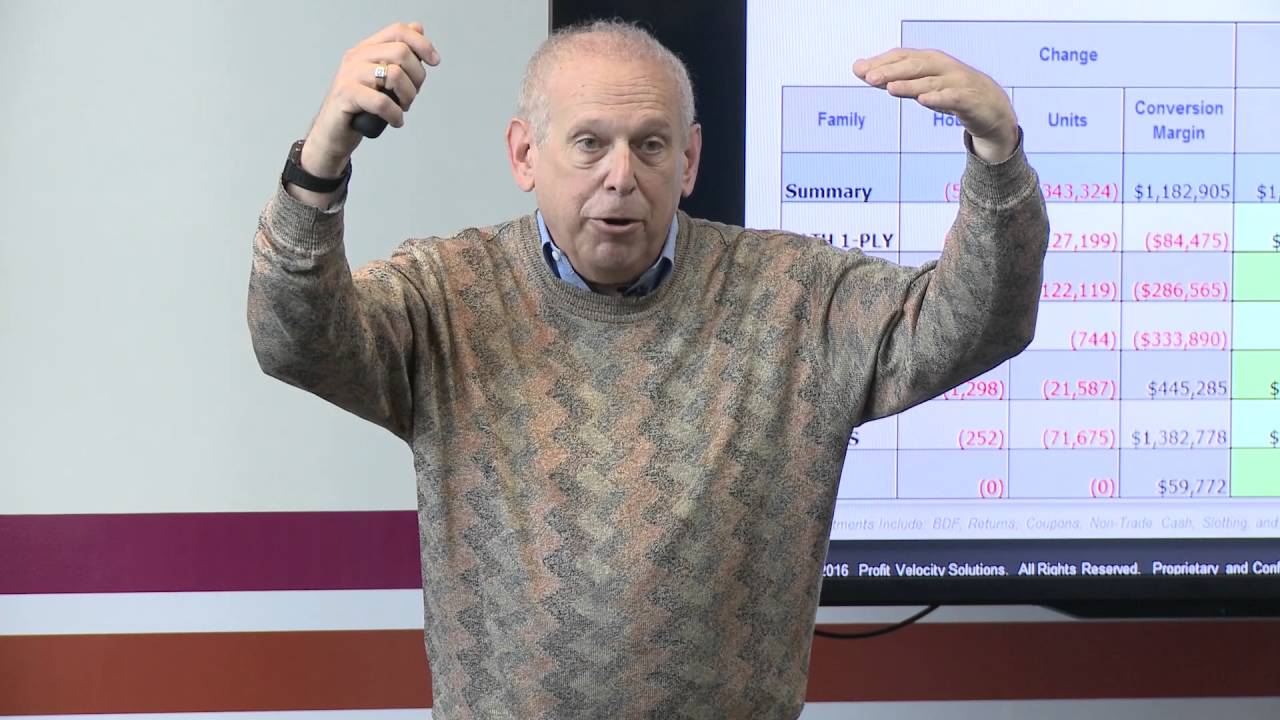
Michael Rothschild walks through how a tissue and paper towel manufacturer used SKU-level analytics to raise profit per machine-hour from $234 to $302, generating $1.4M in incremental profit in four months without higher revenue. The key was aligning incentives with private equity owners who benefit at exit.
Chapters
I'll show you what's it worth to customers. What difference does it make to them? With a case of this, these guys make, it's not this brand, we just used this picture, but they make something fairly prosaic, fairly boring, but we all need it every day. They have facial tissues, you know, Kleenex is the brand, is a brand. Toilet paper, paper towels, pretty boring stuff. Well, here it is. This is a papermaking company, by product family, that's their— so again, pretty good control, they think, in terms of margin per ton. And then you start looking at it by customer, and then here they are by production line, by SKU, by customer. This is where life really happens. This is their business. When we first flipped on our system for them. And what is actually happening? Well, here's a gentleman from the private equity company that owns this manufacturer. Here's the CEO. Here's the head of sales. Here's the head of production. First time they've ever seen this. These execs who make a practice of being poker-faced, nothing ever moves them. They sit in meetings like zombies. When they see this stuff, they get up out of their chairs and they go to the screen and they go, Blake, show me that one, click on this one, I want to see this one. It's a lot of fun when you have 10 different executives yelling at you to click on different things. I want to see this, no, show me that. Yeah, that's the way it is. And then they really kind of get into it. Because, and as they see this stuff, all these anecdotes and war stories come out. Yeah, you know, we set that price for XYZ customer 2 years ago, and it was a special deal. Is it still out there? Are we still selling it for that price? You know, all this stuff is detail they'd never know about. Well, what happened in this customer case study? When they started, this is January through April of this last year, 2015, versus May through August. 4 months versus 4 months. We went in there and showed them their stuff the end of April. Beginning of May, their CEO, who was passionate about making improvements, started using our stuff instantly. So May, June, July, August, 4 months versus 4 months. Baseline, they were making cash velocity of $234 an hour. Napkins, 1-ply bathroom tissues, 2-ply facial tissues, and paper towels. In the second 4-month period after they started using our system, they're making $302 per machine hour. That's a pretty big jump. They're just making non-branded commodity junk in a hypercompetitive market. How do you get that much more money? What'd they do? Well, you can see here that they actually raised prices on the napkins. They cut prices on the very, $1,250 an hour. They said, we don't need to make that much from facial tissues. But the real move was they found their hidden winner. Below average margin, but above the average profit velocity curve, paper towels. Turns out paper towels are real good for them. They grew that business. Okay. Are these machines running 24/7? No, they're— in that case, they pretty close are, but it kind of doesn't matter because we're talking about tons per hour. Whether you're running 20 hours or 16 hours, it's the speed through the machine for whatever time they're running. Okay? Then we're just looking within towel customers. So these are the stores like the Walmarts and the Office Depots and the little mom-and-pop shops and the distributors who were buying paper towels from them. And what'd they do? Well, they discovered some of these customers are making them $2,000 per hour. They went back on bended knee and begged to get business from them because they were losing those customers actually, they told me. They started doing a lot more business with the $2,000 an hour customers. And conversely, they had some customers here who were cherry-picking them, who were buying big volumes, and they were losing their butt on, and they fired those customers. They're not here anymore. They hadn't seen this before. Yeah. They, generally management kind of has a gut feeling that there's something wrong, there's something in here, but you can't put your finger on it, you can't quantify it. So everybody debates it, but nobody ever pulls the trigger and makes a decision. We're pulling away from that customer, or we're gonna cut that price, or we're gonna do that. Everybody's frozen. What's the net effect? So this is 4 months versus 4 months. Baseline period, they did $45 million in revenue. It dropped to $42 million. So on lower revenue, their total conversion margin, their Profit went up by a million. Where'd that come from? They actually did less units with less production hours, but their margin went up 1.2. That's a rounding of this number here, 1.81. Where'd that money come from? Well, there's couponing and there's a bunch of junk over here. The speed, productivity through the machines didn't really change. They lost some customers. 'Cause they raised some prices. These offset, $1 million versus $1 million. Material costs didn't really change. All the change came right here. They picked up about $1.4 million extra in 4 months because they changed their mix. And that amounts to 4.5 points of revenue. So if I'm selling $100 worth, Total, or $100 million worth, $4 million suddenly shows up on the bottom line. Same machines, same people, less utilization, less volume, more money. So unfortunately, that's not enough to get anybody to buy our system. You'd think that would be enough to draw attention. That's not enough motivation, it turns out. But I will explain this. This particular company does about $300 million. Let's say they can do 4% consistently. That'd be $12 million extra cash flow per year. Sounds good to me. Not enough to change the whole way you think. It turns out that the people who care are the people who actually own the company, in this case a private equity firm. who has invested and bought this company. And when that private equity firm turns around and sells this company 2, 3 years from now, they get a multiplier. So whatever the earnings are, they're going to get, call it 8 times earnings. So if these guys can consistently make an extra $12 million a year, and there's no reason they can't, the exit value will be an extra $100 million to the private equity firm, of which the partners in the private equity firm, just like VCs, Get a 20% carry, so $20 million goes to them. That's enough to get their attention. And that is actually, without jumping ahead too much, the answer to our riddle, how do you get disruptive change to be adopted when the customers, meaning the people who work on the factory floors, the salespeople, the CEO, frankly, they just don't care. care because the money's not going in their pocket. It just messes up their lives because they got nice routines. And if we change things, hey, I might lose my job. Maybe I don't look so good on the metrics that I'm familiar with. So you gotta find— I suppose the message is, if you're gonna do a disruptive change, you better figure out who exactly, name, rank, and serial number, is going to benefit so much from disturbing things that they're willing to plow through all the resistance to make it happen. So to quickly wrap up, we take people through a kind of a crawl, walk, run approach of we tell them the story you just saw, we load a sample of data, we come back in 3, 4 weeks to show them how much more money they could make, if they made some changes. If they actually license our software, we'll work with them to help get them on a plan to start making changes. And then we, you know, it's a SaaS model. We license the software per year, a couple years at a crack. They use it as their system. It sits on top of other software that they have. And we encourage them to go into what we call continuous profit improvement, where they're analyzing their business kind of like we're Doing what we just did with you, drilling down, seeing what's going on in a way they never saw before. Doing what Blake showed you, do what-if planning. What if we drop this product line? What if we expanded here? What if we turned off these machines? You know, all these different things are dials they can adjust. And once they come up with a plan that is better, then you can run a control panel like the one I just showed you where it could see all the changes in their money. Where they can see when the actuals come in the following month, the following quarter, how far off were we from our plan? Were we above? Were we below? What's the story? And you crank it again. Do it the next month and the next month to gradually continuously improve profitability. And so what they wind up getting, like Blake showed you, every different user, and there are sometimes dozens or hundreds of users, whether it's salespeople, production people, finance people, they all have their own portals into the big data cube behind all this. But everybody is connected and everybody can see everybody else's point of view because they can all see what's this going to do from a standpoint of making money for the shareholders. And hopefully, per your very important question, if the company realigns its incentive systems— excuse me— To hook onto this metric now that it's available, never having been available before, you really get a surge of improvement in activity. And so you get the whole organization pulling in a direction that works really for a much healthier enterprise. And so to just wrap this up, I told you when I started this journey from the bionomics thing, I wanted to do something that would have a material impact. In the world, right? Well, okay, well, if you really could get 4 percentage points of revenue, now these, to fall to the bottom line, just to give you a sense, these kinds of companies, these people scratch and bite and claw to get a tenth of a point improvement in margins in their business. It's very tough. These are commodity, non-branded, you know, how do you sell more faceplates for electric switches to Home Depot? By having the lowest prices on the planet, that's how. It's very hard to make more money in this business. And suddenly these guys are making 4 full points more? What's that worth? Well, in this sector of the world, $10 trillion, remember? There's about 10,000 of these highly complex manufacturers with an average, average, average of about $1 billion of revenue. I know $1 billion of revenue sounds like a big number, But some of these guys are multiple hundreds of billions and some people are in the hundreds of millions, but a billion is about the average for this kind of stuff. That's $10 trillion. If you could, if they could move 4% of that to their bottom lines, that's $400 billion. Now maybe you can't penetrate the entire market, I know all this stuff, but if we as Profit Velocity Solutions If we can only get 1% of the value we help create, that's pretty bad. I mean, we should be able to get several points, even if there's not total market penetration. So we think our revenue opportunity is in the billions of dollars. That's the kind of— for making a contribution of economic efficiency at this level, you ought to get a reward in terms of your company revenue. Right. It's worth the effort of having done so. So from that standpoint, it's a problem worth solving, but it has been nothing less than a nightmare to try to find the people who have the power and the desire to induce a disruptive change into organizations that are super conservative, Very content to keep on grinding things forward the way they've always done it.
More from Tim


He Sold His Car to Build This Startup, Then Pitched It for $1M 😳 #Startups #AI

This Startup Moves Your Crypto BEFORE Hackers Can Steal It 😳 #Crypto #Cybersecurity




15 Months Without Refrigeration?! This Startup Thinks It Can Go Global 🥥 #FoodTech #Startups



