Who Wins the $1,000,000 Investment?! | Meet The Drapers Global: Finale
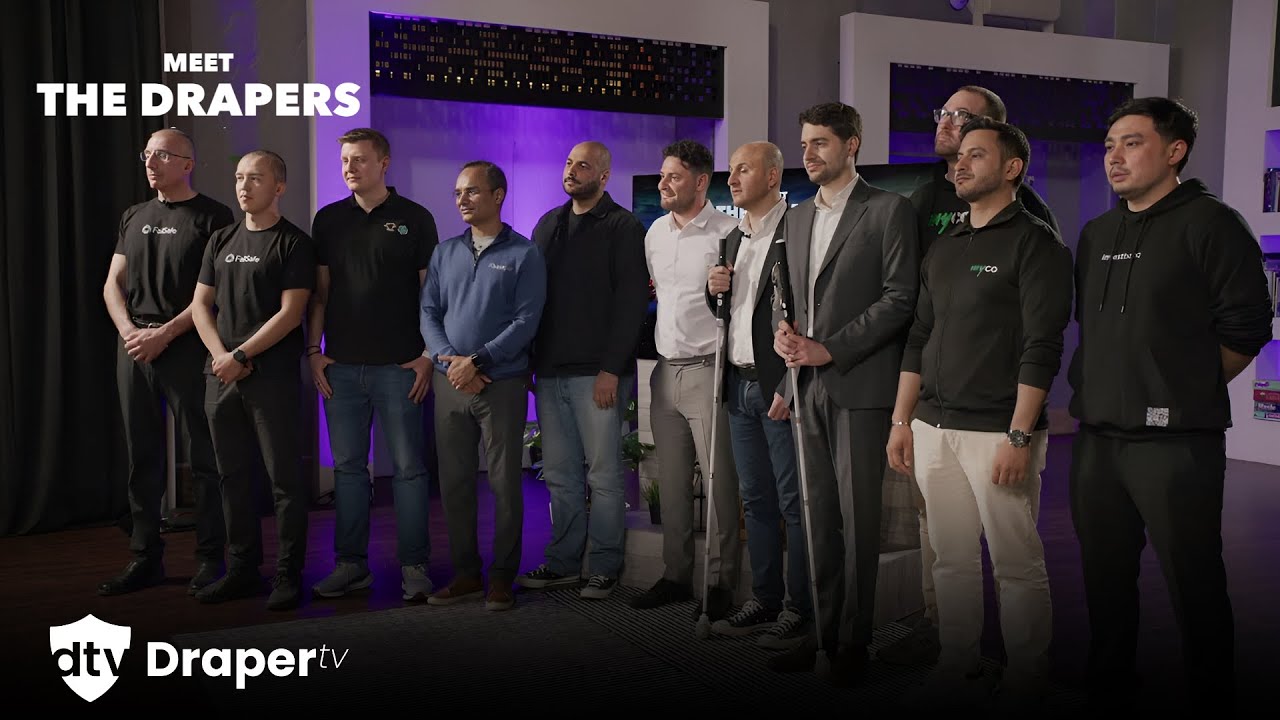
This content was created by Tim Draper. This content was uploaded by Tim Draper. This is a YouTube video titled "Who Wins the $1,000,000 Investment?! | Meet The Drapers Global: Finale" (finale episode, metadata timestamp July 1, 2025). The clip is the season finale of Meet the Drapers featuring Tim Draper as host/judge alongside Bill Draper and Adam Draper (three generations of Drapers). Entrepreneurs from around the world pitch startups across sectors — space propulsion and hybrid rocket fuel, decentralized media/tokenized content, an assistive smart cane for the visually impaired, genomics analysis software (Basepair), crypto/security (Failsafe), cross-chain liquidity/bridges (CrossCurve), AI-powered wealth management, and more. The episode interleaves investor Q&A and feedback, highlights of survival/team challenges (survival training, paintball, raft-building, rock-climbing, shooting, ice plunge/Wim Hof), and judges’ reactions as they decide on substantial prize investments ($1M, $500K, $250K).
Chapters
Entrepreneurs and help them secure a spot in the finale. Who will rise to the challenge and secure the funding to, to turn their dreams into reality? Let's find out together on season 7 of—
Shark Tank. Meet the Drapers!
Hey, welcome everybody to Meet the Drapers. We're here at the season finale in the middle of Silicon Valley at Draper University. I don't have to adopt anybody this time because they are already Drapers, and you're getting 3 generations of Draper. We have Bill Draper. He was one of the founders of all venture capital here in Silicon Valley. He did extraordinary things. He was a part of the United Nations Development Program, the chairman of the Export-Import Bank. He was the first venture capitalist in India, in the world, ever. And he's been my dad for a long time. Dad, welcome to the show.
Thank you very much, Tim.
Anything you're going to be looking for?
I look for energy. Ability to be very clear what they're doing and why they're doing it, and a couple of things that I'll be looking for.
Terrific. To my left, we have Adam Draper. He is a venture capitalist. He runs Boost Ventures. Boost was actually the first Bitcoin incubator in the world. He has focused on everything from Bitcoin to exoskeletons to oceans to deep tech. And now Boost VC is one of the One of the most dominant deep tech venture funds in the world.
Thank you.
While you were talking, I was thinking we have like 205 years of Draper on stage right now.
Oh, 205 years?
I'm half of it.
At Boost, we invest in bold ideas and great people, and I hope to see a lot of those today.
These entrepreneurs have come from all over the world. We visited 10 different countries, brought in the best of the best entrepreneurs from all those countries. In the finale, we invest $1 million in the winner, $500,000 in second place, and $250,000 in third place. These entrepreneurs have been through a lot, not only starting and building businesses, but they also went through survival training with our team from Draper University.
Oh, they did survival?
They did survival.
Oh, this is gonna be awesome. Yeah, they're ready.
They're ready.
Battle-tested.
So with that, Why don't we bring on our entrepreneurs? But before we do, here we've got real eyebrows. Let's see what's going on behind the scenes.
I think of all the presentations we made, that was the one where we felt the most relaxed.
This is for you and Bill.
Oh, look at this!
Nice to meet you. This is for you.
Is that wood?
This is a rocket fuel. Rocket fuel.
You bet. You're doing—
that's what you're doing?
I'd like you to imagine just a day without access to your credit card, or a week without the ability to fill up on gas. How about months without weather forecasting? Space isn't just for astronauts anymore. It is the invisible backbone of modern society and our daily lives. Space is about the vital services that power our economy and protect our safety. We are launching and delivering the world's most critical infrastructure and satellite technologies for governments, for agencies, and for commercial operators alike.
Our launch and delivery vehicle system can be deployed both from Earth and from space, leveraging sustainable fuels, a result of a radical scientific breakthrough and a unique additive manufacturing know-how.
Your special sauce is the environmentally better rocket.
We were able to lead them down that path by providing them with a sample of the fuel to really focus their questions and their ideas around what it is that they're holding in front of them.
It is the way that fuel The way the fuel interacts with the rocket engine that we have a patent on, it is the fact that it cannot burn on its own. The injection of the oxidizer in the combustion chamber is really what will enable that fuel to burn.
When we last saw you, we had announced our first commercial agreement with your portfolio company, Gravitics.
So what did you do with Gravitics?
So the, the Gravitics contract was studying the insertion of 36 vehicles that can be stored Inside Starship that will ultimately be launched from space.
How do each of you divide your time?
I'm the company's COO and Chief Technical Officer.
I'm the company's Chief of Staff.
How are you better than whatever SpaceX is using right now?
You know, we really felt like Tim would sort of stick to, you know, vision.
We're different. SpaceX, they do rely on cryogenic propellants. Those propellants need to be stored at subcool temperature and they cannot be stockpiled. Our launch vehicle can be stored, it can be scaled, but most importantly, it can be stockpiled. Whenever you need to launch, within an hour or 2, we can restore it.
What does this enable that wasn't possible before?
Rapid reconstitution and replenishment. So today, if you fuel a SpaceX rocket or a Rocket Lab rocket, it has to go. It has to fly, right? You fuel it, it's got to go.
I did not invent hybrids. They've been around since the '30s. But hybrids, despite all the advantages that we talked about and we cited, they couldn't meet the performance requirements for a long-duration burn to reach orbit. And that's what's possible with our technology.
Terrific. Thanks so much for being on Meet the Drapers. Dad, what did you think of Reaction Dynamics?
I like the energy. They pretty clearly told us what they're trying to do. I would have to get out to outer space to really see it.
To really focus.
Yeah.
Adam, what'd you think?
They knew every question, they had a great answer, and it feels like it comes from a very good place of just wanting to truly innovate in space. Also, it's pretty cool to just like hold fuel that's launching something into space in November. It's pretty cool.
So let's bring on our next entrepreneur. But before we do, let's see what's going on behind the scenes.
Hello guys, I'm Amanda and we are here at the season finale of Meet the Drapers. We are doing a survival We have survival training today with the entrepreneurs. Tell us more about what is going to happen today.
What we're going to do is teach them the different skills they might need when they develop their companies in the future. It's going to be fast-paced, intense, and by the end of the day, they should go home and they should have a couple of things in their toolset that they can carry with them throughout the rest of their career as an entrepreneur.
Being on the final with an exceptional bunch of people, leaders, I'm just proud to be a part of today's episode.
As an award-winning Oscar and BAFTA film producer, I know all too well the challenges faced in the traditional, highly centralized media and entertainment sector.
Current model of media distribution is completely broken for all 3 stakeholders. As consumers of content, you cannot monetize your consumption, you cannot invest into the content that you consume. And Adam, I want to ask you, when was the last time you got rewarded for the content that you watched? Are you actually loyal to any content platform, or are you just loyal to the content that you consume? The second stakeholder, advertisers. So right now advertisers are paying for an audience which is completely non-captive. It's not interested in the messaging. You know, Tim, I want to ask you, when was the last time you actually paid attention to an ad that came to your screen on YouTube or any other video platform that you consume? You didn't. The third stakeholder, which is the content creator, they face a challenge. They don't have access to funding. So Bill, if you as an investor can invest into stocks and bonds and cryptocurrencies and all of those great asset classes, why can't you invest into content? We're decentralizing the video content industry. We're solving the problems for all 3 stakeholders.
We're 22 million registered users, 7 million monthly active users.
I mean, your growth looks pretty insane. What is the user getting that they don't normally get?
A part of the advertising revenue We actually give back to the consumers in the form of engagement rewards.
After that initial engagement, which is at industry-high levels, what can they then go and do with those rewards? Do they want to go and cash it in for an IRL, you know, experience, tickets to see their favorite game, or do they want to go and use it and fund their favorite content?
And are you funding any content, or are you just working out deals?
And he understands the scalability of a decentralized app like MyCOS. So I think he got it, like, instantly. So we acquire a lot of the content, we license a lot of the content. So it's like, for example, some of the largest rights that you see here.
Yeah, and I don't, I don't know if you've noticed, but Meet the Drapers is part of their content.
I see it. They put it on 2 spots.
I see that.
That was clever.
We've got 3 million plus unique views just in the past 3 months. It's blowing up.
How do you 2 divide up your work?
The most difficult one was obviously Bill. You're talking about a generation where when you watch TV or media, you can't even choose. I'm more focused on live sports. He's the guy who brings the content to the platform.
He has an Oscar, so he's the pretty face.
I understand the entertainment industry and the traditional side, and, you know, I saw the opportunity to really crack some of those problems that are so key to, you know, making content.
Can people be paid in Bitcoin?
No, only on the MIKO token, which is being built on the Aptos blockchain.
I thought because we said we couldn't take Bitcoin, that might have been like a—
they're gone.
Terrific. Thank you two so much for being on Meet the Drapers. So Adam, what'd you think of my co—
people have talked about rewarding the viewer for a really long time. It's been a hard problem to solve.
Are you concerned that somebody else will just be a fast follower?
And I actually think his answer on the I think your philosophical take is the right one. There's going to be a breakout in this.
Dad, what'd you think?
I'm kind of on the fence on this one.
Media needs some sort of a shake-up. They have been very effective for us. Let's bring on our next entrepreneur. But before we do, it's all in the eyebrows.
We're gonna be doing a couple different training scenarios with them, all paintball-based. It exemplifies leadership skills under pressure. And then also being versatile, adaptive, communicative.
Communication is huge.
We have a VIP and your goal is to shoot that VIP.
That is how you win.
Tactics-wise, we can send one player here and 2 players here and we try to storm at the same time. Similar to entrepreneurship, taking responsibility for the entire team, for the result at the end. So making sure the communication is clear, everyone knows what to do.
I would remember your goal is to protect your VIP. It'd be eight minutes, so it goes very quickly in the game.
I'm thinking like a good thing actually might just be to hide you.
There's not a lot of place to hide this.
Look at this! See you.
All right.
See you in a few minutes. I feel like figuring out some kind of like diversion.
All right. Here we go. Three, two, one. Go, go, go, go, go, go! Eight minutes.
He's definitely hiding somewhere.
Fantastic working with the guys. We had a great strategy, which we pretty much agreed upon immediately. Our guy's still in there, so we're pretty confident of this round.
Where the hell did he disappear, man?
Yes, here he is. It was a 2-to-1 ratio. All they had to do was protect their VIP and keep him alive. Even though they all died, they accomplished their mission.
There's an old saying, leave no stone unturned.
This is like a real world because while you're managing a company, sometimes you have to stay And it's really difficult because you are not taking any action, you are just waiting. Taking action is really easier than just staying still. It was really exciting day. We are here for finale. It was just before the inception of WeWalk. I was in New York City. While I was going my hotel, I was using my traditional white cane with my one hand, and I was holding my smartphone with the other to check the GPS direction. At the same time, I had to pull my luggage with those 3 fingers, and not surprisingly, I bumped into a pole. And this is not only my problem. There are more than 250 million visually impaired people. We created the patented SmartCane technology. It detects Detects obstacles and alerts its users with audio and haptic feedback, gives turn-by-turn navigation, informs you about restaurants, stores, cafes while you are passing by. Moreover, we build an ecosystem with our software service.
We've got over 7,000 users across the globe supported by distribution network in over 25 countries.
How much are the canes and then how much is $850 and $5 per month for end user.
We have to find the sweet spot between creating revenue and creating impact.
How often is it used? Like 5 hours a day? Is it used, you know, sporadically?
We've had some users that have just bought WeWalk for the obstacle detection capability. capabilities, and they found it to be life-changing. We've got some visually impaired people who are explorers, for instance, who love to use their Smart Cane to check out unfamiliar places as well.
If you multiply out 250 million people by $1,000, you've got a $250 billion market size. Maybe you can go into that and how many people actually will get this thing.
When I heard their question, I became so happy because It showed their interest.
And for Smart Cane 2, being that it's the first smart cane to look and feel like a traditional white cane, we're not just going after those 50 million cane users, but actually those 253 million visually impaired people worldwide, because they can still use our software app package for a monthly subscription. They just miss out on the obstacle detection features and the enhanced usability of using our smart cane.
Right now, there is no such technology Our target is to reach all those blind schools, blind agencies all around the world and make WeWalk the de facto mobility aid.
How did you find each other?
In a social innovation program. All our technologies are based on our lived experiences.
Fantastic. Thank you so much for being on Meet the Drapers. So Dad, what'd you think?
God, I thought it was wonderful. Any way we can help them, we should do it. Wow, almost made me cry.
Adam, what'd you think?
I love when I can relate superheroes to founders, and they're building Daredevil's stick. Good go-to-market. Size of market, like, I, I don't know how far they're gonna get charging $5 a month.
But if you're blind, you pay whatever.
Well, I'm saying that they should probably charge more. Charge more?
Yeah.
Oh yeah.
Than $5 a month. Like, I think it's a good service.
Let's bring on our next entrepreneur. But before we do, it's all about the eyebrows.
Gentlemen, welcome to an iteration called Build-A-Boat. So right now we've got you guys broken into teams. You guys are gonna have exactly 5 minutes to plan. When the 5 minutes is up, it's gonna be game time, all right? So the mission is to build a raft to sail across our bay here, and then successfully would be completing with somebody dry. That's the objective. All right, with that said, your prep time has started.
Okay, what do you want to do?
Is there anyone built such kind of thing before?
No, not me.
If there's a cap with those barrels, those barrels are going to be the best.
We could put wooden stuff on top of the barrels.
Yeah, wood stuff.
Then we can tie them. And who are we choosing to keep dry? I think, of course, that's—
So the other thing is one person on top, the rest in the water, just dragging them.
This is not a very good flotation device.
Yeah, I agree.
We were thinking, like, this looks like it's been used quite a bit. Do these float? But I was saying, what do we need to grab right off the bat?
All right, that's time.
Go ahead and start building your apparatuses.
Watch out for the nails. Wait, wait, give me one second.
Here, let's do it this way and on that one too.
Got it.
I think, guys, this one is so broken.
How many PhDs does it take to tie a glove?
Can somebody hold that down, please?
Bashar, we don't have all the time, so we're moving on this side of it.
From that side, from that side.
You want to then take take this side and tie that all together?
One.
All right. Hey, line up by your boats. Line up by your boats. Hands off, hands off. Line up by your boats.
What was the general plan over here?
So we wanted to go with what new could work. And then add complexity as we move.
And what was the plan for this boat?
We, uh, we decided to go with something that will give us as much buoyancy above the water as possible.
On your marks, get set, go! Keep pushing, Ari! Keep pushing! Good job! Nice! Almost there! We're right behind them! We're right behind them! We're literally about to beat them! Let's do this! Good job, good job! Hey, good, you're the engine!
We are here with Team Titanic, the winners. That was awesome! How How does it feel?
The first Titanic that didn't drown.
But just the anticipation of walking on the stage for the finale, that was the most intense 2 minutes of the whole day. We make software for analyzing genomics data. I have a PhD in AI, and the application of AI that I found most meaningful is in medicine. The data is messy, but the impact is high. I worked in cancer at Harvard, and I saw genomics as a powerful new technology transforming medicine. But the big bottleneck is analyzing data, making sense of the data. So we created Basepair as a super easy-to-use software that any scientist can run complex analyses without any coding. Our customers are some of the best life sciences companies making a true impact. NCATA develops new therapies of cancer. cancer using Base Pair. VitroLife can double the odds of pregnancy in IVF. We may have helped hundreds of thousands of healthy pregnancies, and this is what gets us to work every day. And this time, I think the pitch pretty much went as planned.
Can you go into the VitroLife?
In IVF, once you have multiple embryos, so if you use genetics, then the pregnancy odds improve. So we have a white-label software for them.
I see.
So you can choose your favorite child. Before you've ever met them?
Yes.
Adam?
Hey, I'm here.
And who pays you?
We have one large user rather than multiple small ones.
And aren't you at their mercy?
Our logo retention is 100%. In fact, we get logged in. We customize the analysis, customize the reporting, and this is a solution they are selling to hundreds of labs all over the world.
Who do you compete against in this market?
Sometimes the questions were taking a different direction, and then I tried to bring them back to the pitch. When we presented in the qualifier, Andy Tang asked us, sure, small companies are using us, but why would a big pharma use you? We are in the legal to close a deal with a top 20 pharma, and in 2 years they could be ramped up to be our first 7-figure customer. And our platform helps everyone get on the same page.
Are you kind of like business intelligence but You could say that, for genomics. Everyone uses your data as the story to be able to say where they should be doing things.
Exactly, across multiple departments. They were good questions, looked like they understood the problem.
Give us another one of the applications that people are using it for other than in vitro.
MicronBrain has created a kit which can analyze thousands of potential infections in a single test. Why do they trust you? That's a great question. They should not, because these are very sensitive data. They run through our platform, they review the results, they match it up with their existing data, and only when it matches, then they trust us.
Thank you so much for coming and being on Meet the Drapers. Terrific. Dad, what'd you think?
I liked him. I really should have asked more questions about his team.
Generally, they're PhDs. Adam, what'd you think?
He's got a vibe. He just loves data. I think they found a good gateway market with this IVF. They're saying, hey, we're gonna give you all the data, we'll just plug in, we'll solve this for you. Can we accelerate more unique, novel insights? And I think that's what this is.
With that, let's move on to our next entrepreneur. But before we do, let's See what they did in survival.
This is Stone 27. It was built for Burning Man several years ago. If you're afraid of heights, it's going to be a little bit challenging. The best part is the view. So when you get to the top stone, take a couple seconds, look out over the Pacific Ocean, Malibu Bay, and then Inverness. You're up first.
Let's go, Bashar.
A really awesome opportunity to see my co-founder Bashar conquer his fear of heights.
You got it, Bashar!
That one is scary.
Nice.
Wow, it's catching a lot of wind. Man, almost face-planted.
Yeah.
You ready?
It's my turn?
Yeah.
So let me understand the structure first.
All right, so right in front of you, okay, this is a rock that we suspended.
Oh, okay.
So it's about 3 feet wide.
To hold?
There's a cable.
Where is it? Right there.
Oh, okay.
There's no way. Yeah, yeah, amazing, dude.
Good man.
Be careful.
You're there.
You're there. Okay.
Bigger step in front of you. Bigger step.
There you go.
There you go.
Let's go.
Yes.
Bravo.
A kushat walking up the rocks. I think that was definitely a highlight of the day.
Now you kind of have to go down.
This next one is a slightly bigger step.
Okay.
So it's a little bit more of a drop.
Woo! Awesome, man!
What was it like up there? So windy.
It was so windy, and also I didn't know where the cables are. But this is life, you know? We don't know what life will bring us tomorrow.
I was extra nervous because of the fact that I was voted back in. Over the next 20 years, over $100 trillion will be transferred to millennials and other digital natives. Yet wealth management industry is not ready. It is stuck in the past, outdated, not inclusive, not scalable. With 15 years in financial services, I have witnessed this myself. We have developed a We're a fully in-house, AI-powered, modular, cloud-based platform that digitizes every aspect of the wealth value chain. Our 2 core products are Wealth Operating System for financial institutions and a Family Operating System. The whole wealth management industry is facing a Kodak moment.
So we're a family. What would the AI do for us?
Based on your input and your preferred risk profile, the AI will generate portfolios.
Basically, here's my portfolio. Cash Bitcoin startups. Is that well balanced?
It is.
What would the AI say?
Does not compute. Does not compute.
We have achieved much progress since we last met, and we have landed our first large financial institution as a client. We have achieved 70% year-on-year revenue growth. By investing in us, you'll be investing in the future of wealth management: accessible, inclusive, and AI-powered.
You're kind of saying, hey, families, use our AI, right? Rather than like, hey, learn how wealth management works. It feels to me like a lot of people have this problem of understanding the wealth management side. Is there something you're doing to bridge that gap?
Education is something that is very close to us. First of all, we'll do it for a family office. It will digitize the entire operation. I myself, I run a personal financial education blog. I would love to make that a part of what we do.
Why do you care? Why are you doing this?
What I tried to do for many years, I just tried to buy a system. I bought some systems, some systems I couldn't afford. I'm not saying this is not a competitive market, but for me there was nothing. And the other, I would say, deep personal reason is that I survived Kazakhstan through the collapse of the Soviet Union. I know what I know what an inclusive wealth system looks like, and I know it's not good for anyone. I felt the biggest connection when things got very personal.
Who is working with you?
28 people now, including myself. We have a big office in Singapore, but our biggest office is in Kazakhstan.
Thank you so much for being on Meet the Drapers. So, Dad, what'd you think of Olsas?
I liked him. I don't, I don't think he convinced me that He had a feel of customer.
I liked his answer on the fall of the Soviet Union. You know that that was a very tough time for everybody in Kazakhstan.
You know, I think a lot of people are having this conversation internally in their families. I think a big part of it really is that education side where he didn't hit. I want people to be awake while managing their money, and it feels like it's like Trying to automate everything.
Families are complicated.
I should be able to see, like, you know, my dad is just Bitcoin Cash and like, be like, yo, Dad, what are you thinking?
More Bitcoin. More account. Why do we have any cash? Let's move on to our next entrepreneur. But before we do, let's see what's going on behind the scenes.
Real quick, just kind of an orientation on the range. We're going to be shooting on the steel at 15 meters just to let you get used to the firearms. If you haven't shot this platform before, we might shoot from back there later. Right here. No, no, I didn't put your ears on for me.
I've never done this before. No, that's okay.
What's your name?
Amit. Yep, just like that. So we're gonna kind of close these up. Open your feet up just a little bit for me. Yeah, there you go.
We're gonna start on the target on the left.
Okay.
A successful entrepreneur has to be patient. You shoot with your head and just take a breath because when you squeeze the trigger, sometimes It's too late. Same thing with the company. It's important to keep an eye on the target and really ensure that you don't have any sunken cost fallacy. And shooting is the same thing.
9 out of 10.
Okay, shoot this.
Okay.
Yep.
Slowly let your finger out.
Feel that click?
Yes.
Go ahead.
Okay. And you're dropping it right in.
Slow and steady, slow and steady.
Let the gun surprise you.
Do you think this challenge today is tied up to entrepreneurship?
Yeah, it's all about learning a new skill, and it's also about focus because you have to be very steady when you make the shot.
So we got to figure out who's going to be the champion, and we're going to form a line. Everyone gets one shot at the center steel target. Whoever makes it gets to move back, and everyone else We gotta watch the champion, all right?
Thank you. Hit. Don't worry about him, he can't hit anything. Miss. All right, here we go, round 2. Hit. Yes! No hit. Greatest shot. And Draper history!
Hold that thing up high, get some photos.
Yeah, shout out to the team. I've been spending all your money practicing shooting.
Surreal, always surreal to be back.
Yeah, it's, it's, it's been a great journey.
I see, Tim, you've already met our AI-powered superhero, Captain Failsafe. He's protecting the world from crypto hacks. I'm sorry to say it, but Your crypto is at risk today. State-sponsored hackers, North Koreans, every bad guy out there is weaponizing AI, social engineering, and they're winning to the tune of billions of dollars annually. In fact, the largest hack ever just happened. $1.5 billion was stolen from Bybit. And here's the kicker: Failsafe would have stopped that hack.
Good line.
The Achilles heel of any system, of any security system, is Our system takes 5 minutes to set up. Our competition takes days.
It's precisely that ease of use and that simplicity that has driven many of the world's top blockchain companies to already trust Failsafe to protect their assets, even at our early stage. We've already signed multiple deals with distributors who are essentially security auditors that are scaling our outreach efforts. We have the tech, we have the team, and we have the traction to prove it. And we want you to join us on our mission to saving the future of crypto.
How would you have solved Bybit hack?
So we actually replayed that attack. We protect multisig wallets, whitelisting. There's a number of mechanisms. That attack would have been caught by our technology. It does boil down into technical details. I was a little concerned about diving into the weeds.
Would it have been caught by anybody else?
Not that, not that we have seen.
Would this be something that Coinbase would use?
We're working with a few exchanges today. Through you, I think we would love to get in touch with the Coinbase folks. We found that stablecoin issuers are the ones who are more forward with us.
Like, what's the next level of security?
Actually, I'd just like to preface that by saying we're going further up the funnel because, to be honest, anyone can be socially engineered. Into anything. Singapore's largest cybersecurity vendor has reached out to us and said, "Hey, actually, we'd love to bundle this product with you so that we can catch hacks even earlier on." Do you ever reach that end customer? End users don't pay for cybersecurity. They expect the platforms they use to be the ones to investing robustly in cybersecurity.
How are you distinguishing yourselves from all the Competition.
It's so incredible to see Bill at it. I'm not sure that there are many people in the world at this age who would be grilling us on live TV like this. We are really the ones that have been able to prove consistently that we would have stopped these hacks from taking place. Say there's probably only 3 other companies right now that are attempting to do what we're doing. We're also very aggressive with the way that we go to market. Security auditors who are already doing these code audits to sell our tech straight to their customers.
Great.
Well, thank you so much. So, Dad, what did you think?
I don't know. There's so much competition that they didn't answer that well.
Adam, what'd you think?
I like it. I like them. They showed a lot of character. We need more people who are figuring out simple ways that the average person can feel safe in the crypto industry. I don't know technically why they are better. I just think, hey, more smart people targeting this is going to be amazing.
All right, so let's bring on our next entrepreneur.
God, what a day, huh?
Great day.
Amazing.
Good day.
So we're here for the final challenge, and as you can see, it's gonna be pretty cold. Tell us more about it.
So, um, we do the ice plunge really To show people that even though something's uncomfortable, they can jump in the cold water and get through the discomfort.
The ice plunge, I think, was the one that everyone was, you know, definitely not looking forward to.
It's not because it was an ice plunge, but because it was just at the end of everything.
Just psych yourself up. Yes, thank you.
I would never have signed up voluntarily for an ice challenge, but When the challenge presented itself, you have to go for it because I've tried it in the past and I never survived for more than a minute.
Ready? Okay, here we go.
Five, four, three, two, one, go! Two, three, jump in. Here we go.
I think the whole day was about discomfort, sitting in that discomfort and seeing how people deal with that discomfort.
There you go, there you go, there you go.
Now you don't have to spend like $200 on the ball.
Resilience is the most important It was all about resilience. It was all about keep going, keep pushing.
What is the time?
Don't think about the time.
That guy smiling in the back feels sick.
Everybody's looking good. 30 seconds.
Yeah, come on.
All right, last 10 seconds. You gotta put your head under the water. Everyone go underwater. All the way down. All the way down.
There you go.
Nice and slow.
Afterwards, felt like a real sense of, you know, we got through it and we did, you know, far better than we thought we would.
Put into a situation where I have to jump in an ice bath for myself, I would probably come out in 60 seconds. But here I'm representing my brand and my startup and my company, so it's all the more special, right? And I think that's why all of I lost in the semifinal.
That was totally my fault. And when I got back home, you know, I reassessed. The current financial system is broken in many parts. It's inefficient. There's a lot of intermediaries. There's a lot of fraud. 1.5 billion people in the world that are unbanked. There are hundreds of blockchains that are already existing. Each day a new blockchain is created. The bridging is often insecure, so we have a solution for that. CrossCurve Liquidity MetaLayer creates a unified single market for the liquidity. It connects all blockchains together. It creates highly efficient trading. We have an innovation as well. It is CrossCurve Consensus Bridge, making We ensure that at no point of time there is a single point of failure. Bitcoin is known for decentralization. We do the same for the bridges. We are backed by the second largest decentralized exchange in the world, Curve Finance. We've partnered with a number of leading bridges. I try to convey the message that it's all about decentralization. We work tirelessly at CrossCurve to bring blockchain technology into everyone's lives.
How would I use it?
You as a person would have an app in your phone, and you will be able to trade any assets. Currently, it's cryptocurrencies. Tomorrow, it will be stocks. Tomorrow, it would be the tokens of the new tokenized world.
Now, he can do that with Robinhood today. What you're saying is, by decentralizing this, you're making it more secure, more efficient, and cheaper.
The question that he asked. Was already half answered. Absolutely, that's that's what blockchain brings to the world.
But are you gonna custody?
We will have custody solutions. However, in the decentralized world, majority of the people would have non-custodial wallets, so they will always keep their custody, and that's why security is paramount.
I would keep custody on my ledger.
Yes.
Correct.
And I would trade through your platform.
Absolutely.
And then the ledger would update.
Correct.
So you said that you have $2.8 billion in volume.
Correct.
And you're making $10K a month on the transactional volume at this time. We kept our transactional fees super low to achieve this volume, and we're ramping up the fees as well.
So are you more— are you like a good interface for Curve Finance?
The questions that came from Adam, you would You instantly know that he understands a lot about blockchain technology.
You're working with Curve and you're the interface that everyone uses.
Whatever Curve is doing for the single chains, we do across different chains. We bring Curve technology and our technology and connect all blockchains into the single market. I believe that together we can build this unicorn up.
Thank you so much. Thanks so much for being on Meet the Drapers.
Thanks, Faraj.
Well, what did everybody think of Faraj?
Well, I, I think you two decide.
Adam, what did you think?
I mean, it feels like a really important part of what Curve could be. I'm trying to figure out where it is different because it is an interface. That world is very confusing, and if they solve just the interface, it'll be great. I think he's gonna do really well though.
Yeah, I sort of felt that way too.
So tell us what happened at Wim Hof.
In Thailand, I had an opportunity to meet with a bunch of folks that were looking to, you know, I guess find themselves and find their calm in the cold water. At the end, when we had to spend 2 minutes in the water, I only spent about 30 seconds.
Why do you think in this environment he could stay in for 3 minutes? Yeah, that's one of the most important things when you have your startup company is to get that herd mentality and that culture. So you're in that water with 5 other people and it's unbearable and it sucks. If I did it individually, I'd probably have somewhere around 25-30% of the people stay in it. When Tim went across the world, he didn't find heroes, he found superheroes.
Thank you.
It's really crazy the level that you guys are participating at. Hopefully look forward to seeing you guys all close Series A rounds and Series B and Series C and inviting me to the IPO party.
Hell yeah. Hell yeah.
So thank you so much, Rob.
Thank you.
We ride with the Drapers!
This is the first time we've ever done this. We had a survival training for these entrepreneurs. We want these entrepreneurs to survive. Rock, tell them what you did with these entrepreneurs.
We take them out into the wilderness, put them through a lot of different exercises. We are used to working with entrepreneurs. We do a build-a-boat competition. Usually we have one boat that just fails. Both the teams built their boats, they floated all the way across, and it was a photo finish at the end. It was just amazing to see 2 groups, all that effort, come up with 2 different solutions.
If you were to pick one survivor, the superheroes Survived Kursat with the WeWalk.
Just absolutely phenomenal. I've never seen anything like it. He engaged in every single challenge even though he was a VIP, a visually impaired person. For me, it was watching him go around Stone 27. You know, the ice bath. He was one of the few people that submerged up to the chin. Hitting steel at the gun range. And a lot of it, he was doing it by himself. And at one point, we blindfolded everyone. He was leading everyone blindfolded.
So it was—
Oh my God, that's perfect.
And then I would have to say Bashar, the Rocket Man, was the dark horse. He trailed every single hike we did. He was coming in last, but when we got to a challenge, you could see that entrepreneurial, that hero mindset set in. Bashar won the pistol competition at the end, even though he wasn't the best shooter on paper. When it came to the real-life scenario and the heartbeats, you know, coming up, he pulled it out then.
All right, Rock.
All right, thank you so much. I appreciate it.
Rock, thanks so much. Now we have a very, very difficult choice that we have to make.
Well, luckily we don't have to make it.
Yeah, we do have a crystal ball here, so that, that should help. Let's invite out all our entrepreneurs. Dad, who's your choice?
I like everybody. I really have a hard time. They're all so good. I want to just pass or vote for everybody.
Our finales are getting so good. It's a different game now. Adam?
It's remarkable. You can tell that this is the finale. They're really impressive businesses. If I'm weighing it based off of like things I've learned from today, somewhere between We walk and space travel. I don't know, just like sprinkle money on the group Crystal Ball because it's like really good. This is just like a really great group.
I would say those that brought props, they get props.
They get props. I picked the two who had props.
You did.
We have no idea how to do this business. Been doing it for 40 years, still don't know how to to do this business. So we're just going to rely on the crystal ball. Magic words, vibes, send it all into the crystal ball. Ooh, the crystal ball is showing people who are doing extraordinary things, places around the world. And it's— and the crystal ball is sending me a big vibe, and it says, Make a deal. We're gonna make a deal. Reaction Dynamics, we do a million at 18. Myco, we'll do a half a million at your $20 million valuation. WeWalk, we'll invest $500,000. $100,000 at your $15 million valuation. Invest Bank, we're gonna ask you to figure out what to do with education and then come back. Failsafe, we're gonna do $250K at your $6.9 million valuation, and that might be moved up at some point. And Cross Curve, we're gonna do I'm gonna do a million at a $15 million valuation. Base pair, we're gonna do a million at an 8 safe.
So I'll do a 1 at 15.
I'll do 1 at 10.
Done.
This finale has been as good as we've ever seen. As you know, when we commit on the show, we commit.
Deal's done.
Took a bit of time to process.
It felt unreal for a few seconds until we— okay, that's us.
I was super excited. To win, really. I mean, I have incredible respect to all the people that were there with me, so I wish all of them all the success.
They're all very smart, very courageous. 2 people were offered a million already, so I thought, damn, they're not going to do 3 of those. Sure enough, they called out our name and offered a million more. We're like, oh, that's nice.
I felt disappointed in myself that I was the only one who didn't get an offer on the spot. Tim looked at me and said, soon to be congratulations. This is good news with some delay.
I mean, if you look at the likes of the other Draper investments, things like Tesla and Starlink, puts us in perspective at WeWalk that we could potentially now be one of those businesses.
It was invaluable to meet other entrepreneurs. I am happy Maybe more startups got investments than they committed at the beginning.
I think we found ourselves in a great group, successful people, entrepreneurs, and great human beings.
I still thought that he was gonna name top 3 when he was just like boom boom boom boom boom. All the guys winning was just that's a win for all of us, you know. Yeah, we're all in the ice cup together.
See you next time on. Beat the Drapers! Yeah! Well done.
More from Tim


He Sold His Car to Build This Startup, Then Pitched It for $1M 😳 #Startups #AI

This Startup Moves Your Crypto BEFORE Hackers Can Steal It 😳 #Crypto #Cybersecurity




15 Months Without Refrigeration?! This Startup Thinks It Can Go Global 🥥 #FoodTech #Startups



