Alisa Cordesius from Indiegogo breaks down what makes crowdfunding campaigns work: a 3-minute authentic video pitch, well-designed perks, and pre-launch community building. She walks through real examples like Flow Hive and the viral #BeyondBandAids campaign to show how updates and strategic promotion drive momentum.
Chapters
Pitch. Pitch is crucial as well. 2 pieces to it, right? There's your pitch text. This is your real estate. This is where you're able to actually show data and visuals and have your voice attached to it. This isn't a policy memo. This isn't necessarily just a pitch business text or deck or whatever you want to call it. This is like you. And I like to call Campaigns living, breathing blogs with a call to action. Right? So don't be scared to be you. The more you tell, the more you sell. More budget things you can show, more infographics, more information, more transparent you are, the more people are gonna really understand and wanna jump on board. That's your pitch text though. For your pitch video, you really want it to be no more than 3 minutes. And the key pieces of this are to be you. To be authentic to why you started this venture. Like, why are you passionate about this? And why should other people be passionate about it? And then what are you trying to do with this campaign? Why should we care? Right? What's your call to action? I'm trying to raise $100K in order to get my business off the ground that does subscription-based toilet paper, and 50% of the proceeds are gonna go to WaterAid. Boom. If you have a chance to watch this video, check it out. It's pretty funny. Perks. People contribute on Indiegogo for 4 main reasons. One is they know you. Two is they're passionate about what you're doing. Three is they actually want to participate. And 4 is the actual tangible perk, right. So this is different from other platforms because there is a sense of altruism and also selfishness. So we don't require you to have perks that are specifically your product and only your product. Pre-order sales and e-commerce on Indiegogo are a real thing, but you can also have perks that are like, hey, let's do a Google Hangout with Adrian from The Entourage because he's in my film. And you could have 100 people claim that perk, and that's participatory. So it wasn't a product. People are getting something out of it 'cause they're really interacting with what you're doing. Similarly, you can have people come and be a boom mic, or have people come and do a user testing party where they can give you feedback. It's really cool to be able to see the different types of creative perks you can put up there and how you hit all 4 of these reasons. Yes?
So on the Why Contribute, more about the Flow Hive. How did they get such a large amount of people to contribute?
Off the bat?
Over so little time. Is it because they spread the word for a long time beforehand? Or what was that?
Yeah, so they prepped their communities, their forums. This is a very niche market too, that they knew where their people were. They knew where that inner network was off the bat, and they sent emails, they had forums, forums that said, hey, we're launching a campaign. Get ready. And then they also have— so they're getting passion and perks. They're pre-ordering these honeybee hives too. Make sense? Awesome. So perks are crucial. We find successful campaigns launch with 5 to 8, and then you can add as you go. Like I said, you can hide them. You can have early bird specials. You can be strategic with them. And creating demand and exclusivity is key. You want them to sell out. You want those to be like hotcakes, right? $25 is still the most popular. Our average contribution we find across all verticals, so these are like tech wearables to all the way down to like the smallest nonprofit out there, is $80. And $100 brings in the most revenue. But you want to still have those pie-in-the-sky ones. Like $10,000 makes you our super superstar whatever thing. 'Cause you don't know who's out there. Transcendence. These guys are actually working with Adam at Boost. They came out of UC Berkeley. I worked closely with them. They're a software app. Sometimes people are like, oh, I'm a software app, or I'm a platform. That's not gonna work out at all 'cause I can't give anything that's tangible. Not necessarily. They did a perk level where 5 people could go get consulting with Adam for an hour. They did a perk level where they actually— oh, let me back up and tell you what it does. So this is an app that allows people that cannot hear, that are deaf, to actually be in group conversations, and it automatically translates through this conversational piece of whatever. I did not explain that well, but making group conversations between deaf and hearing possible. Using real-time captioning. It's awesome. They had 1.0 out. Now they have 2.0 out. Moving forward with it. Another perk level was actually going to a dinner where you could not hear. Like, you were experiencing being deaf. So that was participatory. Then they had early download software at a discounted price. And then a membership one. Lots of cool things you can do. Loved working with these guys.
Awesome.
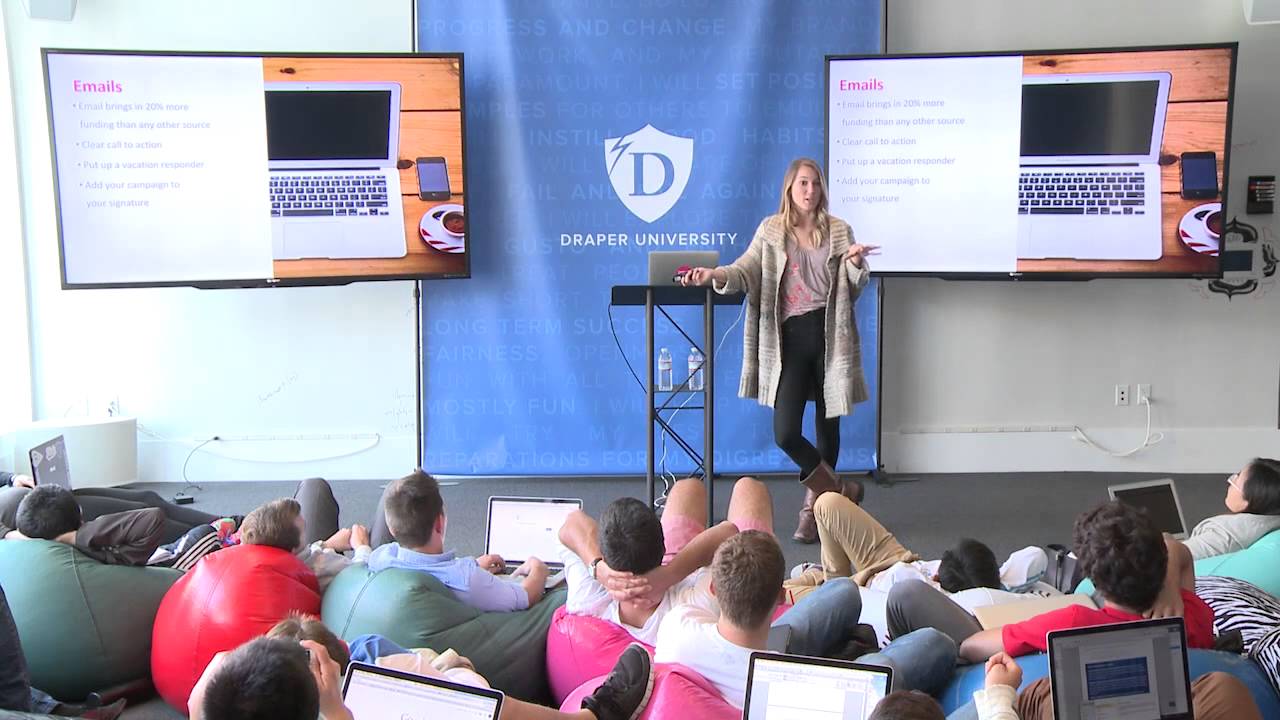
Questions? All right. It's the last one. The reason this is up is because promotion is key, and you only get one time to make a good first impression. Right? So that's why Flo did so well, because they thought of who their crowd was before they did promotion and launched. Emails are key. This is how you get your first 30% with your inner network, because they're receiving personal emails from you, and they understand exactly what you're up to, and you can Like get these in the pipeline way before your campaign launch with your URL link ready to go. Some cool tricks you can do is put it in your vacation responder when it's live so it actually drives traffic to the campaign. You can put your campaign in your signature. There's a lot of cool ways to utilize this. But emails bring in 20% more funds than any other channel of promotion. Social media is important too. But I like to tell folks if you don't have a following in certain social media, social media channels. Don't feel like you have to build it out unless you want to experiment with it and you have the bandwidth to do so. I've had campaign owners come to me and they're like, oh, should I make a Tumblr? And I'm like, are you on Tumblr? Does anyone follow you? And they're like, no, not at all. I'm like, then there's no point. Why are you doing that? Your crowd's not there. You're fine. Key to this: don't start pushing it out publicly until that first third of funding's in there, because you want to capitalize on that bandwagon effect. If you have a press release go out, and all of a sudden your product is in TechCrunch, and you launch that day, it's gonna be at zero. So when somebody in Singapore is reading and they click the link, they're gonna be like, this campaign sucks, and then they're gonna walk away. If that TechCrunch article came out 2 weeks later when you already had 30% of funds going in there, they'd probably be more likely to scroll through and read. Updates are crucial. This goes to your point. Updates on a campaign. There's an updates tab that's on the top above your pitch text. You click that, you make an update. That update goes to your past contributors. Past contributors get excited. They're ramped up. They're like, wow, look what's going on with this campaign. They hit a milestone. They were in Fast Company. They've got a new perk from Obama. I'm so excited. Whatever. Then they're more likely to go and share with their network. And they want to tell them about what's going on because it's a living, breathing blog. Right? So on average, campaigns with updates, they raise 286% more than those that just do zero and die on the vine. You might spend a month prepping your campaign and it's the most beautiful thing you've ever seen from a content perspective, but if you don't keep it going, if you don't tell people what's going on, no one's going to see it. This is my last example of a gal who wanted to create a nonprofit in Kenya where they sold green consumer goods and it was jobs for the youth. And she was trying to get her office and she wanted to raise $25,000. So she didn't necessarily have the bandwidth to hire a videographer or crowdfunding consultant or anything like that. She was just doing this on her own. And her promotion strategy Was to put 25 Band-Aids on her face, and every time she raised $1,000, she was able to take a Band-Aid off. She had 25 Band-Aids on her face for over 30 days, and her updates were always these hilarious things like, oh, I'm in the gym and a Band-Aid fell off, or her poor family was like, please, people, contribute to her campaign so she doesn't have to wear these things. Finally, when the last one came off, it was great. She ended up raising $2,000 more than her goal. And her hashtag, #BeyondBandAids, went viral. Boom. 4 things. High level. Something to marinate on. That's all I got.