Why Engagement and Vision are Key to Creativity | Stanford Professor Tina Seelig
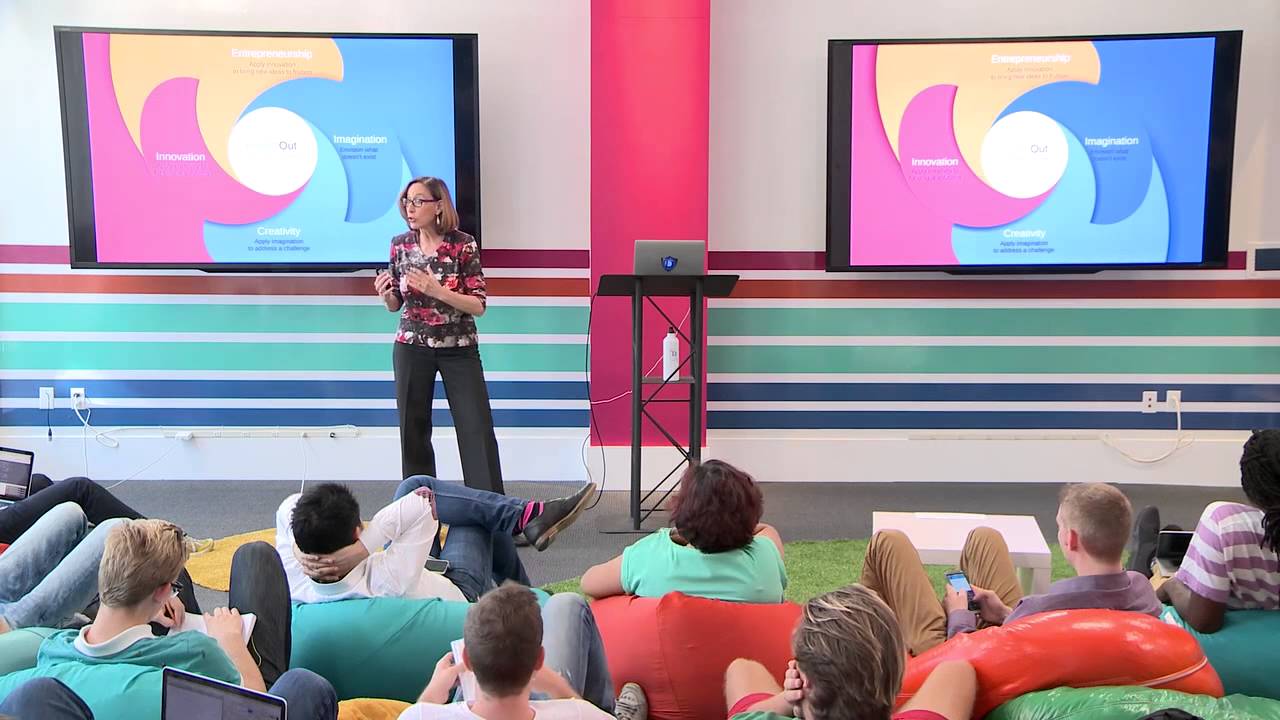
Stanford professor Tina Seelig breaks down imagination, creativity, innovation, and entrepreneurship as an invention cycle. She argues you must engage with the world before you can envision solutions, using Scott Harrison and Charity: Water as an example of how this works in practice.
Chapters
So I bet you guys are all really creative. Are you really creative?
Yeah.
Yeah, you think so? Is it important to be creative?
Yeah.
So help me out.
Sure.
What does it mean to be creative? What does creativity mean?
Either creating new things or finding creative or innovative ways to use existing things differently than originally intended.
Super. So using old things in new ways or coming up with some new ways to do things. Super. What else? Creativity, what is it?
Yes?
Making your dreams a reality. Making your dreams a reality, I love that. What else?
Being able to translate onto paper or design or anything that's in your brain, so even if you're writing or something, so whatever is in your head, just being able to put it out there in a physical form is creative.
Okay, so making something a physical manifestation of your ideas. Ideas, yeah.
Yep. Recruiting people who are more creative than you.
Oh, recruiting people who are more creative, okay, so I love this.
Here, yes?
Being true to yourself, expressing that. Expressing yourself. So, yeah?
Thinking like a child.
Thinking like a child. So here's the thing. You're very good at that? Are you good at that? OK. So here's the thing that is so interesting. If we went around and every person here gave a definition for creativity, they would all be different. And this is actually a problem. Because if we want to teach creativity, if we want to learn how to be more creative, if we want to talk to each other about creativity, We need to have a shared vocabulary. And this is a problem. This is one of the reasons I believe that people think that you can't teach creativity is because they don't know what it is. Okay? And in fact, if you ended up looking at physics, right, force equals mass times acceleration. I'm sure you guys have all taken physics classes, right? We all know what force is. We know what mass is. We know what acceleration is. And we now have a relationship between them. And by having the definitions and the relationships, this now has allowed us to apply this.
Right.
This building is based on the principles of force and mass and acceleration. The rocket ships or the airplanes going overhead are based on these principles. It is our responsibility, if we want to really understand creativity, to have the same sort of rigor that we have in physics, in math, in biology, even in music, right? We have these definitions. So are you ready to go on this little journey with me as I've been working on this last few years? I teach classes on creativity and innovation and entrepreneurship at Stanford, and I realized that this was a huge stumbling block, is the lack of a clear vocabulary around these concepts. So you want to understand what I've been thinking about?
Yeah.
Okay.
Super.
So let's start— let's start at the beginning. Let's start with imagination, because it all starts with imagination. Imagination is, as I define it, and I think it's pretty straightforward, envisioning things that don't exist. Does that work for you? I can envision someone coming in with a nice plate of warm cookies. I can imagine a butterfly flying around the room. Those are— that's my ability to envision things that don't actually exist. And your imagination is influenced certainly by the experiences you have, right? The more experiences you have, the more imaginative you have— imagination you have, because you can draw upon all of those for your ideas. In addition, your imagination can just be in your head, but it's also something you can share with other people, right? You can tell me about the butterfly you're imagining or you can just keep it in your mind. So with that definition, then creativity is applying your imagination to address a challenge, right? I have the ability to envision things that aren't there, but I apply that to address a problem or a challenge, now I'm being creative. To be innovative— Requires you to apply your creativity to come up with unique solutions. You notice each one is the application of the one before? And so entrepreneurship is applying innovation to bring your ideas to the world. I think we captured a lot of the things that you thought were just in creativity, right, in this process. And what I call this is I call this actually the invention cycle. Why is it a cycle? It's a cycle. Because in order to be entrepreneurial and bring your ideas to fruition, you need to inspire other people's imagination. Does that make sense? What do you think of these definitions? Is this some— a set of definitions that actually works for you? Right, where you have this hierarchy of skills? I consider it's like learning how to talk, right? Babies naturally babble. They then apply that to learn how to make words. They apply the words to make sentences and the sentences to make stories. And those stories, right, end up inspiring other people to tell other stories. So this is the set of definitions and relationships that I've put together. Now, once you have the set of definitions and relationships, there is something cool you can do. You can now start parsing them and looking at the attitudes and the actions that have to happen along the way, In order to move to the next level. So you want to see what happens there?
Yes.
Okay, great. So I started out— when I put together this model, I started out with this and I made a long list of all the attitudes and the actions I thought had to happen at each one of these stages, and I drilled it down and compressed it and compressed it until I came up with one attitude and one action that was representative of what has to happen in each step. So let's start with imagination. Let's go back. Imagination requires engaging and envisioning. It means you need to engage with the world and then envision what might be different. Now, what's interesting and surprising about this is actually that people usually do it the other way around. They think that what they should be doing is sitting and envisioning something and then engaging, right? I'm going to envision what I'm going to do in the world and then I'm going to engage in making it happen. But it's actually the other way around is what works. Before something is your passion and something you want to get engaged with, it's probably something you know nothing about. So you start out by essentially engaging with the world, trying lots of things, experimenting, and then saying, oh, that's a place where I can make a contribution. So for example, you could be a waiter at a restaurant. If you're a waiter, right, you could just go through life not paying attention to anything and you could just sort of do your job serving everybody coffee. Or you can pay careful attention when you're doing this. You can pay very focused attention and you can be noticing what days you get bigger tips than others and what happened that day that was different than the one before. You can notice that, boy, there are some things on the menu that no one ever orders. Or you could say, wow, I'm noticing a lot of people have special dietary needs. A lot of people are asking for gluten-free food. I wonder what that's about. You can then dive into those and start thinking, how might I get bigger tips? How might I deal with the people who have gluten allergies? How can I deal with all sorts of other things that come up in your everyday life? By paying attention, you start seeing opportunities where you can make a big difference and where you can then move ahead to being a creative problem solver. Let me tell you a story that's well beyond just sitting and doing it as a waiter. This happens in all aspects of our life. There is a guy who came to speak at Stanford, this is just a photo of him. Anyone heard of Scott Harrison? Do you know him?
Yes.
How do you know him?
I saw him speak once.
You saw him speak once? He is a pretty amazing guy. But guess what? He wasn't always an amazing guy. When he was in his 20s, his job was to get people drunk. He was a promoter, a club promoter in New York City and his job was to get people drunk. And the drunker he got them, the better he did. And what ended up happening is that he was so good at this that he became a drug addict, an alcoholic, he had all sorts of horrible addictions. And one day he woke up and said, my life is a total mess. I need the opposite of my life.
Right.
And he said, I'm going to go out of my way to do something to help people in the world. And he wrote letters to all of these charities around the world asking to volunteer. And they all wrote back to him and said, No way. You don't look like someone who can contribute. But he kept writing letters until finally one organization wrote back to him. It was an organization called Mercy Ships. And they invited him to go on a ship with them if they— if he paid his way. Okay? And so he paid his way to go to Liberia. He had to look up on a map to see where it was. He didn't even know where it was. And when he got there, his job was to take pictures sort of of the experience because he had some background when he was in college in photojournalism. So he got there and was shocked. He had no idea how many people are stricken with diseases that come from bad drinking water. He learned that 800 million people on the planet don't have access to clean drinking water and he decided he was going to do something about it. So he came back to the United States, back to New York and used his skills he had as a concert promoter to start a nonprofit called Water for the World. Start this organization Charity Water where he basically has gone through lots of approaches to helping to secure clean drinking water around the world. And the major lesson from this is that again, before it's your passion, it's probably something you know nothing about. And so by engaging in the world, you start seeing opportunities where you can really have an impact. So imagination basically requires engaging in the world, And then envisioning how you could contribute and what you could do.
More from Tim


He Sold His Car to Build This Startup, Then Pitched It for $1M 😳 #Startups #AI

This Startup Moves Your Crypto BEFORE Hackers Can Steal It 😳 #Crypto #Cybersecurity




15 Months Without Refrigeration?! This Startup Thinks It Can Go Global 🥥 #FoodTech #Startups



