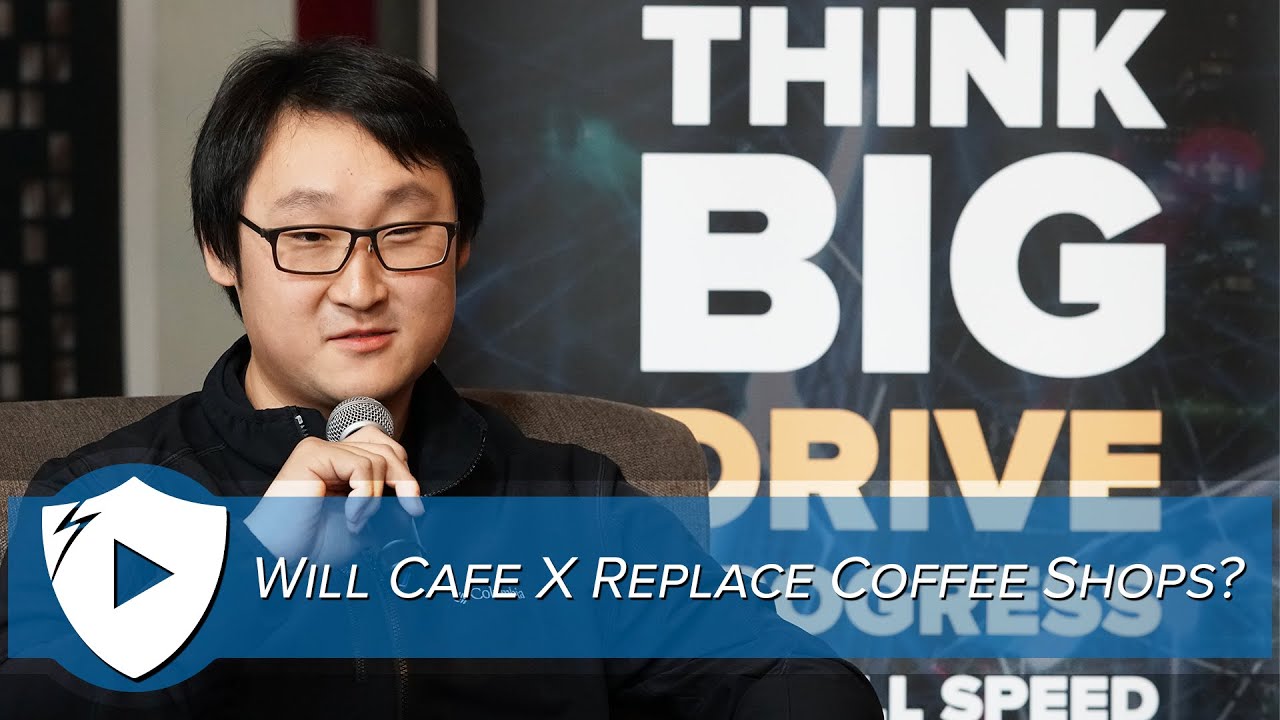
Henry Hu, co-founder of Cafe X, discusses the company's robotic coffee bars that work alongside traditional cafes. The robot arm can make different drinks, and Cafe X has expanded to larger cups, iced drinks, and a cold-brew tap. Hu talks about scaling challenges, potential franchising, and partnerships with local coffee roasters.
Chapters
Hey everyone, you're about to watch the founder of CafeX. His name is Henry Hu, and he's got an amazing story. If you want to be one of the entrepreneurs learning here at Draper University, just like the people you see in the audience, make sure you apply today at draperuniversity.com. Hope you enjoy the video.
I guess, do you think you guys will replace all coffee shops in the next whatever amount of years?
Well, so the machine that we make, the robotic coffee bar, can actually be put inside a coffee shop. So I think, you know, we're working on some concepts where we have the machine basically in a fairly traditional coffee shop, and it's making— it's serving the espresso drinks and like matcha lattes, chocolate drinks, and like cold brew and basically like beverages. But it's still a cafe and you can have people there. They're preparing like pastries or sandwiches. And of course, greeting customers. So it's like we're not, we're not like making this machine to kill all the cafes in the world. We're like, let's make some, let's deploy these in places where people want to get coffee and don't want to wait in line. But if you want to go to a cafe and sit there and Have food, like, you could also just put our machine in a cafe.
Is food one of those things that you guys will move into? I know I've seen a few companies that make hamburgers. I think I've seen some pastries. There's actually one of our alums that makes pastries in Argentina with robots. So are you guys moving into food?
Definitely at some point in the future. So like one of the reasons we use a robot arm Is because it's very flexible. Or we can basically— so we basically designed the machine to have a robot arm move a container around to different machines inside this big kiosk. So that means over time, as we upgrade our menu or expand the menu or change to different things, it's fairly easy to do that. You basically just like take a coffee machine out and put something else in. So for example, like the— our initial machine just had like 2 espresso machines and 8-ounce cups, which is— we designed that in Hong Kong, and 8-ounce only is definitely not big enough for the US market. So we immediately added bigger cup sizes. And then we also added iced drinks recently to basically the same machine, which is—
Iced drinks? Ice drinks?
Yeah, so we like literally just like move the 2 coffee machines apart and then put an ice dispenser in the middle and reprogram the robot. It's like, okay, now we have— our menu is twice as big and we have ice drinks. And then our newer machine has a beer tap that serves like cold brew coffee and tea. And then we have an even newer machine that we're launching at SFO. in September that's going to just basically expand on that even further and have this really massive market— massive menu. Yeah.
Great. In terms of the business model, you mentioned, hey, we can be inside cafes. Are you guys going into more of a robot-as-a-service type of business where you give this to, let's say, the coffee shop across the street? Or will you always own the whole brand, the whole experience?
Yeah, currently we only own and operate. So we have 3 locations now operating, and then we'll have a few more by the end of the year, including at SFO. We get emails every day from people all over the world. They want to franchise or license or just buy machines. People have requested to have their machine in their very large house.
Like a big Keurig.
Yeah. So basically we're production constrained right now. We really believe in being fully vertically integrated. So we do all the hardware engineering, software engineering, and we build the machines ourselves. So basically, it's going to take a little bit of time for us to set up, basically refine the product or optimize it on the engineering side to the point where we feel comfortable building a lot of them. And then we have to build initially a small factory and then a bigger factory to actually build the machines. So in the long term, we definitely would love to do that. I think licensing internationally or franchising. Makes sense. And then in terms of working with other coffee brands, that's kind of already like baked into our our brand. So with Cafe X, we partnered with local coffee roasters. So if you look at our menu, there's Intelligentsia, Ritual, Equator. These are all like kind of really well-known local coffee roasters with their own kind of cult followings. So we're very open to working with other coffee brands.
When I went to one of your locations, I think there were like 4 different types of milk that you could use. And I read somewhere that you guys are the only ones that offer like a specific type of milk that's really not found everywhere.
So we actually— we were one of the first coffee places in San Francisco to offer oat milk. It's from a brand called Oatly, which is from Sweden. And they launched in the US last year. And that's been just taking off. So milk of the year. Milk of the year of 2018 was oat milk. And I read somewhere for 2019 it's going to be hemp milk.