XR will impact every vertical | Jesse Damiani
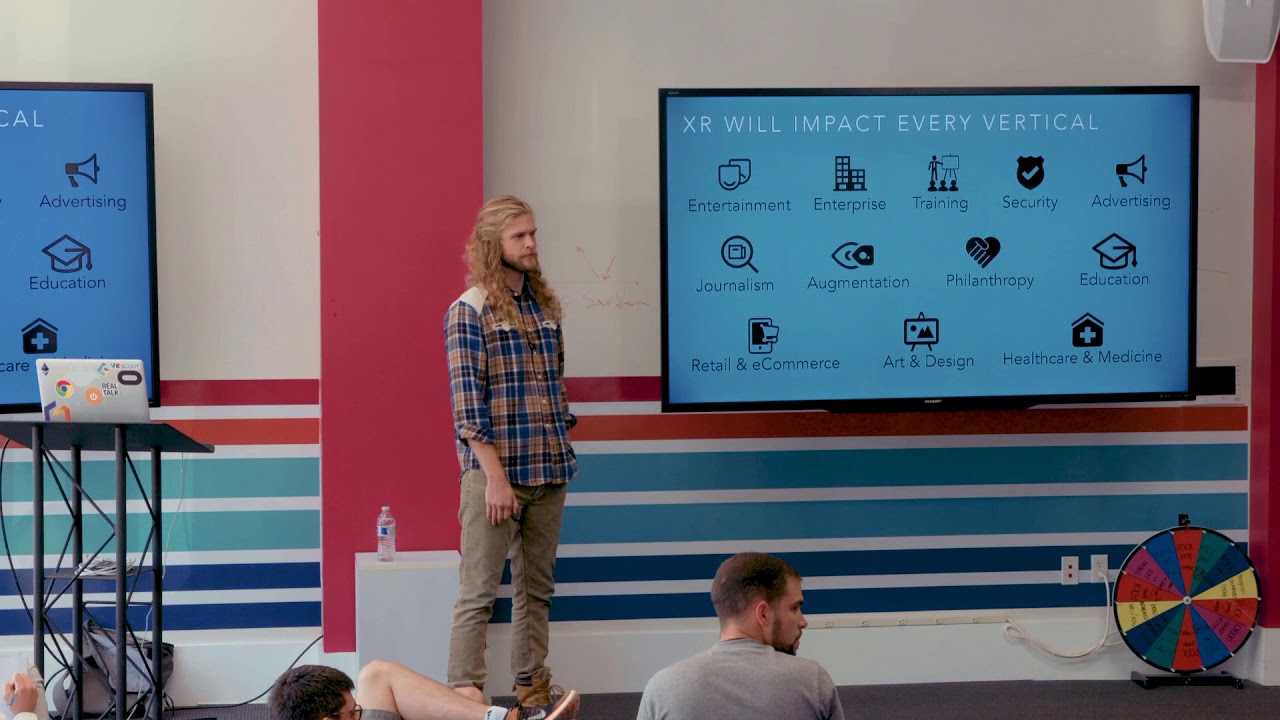
Jesse Damiani discusses how virtual and augmented reality will reshape industries from entertainment to healthcare. Examples include immersive theater, Star Wars experiences, surgical simulations on HoloLens, and interactive learning environments. The panel takes audience questions on enterprise applications and haptic technology.
Chapters
And so this is what I call the attention economy. And it has to do with the fact that over time we've come to realize that our attention is a more valuable asset, and so we treasure it. So consumers want to be engaged in new ways, and we understand that our data is quickly becoming the most valuable commodity. This is something we hear about with privacy and with ad blockers. And so to address that, we're seeing multimedia and franchise approaches to media properties. You know, we're seeing movies that obviously have endless sequels. We're seeing tie-ins in the real world. We're seeing all kinds of things that are trying to broaden the story universe of a given world. And over time, VR and AR will be sort of the linchpin holding those pieces together. And another sort of piece of evidence we're seeing is the rise of immersive theater and escape rooms. And I don't know if you guys have done either of those things, but they're a ton of fun, so you should give it a go if you haven't.
What's an immersive theater?
So immersive theater would be, instead of going to a play and watching a show play out in front of you, you walk into a room, and the play is going on all around you, and you're potentially part of the play.
Right.
Is that with VR or something?
Well, that's the tie-in between VR. So immersive theater and VR are very related. One's a digital experience, and one's a real-world experience. But some people are starting to merge those 2 things, and actually tee it up for this. This year, Star Wars, which I'm sure all of you guys have some familiarity with, has had a really big push into the immersive space. So, we have The Void putting in out-of-home location-based Star Wars experiences in Disneyland and Disney World. We have a mixed reality headset that allows you to have a lightsaber and play the chess board game. Recently, there was a campaign called Find the Force II, 2, which used smartphone AR to allow you to scan characters to, like, get digital characters you could bring into the world. And Star Destroyers hovering over various landmarks all over the world. So if you were in one of those landmarks, you could hold it up, like the Golden Gate Bridge, and see a Star Destroyer hovering over it. And finally, they're working on an immersive resort. And the details are still a little blurry about what that's going to be like, but imagine if you go to a hotel that's framed to Star Wars. All the staff are wearing uniforms. You're given uniforms. You're potentially given a mission. All these things are starting to sort of bubble up, right? So VR and AR are sort of the, like I said, the linchpin holding all those things together, sort of driving that from a consumer standpoint. So I'll stop talking for a second to see what you guys, based on what you already know and what I've been talking about, can help me work through. these different industries that VR is going to impact. So, based on any of these, we can kind of— we've already talked about entertainment a little bit, but how do we think VR and AR might help enterprise?
So, with enterprise, we see data analytics with, like, Microsoft HoloLens. There's a lot of console work. In training, there's health and safety training, where augmented reality will train. Security, not quite sure about it. Advertising, yes, overlays displays. And I think Google is working on a VR project or something with their advertising thing. In VR advertising, even if you're making a VR game, you could have brands, like branded shoes and stuff when you wear that. So that's one way of advertising. Education, I think PSN is doing some good stuff with Microsoft HoloLens. Retail and e-commerce, that's already being developed with IKEA's furniture app. and all that. Art and design, I'm not sure about it. Health and care, because I've already worked on that, pretty much in each sector.
Yeah, it shows.
But out of all, I think the education one is the one that's going to have the biggest impact.
Yeah, let's talk on that a little more. What else? How do we see education?
Education?
I studied engineering, and there are a lot of light mathematics to hard-to-grasp abstract science concepts. And I think that part— like, it's hard to grasp because it's hard to imagine what it would be like to actually be a particle. Let's take, for example, heat transfer. If we see how heat is getting transferred from molecule to molecule, at that level, it's actually quite easy to understand the speed at which heat is going. It depends on the amount of heat that is on one side going to the other. If you can actually see that in the first day of class instead of having to go through—
The whole semester.
3 exams, 8 presentations, whatever.
Totally.
You could definitely grasp it way faster.
And I think that could be—
it'll get people more inspired in things like engineering or physics or things that are like, oh no, I can't do that.
Absolutely. Things we've had to learn on textbook pages that are sort of abstract.
Or like with math. Some people can't see math.
Right. That's true.
I feel like it's going to be experiential, like project-based skill building and stuff. because the data already shows that students learn better through experience. So I feel like it's going to give kids the opportunity to actually walk through a pyramid, touch a hieroglyph, talk to someone else in another language. I think the backend behavior data analytics and heat mapping on what students are looking at when for how long and being able to test them in new ways on skills beyond just a bubble test now is really going to change the world.
And by the way, heat mapping, guys, is when users are in an experience seeing where they look and how long and aggregating that data so that we can start to see where whole groups of people—
Is anyone better than Ben Durham at BrailleBox doing that?
So he's a friend of mine, so I'll say no.
In the education space, I think people know what they want to do earlier on in life. And so you'd be able to build a platform that actually shows individual workplaces that you could be in. In one way, that might be bad because someone could take control over it and kind of guide people to certain places that they want them to be in. But as a whole, I think that'll Totally.
Well, she was referencing the KFC experience. That's a game, but they're training you how to make fried chicken for KFC. So if you know what I mean, it's like that.
I feel like a lot of this, what's really going to tie it all together, the biggest factor is most people are visual learners. And that's the biggest thing that's coming from this, is we're all going to be able to see things happening in front of us and actually be able to comprehend something like what he was saying. I mean, biology would be so much easier if I could see a cell functioning in front of my eyes. instead of having to try to comprehend it and draw it out on a sheet of paper.
Always.
I think even, like, a lot of people write books. Like, books are converted into ebooks. Ebooks can be converted into VR or AR books. And there's certain applications that it can be used for, like military training or combat training, or any sports training, for example. So a simulation can be created and people can be trained accordingly.
Totally. And that was actually, just for the sort of fun of it, that was actually one of, if not the first virtual reality— you know, it's arguable when the first virtual reality sort of system was developed, But Tom Furness in the '60s built a cockpit, you know, a VR cockpit in the early '60s. I saw other hands. I don't want to leave people hanging.
So, is there any, like, VR suits being created at the moment to, like, I don't know, like, just to enhance the experience? Or is it just, you know, sensors out there?
No, absolutely. So, haptic technology is what I've used As like a corollary technology with VR, and I reference it a little later, there's—
What's the technology called?
Haptics.
Oh, haptics.
What you're describing, like a suit that you can feel input from. And feeling things in your hand, and force feedback, and things like that. Those are all being developed, and VR is sort of helping push those forward, because there's actually an application for them, rather than like, hey, I have a glove that makes your hand feel things. It's like, hey, I have a glove that makes your hand feel things, and it's actually freezing because you're in a frozen tundra in VR. I saw your hand up.
I don't want to leave you hanging.
I just wanted to say that at my university, when it comes to education, we have virtual reality for the doctors. So to actually do the surgeries in virtual reality so they can zoom in better and get more in detail on it. So because they have this one test where they have very small tools and they have to take a Lego cube and plug them together and they're really small. So they use virtual reality to help them do that because they can't do it in real life. Totally.
Well, there's that, and then there's also the aspect where you could be training for a given surgery over and over and over and over again before you ever actually touch the body or use, you know, VR to help you to do surgery.
And it also saves them having to go out and find corpses, so.
Helps all of us.
I was just coming back to health and healthcare and medicine. With VR and AR, like, I do know that healthcare is like a pretty slow space to go in because there's a lot of regulations and info.
Sure.
What are the most, like, interesting stuff What are the startups that are doing something around healthcare and medicine?
So, that's a longer conversation I'm happy to have with you after. One, I'm interested right now in the things that really help the public see, have a little more insight into how medical technologies are working. So, the HoloLens experience where you see the different systems of the body, the nervous system, the respiratory, all these things, and you can actually see that. Breaking down the barrier of sort of how inaccessible medicine often feels to people. I think startups that are handling that are really interesting.
More from Tim


He Sold His Car to Build This Startup, Then Pitched It for $1M 😳 #Startups #AI

This Startup Moves Your Crypto BEFORE Hackers Can Steal It 😳 #Crypto #Cybersecurity




15 Months Without Refrigeration?! This Startup Thinks It Can Go Global 🥥 #FoodTech #Startups



