10/05/15, Why Business and Personal Credit Matters for Startups, Tim Graczewski
This content was created by Tim Graczewski. This content was uploaded by Tim Graczewski. This is a YouTube presentation titled "10/05/15, Why Business and Personal Credit Matters for Startups, Tim Graczewski" (created 2015-10-11) in which Tim Graczewski—introduced as Head of Strategy & Business Development at Creditera with prior roles at AltaVista, Oracle and Intuit—gives a recorded talk to an audience about why business credit matters. The speaker explains that businesses have credit scores separate from personal scores and covers how scores are produced (credit bureaus: Experian, TransUnion, Dun & Bradstreet, Equifax; and score providers like FICO), differences between personal and business scoring models (e.g., D&B Paydex, Experian Intelliscore, FICO SBSS), sources of reporting data (public records, lenders, vendors/trade lines), concepts like thin files, and practical impacts for startups (financing, payment terms, insurance rates, merchant fees, and eligibility for large contracts).
Chapters
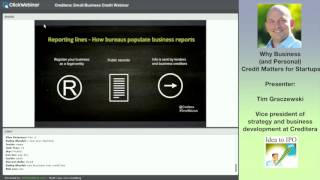
So first of all, tonight's discussion is going to be about small business credit, both personal and business, and why it matters for you and your business. So actually, I should think here, let me just go ahead and connect to make sure that everyone can see the deck because I don't want to start talking and have people find out that it isn't working. So I'm looking at the chat session now. Can you at least reply that you can see my. My screen? Okay, so I got one confirmation that it is. You guys can see it. So I will go ahead and trust that that is valid for the rest of you. Again, let me make sure here the recording is on. All right, perfect. So, first of all, a little bit about myself. I've been here with creditera for a little over a year. I'm the head of strategy and business development for the company. I've got about 15 years of corporate experience prior to coming to Credotera. I moved out to Silicon Valley in 2000, the first Internet tech boom. I guess we're well into our second here. I came out to work for AltaVista back in 2000, and then after that I spent seven years at Oracle and then seven more at Intuit, where I was director of strategy and corp Dev. Then I was the product leader for QuickBooks outside of the United States. So the Canadian and Australian and British versions of QuickBooks and Payroll. And then my last job there, I was the head of customer care for QuickBooks Online. And as I mentioned before, I've been with the company since our A round closed with Kleiner Perkins back in July of 2018. So what we're going to talk about today is your business and the fact that your business has a credit score whether you know it or not. So most people are very familiar with the fact that everyone has a personal credit score. So in this particular case, you've got this woman here, Gloria, with a 715 credit score, and she's got Gloria's cosmetics. But the reality is her business has a credit score just the way her person does. And in many cases, this business credit score is used for a variety of purposes. Now, the purposes can vary. Most people think automatically about financing, and financing is, in fact, important. But there are other reasons in which a small business credit score matters. It matters in terms of your payment terms, whether you pay 30, 60 or 90 days. It matters in terms of whether or not you can get small business insurance coverage, and if so, at what price. It also matters in terms of your ability to get a contract with the US Government or other large scale retailers. So it sounds like my deck is not showing here. So I am going to go again. So right now you'll be seeing this picture of this old time photo of Gloria here in her cosmetic shop. And again, Gloria, the individual and her business, and they are separate, but yet they are looked at combination. So why does business credit matter? I mentioned before obviously getting finance and credit, and we've already talked about that and I think most people realize that credit scores matter for those things. But like we said, it matters for a lot of other things. And it can really lower your costs, whether it is insurance, the terms that you pay, your merchant processing fees and so on. And at the end of the day it also can save you time. And it can save you time primarily because now you're going to get the best deal possible without working too hard for it. So first of all, where do these scores come from, both personal and business? So there are four national credit bureaus, Experian, TransUnion, Dun and Bradstreet, and Equifax. Now FICO is not a bureau, it is a score provider. And what FICO does, in case you ever hear about FICO scores and so on, FICO stands for the Fair Isaac Corporation. And what they do is they're the ones who pioneered the algorithms to determine the risk factors that somebody might be late in their payments. So the credit bureaus, Experian, TransUnion, Equifax, D& B, they collect data, they suck in data about you, about your business, and they do it through all for a variety of different ways, which we'll talk about in a second. And the way they had worked things out was they would suck in all this data and they would give the data to fico. FICO would have their engineers and their statisticians who would ultimately create a formula that would determine your credit worthiness based on that historical data. And so that's where the FICO score comes from. Now, over time, many of these bureaus realize, well, if we're the ones with the data and the data really matters, why are we giving this data to FICO so they can come up with their own score on us? Why don't we create our own scores based reverse engineering what FICO has already done? And those companies did that certainly on the personal side. So Experian and Equifax are the two bureaus that report both on business and personal. TransUnion reports only on personal and Dun Bradstreet only reports on business. But within, with Experian and Equifax, they created their own scores on personal credit Worthiness Rifle that was based on fico. So if you ever hear anyone say that's not a FICO score, it's a FICO score that is a score provided by Experian and Equifax based on their own data that they normally would have given to FICO and their own algorithms that were based essentially by reverse engineering FICO scores. For the most part, they're generally accurate for what FICO would come up with. And the reason they did that is for, like I said, a variety of reasons, not least of which was they were paying a bunch of money to FICO to create something they thought they could do for themselves. But then FICO also sells that score at a pretty high premium. So these other bureaus ultimately started providing their own scores. Now let's talk a little bit about personal and business credit and those scores and how they differ. On the personal side, they are very, very similar. They measure the same things and they have the same score profile. So whether it's TransUnion or Experian or Equifax, which we don't have up here, they have 97% data consistency between all those bureaus. They're all looking at the same thing and they all have a score that's very similar, roughly 300 or 350 to 850. So if you're over 750, 770, you're in a really good shape, maybe high 600 to 7 hundreds, you're medium and so on. But the reality is on the personal side, the main takeaway is they're looking at the same data and they're measuring the same thing, which is what is the likelihood you're going to be late on a payment of over 90 days in the next year. Now on the business side, first of all, they have different scoring models and they look at different things. So Experian and Dun Bradstreet. Experian has something they call the intelliscore. Dun and Bradstreet has something they call paydex. Now, FICO SBSS is a different business score. It's a model of personal and business and that is a score that rates from 0 to 300. Experian and D&B, it's 0 to 100. And moreover, D and B and Experian look at different things. Dun and Bradstreet's paydex score is purely backward looking. So they take if you have four people trade lines reporting against you, they'll essentially determine how you're doing based on your payment record, do you pay your bills on time or even ahead of time? Intelliscore, on the other hand, is forward looking. It looks at your historical payment record, but it also takes into consideration your industry, your time in business, and a variety of other factors to determine looking forward, what are the chances you might be late? So the best example here might be a restaurant. If you're one year in business as a restaurant and you pay all your business, you pay all your bills on time, you might have a great paydex score from D and B. But on Experian it might be very average or poor, primarily because you are in an industry. Restaurants that tend to fail. And again, they are forward looking. The FICO SBSS score is a combination of your personal and business score. And in this particular case it is used for granting SBA loans. So most major SBA lenders, whether it's your local community bank or even a major money center bank, they have to look at the FICO SPSS score to expedite improvement. D&B Paydex score, that's something that a trade services firm might look at, such as a Walmart or a Target, whether you can work as a contractor for them. And Experian would probably be more along the lines of a business credit point. So personal, it's all very uniform, very similar business credit, rather distinct. So where do they get information about you? First of all, once you register your business as a legal entity, that becomes a public record and those public records are sucked up by these bureaus. So on the business side, again, it's Experian and D and B as well as Equifax, they're going to be pulling in this information on you, whether you know it or not. There's a record about your business and people want to know how trustworthy you are and they're going to pull that data in. Perhaps even more crucially. And this is where many small businesses, whether brand new to the market or been around for a while, tend to fail. And that is that information is sent to the bureaus, both by lenders and business creditors. So if you get a certain business credit card, if you get a certain business loan, that bank, that credit card company is going to start reporting data about you and your business to those bureaus. Now, what many people don't realize is that even if there is a vendor out there who maybe supplies your steel or your raw materials or whatever it might be in your small business, particularly if you're a manufacturer and you've got various vendors and suppliers. Those vendors and suppliers can be trade lines for you. And if you are paying them on time or ahead of time, you should absolutely make sure that they are reporting your payments to those bureaus. The bureaus are starving for information. They want to know as much about you as possible. So if you are a strong business who pays on time or ahead of time, you should by all means ensure that anyone that you're paying is reporting your payments to the credit bureaus. So what are the credit factors? When it comes to a business credit score, the reality is it's not too different from your personal reports. So your debt to income, your payment history, do you pay on time or ahead of time or late length of history? How long have you been in business? Is this a restaurant that's been around for 20 years, 10 years? Or is it six months into business utilization? When you get credit, do you actually use it and are you responsible with it? And then again, the business data that kind of comes into the bureaus. So next we'll talk here about a thin file. And what a thin file means is the bureaus know that your company exists. And they know that it exists because you've been legally incorporated. Maybe you've got one or two companies that are reporting because you have a loan or a credit card, but they do not have enough information about your business to provide any sort of assessment. So with the case of, for instance, the Dun and Bradstreet paydex score, they require at least for trade lines to come up with a score. Trade lines means people who are reporting against your business in terms of how you pay. So unless you have four entities reporting against your business.