The Incredible Growth of Techy Franchise From Local Startup to Global Tech Repair Leader
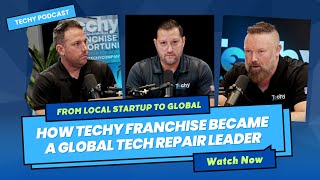
In this promotional podcast, host Kyle Burnett (VP of Operations) is joined by COO Timothy Phelps and CEO/President Bill Darrigan to walk prospective franchisees through Techy’s evolution, business model, and the mechanics of buying a Techy franchise. They explain the 2006 founding as Dr. Phone Fix, the 2020 rebrand to Techy driven by customer demand for broader repair services, and the resulting expansion into devices, accessories, memberships, and café concepts. The discussion details the franchise fee structure—a $15,000 upfront fee plus a total investment ranging from $75,000 to $250,000 depending on the chosen package (tiny store, full‑size store, or Techy Café) and inventory needs. They describe how acquisitions (e.g., Experimax) and international master‑franchise partners create discrepancies between the number of stores shown in the Franchise Disclosure Document (FDD) and the actual footprint. Royalty rates are 7% of gross sales, dropping to 6% once a weekly margin of $6,500 is reached. A $785 per month marketing/technology fund covers point‑of‑sale systems, partnerships (e.g., Allstate, Brandsmart), website development, AI initiatives, voice‑call automation, and other tech tools. Training consists of a three‑week on‑site bootcamp (two weeks at headquarters, one week in‑store) followed by daily remote support, weekly themed calls, and access to Tech University, an LMS with hands‑on videos, quizzes, and updates on new partnerships. Future tech investments include AI‑driven call handling and labor‑cost reduction tools. Finally, they acknowledge the omission of Item 19 financial performance data in the 2024 FDD, urging prospects to speak directly with existing franchisees for transparent earnings information. The tone throughout is promotional, enthusiastic, and transparent, aiming to build confidence in the franchise opportunity.
Chapters
Hi and welcome to Techie Franchise Podcast, where we buy, sell, trade, upgrade everything with a power button. We believe, you know, words are powerful and, you know, having clear communication and transparency is key to anything you do in life. My name is Kyle Burnett, your host, Vice President of Operations. To my right here, I have Tim Phelps, COO. Left, Bill Darrigan, CEO and President of Techie Franchise. And today we're going to talk to you a little bit about about franchising, the repair industry, and kind of a mix of everything in between. Hi everybody, and welcome to Techy Franchise Podcast. Today I'd like to talk to you a lot about Techy Franchise in general, right? There's some misconceptions out there, some different maybe misbeliefs, things of that nature. We believe in true transparency, right? And we want to make sure that we highlight some of these opportunities. We want to speak about some of these things in detail to you today. And I think the first one that comes to mind right out the gate, Tim, is how long have we been doing this? How long have we been around? How long have we been in the repair industry? And, you know, where are we going to take this?
Yeah, yeah, it's a great question. And Bill and I started this in 2006, right? And it didn't start off as the name Techy. It started off as the name Dr. Phone Fix, right? And so, and then it morphed into Techy. Yeah. And so, We've been doing this for quite some time. And so when you, when you look around, you'll, you'll see Dr. Phone Fix and Techy kind of side by side and maybe you get a little confused of what that is. But we went through a name change in 2020.
Right.
And, and I think there's many reasons why we did it. And it's one of the best things we've ever done.
Well, you certainly don't forget your grassroots, right? You don't forget where you come from, right? There was a lot of great things that happened. It was a very strong brand. But Bill, maybe you can give me the reasons why the rebrand made so much sense from Dr. Phone Fix into Techy.
I mean, I think both names say it all. You know, Dr. Phone Fix, that was what we first started with. You know, in our first location, people started running up to us asking us if we could repair their iPhones. Mind you, we did sell accessories and some other items, but phone fixing was like, let's do this. That's what we started with before anybody even, you know, any major companies were out there doing this. So let's repair phones. And Dr. Phone Fix sounded like a pretty good name.
Sure.
We took it, ran with it, and it went phenomenal. It was great. But as we morphed into a lot of other, you know, revenue streams, as in selling devices, memberships, and in fact, techie, it's not going anywhere. Technology is a billion-dollar, trillion-dollar industry. Sorry, trillion-dollar industry. It's not going anywhere. So why not name it techie compared to Dr. Phone Fix that specific, you know, specifically, you know, put you in that one direction of, uh, all you're thinking about is phone fixing, you know?
Yeah. And I think the customers really helped us with that too, as well. Like, because again, guys, we started this in 2006, and customers started slowly coming in. You know, we were fixing BlackBerrys, then iPhones, then no, like, Nokias. And then they started saying, hey, can you fix my computer? Can you fix this? I'm like, yeah, we can start getting into that.
And then they're asking us the questions of what we already did, right, just based upon the name, you know, Phone Fix.
Yeah. And so now we started getting people within 10 years coming to us because we were still Dr. Phone Fix. Like, hey, do you fix computers? And like, yeah, we do. He's like, well, your name says phone. And we're like, oh, we need to change.
What about this iPad? What about this tablet?
Exactly. So we're like, we need to change. And then we started, you know, acquiring other brands and doing these other things that bring so much more into the business. And it, it, it couldn't be Dr. Phone Fix anymore, unfortunately. And we had to move forward. And that's why we did that. And it was It's the best thing we've done.
Yeah. And I think you kind of said it the best. It was almost consumer-driven.
Yeah.
Right. It, it, we didn't even really think about a rebrand until we started getting asked that question time and time again. Do you repair this? Do you repair that? Do you repair this? And it's absolutely, of course we can help you out with that. Almost like, why are you asking that question? And it's like, well, your name says phone.
Yep.
Right. And it is like, ding, ding. We, we need to get a, a little bit bigger, broader, right, reach on the products as a services. And boom, comes in Tech-E. 100%.
Yep.
Yeah, absolutely.
That was exciting. Exciting time. And it's— I mean, we've grown in tenfolds because of it too, because now people know what we do. It's in the name.
It's in the name.
Yeah.
So very good. Yeah.
No matter what direction, you know, the future holds for us, technology is going to be there and Tech-E will be there for you.
Right. And one of the main reasons we wanted to come and do this today is we understand it's a lot. It's a big investment. Buying a business, right? There's a lot of moving parts. There's a lot of moving pieces. You get a franchise disclosure document, right? You have the 14-day cure period. But there are some highlights within that document that we want to talk about today. And I think the very first one that you got to start with is the overall initial investment, right? What is it going to cost me as a lead, as a person that wants to come into your brand and do business with you? What is that financial commitment that I'm looking at? And I think the very first thing you start with is the franchise fee., right? And what does that mean and what does that include? And, Bill, maybe you can talk to us just a little bit about that franchise fee. What is it for Tekkie and then kind of what is the principal mindset behind that franchise fee?
Well, it's great that you mentioned that, Kyle, because people hear franchise fee and they could either think, you know, that that's the cost of the business, you know, the franchise fee. You know, a lot of other major franchises out there, you hear McDonald's and Chick-fil-A and a bunch of them, Steak 'n Shake. They have these franchise fees under $50,000. We're thinking, why can't anybody do this? But a franchise fee is really very broad. And the way we sell our stores is pretty much just a package built in. Our franchise agreement is 300 pages, is very specific, but it's a broad package to where you can buy a store from anywhere from, say, $75,000 to $250,000. And we're very specific on when you're interested on what you want to do. You want to do a basic tiny techie package or do you want to do a techie cafe?
Right. And I'm glad you brought that up because I think that's where some of the confusion may lie. And that's what we want to talk about is there is a gap, right? There is a wide range from $75,000 all the way to $250,000 if you're looking at our document. And that's really because we do offer different business models, different packages, and And Tim, I think you can talk about each one of those specifically and what you can expect. But, you know, kind of give them that 30,000-foot view of if you're looking at that investment, you're looking at the different packages, what does that include and what is this all-in investment, right, that, that you can expect when you're looking at these prices?
Yeah, I mean, there's a lot of things that go into— I mean, location's one of them. How big is your store? Is your store 500 square foot or is it, is it 2,000 square foot? I mean, 500 square foot, you're going to need less inventory than than 2,000 square foot furniture. You know, I mean, you name it. So that stuff adds up. So we don't really know going in. Look, you want to be involved in techy, you give the $15,000 franchise fee, which includes training, but it doesn't include everything that follows permitting, you know, hiring process, all these other things. I mean, just so much stuff. That's involved afterwards. The franchise fee is just a commitment saying, I want to be involved in Tekkie. Here's $15,000. Let's find a location. Let's start moving forward and let's forefront this to the next thing.
Make the package specific to exactly what you want. Do you want more inventory? Do you want to do the cafe?
Yes.
You know, the robot Tekkie Cafe is phenomenal. You know, do you want to do the tiny package where you're talking about a store that's, you know, 400, 500 square feet?
Yeah. And so less inventory, less buildout. You know, so our, our techie franchise model is all about really what you want to do, right? Do you want to sell more accessories? Do you want to sell more devices?
It's customizable.
Yeah, exactly. And so we're super friendly with that kind of stuff. And that's why you see the range.
Yeah. When I'm, when I'm talking to leads and prospects about this, I make it very simple, right? We're an inventory-based business. Yep. We have parts, we have tools, we have accessories, we have devices that we sell. Equipment. Equipment. You can go plus or minus $10,000, $20,000, $30,000, $50,000 on some of those items. It's just kind of what is your appetite, maybe what is your operating capital, what is your budget? Everybody has a different one. So we have that type of flexibility into our brand. And I think that's just the easiest way to explain it. Right. And I think that makes a lot of sense. Yeah.
And you can look, things change. I mean, pre-COVID, wood prices were one price. You know, displays are now even higher, you know what I mean? So things fluctuate too. So we have to understand too, as well, that things fluctuate and we can't just set a price in stone and that's what it's going to be because it's not. Yeah.
Well, it's great you mentioned that. Remember, I'd say probably about 3 or 4 years ago, refurbishing, you know, the refurbishing equipment alone, maybe 10 different equipment packages. Yeah, it was $20,000, $30,000. Now we narrowed it down to, you know, $4,000 and we give you separate training on that as well.
Exactly.
So it's really very specific on what you're looking to do.
Yeah.
Per store. Yeah. And I'm glad you bring that up because things change. And so that's why there's such a big number of flex, you know?
Yeah.
Yeah.
The other thing that we talk about a lot is, is in every franchise does this, right? Your footprint, right? How many stores do you have? Yeah. Right. What is your count? What are you plus? What are you minus? Right. There is a section specifically in the FDD that talks about this, but Techie itself is in a pretty unique situation because we've been able to acquire a few brands throughout the years, right? In August 2021, we acquired Experimax. So, Bill, walk me through, you know, if maybe you're viewing something online such as our website, something of that nature where you're seeing a number and then you're looking solely at the Techy FTD, why might you see a discrepancy there through that? Is it, is it because the acquisitions? Is it because these other franchises are under different agreements or what's your thought process on that?
Yeah, Kyle, that's a great question. I mean, when, you know, so you're talking about an FDD, a franchise disclosure document that's over 300 pages long. So it's registered in many states. So we got to be as specific as possible. So when we acquire these companies, they are under different entities. They are not required to be under our franchise disclosure document for a lot of liability and legal reasons. So when our franchise disclosure says that we have say, 100 stores, that's not including all the companies that we acquired throughout the years.
Yeah. Yeah, absolutely.
Yeah. And we started franchising in 2013, so it's been quite some time. And but that's even in the FTD. It doesn't show all that too as well because of the name change and these things that have happened over time, you know what I mean? So, but yeah, that's a great point. And we learned that as we purchased Experimax. We didn't know. We thought we could add it to the franchise FTD. And our attorney was like, look, you can't add that. That to the FTD. It's got to be separate because you're not franchising that model anymore. You're only franchising Techy, and you're not franchising Lifeline anymore. You're only doing Techy. You know, you're not franchising, you know, we took over some stores like Simply Mac, and we took over the store and stuff like that, but we're not franchising that.
So yeah, I mean, the best way to put it is you're under the Techy umbrella. You know, Techy has acquired you. You're on our platform. You're building the structure that we have, that we built, the guidelines. So you're under the Techie umbrella. Under the franchise disclosure document, it doesn't really matter because guess what? You know, the entity still ends up owning it.
And, you know, and I think you just hit the nail on the head. The easiest way to connect the dots is all of these brands are fully 100% supported by Techie Company. Yes, 1000%. They're on the website. They follow our practices. They follow our structure. They follow our business model. We are fully engaged 100% with these locations and they are us. The name may be different on top of the building, but they are us, right? And that's why they're collected and that's why they're included in the numbers that you see.
Well, I mean, that's the main thing of a franchisor, you know, support, communication, training. And we do that with every company we acquire, not even just acquire, but even conversions. You know, you're taking a Steve's Repair and making it a Techy as well. Those we cannot add to our franchise agreement. So It's an overall, you know, bunch of reasons.
You know, another interesting opportunity as franchisors expand, right? There's the US, there's the domestic footprint, and that's one thing. Techie's been very fortunate to have some international success as well, right? We've grown into multiple different countries. They're ran by master partners. Tim, kind of what could be some causes or some reasons when you're starting to kind of plus minus store count with when you're dealing specifically in international markets? And master partners that you can see where, hey, maybe you're plus or minus, you know, 5 or 6 locations?
Yeah. I mean, I think as you continue, you pretty much copy and paste what we have here in the corporate side in the United States. And then we have master franchises in Canada, we have master techie franchises in Africa. And so you're going to see different numbers as they continue to launch more stores. Right, right. Because they're going to have like not an area developer but a master developer. And you're going to see over time they're going to— they're supposed to open up these many stores. So let's I say they're supposed to open up 50 stores in 2 years, it's going to show, right, that we have 50 stores coming. So does that— I hope that makes a little sense.
Yeah, absolutely. As Bill had mentioned, you have to do— you have to register your FDD in multiple states and there is a deadline, right? And sometimes these master partners, as they're reporting their numbers back to us, hey, what was your— what was your growth in your— in your development schedule this year? Did you grow by 5 stores? Did you grow by 10? Yeah. That information is not provided to us in a timely manner. Then it's difficult for us to submit that FDD for registration. Correct. Right. And really include that number. So that's what we mean. Hey, when you go international, there's a little bit of discrepancy there just based on the requirements of every country.
I mean, there's a lot of, right, a lot of moving parts.
Yeah. Yeah. But again, full transparency. That's what we're seeing.
And I mean, just this year alone, we've opened up 20-plus stores.
Right.
And those probably aren't going to be on the 2024 FTD. They'd probably be on the 2025.
Right.
Well, that actually brings up a good point, you know, so our 2023 FDD pretty much just got finalized because it's got to be done by 2024, April 2024. You know, so you have that gap in there too. You said we open up 20 stores. Yeah, of course. So those aren't even going to be on there until next year, you know, by April.
Right. So that's a big gap.
Yeah.
And a lot of people understand that you're not updating your franchise agreement weekly, monthly. It's once a year. Especially when you're in registration states. Maybe you could do it if you're not in registration states because it's a lot more easier. But to get registered is a 2 to 3 month process alone. So there's a lot that's behind the scenes that you don't really understand when, you know, when it comes down to locations and updates and everything else.
Yeah, it's a lot going on.
Very good. Very good. So certainly hope this information is helping, but I wanted to really carve out some time for this next this next topic. I know when I engage with leads, it's an area that we spend a ton of time on, and that's the fee structure, right? Kind of the pay-to-play, you know, there's every single franchise has royalties, every single franchise has a marketing contribution and all those things. And we want to talk specifically about Tekki's fee structure, what it includes, what are those percentages so you understand exactly what to expect when you invest into this franchise. So I think the first one we need to start off with is, is this is the royalty structure, right, Bill? So give me, give it to me. What is the royalty structure at Tekkie?
So 7% royalties on your gross sales. And then when you hit a margin of $6,500 a week, that drops down to 6%.
Okay.
And, and you know, it's, it's royalties. It's, you know, we're part of this with you guys, you know, so we're supporting, we're communicating, we're training you. We wanna make sure that you reach your potential and we're gonna be there pushing you as much as we possibly can. This is their business. This is totally up to them. But we stand by them 100% and we'll never back down because we're a part of them.
Yeah. Yeah, I love that. And it's $7,500 a week, just full transparency, you know.
We'll make sure that's edited. Yeah. Okay.
But yeah, I just want to, you know, we don't know all the numbers. I mean, crap, it's a lot of information.
There's a lot going on. Yeah. The, the idea though is, is what I like to see is, you know, I'm 7% partner. Right. You own 93% of this business. And I own 7% in a sense. And all the things that you get from the branding, from the ongoing training, the, the strategic partnerships, the developments that we have, right, growing the brand awareness, that's what all that stuff pays for.
Right.
But then we also have a marketing fund that you'll see very quickly. It's $785 per month. Right. And what are those? There's a lot of stuff that goes into that $785. I mean, a ton of stuff. We could sit here probably for 30 minutes and talk about everything that $785 goes into. But let's, let's give the 50,000-foot view real quick. Tim, break down some of the high-level things that that $785 goes into.
Yeah, this is the number one question that we get a lot of times is like, what's that $785 going to? And it goes to a lot, starting with the point of sale system. We pay for your point of sale system. And an average point of sale across any industry is over $100. So we're going to pay for that. Any partnerships that we bring in, we just brought in Apollo Scooters. That is part of it. Our website, the constant development of the site, adding new opportunity. Last year we launched and we hit heavily on buyback. You buy back a lot of stuff. And so it's there. That's part of the $785. We launched Tech University, right? And we had a team that did these videos, this video content that we're sharing now. I mean, there's so much that goes into the 785 between partnerships, point of sales. I mean, we have partnerships with Allstate where we do repairs for them. We have Brandsmart, another big company where we do repairs for them. So it's so much more than just a marketing where it's marketing for your store. No, it's marketing for the brand. And so I think that's where a lot of misconceptions are made. But I might be missing a couple of things that maybe you can add.
Yeah, but you know, I mean, that's why it's— yeah, the marketing and tech fund. I mean, it's so broad. Yeah. I mean, you, you nailed a lot of them, but there's a lot more.
I mean, what do we got coming soon? AI. Yep.
Right on.
AI answering the phone calls where you don't have to get off the workbench to answer your phone.
The platforms we're diving into. I mean, as— yeah, obviously AI where it's going to help you with your labor costs, with your, with, you know, bringing in more revenue to the store. Just everything. We're always on the go on trying to be, you know, the newest and the best out there in AI. It's, it's, you know, yeah, yeah. Our phones, a lot of attention.
Our voice recording phone system.
Our voice recording phone system. I mean, that, that alone, that takes a lot of development. Yeah. And it's amazing.
Like I said, we could probably film our own podcast for an hour simply on the 785 and everything it covers. And I can assure you, you're getting your money's worth. There's no doubt about that.
And that's really the main key. I mean, the 785, it's, you know, it's a fund.. And I could guarantee you it's a lot more than that $785.
Yeah. The value that you're getting, if you were an individual business owner trying to do this by yourself, we're not even— Oh, you're talking about thousands, thousands of thousands of dollars a month. Yeah. Right. And the type of support and the type of products and things that we're pushing out. So very, very good. So definitely wanted to leave some time for that. The next thing we want to talk about is the actual training and support. Yeah. Right. We're buying a business. I'm coming into an industry that I have never been a part of. I don't know how to repair this. I don't know how to repair that. So Yes, we have an extensive training program. Tim, what is our training program at a high level? And then what does the ongoing training look like for a franchisee?
Yeah, our techie franchise training. I mean, it starts with who's doing it, right? We have Mike. He has a teaching background. Fantastic. And so he understands how to communicate this stuff with you.
Mike's a stud.
I mean, he—
and so feedback we get from the owners when they leave is—
yes, I mean, we've had So the— it's a 3-week training course, right? You come to our headquarters for 2 weeks, 1 week of operations, 1 week of repairs mixed in between. And then we— after that's done, your store is getting built out and your store is done. Now we go out to you for a week. Yeah. Boots on the ground. And, and, and get all the hiccups out and make sure that you're ready to go. It doesn't stop there. It continues. We do daily conversations. Monday through Friday on a, on an app where we have discussions. Monday's marketing day, Tuesday's tips day, Wednesday's open mic. We want to hear from our partners. Communication is key. Thursday is a live day where we do live, live calls and then experience days Friday. And that's Monday through Friday and all the executives are there to talk. And so that's one of the training. Then we have Tech University. Yeah, right. And then on top of that, if you hire somebody new and you're busy at your store, you don't have time to train them. You can send them to Techie Headquarters for free.
Right?
We don't offer— we don't ask for any more money for you to get more training.
Yep.
Right. If you're having an issue, you can always get on a Zoom call and that's free. So we don't charge you for those things. And that's what we love to do training. And it all starts with the very beginning.
And that's Mike and the rest of the team that helps us You know, I want to talk a little bit about the fundamental theory of why Techie University was so critical for us last year. It was, it was one of our top 3, right? We have top 3 objectives here in our corporate where, hey, these are the 3 things that are going to drive our business. And last year, I would say almost number 1 was Techie University and creating an online LMS platform to continue to educate, to continue to be lifelong learners. We understand that this is retail, turnover can be real., but we wanted to make sure there was an opportunity because there is so much to learn. Can you learn everything about this business in 3 weeks? Probably not. But we wanted to make sure we had an area, a dedicated platform to where you can go and continue to learn. And that's exactly what Techy University is.
Yeah, no, 100%. I mean, and not only that platform alone, I mean, in that platform is asking you questions. It's hands-on. So it's not just something you're reading through. Okay. This, you know, it's, 10,000 better than any operations manual out there. You know, operations manual, you're just pretty much going through it, reading it, and that's it. This is asking you questions, videos, you know, content that, you know, live interactions with customers. You know, it's definitely a phenomenal tool and everybody 100% should be using. There's no reason why you should come to us and say we were not trained. There's so many platforms, Techy Talks that Tim mentioned.
Yep.
You're talking about Monday through Friday, 9:00 every morning. We're there talking to you guys. Even though he mentioned we have specific topics each day, we'll listen to you guys. We need to hear from you. We need to know what's going on.
And we want to share some of the new things that we have. Right. And I think that's what happens a lot of times is like you come here for the 2-week training and then you leave and then now we got a new partnership, right? We just— Apollo just launched. So that's going to be on Tech University. And then you go on there and you take that course and now you know what to do with the Apollo.
Right.
But you didn't know that before because we, we just got that, that, that process, that partnership. So there's a lot of new things coming about and you're not going to know everything, but we're there to— to—
the best way to say it 100% is we do not put you on an island. Yes, you are surrounded by support, help, whatever you need. If it's remote training, if it's Mike getting on there to show you how to repair something or how to do something in our customizable POS, Everything is there and we're hands-on. We're always, you know, making sure that communication is our—
it's not just Mike. I mean, I'll get on a call, Kyle, get on a call, Bill, you'll get on a call.
I mean, we're invested. Yep.
We're all in.
We're all in. No doubt. So the last thing I want to talk about, and I think most franchises, most leads, most opportunities are going to have this conversation, and that's financial performance, right? That's discussed in the Item 19 of the disclosure document. Techie, we have omitted one for 2024. There are many reasons why. We'll cover a few of them today.. But I think at the end of the day, we believe in true transparency and they're who better to talk to than actual owners. Yeah. Right. Who knows better than the people inside the business doing this every day? Yep. I can't think of anybody better. Yeah. Our main objective is to link you up with as many people that you want to speak with to understand everything about the financial performance of this business and everything in between.
Take it directly from an owner's mouth, right? And you know what that item 19 is for? It's for comfort. You want to make sure that you want to understand what you're getting yourself into. So we could put a bunch of averages, highs and lows on there, but what, what's going to make you more comfortable is actually talking hands-on with our franchisees. You can talk to any of them. We'll give you their numbers, you ask, and we'll, we'll set up the schedule appointments to talk to them. And who's better to tell you exactly what the the revenue is, what the, uh, overall expenses and costs are, uh, you know, what margins they're making on stuff, than the actual franchisee.
Yep.
So that's our biggest thing, is making sure that you're comfortable and you're talking hands-on with people that are live in the situation.
Yeah, I mean, I always say, like, at our Techy Franchise, just go step foot into a store. I'm sure we have a store near you, and go spend an hour there. See if you like it.
Do you enjoy it?
Do you like it? Do you see all the traffic that's walking by your store? Do you see the traffic that's inside your store? Like, go engage in the process and then come do a techie tour.
And I was going to say, we do that through our techie tour, right?
And come to our headquarters, 25,000-square-foot facility, meet all our teams, shake our hands, build relationships with us, and you'll see what we offer is pretty incredible. So get engaged, I think, through the process more than just looking at the numbers, you know, and then kind of go from there.
Yeah, I think it's, it's pretty easy to see, as we mentioned, we're all in. We're completely transparent. We believe in communication. If you are interested electronics, if you are interested in owning a business that is really, I think, just scratching the surface, we're growing in so many aspects. Our relationship with Walmart, consumer electronics in general are just absolutely exploding. The renewed market, the buying and selling of used devices is absolutely booming and Techie is forefronting that in a retail environment. There is no doubt that if you are interested in the consumer electronics Techy is a premier leader in the franchise industry.
Absolutely. Techy Franchise is the way to go, I promise you.
And, and come talk to us about it. Yeah, we're open anytime.
Please reach out. And as always, we hope this information helps you and we would love for you to subscribe to our channel, comment below, and like us as well, and give us more information if you would like to hear more stuff from Techy Franchise.
More from Timothy
BIG NEWS! Techy has officially acquired NerdsToGo, our leading IT management and support company.