Eric Schmidt’s Terrifying A.I. Warning: ‘It Could Learn to Kill
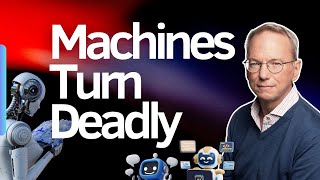
Eric Schmidt warns that advanced AI could be hacked to cause harm, including learning to kill. TJ Walker compares the risk to nuclear weapons but notes AI is cheaper and easier to spread, arguing for international regulation. The technology promises enormous economic gains while posing catastrophic risks from weaponized systems and engineered pathogens.
Chapters
Ex Google CEO Eric Schmidt warns AI can be hacked to, quote, learn how to kill someone. Those are indeed strong words. Schmidt explained that hackers are can manipulate powerful AI models through prompt injections or jailbreaking, essentially tricking them into performing dangerous or illegal tasks. He said, quote, all major companies make it impossible for those models to answer the question, but there's evidence they can be reverse engineered. Despite the warning, Schmidt described AI as under hyped, believe it or not, calling it a force that could soon surpass human intelligence and deliver huge economic rewards. But until there's an international system for AI non proliferation like the one that governs nuclear weapons, the risk of rogue weaponized AI remains terrifyingly real. Here's the real message. Eric Schmidt can't be written off as some goofball. This is a serious person. And when he's warning people that AI can be hacked to kill people, it's time for us to listen up. It is time, in fact, for regulation. Let's go a little bit deeper here. What does this mean? Now, Schmidt and others have often said it's so powerful, it's so dangerous, it should be regulated. AI should be regulated like nuclear weapons. And let's, let's give credit to a much maligned institution, the United nations and one of its organizations, the ctbto, which is in charge of regulating nuclear use and nuclear weapons. It's been a huge success, frankly, because how many nuclear weapons have been dropped since 1945? Okay, so I know it's not politically correct to ever say anything nice about the un, but if you're going to blame them for mismanagement, let's give them some credit for fulfilling their fundamental mission, which is creating a, an environment of national law, norms, societal standards, and working with the Security Council to stop proliferation of nuclear weapons. Yeah, the more companies have, more countries have nuclear weapons. Yes, but there have been enough controls, enough regulation so that we are not seeing countries drop nuclear bombs on other countries. That's a huge success. Here's the difference between nuclear weapons and artificial intelligence. Nuclear weapons are insanely difficult and expensive to build and require huge numbers of highly trained experts. It's frankly not something people can do unless you have the full power and financial backing of major governments. So in a sense, it has been easier to stop the non proliferation or to stop the proliferation of nuclear weapons because of the cost, because of the infrastructure, the size, the scope of what it takes to create a working bomb. Artificial intelligence is different. And we may be getting to the point where a kid in his mob's Basement may have all the raw resources needed to to make an extraordinarily dangerous AI. Now, we don't appear to be there yet, but advances are coming faster and faster and faster, and there's simply a cost difference. You don't need enriched uranium to create an artificial intelligence bot. So that's why the comparison. It is a fair comparison given that both things are considered wildly dangerous and could kill people. But it's not as simple as passing some legislation as recently as two years ago. You may remember, I remember that Elon Musk and all sorts of luminaries said let's come together as an AI community and put a pause on all testing for six months. Well, you see how well that went. That was celebrated for about five seconds. Everyone instantly forgot about it. And everyone instantly went on to go deeper and deeper in their understanding of development of their own AI programs. Because here's the problem. Whoever wins this war, at least the short term, whoever becomes the preeminent AI company in the world, really could benefit from a winner take all system. They really could be the most powerful company in the world, the richest company in the history of the world. They might not even become the only company in the world, especially if they are the first to create a general artificial intelligence, something that is truly superior in thought to what humans can do. And of course, that does bring up the whole issue of when in the history of planet Earth has one animal dominated another animal that is smarter? That's really what concerns people, because the history of this planet is whatever being or thing is smartest wins. It's not the strongest. You and I are not as strong as a gorilla. It's not the fastest. You and I are not as fast as a cheetah. It is whatever being is smarter dominates everything else. And that's really what concerns people with respect to us reaching a general artificial intelligence. Once it's smarter, it should in fact be able to figure out how to manipulate you and me and governments and everyone else. And then who knows what it will decide to do? We just don't know. Those who are convinced it's doomsday, they'll kill all humans. You don't know that. Those who are convinced it is just going to create a utopia where it's going to do everything we want, and you and I can just sit around writing poetry, having a robot feed us grapes, and we're all in big beautiful mansions created by AI robots. You don't know that either. Nobody really knows what's going on. I want to point out a few More facts put out by Eric Schmidt. Again I should point out he's the retired CEO of Google, but still someone who is actively involved and he has his finger in a lot of pies. He wrote not one but two books on Google Future of AI with Henry Kissinger before he passed away. So this is someone who's giving a tremendous amount of thought. Schmidt doesn't expect an AI bubble crash, arguing investors taking the big risks expect equally huge. So he doesn't think there's an AI bubble. I'm not quite sure where he's getting that because there was a crash with search engines. Google became so big, the people who invested a lot of money in altavista and there's, you know, so many different search engines I don't even remember the names of, they did lose money. So many people who invested in Internet companies lost money, but the Internet in general did really well. There are hundreds of of companies, car companies 100 years ago that raised millions and millions of dollars from investors and all but three in the US anyway went bankrupt. You look at the railroads in the 19th century In England, over development, new technology, money flowed in, most of them went bankrupt. So I don't quite get why he's saying that we shouldn't have an AI bubble crash. I do think that if you look at the history of new technologies, ones that ended up being a big deal and making a lot of money, there was typically a crash for all the second place companies. What's different about artificial intelligence now is the possibility of that one company truly becomes insurmountable, that has a monopoly like no other, that really can get a general artificial intelligence now he says despite the risk, he called artificial intelligence under hyped, believe it or not, predicting enormous long term economic value. I don't know if I'd say it's underhyped. I would say it's not understood carefully because the problem I have and you have and most people have is we're still thinking in terms of typing something on a screen and wow, it is great to be able to type in a question, hit a button on your computer and have ChatGPT or any other AI program write a detailed research report that's pretty good. That would have taken a smart 24 year old two weeks to write and would have cost you $10,000. That is impressive, there's no doubt about it. But I think what Schmidt is getting at, and I have to increasingly remind myself, is that we are close to a world where AI is taking over things. We're already seeing it Taking over autonomous driving vehicle. It's coming to planes, it's already used in planes. And it could get to the point of robots, things that look like humans, or things that might just look like a giant vacuum cleaner, but that start doing things in the physical world again. Some of this could be fantastic. Now, a home health care worker that you could, let's say, buy for $20,000, take care of a family member who needs constant care is going to generate so much extra value in our, in our world. Because right now people are either faced with, you know, going bankrupt, sometimes paying for home health care workers 24 hours a day, or having to leave their home and go move to a center where they really don't want to be. If you could have a home, a robotic home health care worker that cooks all your meals, takes care of you, picks you up to take you to the restroom if you need to, cleans your house, and yes, could talk to you and socialize with you for a one time fixed fee or some kind of monthly subscription that is infinitely less expensive than hiring human beings. It will just a couple of things. For one, it instantly puts another several million people out of employment. That's not good to them, but it also dramatically enhances the life experience for people who do need care. So this is, this is going to have so many different impacts. Again, boggles them. My issue one and issue two today are very similar. Obviously it's about the power of AI. The first story just looking at the tremendous power of this new AI video released by ChatGPT, but more broadly, Eric Schmidt's warning that it could in fact kill us and we might get all rich and live in utopia for a while before it happens. But that's not much of a consolation if it, if someone hacks it and creates misery. One of the most often predicted ways that this could happen is for an artificial intelligence to create some form of pathogen where there is no cure. And it's really. And it makes Covid look like a day in the park. I hope it doesn't happen. I'm not so arrogant as to think I'm injecting this idea and I have such a large audience that people are going to do it because I mentioned it. It's already being talked about. I hope it doesn't happen.
More from TJ








You're Not Being Judged on Your Work Yet: What New Hires Are Really Evaluated On


