Mastering Active Listening for Professional Success: TJ Walker's Live Workshop
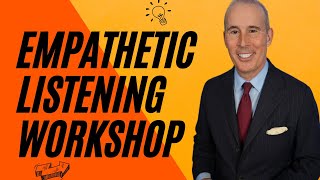
TJ Walker leads a live workshop on active listening and professional communication. He demonstrates recording techniques, covers how to communicate difficult decisions, and explains why over-communication matters in internal employer updates.
Chapters
Hello and welcome. I'm TJ Walker. Thanks for joining me today. This is a live, active workshop. You're not going to just see a finished product of communication videos. You're going to see me making them in real time mistakes and all flubs and all redos and all things that have not been edited out yet. So thanks so much for joining me. If you're catching this live, I do hope that you get a chance to see the regular videos that are in fact edited. We typically post three, sometimes four a day on the TJ Walker Success Channel. So if you have any questions please post them. I have posted the link to join me live. You can actually come on and speak to me. I have posted that on the Community tab in my YouTube channel. I'm also posting it here in the comments that will show up on some platforms, not all of them. So if you're joining me, thanks so much for doing so. I'm going to hop right in and answer common questions about communication skills. These come from ChatGPT, but I always love answering real people questions first. So you do in fact get priority. I'm going to typically do a long version and a short version answering the same question because different people like to consume content in different ways. So that's what we're about. I'll be coming to you today on and off for about three hours. Today we're doing some things with my Udemy students where it's just for them and they have a chance to get critiques of their videos. But then I'll be coming back to you. So I'll be with you now for about the next 50, 55 minutes or so and I see some of you have joined me. Thanks so much. Please you, if you don't have a question, just say hello, let me know where you're from. It's been fascinating just in the last few days we've had people from everywhere, from Cambodia, Haiti, a lot of folks from India, Europe, North America obviously. So it's quite an eclectic crew all over the world. I'm going to hop right in and do some long form videos now and short form answering questions. So if I don't look at my notes here, the comments section, don't think I'm ignoring you. I will come to you, but I'm going to be in other positions in the studio and doing different camera angles. But I will come to you and we're going to have plenty of time today to answer any question about communication skills. Okay, so the first question I'm going to look at is how can I employ active listening techniques to build stronger and more empathetic professional relationships? So I'm going to go to camera one. I'm going to hit record, Try to get things neat and straight here. So how can you use active listening skills to build more productive, harmonious and I forgot the name. The actual build stronger and more empathetic professional relationships. So, folks, there's a great example of. Some of you just see my finished videos and think, wow, TJ's really articulate, or he's taking some of my online courses and everything is smooth. It's not because I'm really any more articulate than you. It's because I just hit delete. If things didn't work out well and I start over again. That's the same technique you can use as well. So how to build stronger, more empathetic professional relationships. That's worded a little bit awkward. Awkward, awkwardly. But I'm going to use it. So we'll go back to camera one. So how can you use active listening skills to build stronger, more professional, empathetic relationships with your colleagues? Here's what you have to do. Fight your natural instinct to listen to someone with part of your brain and be thinking about what you're going to say, your rebuttal, how you're going to be smarter, how you can fix their problem. That is what most people do. That's kind of the default of way human brain works. And I'm guilty of that. We're all guilty of that, too. But it doesn't build stronger relationships with colleagues, with people you deal with professionally. So the first thing is you're going to have to try to build this habit of just listening and almost having your brain go blank. Think of it as a Zen experience. Almost. Your brain is going blank because you're not generating your smart, clever ideas. You're not generating your response or your rebuttal. You're just listening to them. Now, some people give the advice of, you know, nod and smile. You can do some of that. That's not really what's most important. What's important is that you listen. You try to understand. And you may even have to interrupt occasionally and say, let me make sure I'm getting this, and then summarize what they're saying. Don't just mimic them and do it word for word the same way, like you're almost being annoyed, but show them you've listened to them. You're trying to process it. You've now summarized it using your own words. So do that don't let them just go on and on and on. Stop. When you think you've gotten a good, important idea, summarize it. Really look at them after you've summarized it, then say, am I getting this right? Am I understanding you? Wait until they actually say yes, or nod their hair, their head. Let them continue. When people do that, they really feel listened to, they feel respected, they feel empathy coming from you. Because so many people go through a typical day at the office, or at home for that matter, sometimes a typical week, and never feel like anyone is truly listening to them. So when you do show your listening, you're creating a stronger bond, they respect you more. They feel like there's a connection there because there is a connection. Your minds are actually meeting because that's not what happens. So often somebody says something, they're not even halfway through their sentence and oh yeah, we tried that last month, it didn't work. And that shuts someone down. It makes them feel disrespected, it makes them feel unheard. And they are literally unheard because you didn't even hear the last half of their sentence or the last half of their idea. So it's not true that you should never interrupt if you're unclear on something. Stop interrupting. I want to make sure I'm getting this just right. Don't interrupt to interject your own ideas. But it's okay to interrupt to make sure you're understanding them. Or if they used a word you didn't know, that shows you're curious about their ideas, nobody's really offended by that. And it's okay to interrupt if you want to summarize to make sure you've gotten their first point before they go to the next and the next and the next. Interruption in that case shows you're really listening, you're paying attention, you're trying to get what they're after. So after you've done that and you feel like you really do have a strong understanding of what they're talking about because you've listened in a particular way. It's still possible to botch things if all you do is go right into your all knowing expertise, guidance. Here's exactly what to do to solve this problem that might not have been looked at they want. So it is important to ask people, how can I help? Do you want a sympathetic ear? Sometimes people just want to vent. If they want to talk about how awful their boss is and you share the same boss, they might not be expecting you to have a solution, or they might be venting on how awful a certain client is. They're not expecting you to solve the problem. They just want a sympathetic ear because maybe their family and friends don't want to listen to it. So that may be all they're after sometimes, and this can build a stronger professional bond. It's important to ask people, how can I help? And to mean it. Sometimes people want sympathy. Sometimes they actually want advice on what to do. Sometimes they want analysis of whether or not you think they're crazy or are they right? Are they on the right path? Really try to figure out exactly what they are looking for when they speak to you, rather than just saying, I'm the expert, I know this, and do this, this, this, this and this. That will make you come across as much more empathetic and you'll build a reputation of being a good listener. This builds on itself. It means your colleagues, whether it is someone who's a peer, someone who works for you, someone you report to, will then think of you in a different light. They will feel closer to you. They will feel a stronger professional bond because they know you truly listen to them. Listening is a gift that you give to people. We live in a world that is screaming for attention. Some say we live in attention economy these days. Every social media platform, I'm doing it right now, asking for your attention. Every traditional media outlet, every newspaper, magazine, billboard, everyone is screaming for attention because they all want you to listen. Consequently, there is more demand for attention than ever before, which means for most people, it's harder and harder to get anybody to listen to them. So when you truly listen to someone, you're giving them a gift and it is one that will be appreciated. Okay, so that's finishing the long version. I don't think I did that quite long enough. Again, some of you may think, well, if you said what you needed to, seemed like you had plenty of stuff. The reason is current best practices, as far as I understand, show that YouTube favors content that is eight minutes or longer. They want longer retention on videos and they want to be able to run more ads. Now, I would love to just come to you and give you information the absolute least amount of time that really helps you. And I try to do that most of the time. But I'm also trying to reach more people. And if going seven and a half minutes gets me seen by 500 people, but going eight and a half minutes gets me seen BY 50,000 people, then to me that's a trade off that seems to make sense. Okay, I see upcoming has written and says good Morning suit and long bermuda shorts join trend to you look nice today. 3. A long strip of light may work. When you get a budget it goes with spots of light. So thank you so much for stopping by. Do do appreciate that. When you say long strips of light, let me know what you mean. I have. You mean along the floor. I have that one which typically isn't visible because I'm standing in front of it from any angle. I. I've bought a number of lights that I've tried and it didn't seem to do much because I have very powerful lights in front of me and when I put them on they didn't do much. So as you could see I have accent lights here, others here, the one down there and very powerful regular stage lights production lights in front of me. So if you have a specific recommendation, please leave it. Frankly the best thing would be if you could leave it in my community section because it's hard to get into these comments. Once the live feed is going over I have to fast forward to find the part where you you did it live. So I would love to know any suggestions you have for lighting. I won't say I have an unlimited budget, but I've spent, you know, significant five figures on this studio in the last month and I would like to improve it and make it even better. So if you have suggestions on lights, I'd love to know. Okay, before I forget, let me do a short version of the one we just did. Go to camera two for that and hit record. Try to get this cup out of the way and make the papers a little less noticeable. So how can you use powerful listening skills with professionals to build stronger relationships, more empathetic relationships? It's simple. Someone talks to you. Don't just think, well I know the answer to that. Instead really listen and then summarize what they said to you and then ask them am I understanding correctly? Do that and they'll know you listened. Okay, so that is the short version that will be edited by my team to try to make this into something useful to people on social media because I going to be here today live for about three hours and I appreciate the many of you who've joined me. Thank you for doing so. But not everyone can spend three hours. Others will watch a 50 minute video from time to time. Others will watch the long form 3, 4, 5, 8, 10, 12 minute videos. I do, but a lot of people only want to spend 10 to 59 seconds so. So that's why we make the long form videos and they are Increasingly popular on every single platform, whether it's Facebook, Instagram, TikTok, LinkedIn, even getting a sizable audience there. And hello to our LinkedIn friends. So we try to communicate in a lot of different places and make it accessible to people wherever they happen to enjoy spending time on social media. So I'm going to check that one off. I don't really want to redo that. Next question I'll be dealing with. And by the way, those of you just joining us, if you have any question about communication skills, please post them in the comment section and I'm happy to answer them. Next question, what are the most effective strategies for communicating difficult decisions to a team or organization? Okay, perfectly fine question. I'm going to hit record. And now I'm going to look at the time. 1545. So what are the most effective strategies for communicating difficult decisions to your team or organization? The instinct, unfortunately, is to keep everything bottled up for as long as possible, especially if it involves something like firing people, laying people off, shutting down offices, shutting down factories. These are understandably difficult decisions to make. And if you're not 100%, you don't want to scare people needlessly. But keeping things bottled up too long can cause a problem. It creates an environment where rumors are swirling around. So the sooner you can be transparent with with people, the better. Now, it's good to get advice from a lot of different places. Your communications team, your legal team, your HR team. But I do want to caution you, in too many organizations, the decisions about this are made by the legal team. Now, I don't want you to get into legal trouble. I don't want extra lawsuits. Those can be time consuming and wildly expensive. In some cases, they can destroy a company. But you should not let the legal team or the HR team necessarily call all the shots on how you communicate difficult decisions for your organization. Because they're only looking at it through the lens of the legal side, the regulatory side. You really have to look at things. If you're the leader of an organization or the leader of a group, you have to look at it. The bigger picture of how does this determine the culture of our organization? How does this guide the mood of our employees? Is this going to destroy morale? You might avoid all lawsuits in the future, but if everyone is so depressed and they hate the organization and they hate you and they're all off spending every second of the day polishing their resumes because they want a different job someplace else, you haven't accomplished anything simply by avoiding legal problems. Now, the legal team Quite often wants you to communicate difficult decisions in writing. And I understand why. If it's a written document, you can look at it, you can proof it, you can edit it, you can have 1, 2, 3, 5, 10 lawyers look at it, make suggestions. So eliminate that one word, eliminate this comma. Traditionally, text has been the format for doing that, because you can refine it, process it, eliminate possible legal issues that could be headaches later on. So I understand completely why a lot of organizations like to communicate official bad news in a text format. But there's a problem. Your organization is made up of human beings. And if you're talking about a decision that has an impact on their life, people get emotional. And text is the absolute worst medium for communicating emotion. Yeah, I understand. Great novelists can do it. But if you're writing a memo on firing people or downsizing or shutting down a factory, you're not going to convey the right emotions in text. So the most important thing you can do is to talk to people. If you can talk to people face to face, that is always going to be better, because then empathy can be shown. It can come out in your face, it can come out in your voice, it can come out with your body language. It can come out by you listening to people and their concerns. So it's critically important for big decisions, important decisions, difficult decisions for you to talk to people in the organization. If you all work in the same office, then call a town hall meeting and get everyone in the office and be candid, be transparent. Let them know your thought process. Don't just say, all right, I'm firing 10 people. Here are the names, and then walk off. That is going to create ill will. Not just with the 10 people who were fired or laid off, but with everyone else thinking, well, I don't know why they were fired. I guess I'm next. And no one's ever going to tell me why. Let me start looking for other places to work. That's not going to help you. So the more transparent you can be, of course you can listen to your lawyers about what you can and can't say. But you need to speak to people. And no, I'm not suggesting you stand up in front of people and read the official document that your lawyers have prepared. I'm suggesting you look at people. You can have some notes and some talking points or some numbers, bullet points. But most of the time, if you had to make a difficult decision that had a big impact on your organization and the lives of the people there, you need to be looking at People, now let's say some or all of your employees are in different locations. You've got to do it virtually. Well, then I suggest you do what I'm doing right now. You talk to them on camera and share with them and let them know why this decision had to be made, what your thought process was. Acknowledge the fact that this is going to be tough for some people. If it is a situation like shutting down certain offices, factories or laying people off, show some humanity and let people know that you understand how they feel. Doesn't mean everyone's going to be happy, especially if you're a highly paid executive and people who are not making much money have now lost their livelihoods. So I'm not suggesting you're going to make everyone feel good about everything, but all you can do is the best you can possibly do. And if you can let people know the facts as you saw them, your decision making process, show empathy along the way, then generally they're going to feel better about the result. Even if it personally isn't great for them. They're going to have less animosity toward you and your organization. The other thing is let people ask you questions, whether they're in the room, whether they are online. Now, your lawyers might not like that, but if you're concerned about building a long term culture of trust, of optimism, of positivity, then you need to give people an opportunity to ask questions. Now, you may think in your statement, your explanation, everything is perfectly clear. Well, it's clear to you. You've been thinking about it sometimes for days, weeks, months, maybe even years. It's been a tough decision you've had to make, like why I'm shutting down the business. But the people you're speaking to in your organization, this may be the first time they've ever heard of the topic and they're blindslighted. They may be in shock. So you said something that was bad news in the first 30 seconds, explained it in minute one, two and three, and now finally in minute four, they're like, what? They missed what you said. So give people an opportunity to ask you questions, even though in your mind you've already answered it. Don't say, well, as I mentioned earlier, as I said in my statement, no, just answer them again like a real human being. You don't have to do it word for word, the same way. In fact, mixing it up a little, maybe a different example, different word order will make it come across as more of a genuine conversation. I would not recommend having a specific time limit if you have big news about an important decision that's had a huge impact on people and maybe a huge impact on their entire lives. Certainly if you're ending their job, don't say, well, that's all the time we have, and then march off. No, you want to give people an opportunity to ask you questions. Now, occasionally people could really vent. They could get angry, they could yell at you. I'm not suggesting that you have to suffer verbal abuse if someone starts cursing at you or yelling or screaming, okay, you shouldn't have to put up with that. But if someone wants to express their displeasure, their genuine displeasure about a decision, it's going to be a lot better to let them express themselves now than in the future in terms of lawsuits or constantly complaining to co workers and other people when you aren't around. So keep in mind your default form of communication when talking about big decisions that have possible negative impact on your employees. Your organization should be speaking. The closer you can be to people, the better. If it's a big decision that affects one person, you need to be in the same room with them, two, three feet away. If it's people in the same office, same building, get them all there. If everyone's scattered, they need to be able to see you. And so no, don't just do an audio, don't just do a memo, don't just do an email. Let people hear your voice, your explanation, make it live so they can communicate back. That's the problem with just sending out an email or a notice or a pink slip. It's you handing it out. Here's the way it is. And people have to just sit there and quietly take it. Nobody likes that. You want a live experience where there can be a real conversation, and then that is the most effective way you can communicate difficult decisions in your organization. Okay, so, okay, I think I did right around 10 minutes there, which is basically the length I'm looking for for YouTube long videos. If you're just joining me, I am doing a couple things here. This is a live forum taking your questions on communication skills. I'm trying to give good communication skills advice, but I'm also making the raw video of communication questions and answers that will later be turned into polished, edited videos for my channel, giving you an opportunity to see my thought process, how I do it. It's not the only way of doing it. Some people script everything and use teleprompter. It's not the way I do it. I'm doing it more extemporaneously and using things, pulling on My experience. And if I make a mistake, I'll just start over. I see we've got a few folks joining us. Karima, our good friend and great student from our Udemy courses, has joined us and she's in Ireland and has a fantastic Irish accent. Is it Kavan? I forgot. I know you've mentioned it and I just forgot if I knew the proper way of pronouncing your town. As I mentioned to you before, I've had the. The good fortune of, oh, you're telling me the sound is not good. I've been to Dublin, but I've not been to other towns in Ireland. I'd love to go there at some point. Faith says hello. Ashu says hello. Great for joining us. Thank you so much. Can anyone else give me feedback on the sound? I do have a very powerful shotgun microphone and the audio is supposed to be great, but maybe I've done some setting that's wrong. So if anyone can tell me if the sound. Just tell me your experience with the sound right now. I would like to know, as you says, change it to Samsung S24. I don't know what I mean. I've heard of the brand Samsung. I have Samsung equipment. I don't know if that's an instruction to me or if you're telling that to Karima, but if anyone else could just let me know. How does the sound come across to you today versus other days? Oh, so Sander says your sound is totally fine. Anytime there's a problem with audio or video, you never know if it's the creator's problem. The person on the other end, there could be a connection issue. So it's hard to really know sometimes. Okay, so I've got to do a short version of that answer to that question right now before I forget, because different people like content in different ways. As you says, the sound is good here. Okay, so I do want to hear from all of you. I'm not just looking for praise, but if there's a technical problem, if the audio sounds really bad, let me know. Now, sometimes things freeze on the camera and it could be because I have foolishly left extra tabs open. I see. I have one open right now, but sometimes it's the WI fi you're on and there's nothing I can do about that. So Karima says I'm on my Samsung Galaxy 12. The live video is not showing on Facebook at all. Okay. So, Karima, I'm doing things a little bit differently today. This one is not going live on the Facebook UDEMY page as it normally does. Because I'm going to have a couple of sessions with the UDEMY students later. I didn't want to overwhelm the feedback. It is on my Facebook business page, which is TJ Walker Success on. On Facebook. Okay, let me do this quick. Short one now. On difficult decisions, what's the most effective way to communicate difficult decisions to your organization? Well, here's what's not to do. Don't just send an email that your lawyers approved. If it's a difficult decision that involves changing people's lives, like firing them, you need to talk to them. You need to look them in the eye, either in person or online and tell them what the reasons were, how you feel about it, and most important, you need to listen to their concerns live. Okay, so that's what I'm doing for the short form version of that. And I would love it, frankly, if you tell me your feedback now. Like, you could say tj. The long version seemed a little bit too meandering. You should have done it in half the time. I can appreciate that you might say tj. Your short version just cut out your most important point and I don't think it's going to be useful. I would love actual feedback you have because I'm trying to answer the same question in two different formats, long version and short version, and that can give me guidance on how to be more helpful to people looking for guidance on communication skills. Ryuka Bello writes, can you please give us examples of what what you want your audience to do for you in any presentation, how to motivate them and give a story? So real kept. Part of what I recommend people doing is for any presentation, unless you're just chit chatting with a friend and talking about the weather and sports. But any business presentation, presentation in school, civic life, you're running for office, you're on a job interview, you are trying to raise money for something. Typically when you present, you want your audience to do something. I can't tell you what. It's different for every person, and it's different for every presentation. Yesterday I gave a presentation to a major corporation and it was a pitch presentation because they were looking at hiring a media trainer. So my one goal was to get them to say, yes, we'd like to hire you. Are you available? April 3rd? Send a contract. That's what I wanted them to do. Unfortunately, that is in fact what happened. You've got to decide what that is. That's what drives it. Then you got to come up with messages and Then you need a particular story to make the message memorable. So I do try to illustrate these really every single day. But it's. It's different for every person. What motivates people to do any action can be a little bit different. But let me try to be more specific. So I'm going to try to motivate you to a subscribe to my channel because the very questions you ask here, I have a lot of videos on these subjects. And if you go to and it appears you are on YouTube, great. So if you go to my YouTube channel and go to the search button and you can type in storytelling and you're going to see lots and lots of videos just specific to that. You can type in motivation and you're going to see a lot of videos just to that. If you want to know how to get an audience to do something, the setup just look at, you know, fundamentals of public speaking, presentation skills. And I have a lot of videos on that. So that's really my main goal for you, to motivate you. I'd like to motivate you to subscribe to the channel and look at these others. If I could motivate you even further, I'd love for you to ask specific questions on those videos and then I can do. I can go even deeper and deeper. That would be very helpful. So the other thing, again, I don't want to be greedy here because I typically try to ask people when you're giving a speech, ask, try to motivate people to do one thing and that really is the main thing I would ask for you is to subscribe to the channel and then search for these topics in more detail. But I am in business and I do have courses on, you know, the complete communication skills course, for example, which is on Udemy. It's on my own website, Media Training Worldwide, where I've got dozens of videos on every one of those elements you just brought up. And feel free to post another more specific question too. And I'm happy to do that to be responsive to you. Karima says how am I able to access this live through the Facebook group using Hawaii phone and not using any Samsung phone. I should not be able to access it in this way at all, right? I think maybe you mean I should be able to. I'm not sure. So Karima, later today. Okay, now. Yeah, it's not in the Facebook group right now. So that's why. But it is on Facebook. If you just go to TJ Walker Success on Facebook, I am streaming live there and Frankly, I would love it if you could go to the YouTube channel YouTube.com j walkersuccess reason I say YouTube is YouTube does make it easier for creators to build actual businesses. And your content there can. When you have good content, it can be seen again and again for years and years. I have a video that's been been seen hundreds of times in the last week. My complete media training video. And I made it 10 years ago. If you post something on TikTok 10 years ago, what didn't exist, but even four years ago, you're not going to get hundreds of views today. Typically it's more of a quick in the moment thing. Okay. And Karima, thank you so much for checking out the YouTube channel. I do appreciate that. All right, let's go to the next question. And by the way, if you have specific questions, post them and I will answer them. And I'm still feeling a little frustrated that I didn't give Bella as good of an answer as I could have. Part of it is what you're asking me, sort of. It encapsulates every possible aspect of giving a presentation and it's hard to talk about that with without spending a full hour or two on it. So if you have any other subsection of that question, I'm happy to take another crack at it. Moving on to the next question provided by ChatGPT, how can I use communication to build and maintain a strong employer brand in the eyes of current and potential employees? Fantastic question, because it is something I think people think about, but people don't typically write that question down to me. So I'm going to do a long form version of that now. How can you use. Let me look at the timing. So I want to get roughly at least over eight minutes. And I'm going to take some water too first. I could stop in the middle of it while I'm doing it and that part be edited out, but I just find it's easier for me to go in the flow and try to do the whole thing at once, especially when I'm trying to figure out the timing. So how can you use communication more effectively, not for your customers in the outside world, but for your own employees, your prospects? Let's not forget them. Too many organizations spend all their time, energy and money on ads for customers, communication, social media posts just to attract more and more customers. Meanwhile, your own employees don't know what in the heck is going on. You need to be communicating on a daily basis with your employees, with your prospective employees, so they know what your Vision is, where are you? What should they be excited about? What should they be telling other people about that's going on in your organization? It doesn't matter if you have one employee, one freelancer, or if you have 20, 50, 100 or 1,000 or 10,000 or a million. You need constant communication. It's very difficult to actually over communicate. Anytime you think you're even close to over communicating, chances are a lot of employees just didn't get it. They missed that email. They didn't see that town hall. They were preoccupied because they had a crisis at home. So if you're going to make a mistake, err on the side of over communication. Now, the single biggest recommendation I have for you that you might not be doing that costs nothing that most people don't do is this. If it's your organization or you're the manager of a group, make a video at least once a week, maybe even once a day. Doesn't have to be long. It could be 60 seconds long, but just give people quick updates. It's so much more powerful than a memo, email once a month, or quarterly reports. It also, frankly, takes a lot less time. Now you may be thinking, oh, what are you talking about, T.J. a video. I've got to have a big setup. I got to have a script, teleprompter. I got to. Now, it doesn't have to be fancy. This is not an ad for the Super Bowl. You don't have to have perfect lighting and a fancy microphone and accent lights. Just talk to people. You could do it on your cell phone while you, I mean, you could in theory be driving and just capture it on your cell phone and let your employees, let your vendors, let the people out on your inside world know what's going on. They want to feel like they're on the inside. They don't want to read about what's going on in their own company, in the Wall Street Journal or the local business page and be blindsided. That's going to make them feel alienated. That's going to create an us versus them mentality in your organization. So when you're speaking to people, it's simply more powerful when you speak and they can hear your voice and see you. So much more communication takes place than just the printed word or the text on a screen. They can get a sense of what's really important. They can get the emotional impact of what you're talking about. And all you have to do is hit record. You can do it on your cell phone. You can do it on your webcam and then send it to your employees. Now, it may be three employees and all of you are in the same room. There's something about just reflecting on what you want people to know. Maybe it's Friday at the end of the week and everyone else has gone home and you just want to reflect on the successes of the week and what's coming up next. There's nothing wrong with you making a video and sharing it, even if it's to three people in the room. Now, of course, if there are three people in the room, ideally you're sharing and talking out loud and people can hear you regularly anyway. But for so many organizations these days, people are working virtually. Even if it's a two person business, you're not in the same room. Therefore, it's a great way to connect with people, especially if there's a lot of different time zones. Because yes, live communication is best. The problem with live communication is if you're 12 time zones away and you're asking someone to get up in the middle of the night or 5am Their time, they may be half asleep. The other issue with live communication, and I'm certainly a big fan of live communication, in terms of keeping your staff, your team members up to date of what you're doing, is it's very easy. For something that seemed like it would take five minutes to turn into an hour, there is a time and place for that. Ideally, you have both. You have live meetings, live town halls, live sessions with your employees. Doesn't matter how big you are. Steve Jobs did it regularly with thousands and thousands and thousands of employees. Employees let them ask questions. So you want some communication that's live and give and take. But there's also a role for making a simple video. Could be 45 seconds long, could be 5 minutes long. Don't edit it, don't worry about an or a stumble. Just treat it like a conversation where you called up one employee, you and said, hey, let me give you a quick update on what's happened today or in the last week. And you just talk, record it and share it, push it out, let people see it. Of course they can email with questions, of course they can write or call you if there's real confusion. But if you know, okay, once a week, every Thursday morning, going to send a short video talking about what's happened this week, what's going to happen next week to our entire organization. It's going to get faster and easier. Every single week you do it and a lot of people will appreciate it and it will build a cohesiveness to your organization because people will know what you're thinking. They won't feel blindsided, they will feel included. They will feel like they are on the inside and more part of a family. Even if it's a really large organization. Do not be afraid to repeat yourself. Important messages need to be repeated. Telling a message once doesn't matter. If it's a small child, you're 14 year old teenager living at home, or a major investor who is a genius with a PhD from MIT. It doesn't matter. Very few people instantly get a message hearing it once. So do not be afraid to repeat your important messages again and again. There may be some messages you want to repeat once a week, even once a day. Don't be afraid to repeat it, but make. Make it conversational. Don't read in a generic way. And remember, safety is our number one priority. That's going to go in one ear and out the other. Make it conversational. Give people a sense of this is what is important. Here's why I'm sharing it with you. Here's why I think you need to know. Here's why this has an impact on you. Really communicate things and look at it through the lens of why is this important to these employees, not simply this is what it is. Take it or leave it. If you do this on a regular basis, your organization will be a happier organization and it will be a more productive organization. Let communication be a huge asset of your company, not a liability. Okay, so that was the. And I forgot when I started that. So I think that was about the right length. I think we'll be okay there. Those of you who are my students and I know Karima is. I will be going live at 10am just on the Udemy Facebook page that I have for students. And then around 10:45, maybe even a few minutes earlier, I'll be coming back live right here to take more questions and give more demonstrations. I'll also be demonstrating. Don't like it when my pocket square pops out and is too big. Excuse me. I'll be making more demonstrations on how to make Amazon influencer videos because I know a. A number of you have really asked about how can I, how can I somehow speak in front of more people? Maybe make some money, get better at this. That is a great way of doing it. Okay, so let's see. I didn't do the short version of this. Okay, let me do that right now. Gonna go to camera two. Record. How can you use strong communication skills to build Your corporate culture. The main thing is communicate with your employees on a regular basis. Don't just send emails or a memo saying, here it is. Instead, talk to them, preferably in person, but at minimum, make a short, simple video once a week telling them what you're thinking about the good news, the bad news. Communicate. Err on the side of over communication. Okay, so that's the short form for that, that particular question. Sometimes I do a short form one. I think, wow, that's great. That's really a great way of crystallizing the insights that deal with that question. And the long one was a bit rambling. Sometimes I do the long one. I think, wow, that is fantastic. And that the short one didn't quite get to it. So it can cut back and forth. So I want to thank everyone for joining me. I'm going to have to sign off in a couple of minutes, but if I could ask a couple of things. Post in my community section on my YouTube channel any questions you want me to answer. And I will in fact create an entire video just, just answering your question in detail if I don't already have one or two or three videos on that subject. So put me to work. Doesn't cost you anything. So post in the community tab on my YouTube channel. If you're watching on Facebook, Twitch anyplace else, just go to YouTube. Type in TJ Walker. Success. It will pop up as number one if you type in TJ Walker. Typically it'll be number one or number two of the channel, so it's pretty easy to find. Now I missed a few folks who, who joined us. Nafia is with us today from, from Bangladesh. Really happy you're here. Nafia. Would love to find out more about what you're doing in your career and how communication skills have an impact. I've unfortunately not been to Bangladesh. I've been to India many times, so your neighbor, but I've not been to Bangladesh, hoping to get there at some point in my life. If I don't. If you're. If you post a question in the next couple of minutes, I probably won't be able to get to it. But I will be back in about an hour. Right here we'll be broadcasting again live across all these social media platforms. So come back at that point and I'll be able to answer your questions. In the meantime, you could really do me a huge favor by subscribing to this channel if you haven't already subscribed. Our own research shows that most of the people who come to the lives who come and watch a video even like it and comment don't subscribe. They may never join us again not because they didn't like it, just forgot about it. So please subscribe. Please sign up for the notifications and if you see a video and you like it hit the like button. It makes it a lot easier for YouTube to know and the other social media platforms that hey this person likes it let's send it to more people like that so it helps really spread the word and then the best thing you can do frankly is leave a comment. Question that you want me to address is always preferred of course I love it if say oh great video, really helpful, nice and that's nice but an actual question so we can continue this dialogue is even better so please do that. Thanks so much for joining me again. I'll be back live in this very spot in an hour. See you then.
More from TJ








You're Not Being Judged on Your Work Yet: What New Hires Are Really Evaluated On


