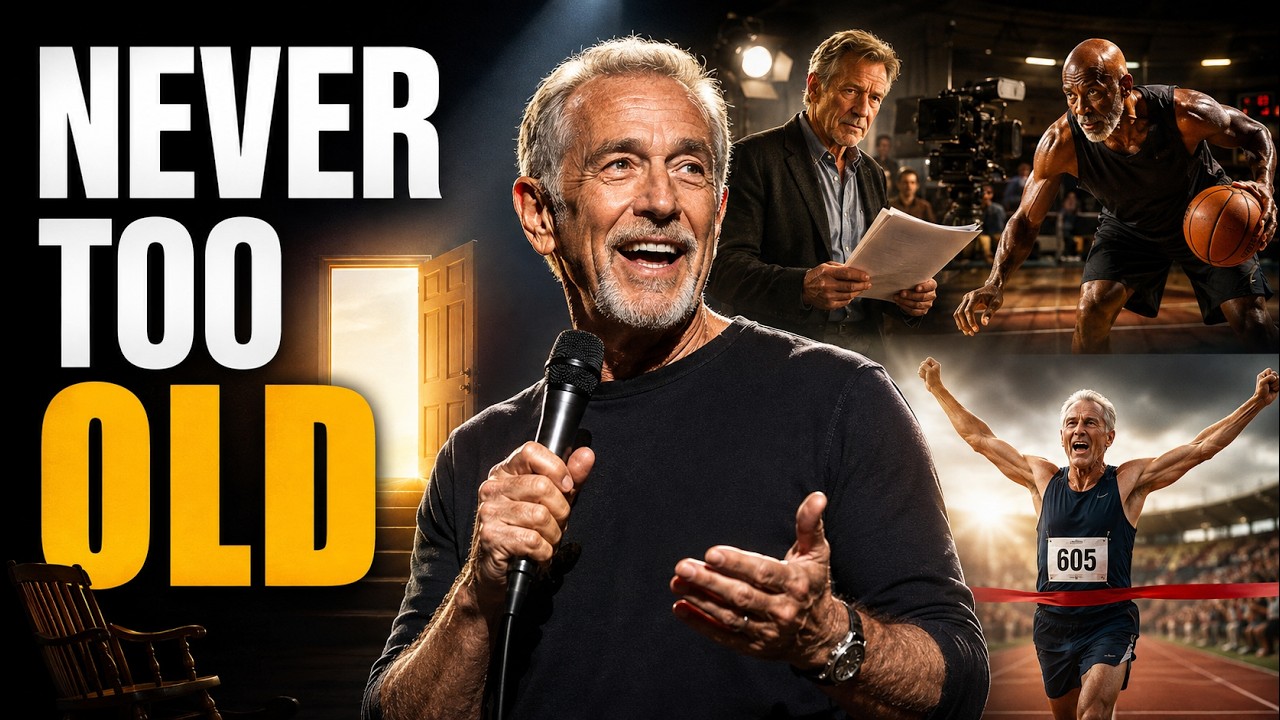
TJ Walker argues age limits are psychological, not biological. Morgan Freeman acts into his 80s, LeBron James competes in his 40s, and Walker himself did 20 stand-up sets at 63. He says consistency and sleep matter more than supplements, and the real barrier is fear and habit, not the calendar.
Chapters
Ultimize. Remember when turning 50 meant you were supposed to retire, buy a rocking chair, and start yelling at squirrels? Morgan Freeman is 89 years old, about to be 90. He's still memorizing scripts, starring in Lioness, and taking on new acting challenges. LeBron James is 41. Instead of retiring, he's packing for Philadelphia, hoping to win one more NBA championship. Aaron Rodgers is in his 40s, apparently still thinks being chased by 300-pound defensive linemen counts as a healthy hobby. And just a few weeks ago, 28-year-old Josh Kerr— I know that's young— but he ran the fastest mile in human history, 3 minutes 42.66 seconds, breaking a world record that had stood for 27 years. Notice the pattern? The biggest limits in life usually aren't biological. They're psychological. Somewhere along the way, millions of people started saying 4 of the dumbest words in the English language: I'm too old. Well, I'm 63 years old. The past month, I've done 20 stand-up comedy open mics. No, I'm not announcing my Netflix special. Let's first see if I consistently make 12 people laugh who got in for free. But I refuse to let the phrase I'm too old decide the rest of my life. Now, before anyone misunderstands me, biology always wins. Nobody has yet defeated aging. Nobody's defeated death. No matter how many supplements you're taking or how many podcasts you listen to, eventually nature sends you the final bill. But here's what has changed dramatically. We've stopped confusing aging with quitting. Those are not the same thing. For most of human history, people assumed there was a certain age where you simply stopped doing difficult things. You stopped learning, you stopped competing, you stopped creating, you stopped dreaming. Today we've discovered that many of those limits were never really imposed by nature. They were imposed by culture. Morgan Freeman is a perfect example. The New York Times just profiled him as he approaches 90 years old. He's returning for another season of Lion Tennis. He's still taking on demanding acting roles. He's producing blues projects. He's preserving American musical history. Most impressive to me, he's still memorizing pages and pages of dialogue. I had trouble memorizing scripts when I was 20. He's doing it at 89. People constantly ask him about that legendary voice. He says he doesn't understand the fuss. His secret? I just try to speak clearly. That's what he said. Now, that's wonderfully disappointing at some level. No magic crystal, no secret vocal exercise, just decades of speaking clearly. Another part of Freeman's story gets overlooked. His career didn't really explode until he was around 50. Imagine if he decided, well, I'm 50 now, better slow down. No Driving Miss Daisy, no Glory, no Shawshank Redemption, no narrator's voice that somehow became the official sound of God, documentaries, and half the commercials on television. Then there's the body. For years, people acted like Tom Brady was some once-in-a-century medical miracle. Maybe he was simply the first member of a much larger generation. Aaron Rodgers is still competing in his 40s in the NFL. LeBron James is 41 years old and preparing for a new chapter with the Philadelphia 76ers. Quarterback isn't exactly a desk job. Neither is NBA basketball. These athletes aren't succeeding because they discovered unicorn vitamins. They're doing incredibly boring things. They exercise, they stretch, they recover, They sleep. Oh wow, do they sleep a lot. They eat well. They repeat every single day. There's no off-season. Everyone wants to know the miracle. The miracle is consistency. Sleep is free. Walking is free. Broccoli is still cheaper than Ozempic. Would you like to be the sort of successful person who is dominating news, at least in your industry? Well, if so, it's time to up your skills. At ultimize.com, I've created online courses to help you do that. Now, here's the thing, no obligation. You can get a free course on communication skills, a free course on how to build better habits. All you have to do is go to ultimize.com. That's ultimize.com. No obligation. Go there now. Now, let's talk about limits. For centuries, everyone knew the 4-minute mile was impossible. Doctors actually claimed the human body couldn't survive it. Then Roger Bannister ran it at 3 minutes 59.4 seconds in 1954. The truly fascinating part wasn't that one man did it. It's within a few years other runners started doing it. The barrier had been as much psychological as physical. Today, elite college runners regularly break 4-minute miles. Hundreds of high school runners have done it. What used to define the absolute limits of humanity has become almost a prerequisite for elite competition. Then just a few weeks ago, another reminder. Josh Kerr, only 28 years old, ran at 3 minutes 42 seconds, breaking Haikam El-Girra— and forgive me, I know I'm botching his name— but the previous record holder had had a record for 27 years. 27 years! An entire generation looked at that number and assumed maybe that's as fast as humans can ever run. Then one person proved otherwise. Records don't simply measure speed, they measure imagination. The same thing happens outside of sports. Think about the movie and Broadway show Sunset Boulevard. Norma Desmond was portrayed as the tragic, washed-up former movie star. Do you know how old she was supposed to be? 50. And that's how old Gloria Swanson was when she portrayed that role— 50. Today, 50 is when people are training for marathons, starting companies, learning new languages, raising teenagers, and sometimes having abs better than their own children. Our expectations have changed much faster than our biology, and that's wonderful. Now let me make this personal. I'm 63 this month. I walked into 20 stand-up comedy open mics. That's intimidating at any age. Most of the comedians were young enough to be my children, or dare I say it, grandchildren. Some looked young enough to need permission slips to stay out after 9 o'clock. Am I going to end up with a Netflix comedy special? Hmm, probably not. Could I? Maybe. I honestly don't know. But here's what I do know: I'll never find out if I stop myself with the sentence, "I'm too old." That sentence has probably killed more dreams than arthritis ever has. Now, obviously, there are exceptions. If you're 90, maybe don't become a coal miner. If you're 85, downhill motorcycle racing might not be your ideal next hobby. Use common sense. But wanting to paint, wanting to write, wanting to learn the piano, wanting to speak another language, wanting to start a business, wanting to finally get healthy— age is not the thing stopping you. Fear is. Comfort is. Habit is. The calendar is usually innocent. The real prison isn't built by biology. It's built by vocabulary. So today I'd like to suggest retiring one phrase forever: I'm too old. Replace it with something much more honest: I haven't started yet. Because those two sentences create two completely different lives. One sentence ends the story, the other begins it. And as long as you're still breathing, I think I'd rather keep beginning. I'm TJ Walker. This is Filtered. Ultimize.