NYC’s Affordability Scam: Who Really Pays for Government Promises?
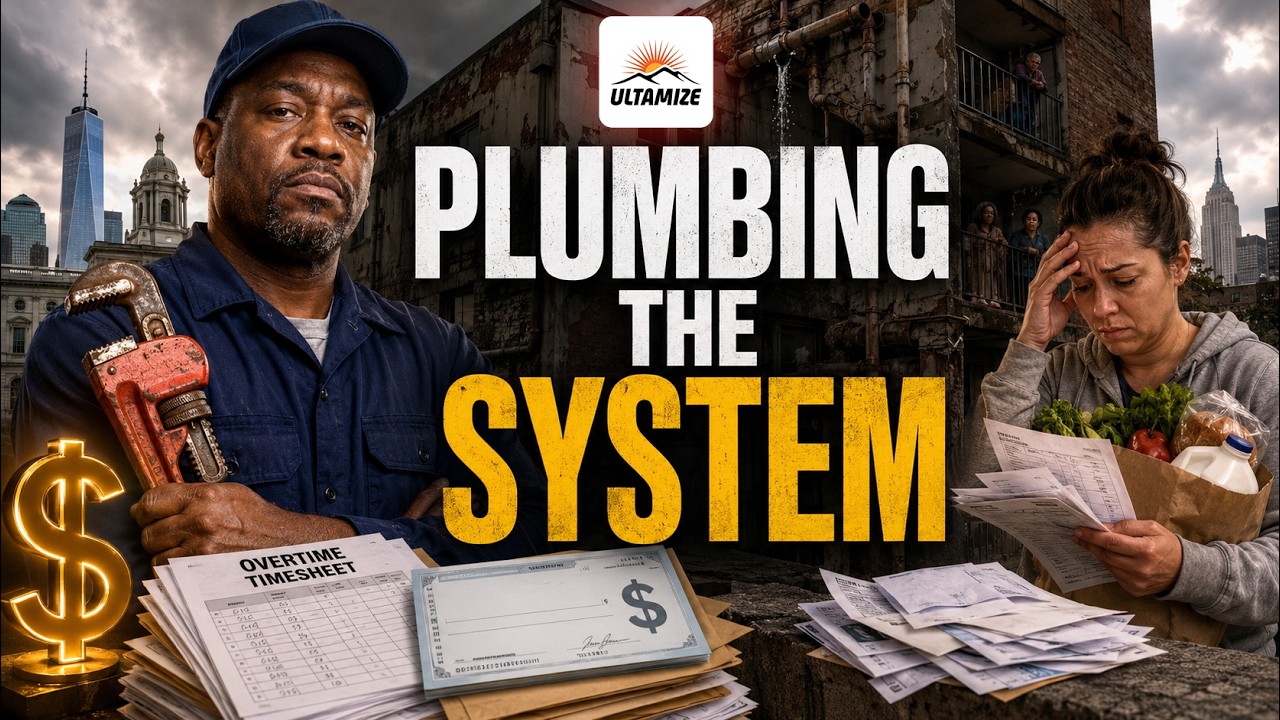
TJ Walker examines how a NYC Housing Authority plumbing supervisor earned $465,000 in one year, far above the city's median wage of $50k. He argues that generous public-sector pensions and fringe benefits consuming 21.7% of the city's budget undermine Democratic promises of affordability, fueling resentment among ordinary workers.
Chapters
Ultimise. Donald Trump finally found a way to make Americans root against America in the World Cup. An achievement of sorts. That's like making Dolly Parton unlikable. Trump leaned on FIFA. Balogun's red card suspension got delayed, and then Belgium beat us 4-1 and basically danced on the grave. The rest of the world wasn't just celebrating Belgium. They were celebrating the rare international holiday known as America tried to cheat and still lost. Meanwhile, Democrats in Maine are discovering something shocking: when your Senate nominee is accused of rape, you can ask him to leave the race. Republicans are watching this like anthropologists. Wait, you're allowed to care about that? And in New York City, a public housing plumber made $465,000 in one year while reportedly running not one but two private plumbing businesses. This is why liberalism is losing working people, because at some point protecting workers became protecting the one guy with a government job, unlimited overtime, a pension, two side businesses, and a better tax strategy than the mayor. And the single mom paying taxes on $52,000 a year is supposed to say, thank God the system is looking out for the little guy. Hmm, no, it's looking out for the little guy's plumber. The story I want to focus on today is not really about plumbing. It's about political plumbing, because when the pipes are broken in New York City government, somehow the water always seems to flow uphill, away from the average taxpayer, away from working people, and toward whoever already has the best deal in the system. The New York Times reports that Jacob Markowski, a plumber supervisor for the New York City Housing Authority, made $465,000 $100,000 last year. That's more than the mayor, more than the police commissioner, more than the fire commissioner, and frankly, more than most New Yorkers will make if you combine their salary, their side hustle, their tax refund, their fantasy football winnings, and the $18 they found in an old winter coat. Now, I want to be very clear, I'm not bashing plumbers, I'm not bashing blue-collar workers, I'm not bashing government workers. I've worked for the government. I've worked for state government. I've worked for federal government. I've known honorable, hardworking public servants who could make more money elsewhere and chose public service. So this is not some right-wing rant about lazy bureaucrats. This is a sane, sensible centrist asking why liberal government so often ends up protecting insiders instead of the actual working class. And that's the problem because liberalism at its best is supposed to lift people up. It's supposed to say, if you work hard, you should have healthcare, you should have decent wages, you should have some security. You should not be one illness, one layoff, or one landlord's whim away from financial collapse. That's the liberalism I believe in. But somewhere along the line, and I don't know if the year was 1975 or '85, too much of the democratic politics became less about helping everyone and more about protecting whoever already got inside the castle walls. And once you're inside, civil service protection, union protection, overtime, crazy pension formulas, work rules, political allies, a system that treats accountability like asbestos— dangerous, expensive, and something everyone agrees should be removed eventually but not from this building. This plumber was paid for almost 2,560 hours of overtime in one fiscal year. That's an average of about 7 extra hours a day if he worked every single day of the year. Every day. Christmas, Thanksgiving, Easter, his birthday, the day after his birthday when most of us are just trying to metabolize cheesecake. And while doing this, he reportedly had not one but two private plumbing businesses. Now, do we know yet that he used government connections to funnel work to those businesses? Okay, I can't prove it. Do we know he broke the law? Can't prove it. But if a public housing plumbing supervisor is making nearly a half a million dollars from the city while also operating private plumbing businesses, The public has every right to ask questions. This isn't union bashing. This isn't plumber bashing. This is not hate the working man. This is, excuse me, how many hours are there in your day, and are they the same hours the rest of us get? And this is where Democrats keep losing the plot. They hear a story like this and instinctively defend the category. Blue-collar worker. Union worker, public employee, therefore must be a good guy. But politics isn't about categories, it's ultimately about fairness. The median earnings for workers in New York City are about $50,450. The city controller has also put the median hourly wage for workers who both live and work in New York City at roughly $27 an hour. In 2023. Annualized, that's less than $60,000. So let's stop pretending this is complicated. A public employee making $465,000 is not a symbol of the working class. He's making roughly 9 times the median worker in New York City from the public payroll alone. We don't even know what he made from the private businesses. So when you tell the average New Yorker, don't worry, liberal government is fighting income inequality, and then see a government plumber making $465,000 a year, they don't think, ah, the revolution is proceeding beautifully. No, they think, I'm paying taxes so this guy can become a plumbing oligarch. And they're not wrong to be angry. This is where a lot of liberals get uncomfortable. Because we like to think inequality only comes from billionaires. And yeah, Wall Street hedge fund managers making $10 million a year are richer than a plumber making $465,000. Thank you, math department. But that does not make $465,000 normal. That doesn't make it working class. That doesn't make it the little guy. In New York City, $465,000 a year is still pretty rich. Okay, maybe not private jet rich, maybe not naming rights on a hospital wing rich, but absolutely I can order guacamole without checking the price rich. And when that money comes from taxpayers, Democrats have to stop pretending the resentment is irrational, because the resentment is the point. Now let's talk about affordability, because this is the issue every Democrat has suddenly discovered, and good. New York City's mayor won on affordability. More and more Democrats are running on affordability. That's smart politics. People don't wake up in the morning thinking, I need a candidate with a 14-point white paper on intersectional stakeholder empowerment. They wake up thinking, can I pay rent? Can I buy groceries? Can I afford child care? Can I stay in the city where I work? Can I avoid moving to a place where the nearest good bagel is 400 miles away and considered an ethnic food? Affordability as an issue is real. It's urgent. It is the right issue. But here's the part Democrats don't want to say out loud: you can't make a city affordable if the government itself keeps making the city more expensive. You can't say we're fighting for affordability and then keep voting for benefit packages, pension sweeteners, overtime rules, staffing deals, and work protections that are funded by everyone else. Most, and I gotta repeat this, most of whom make far less than the people inside the protected system. The math doesn't add up. Now, this is not ideology, this is arithmetic, and arithmetic is undefeated. You can call it democratic socialism, you can call it progressive budgeting, you can call it investing in our communities. At some point, the bill arrives. And in New York City, the bill arrives wearing a Yankees cap, charging 18% in local fees and telling you the subway is delayed because of train traffic ahead. In the city's fiscal 2026 budget, fringe benefits and pensions for city employees and retirees accounted for $25.17 billion, about 21.7% of the entire budget. $1 out of every $5 Before you build housing, before you fix public housing, before you clean streets, before you expand child care, before you make anything more affordable, 1 out of every $5 is already going to benefits and pensions for current and former city workers. Again, that doesn't mean every dollar is bad. Workers deserve health care. Workers deserve retirement security. But if you're serious about affordability, you have to ask, affordable for whom? Affordable for the family paying taxes, or affordable for the people whose retirements those taxes are subsidizing? Because if you take money from a worker making $52,000 a year and use it to fund a retirement package for someone who made $120,000, $150,000, or in this case $465,000 in public payroll income. That's not Robin Hood. That is Robin Hood's evil accountant. That is taking from the middle and giving it to the protected. And this is why so many working-class voters no longer believe Democrats are on their side. They hear Democrats say, "We're fighting for the little guy." Then they look around and realize the little guy is apparently a 51-year-old agency supervisor with a defined benefit pension, lifetime health coverage, a union lawyer, and a second home in Pennsylvania. Meanwhile, the actual little guy is driving Uber after his real job. The actual little guy is paying $2,400 a month for a studio apartment. The actual little guy has a 401 with $11,000 in it and a retirement plan called hope I die on a Tuesday. That is the affordability contradiction, and Democrats need to face it. Would you like to be the sort of successful person who is dominating news, at least in your industry? Well, if so, it's time to up your skills. At ultimize.com, I've created online courses to help you do that. Now here's the thing— no obligation. You can get a free course on communication skills, a free course on how to build better habits. All you have to do is go to ultimize.com. That's ultimize.com. No obligation. Go there now. You can't make a city cheaper while making government promises more expensive. You can't keep expanding the protected class and then wonder why everyone outside it is resentful. You can't tell ordinary taxpayers, be patient, we're building a more just city, while the city budget is full of promises they will never receive themselves. Because the average private sector worker doesn't get this deal. The average private sector worker does not retire after 20 years or even 30 years. The average private sector worker does not get a guaranteed pension. The average private sector worker does not get to spike the last few years of pay and turn that into a lifetime benefit. The average private sector worker gets a 401, which is basically Wall Street saying, here's a menu of mutual funds, try not to be poor during your hip replacement. And the pension numbers are staggering when you say them plainly. Full career new fire department retirees recently averaged $171,000 $336 a year in pension benefits. If someone retires at 52 and lives to 88, that's 36 years at $171,000 a year. That's about $6.17 million in lifetime pension checks. That's not even adjusted for inflation. Now, that's not some fancy Wall Street present value calculation. That's just one number times another number. $6.17 million for retirement. Again, I respect firefighters. If your house is on fire, you don't want me showing up with a garden hose and a TED Talk. You want professionals. Pay them well. But when the retirement package alone can be worth more than $6 million over a long retirement, we're no longer talking about modest middle-class security. We're talking about a system the average taxpayer cannot even dream of. New full-time New York Police Department retirees average $103,859 in annual pension benefits. If someone retires after 20 years at 42 and lives to 88, that's 46 years of checks. At that average, that's about $4.78 million over a lifetime. Teachers are lower but still far beyond what most private sector workers get. The Teachers Retirement System says retirees with 30 to 35 years of service average $63,000 a year. If someone collects that from age 58 to, say, 88— I realize not everyone lives to 88— but that would be about $2 $1 million. Now compare that with the private sector worker who has no pension at all. The public worker says, "I earned it." Fine, okay. But the private sector taxpayer says, "I paid for it." And that sentence is the political problem because affordability is not just rent. It's not just groceries. It's not just whether a politician can freeze one price somewhere. And hold a press conference in front of a bodega. Affordability is the total cost of living in a place. Taxes are part of that. Government labor costs are part of that. Pension obligations are part of that. Debt service is part of that. Every promise made to one group becomes a bill sent to another group. And if the city keeps sending that bill to people who make $50,000, $60,000, $70,000, $80,000 a year, they are going to leave. Or at least become very angry, or they're going to stay and hate the government, or they're going to vote for someone who says, "This is a scam." And that person may be a fraud, that person may be a demagogue, that person may be Donald Trump wearing a hard hat he's never once used for anything but a photo op. But resentment is powerful fuel, and Democrats keep spilling it everywhere. Than acting shocked when someone lights a match. This is one reason small and mid-sized towns in Texas and Florida are cheaper. It's not just weather, it's not just zoning, although that's a part of it. It's not just that in some towns the fanciest cultural institution is a Cheesecake Factory with valet parking. It's also that many of those governments don't carry New York-style labor costs, pension promises, and benefit structures. Now, are Texas and Florida perfect? Of course not. There are underpaid workers, there are bad services, there are weak safety nets, there are plenty of public policy disasters. But the basic cost structure is different. If a city keeps making government employment a golden ticket, then everyone who doesn't have that ticket pays more to live there. And that's exactly the problem. New York City has roughly 350,000 municipal workers. The city's private sector job count is about 4.2 million. That means city government workers alone are something like 7 or 8% of payroll employment in the city. And that doesn't even count state workers, federal workers, transit workers, public authorities, retirees, and all the other public sector pension systems orbiting the taxpayer like very expensive moons. Sono, it's not everyone, but it's enough people to matter politically, enough people to shake budgets, enough people to shape union politics, enough people to shape Democratic primaries, enough people to make reform painful, and enough people that the costs spill onto everyone else. This is where Democrats have to choose. Do you want broad liberalism or insider liberalism. Broad liberalism says everybody should have healthcare, everybody should have childcare, everybody should have safer streets, everybody should have decent schools, everybody should have a realistic shot at retirement. Insider liberalism says we can't give everyone those things, but we can give spectacular benefits to the groups that help us win primaries. And then we call that justice. Well, that's not justice, that's patronage with better pronouns. And it's politically deadly because ordinary voters can smell favoritism. They may not know the pension formula, they may not know what Tier 6 means, they may not know the difference between final average salary and pensionable overtime, but they know when somebody else got the deal they never got. They know when they're paying for it, and they know when politicians are pretending not to know. This plumber is a symbol because he collapses the whole contradiction into one human being. A public housing agency where nearly 300,000 residents depend on the system, buildings with massive repair needs, tenants who need functioning plumbing, heat, safety, dignity And somehow inside that same system, one plumbing supervisor makes $465,000 in one year while connected to two private plumbing businesses. Maybe every dollar was technically approved and legal. Maybe all the paperwork was stamped. Maybe somewhere there is a form saying, yes, this is fine. But that might be the worst part, because if it was illegal, prosecuted. If it was legal, then the system is insane. The public is not comforted by hearing, "Don't worry, all the paperwork was properly filed." That is what every collapsing empire says right before the barbarians arrive with an audit. And this is where I want liberals to be more honest. If we believe government can do big things, then government has to be clean. If we believe taxes are the price of civilization, then taxpayers need to believe they are buying civilization, not someone's overtime yacht. If we believe public housing matters, then public housing agencies can't become machines for generating absurd paychecks while tenants live with leaks, mold, broken elevators, and heat that works on the same schedule as a divorced dad— every other weekend, maybe. The left can't keep asking people to trust government while refusing to police government. That's the contradiction, and it's killing us. I'm TJ Walker. This is Filtered. Thanks for watching. Ultimize.
More from TJ








You're Not Being Judged on Your Work Yet: What New Hires Are Really Evaluated On


