The Biggest Media Shift in a Generation
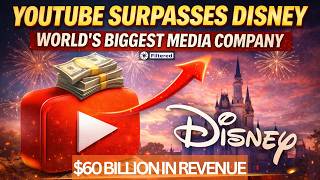
TJ Walker explains how YouTube became the world's largest media company with $62 billion in revenue, surpassing Disney. He breaks down the creator economy: over $100 billion paid to creators total, but most earn almost nothing, with only a few like MrBeast reaching real wealth after years of unpaid work. The traditional Hollywood path is dead, replaced by a long-term bet on building an audience from scratch.
Chapters
YouTube becomes the largest media company. A major milestone in the media world. YouTube has officially become the largest media company on the planet. According to research firm Moffett Nathanson, the Google-owned platform generated about $62 billion in revenue in 2025, edging past the traditional media business of Disney. This reflects a huge transformation in how entertainment works. Instead of relying primarily on television networks and movie studios, audiences increasingly watch video online. Well, stuff like this, often created by independent creators like me. Advertising remains a major driver of YouTube revenue, bringing in more than $40 billion a year, but the platform is also expanding its subscription business through services like YouTube Premium, YouTube Music, and YouTube TV. The company says it has now paid out more than $100 billion to creators, music companies, and media partners, and people like me, although I didn't get that much of it. For Hollywood and traditional broadcasters, it's a powerful reminder that the center of media has shifted from studios and networks to global digital platforms. Okay, this isn't a huge shock. Those of you who watch this regularly know that I often talk about milestones that that YouTube has reached and how the whole world of entertainment media continues to evolve. It wasn't that long ago where the people at Netflix kind of referred to YouTube as the farm team, the training ground, the minor leagues. They're not doing that anymore. They're much more humble about it. I still don't think most of Hollywood understands what's really going on. And the, the Ellison-Nepo baby that has unlimited billions of dollars to buy old-school media companies and movie studios. I think, you know, 5 or 10 years from now, he's going to be a billionaire. Um, but let's not forget, he can be a billionaire and still lose about $50 or $80 billion, which I think is what is going to happen there. Let's look at some more of the facts regarding YouTube. They did pass $62 billion in revenue in 2025. This surpasses Disney media revenue of $60.9 billion. Now, Disney's been around for 100 years. I think of Disney, I think of Disney World and Disneyland and Mickey Mouse and these iconic, iconic media features and intellectual property. Goofy, Mickey Mouse, you name it, they have it all. And now YouTube is bigger. At least in terms of revenue, but arguably in cultural significance too. YouTube is currently valued at between half a billion dollars— excuse me, half a trillion dollars and $560 billion. Now, it's hard to tell exactly because they are owned— they're completely owned by Google. I almost said YouTube— by Google. So they're not a standalone company, but if they were, they'd be worth almost half a trillion dollars. The Netflix market cap is at about $409 billion. So yes, they do appear in sort of every significant way to be larger than Netflix. The fourth quarter ad revenue hit $11.4 billion. Annual ad revenue exceeds $40 billion. And again, they have other sources of revenue, subscription, ad-free versions, things like that. They have paid a significant amount of money to creators. Now, before you say, TJ, you're making it sound easy, it's get rich quick. No, it's not get rich quick. When you look at most people who make money on YouTube, quite often they did a 5-year apprenticeship without making any money. And that's basically what MrBeast did. So let's not overglamorize this. 90— it's something like 97% of all people, all creators across all social media platforms make peanuts. I mean, maybe a few thousand dollars or less. So it's still heavily, heavily skewed towards the most successful creators. Nothing's really changing that, but the ones that are successful are becoming really successful. The other trend I think we're going to continue to see is people leaving traditional media, especially if they already have some fame or notoriety. You look at how Trevor Noah went from hosting a daily show, having a full-time job, having to show up every day hosting The Daily Show, to being able to travel the world, do gigs wherever he wants, do his podcast basically when he feels like it, and he's making tons more money, tens of millions of dollars more hosting podcasts. I think that is the model we're going to see increasingly. So someone like Stephen Colbert is going to do better than ever in this new world. The problem, of course, is People who want some kind of a traditional route of you get out of college, you go to work in a small TV market for barely enough to live and survive, and you work your way up bigger markets, then to a network and on. That career trajectory, I think, is going to be gone. And the people who just want to go be a production assistant at a big TV network, that's going to be gone. I think the new career path is you need to decide What's something you're willing to work on for the next 5 years without making a penny? I think we're going to have to go back to looking at this as an apprenticeship route, something that was common hundreds and hundreds of years ago and is still common in certain companies or certain, excuse me, in certain countries. So that's the route. Now, I think the easiest time to do that is when you're in high school and college and no one's expecting you to make a living, but you could be 50 years old and decide, you have a passion for blacksmithing and making video content about making horseshoes, and you're perfectly fine not making any money on that for the next 5 years, and you're just producing new videos every day for 5 years, or maybe one fantastic high-quality video a week for 5 years, and only then will you make money or even expect to make money. I think we're going to see more and more of that. Neal Mohan, the CEO of YouTube, said this, there are two really fundamental things we do for creators, help them build an audience and help them build businesses. Yes, it is true, again, for maybe 1% of the people actually build a business. Now anyone can get an audience. Your audience might be 3 people watching your video, but that's better than just sitting at home and yelling out the window. So it does help create audiences. Michael Nathanson, one of the analysts, said, we strongly believe that YouTube will be the beneficiary of both the structural tailwinds and headwinds facing technology and media companies. That's a polite way of saying traditional Hollywood is going down the tubes. Everything is too expensive, it's too bureaucratic. And this idea that you can't make a, a movie without spending tens of millions of dollars and having every kind of, uh, grip and unionized labor. And folks, I'm not anti-union, but it's just not working in the world of media anymore. Sorry, it's just not. So What he's saying is essentially the old media companies with their high cost structure are going to be out of business. You used to be able to justify high cost because there was such limitation in distribution. Yeah, you could spend $100 million making a movie if you could distribute it to 2,000 screens and nobody else had any option for watching new entertainment. That's what life was like when I was a kid. That's what life was like when I was a young man. You wanted new entertainment, you had to wait until a new movie came out. Otherwise, you're watching reruns on network TV. There was no internet, there was no TikTok, there was no Facebook video. All that world has changed. And unfortunately, many of the funders of Hollywood productions, the buyers of these companies, the people who like to go to the Oscars and feel important, are still living in the world that I grew up in. They're my age or older. And I don't think they've come to grips with the fact that there's simply a new reality. And I don't think we're that far away from YouTube just destroying and putting out of business all of Los Angeles and all of Hollywood. Maybe there are a few, a few remnants left, but not much. Okay. What are we to make of this? What's the implication for you and your career? You gotta read the room. You gotta see what's going on in your industry.. And you have to adapt. You can't just cling to the past. You can't say, technology, stop. I want to go back to the way things were. I certainly know a lot of people in my own industry of presentation skills training and media training saying, ah, you know, these ebooks, who wants to mess with that online training? Why would I do that and sell that for $100 if I can get people to pay $5,000 for a day of my time? And after the pandemic, most of them were unemployed or retired because they didn't adapt to new technology. Now, I'll be the first to confess, I'm not really particularly skilled at technology. I never learned how to code. I never even saw a computer when I was in college, much less took a computer science programming course. But when I needed to, out of fear, I have forced myself to learn new technology. Way back in the 1990s, this was before podcasting, I was approached by an internet— they called it internet radio— and I took apart my computer and had to install a second sound board so one of them could dial AOL with the sound and the other one could call somebody on a regular phone and I could interview them. I had my entire computer taken apart on my studio apartment floor for a week. But I figured it out, not because I'm a tech genius, but because I just told myself, I've got to do this or I could become irrelevant. And that unfortunately, I think, is the attitude you're going to have to have and everyone's going to have to have if they want to survive because the old world isn't coming back. It just isn't. So you've got to learn technology. You have to constantly recreate your career and you've got to devote yourself to lifelong learning. That's one of the reasons why I do a show like this is it forces me to learn about a lot of different issues every single day and to show up prepared for you. I think that's what it takes for building a career. If you're interested in enhancing your own career, I do have online courses on how to build a successful career and a lot of other personal development courses. So if you're interested, you can get a free course of mine on good habits building, which can help your career, just by going to ultimize and you can sign up for a free online personal development habits building course or communication skills course.
More from TJ








You're Not Being Judged on Your Work Yet: What New Hires Are Really Evaluated On


