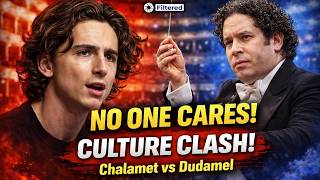
Media trainer TJ Walker analyzes how Timothée Chalamet's comment that nobody cares about opera or ballet anymore became a headline. He shows why reporters pull provocative soundbites over balanced reporting, and how one careless line can dominate coverage and put you on the defensive.
Chapters
A single blunt quote from an actor, Timothée Chalamet, has triggered a surprisingly large cultural debate about opera and ballet. During a CNN Variety town hall conversation with Matthew McConaughey, Chalamet said he didn't want to work in art forms where producers have to "keep this thing alive," adding that he doesn't want to work in areas where "no one cares about this anymore." The comment quickly spread across entertainment media and arts publications, drawing criticism, from famed conductor Gustavo Dudamel speaking at Lincoln Center while announcing his first season leading the New York Philharmonic. Dudamel said the comment reflected ignorance about the role classical music plays in culture. The episode shows how modern media works. A short, emotionally charged soundbite, absolute, provocative, and dismissive, can dominate headlines and social media far more effectively than the longer conversations surrounding it. So this is of particular interest to me because I teach people how to speak in soundbites. I work with politicians, the occasional Hollywood celebrity, and no, Timothée Chalamet is not my client, but I wanted to use this as a case study to help you have a better understanding of how the media world really works. So many people think the media is all about, uh, well, it's all about left-wing bias or right-wing bias. And yeah, there's some of that. But there's a much stronger bias by reporters everywhere in favor of something interesting enough to capture attention from audiences, readers, viewers, listeners. So I want to dig a little deeper so you understand this. So again, here's what he said: I don't want to be working in ballet or opera. No one cares about this anymore. So he's basically saying nobody cares about opera. Now, I saw a quote from this maybe a week ago, and I thought, oh well, who cares? But I kept seeing it again and again and again. It's a soundbite that keeps going on and on. And I wanted to use this as a learning point. So, "Nobody cares about it anymore." Why is that quoted? When you use the word nobody, it's an absolute. Reporters are looking for absolutes when they quote celebrities, politicians, experts. It brings clarity to the issue at hand. Reporters are afraid of being perceived as biased, so they don't want to use absolutes, but they love quoting other people saying absolutes. Nobody cares. That's emotion. Reporters are not supposed to write about their emotion, but they love quoting other people using emotion. Nobody cares about this, the opera. It's an attack. So you've got absolutes, you've got emotion, you've got attack about opera, something well known in pop culture. He's saying it as a modern-day movie star. So you put it all together and it has many, many elements of what reporters are looking for. Of all those soundbite elements, it's the attack that gets the most attention. Reporters love controversy more so than making their side look good or another politician looking bad. They love controversy. When you attack, you generate controversy. And if in just a few words you can pack in emotion, absolutes, attacks, pop culture references, well, that's 40% of all the major soundbite categories. So you're gonna get quoted. By the way, this is one reason why when you see celebrities and some politicians on talk shows, they're kind of bland. Oh yeah, he's great. I love them. Everything's wonderful. Everyone was great on the set. Uh, best movie ever. Oh, I love my— the reason they do that is because if they're positive 98% of the time and they have one thing outta their mouth and say, yeah, that director was kind of difficult to work with, but That's the only quote they're going to see. The negative soundbite quite often trumps all other soundbites. So that's what happens quite often with celebrities, other politicians, is they become sort of bland and generic because they don't want to have things like this. I'm sure Timothée Chalamet doesn't really think he said anything wrong or stupid. He's just simply saying, I want to be in a field that attracts people. And people want to pay with their own money, like going to movies. I don't want to go work in a field where everyone's always having to beg for money because the masses don't want to go. I'm sure he still believes that, but I'm sure he wishes he hadn't said that quote that way because now he's got to be on the defensive and be a part of all these negative articles. So let that be the lesson to you. I'm not telling you never have strong opinions. I'm not telling you to not state clearly what you believe, but Realize you can have 3 good messages, you can have complex messages. If one of them is an attack, you need to be prepared for that being the only quote of yours that gets in the story. By the way, if you are facing any media interviews yourself, whether you're a celebrity or whether you are a stockbroker in your small town and you're occasionally asked to weigh in on finance issues, I do have online courses on how to speak to the media, plus people hire me directly to do media training, and crisis communications training with them. So if you're interested in that, you can go to ultimize.com. You can get a free online communication skills course there, absolutely no charge. Go to ultimize.com.