The Nicotine Hack Hype That's Fooling Millions
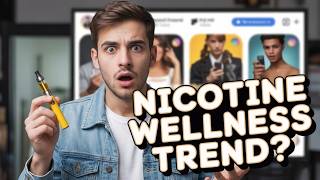
TJ Walker exposes influencers like Dave Asprey and Tucker Carlson pushing nicotine pouches as cognitive enhancers, despite CDC and American Heart Association warnings about addiction and cardiovascular harm. Nicotine may increase alertness but doesn't improve intelligence or creativity. Walker traces the pattern to a broader "Make America Healthy Again" ecosystem built on selective skepticism and financial motives.
Chapters
Ultimize. There's a new genius idea floating around the wellness internet. Nicotine is good for you. No, no, not cigarettes, they'll tell you. Don't be ridiculous. They've upgraded the scam. Now it's nicotine pouches, nicotine gum, nicotine patches, nicotine lozenges. Same addictive chemical, nicer packaging, cleaner font, and a podcast host telling you it's optimization. The basic story according to the Times is that a cluster of health influencers aligned with the Make America Healthy Again orbit are promoting nicotine as a natural health tool that can improve focus, sharpen cognition, and maybe even protect against Alzheimer's or Parkinson's. Wow, sounds, sounds great. Dave Asprey called nicotine one of Mother Nature's cognitive enhancers. Julianne Michaels says she uses low doses for focus and possible neuroprotection. Tucker Carlson has called nicotine pouches life-saving and linked them to productivity and male vitality, whatever that is. That sounds exciting right up until you introduce one annoying little detail: evidence. Because the actual experts quoted in the same article are not saying, yes, America, start chewing nicotine like it's kale. They're not advertising or recommending that. They're saying the exact opposite. Jonathan Voldz of Penn State University said nicotine may make you, quote, slightly more alert, but, quote, it doesn't make you more intelligent, doesn't make you funnier, and it doesn't make you able to write interesting novels. Adam Leventhal at USC warned that people can become addicted and then struggle to concentrate without it. How's that? Paul Newhouse at Vanderbilt University, whose work is often invoked by nicotine enthusiasts, said many of the claims about nicotine's benefits misrepresent the research. And that lines up with mainstream public health guidance. The CDC says nicotine is a highly addictive chemical and is especially dangerous for youth, young adults, and pregnant women. The American Heart Association says nicotine raises blood pressure, heart rate, and blood flow to the heart while narrowing and hardening arteries, which can contribute to heart attacks. So let's translate this from influencer language into English. Nicotine can stimulate you. Yeah, that is called being a stimulant. Cocaine can also perk you up. That is not the same thing as being a health food. This is why the debunking has to be precise, because the nicotine crowd always hides behind one tiny sliver of truth. There have been narrow research questions about whether low-dose nicotine might have some cognitive effects in very specific clinical populations, such as certain older adults with mild cognitive impairment. Vanderbilt's Paul Newhouse has studied that. But Vanderbilt also notes that a more recent 2-year clinical study in people with mild cognitive impairment found that nicotine did not slow memory loss compared with placebo. So even in the tiny corner of research most favorable to nicotine, the conclusion is not healthy people should start taking it. It's this is complicated, limited, and nowhere near proven enough to justify the hype. That's according to the Vanderbilt University Medical Center. And meanwhile, the downsides are not theoretical. The CDC says nicotine is highly addictive. The American Health Association says it harms the cardiovascular system. The Times story includes a user who started nicotine pouches after hearing the cognitive enhancement pitch and then found himself dependent, using a pouch first thing in the morning and getting such severe brain fog during an attempt to quit that he had to pull over and buy more. This is not a wellness protocol. This is an addiction with a better publicist. And now we get to the bigger point, which is not really about nicotine. It's about the Make America Healthy Again premise. They market themselves as the brave skeptics, the people who question everything, allegedly, the rebels. The econoclasts, sounds cool, doesn't it? The ones who won't be fooled by Big Pharma, wonderful, question everything. Then why is the questioning so selective? Why is it always don't trust doctors, don't trust universities, don't trust peer review, don't trust the FDA, and never, maybe I should question the guy selling me something on a podcast getting rich. That's the miracle of this movement. Their skepticism always stops right at the cash register. Take Alex Jones. This is not a subtle case. Courts held him liable for false Sandy Hook claims, and he was ordered to pay enormous defamation damages. Reuters reported nearly $965 million in damages in Connecticut, plus additional punitive damages, and later reported the appeals court upheld the Sandy Hook verdicts. The Supreme Court later declined to disturb the roughly $1.4 million judgment. Again, I'm pointing that out because he's a proven liar. So when someone says the crowd is merely asking questions, no, some of the people they elevate have a documented history of promoting catastrophic falsehoods, i.e., lying. Then there's Tucker Carlson. Again, this is not me calling him names because I'm cranky. This is what came out in litigation. In the Dominion case, Reuters reported that Fox settled for $787.5 million over false election claims. AP reported that internal messages and court papers showing Carlson privately saying this of Trump, "I hate him passionately," even as Trump publicly praised him and Carlson publicly served audiences a very different performance. In other words, he's a proven liar. AP also reported that Carlson used January 6 footage to produce a false narrative of the Capitol attack and amplified conspiracy theories around January 6. AP further reported that Fox hosts, including Carlson, privately did not believe the election fraud claims that were being pushed on the air. Forgive me if I don't find this movement, we're just questioning things slogan, terribly convincing because they're not skeptical in any principled universal way. They're only skeptical toward institutions they already dislike. When their own side pushes nonsense, suddenly skepticism takes the day off. Now let's talk about the other business model hiding underneath all of these supplements because every Maha adjacent entrepreneur wants you to believe The real danger is a pharmaceutical executive in a dark suit, while the nice man with the microphone and the all natural label is your friend. But the supplement industry has massive incentives too. NIH background materials cited US dietary supplement sales at $55 billion in 2020. More recent literature— that's big business, by the way— more recent literature describes the US supplement market as roughly $54 billion and growing. This is not some cottage industry of herbal grandmothers. This is big business, and it's regulated very differently from drugs. The NIH Office of Dietary Supplements says supplements are not intended to treat or prevent disease. It also notes that unlike drugs, supplements do not have to undergo FDA pre-market review or approval be— before being sold. Let me explain that in simple terms. It means I can get a a pile of dog poop off my sidewalk, dry it, put in a pill form, and sell it to you and say, "Hey, this magic elixir will make you lose 30 pounds and grow 50 pounds of muscle." I could basically get away with it. The FDA likewise explains that supplements are regulated under a different system from drugs, and structure-function claims can appear with the familiar disclaimer that the statement has not been evaluated by the FDA. Okay, so the same movement that says, how dare you trust medicines that went through clinical trials, regulation, labeling requirements, adverse event reporting, and approval process, turns around and says, here, buy this powder that didn't have to clear the same evidentiary bar. That's not skepticism. This is just switching sales departments. And there are real harms here. There are warnings from the National Institute of Health warning that some supplements can cause serious side effects including kidney damage, liver damage. NIH's LiverTox resource documents liver injury from herbal and dietary supplements and says they are an increasing cause of drug-induced liver injury. The NCCIH specifically warns that bodybuilding and performance enhancement supplements are the most common cause of liver injury linked to herbal or dietary supplement use. The FTC has spent years bringing cases against deceptive health claims in supplements. Its health claims page says the agency has filed 120 cases challenging supplement health claims. In late 2024, the FTC announced a win against the makers of, uh, Prevagen, with a court ordering them to stop making misleading memory loss claims. Folks, it goes on and on and on. And that's why I wanted to bring attention to this, this idea that, uh, nicotine is sound good— is now good for you. Why would you believe these people when the only thing we know about them is they're liars? That's not completely true. We know other things. So, uh, Robert F. Kennedy Jr. is seen taking these nicotine patches. We do know some things about him other than that he's a liar, although we do know he's a liar. He promised in his confirmation hearings, he would not attack vaccines, and that is in fact what he's done. But we do know other things about him. He was a heroin addict with a worm in his brain, and that's who you're taking health advice from. Realistically, you're probably not going to remember most of what you hear today, not because it's not useful, just because that's how the brain works. Unless something shows up again and again and again, it disappears. So instead of hoping you'll remember this later, just give yourself a system that keeps it in front of you. That's why I built Ultimize. If you're getting any value from this program, go to ultimize.com, that's U-L-T-A-M-I-Z-E dot com, and grab the free course. There's one on communication skills, habit building. It's designed to reinforce the right ideas that actually stick. It's free. Takes just a minute. Ultimize.com. Ultimize.
More from TJ








You're Not Being Judged on Your Work Yet: What New Hires Are Really Evaluated On


