TJ WALKER - THE HABIT INFLUENCER - Personal Development | LIVE STREAM
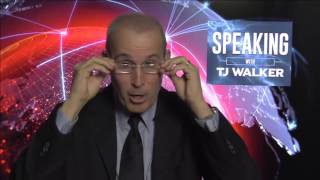
TJ Walker explains why calling yourself a professional speaker isn't enough anymore. Build expertise in a field, grow an audience, then monetize through books, courses, and consulting. Skip the guru programs and unpaid local gigs.
Chapters
How to become a professional speaker.
Speaking the show about effective speaking in public to the media, at work and in life. Speaking with TJ Walker.
So folks, I'm often asked or people write to me, T.J. how can I become a professional speaker? My first question is why? Why do you want to do that? Well, I like people, I like the stage. It seems fun. You can make a lot of money. All interesting reasons, but frankly horrible reasons when it comes to why anyone should hire you. Now folks, this is a, this is a touchy subject, let me just say right out of the gate, conflict of interest here. So you don't think I'm an absolute complete phony? Yeah, I do have an online course on how to be a professional speaker. Having said that, let me tell you, there are more flim flam artists, con artists and BS artists in this niche of how to become a professional speaker than anything this side of the garage of Fred Flintstone. If you Google how to be a professional speaker, there are 206 million web pages that show up. So this is obviously a topic of great interest to people and I'm going to share with you my expertise because in truth, I am a professional, professional speaker of sorts. And a professional speaker slash trainer. And a professional speaker slash trainer, author slash expert. And if you scratch deeply these days with almost any so called professional speaker, you are going to see a lot of slashes. You are going to see people who primarily are known for something. The most highly paid public speaker I know of, former President Bill Clinton, makes millions and millions and millions of dollars a year as a speaker. If you asked him, if you'd never met him before, didn't know who he is, and you asked Bill Clinton, who are you? What do you do? I dare say he would not use the phrase I am a professional speaker. Now he may mention to you that he speaks around the world about policies he cares about, about initiatives to help hungry people through his Clinton initiative and global education program. But I dare say he would not mention to you that he's a professional speaker. Nor would Bill O'Reilly or Sean Hannity. I'm not being partisan here. They both speak for tons and tons and tons of money. All three of those people make more money in one hour speech than the average family of four does in America times two or three. So it's not that you can't be a professional speaker or make money as a speaker. It's just the speaking world has changed dramatically from where it was in the 60s, 70s and 80s. There actually was a time when there were these people who were just professional speakers. They weren't really known for anything else, but they were kind of the first people out there who made themselves available and they would give a speech on leadership, even though they'd never been a leader of anything in their life or sales, even if they hadn't sold much. So there was a time when you could just sort of call yourself a professional speaker and get a good demo reel and a good marketing kit and maybe do fine. I'm here to tell you folks, those days are gone. By and large, most people who make good money and a lot of money speaking professionally do not call themselves professional speakers. They don't think in those terms. What they do is they actually focus on doing something interesting in their life, helpful to people. They become deep, deep, deep experts at something. They become well known and then people call them up and say, please come speak to our audience. Gary Vaynerchuk of TV Wine Library and Vayner Media and all of his best selling books didn't just quit his wine business. One day I'll just become a professional speaker. No, that's not what he did. He spoke out so passionately on his online wine library show and then he got invited to other TV shows and radio shows and he did that to promote his wine business and his wine show. And then he got asked to speak for free at conferences and he did that. And then there were so many demands for his time to speak. Some people started saying, well, we'll pay you. And he said, oh, that sounds like a good idea. Folks. That is the model you want if you want to be a professional speaker. What you don't want is, well.
Bad advice.
Folks. I could do a whole series of shows on all the bad advice you get from the many, many gurus out there who are for the most part failed public speakers themselves, who've now held out their shingle teaching other people how to be professional speakers. Well, it's all about the demo reel and it's all about your exact positioning. I mean, they've got all these things. Some of their advice is good. It's just that in my experience, if you're the sort of person who focuses your energy on going to professional speakers workshops on how to become a professional speaker, you almost by definition not the sort of person who's going to be of interest to meeting planners and people looking for great speakers and paying them a lot, think of it, and I'm going to give you an example here. It may come across as even sexist or distasteful. But I just can't think of a better example. Now I am a male, over 50, happily married, but certainly most of my adult life I was single. Looking back my 20s and 30s, we all have friends like these guys who really didn't have much going on with their career, weren't doing much and spent all their time thinking about how they can have successes with females, how can they meet more women and have a much more active social life. And they spend all their time thinking about how they can pick up women, trick women this, that they may have gone to workshops, seminars, read books on it. It's not that they never got any better, but when you look at their success as they defined it versus guys who are actually out doing interesting things, the guys who were out running businesses, building businesses, being successes in athletics and sports and politics, they're the ones who attracted women. They are the ones who had a much stronger active social life. It's because they weren't focusing on how do I manipulate these people and trick them into liking me. They focused first and foremost on having interesting lives, on accomplishing, on writing books, whatever their niche was being the best engineer, designer in the world. That's what made them attractive to other people. So by focusing on being great at something over here, it helped them in their social life way over here. And it's remarkably similar to that situation in the sphere of public speaking. You will become more attractive to the professional speaking market if you don't even focus on the public speaking, the professional speaking market. If you focus on being genuinely known as a world class expert in something, that is really the most important advice I could give you. It's certainly possible to just grind it out and build a business as a professional speaker. In fact, when I first joined the National Speakers association way more than a decade ago, they did a survey of their members. Now these are people who are ostensibly in the top of their class, professional speakers, certified at some level. And they asked them, how much money do you make in a year? And again, this is going back more than a decade, more than a dozen years. But the response was the average so called professional speaker in the National Speakers association. The average income was $38,000 a year. Now folks, I don't want to sneer at that, but even at the time you could be an assistant manager at Burger King and make with benefits and everything, more than $38,000 a year. So the idea of just putting on your hat, calling yourself a professional speaker and saying, well, I'm going to be now a diversity speaker and I'M going to email meeting planners all day and do demo and back then mailing out videos and mailing out brochures and all this because then someone will hire me to give a speech and I'll make $3,000 a speech and that's $3,000 an hour. That's the greatest thing in the world. I make $3,000 an hour. That was kind of the mindset, and many people still do have that mindset. The problem is, yeah, you got $3,000 the hour of that speech, but it took you a couple of months to get the booking, plus you have to prepare for the speech, plus you got to fly to another city. Well, that's a day. There's the day there, there's the day home, there's the bookkeeping, there's the accounting. So it's not really $3,000 for an hour. It's more like $3,000 for a week. And guess what? Since you're not famous and you're not well known, maybe you only got one gig that month. So now it's not $3,000 for an hour, it's $3,000 for the month. Because what's relevant in a business is not how much money you generate in an hour, it's a lot more relevant to what do you make and actually keep after expenses at the end of a month or at the end of the year. So if you only got one professional speaking gig that month, you made $3,000 for the month. Well, multiply that out, you're making $36,000 a year. Folks. There are a lot easier ways of making $36,000 a year than being a low level, non famous, non recognized expert. Being a professional speaker. So my first. I know this sounds a little bit harsh, but my first advice to people when they tell me they want to be a professional speaker, it's almost. I don't say it literally like this, but what I'm thinking is, get a life. Why should someone want to listen to you in this day and age unless you've shown true, true, true expertise? Because there was a time when people thought speaking was this completely separate, different skill. It's like open heart surgery. It doesn't matter how smart you are, you can't do that unless you have been performing open heart surgery for decades. People used to think public speaking was like that. Well, now everyone these days speaks. Richard Branson is a well known billionaire entrepreneur, but he speaks professionally. He's a professional speaker. People pay him to come give a speech at his convention. Every TV personality, every former TV personality Larry King is on the speaker. Every famous person, every former dictator, every former politician is now a professional speaker. Yet most of them are smart enough to realize this is a small percentage of their income. Now, they may make a million dollars a year speaking, but if you're like Rudy Giuliani, the former mayor of New York City, who may well make more than for many years he made a tremendous amount. But let's assume now he's still making a million dollars a year speaking, he makes a lot more money from other things. Consulting, legal advice, book, all the other things. So even if you're making a million dollars a year from speaking, chances are it's a small, small slice of your overall revenue pie based on your expertise. So that's why I want you to focus first and foremost on becoming a true, true expert on something and then figure out how to monetize that expertise and a part of your way of. And that's just a fancy word for how do I make money on this? Once you've done that? Well, sure, public speaking could be that. It should be that. It's definitely a part of that.
Inside doe the craft of media and presentation training.
Okay, When I'm working with someone professionally, they've come to me, they want me to teach them how to A be a better speaker, B launch into professional speaking. What I always do with them is really do an inventory of how are you building your expertise and then how are you putting it out to the world. So if you have, let's say, a consulting practice on, let's just say, some aspect of diversity, what I would want to do is say, okay, how many people are you reaching on your blog every day? How often are you putting out videos on YouTube? Because you can also put ads on YouTube videos and make money that way. Have you written a book? If not, why not? A big publisher, self publish these days? Do an electronic book. You should really get that out quickly, make money from selling books. Do you have an online course these days? It's incredibly easy, simple. It's not as complicated as it was when I first got into online courses in 1999. It's not as complicated as 10 years ago when I spent a couple hundred thousand dollars creating online courses. These days you can do it virtually for nothing and you can start making money from that then, sure. Let's announce to the world you are available as a speaker. Put it in your bio, put it on your website, put a place for people who are interested in contacting you to get a hold of you about speaking opportunities, let your social media outlet know it. If you are producing regular audio podcast and video podcast, by all means let people know. In fact, I'm going to do that right now. But notice that I'm doing this after 16 minutes of talking to you. I'm not doing it right away. And I'm not relying on my speaking income as my primary income. Most of my income, by the way, comes from people hiring me for a day of public speaking training and media training and crisis communications training. But here's an example of exactly what I'm talking about.
Speaking is brought to you by Media Training Worldwide. For all of your media training and public speaking training needs, go to mediatrainingworldwide.com.
So just put out an ad there, folks. Let people know and do it wherever you can. Now, if you haven't done a tremendous amount of speaking 40 years ago, 30 years ago, even 20 years ago, the standard advice was knock on a lot of doors, call every Rotary club, offer to speak for free. I don't give that advice anymore. What I would say is start speaking right away on your own YouTube channel and monetize that. Use that to promote people back to whatever your core business is, whether it is as an author, an expert, an academic, whatever it is you're doing, consultant, use that and monetize it by essentially being your own advertiser. Rather, because you can spend a lot of time calling up civic groups just to give away a speech. I don't think that's your best use of time. And then you got to go there, clear your calendar, reschedule a few times. It's a lot of wasted time. The second easiest way of getting paid as a speaker, Go ahead and start your own online course. Now I work with about 30 different online platforms. I have a platform that I use for my own website. But I can tell you as of right now, as of February 2016, the easiest way to get in front of a lot of eyeballs, a lot of customers for people to hear you speak is to do a speaking based, video based course on your area of expertise for the website udemy.com that's letter U and I'm going to do an entire show on that later this week on how to do the online. But that's really the easiest way where you can start speaking, you can get more experience and you can start getting paid right away. You might not make much money. And full disclosure, my first six months on Udemy, I only made $10 a month per course. But now I'm averaging four and $5,000 and as many as a thousand course sales a month on Udemy. So you can do it as well. And it's certainly a way to sort of plant your flag into the ground of professional speaking. And the other biggest piece of advice I have for you? Don't waste your money on all the $2,000 programs and the special weekend programs and come here for the million dollar weekend and spend $5,000 and you'll become a professional speaker. All of that content is available for free or no cost online. Certainly there are a gazillion books on Amazon, Kendall on the professional speaking market. Read all of them if you're serious about it. But first and foremost, develop real expertise. Develop a following. Get a thousand people, maybe tens of thousands of people who love your expertise and want to hear from you and want to talk about you. That's the easiest way to become a professional speaker. I'm TJ Walker. May all of your presentations in life, whether they're paid or unpaid, be a huge success.
Speaking With TJ Walker is the number one rated daily streaming TV and radio show devoted to all aspects of speaking and communication. If you received value from this show, then please subscribe to it@mediatrainingworldwide.com Please review the show, leave comments and share it with your friends and colleagues.
Today.
More from TJ








You're Not Being Judged on Your Work Yet: What New Hires Are Really Evaluated On


