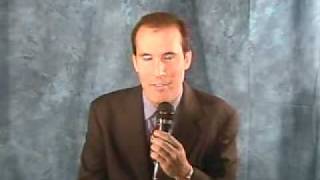
TJ Walker coaches someone prepping for a TV interview. Sit forward 15 degrees, keep your face expressive, maintain a slight smile, and use natural hand gestures. On camera, your movement and appearance have to carry the message as much as your words.
Chapters
You've got a television interview in half an hour. What do you do? How do you look your best? How do you get through this? Well, let's start at the very beginning. How do you sit? Everyone says, be comfortable on tv. Relax. Well, look what happens if I sit back and just comfortable and relaxed the way I might be in a conference room. What do you see? You see my gut. You see a double chin. You see my head look small and my gut looked big. So don't ever sit back. This is what people mean when they say TV makes you look 20 pounds heavier. It doesn't if you sit the right way. So never just lean back. Here I am. You see this all the time on business shows. I'm sitting up perfectly straight. You'll see CEOs and CFOs on CNBC doing this. How do I look? I'd like to tell you today about TJ Walker Media Training Services. I look like a stiff. I look nervous and unprofessional. That's why you don't ever want to sit up perfectly straight. What you want to do is hold yourself up high, but then lean forward about 15 degrees into the camera. Now you don't see the double chin. Now you don't see the gut hanging out. This is the way professional newscasters are going to sit. This is the way good talk show host will sit. This is how you should sit when you're on TV. So lean forward about 15, 15 degrees. Now, of course, you've got to have a good message. We'll get to that in a moment. But television is a visual medium. If you don't look the part, your message will not get through. Let's start from top to bottom. Your head. I'd like to tell you about T.J. walker media training. I may have a message just right, but if I freeze my head, I'm going to look stiff, I'm going to look nervous, I'm going to look boring. So don't make the mistake of freezing your head and thinking about, how can I read the teleprompter in my brain? It's not just about getting the words right. Every part of your visual image must be congruent with what you're all about. So you must move your head. Your face. What do you do with your face when someone is talking about you? When someone is introducing you, the natural thing to do is to have your face go blank. You're paying attention. So if you're on a talk show and the host is introducing you, or a business show and they're talking about who you are. The natural thing to do is to have your face look like this. Do I look comfortable, confident and relaxed? No. On television, a blank look seems like a frown. It doesn't seem like you're happy to be there. So you have to have a slight smile on your face at all times in order to look natural or normal on tv. I'm not talking about a great big toothy grin, slight smile, someone is introducing you. Just a few teeth, slight smile. And when you're talking, I don't care how serious the subject is. Slightly open look on your mouth, showing a few teeth. You look more confident, more relaxed and more comfortable. Now let's look at the eyes. Here I am, I'm looking at the camera. But you're probably not going to have to do this. Don't just look at the camera. Look at the reporter. Look at the talk show host. Only look at the camera if there is someone specifically telling you to. Now, when you are in a situation where there is a camera around, don't make the mistake of sort of checking yourself out. I have a TV monitor right above the camera. Now I'm looking so fast that when I see myself, I'm looking at myself right now, hey, I look great. But to you, you can see my eyes darting back and forth. It's going to make me look like I'm not comfortable, like I'm not confident, I'm shifty eyed. Nobody trusts anyone who's shifty eyed. So the easiest thing to do is talk to a human being. You're not used to talking to a piece of machinery. And what happens when most people talk to a camera? If you're not a professional actor or professional news anchor, what happens is your head stops moving, your face goes blank, your voice becomes more monotone and you're thinking about how can I read this message off my teleprompter in my brain. So don't do it. If there's a reporter or talk show host next to you, just talk to that person. If you're being interviewed by satellite, they will tell you, look at the camera and then just treat it like a human being. If there's a television monitor over here and it's distracting, don't try to look back and forth. You can even ask the producers to turn off the TV so you can focus just on the camera. Now let's talk more about the face. Someone nervous, someone inexperienced, will often have a blank look on their face. Their message might be fine. I'd like to tell you about TJ Walker media training and all we can do for you and how we can make you come alive. It's not going to work. You have to do all the things you do in normal conversation. Move your face. Move your eyebrows become expressive. So don't freeze up your face. Don't have it locked, don't have it stiff the rest of your body. Don't be stiff. Don't be a stiff. Nobody likes a stiff. It's natural to be a little nervous if you haven't been on TV much or lately. But continue to move. Just don't move out of the screen or you'll be way too distracting. So move a little. What do you do with your hands? A lot of you are told, oh, don't use your hands. You'll look unprofessional. Hogwash. Use your hands if you do in normal conversation. Why? It puts more energy in your voice. It makes you look more expressive, it makes you seem more confident. So if you normally use your hands, use your hands when you're on tv. Just be careful. Don't gesture way out here because people will just see arms chopped off. Don't gesture above your face because that will be distracting. You don't want to distract from your central message. You want people to learn about what it is you're talking about and you want to seem comfortable and confident in the process.