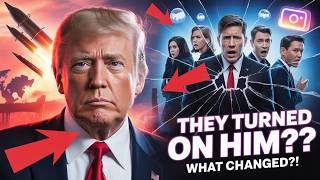
Tucker Carlson, Alex Jones, Candace Owens, Tim Dillon, and Joe Rogan have publicly broken with Trump over his handling of the Iran conflict. TJ Walker argues this fracture in right-wing media could cascade into grassroots dissent and pressure Republican politicians to distance themselves, potentially dropping Trump's support from the high-30s to the 20s.
Chapters
Ultimize. A growing number of influential conservative voices are now publicly breaking with Donald Trump over his handling of the Iran war, raising new questions about the durability of his political base. Now, I talked about that earlier in the week, but the problem is growing for him. According to reporting from Axios, what was once a unified pro-Trump media ecosystem is beginning to fracture. Prominent figures include Tucker Carlson, Alex Jones, Candace Owens, the comedian Tim Dillon have all sharply criticized Trump's rhetoric and actions toward Iran, with some going as far as calling his approach evil. That was the Tucker Carlson flourish. I did enjoy that. And demanding intervention to stop him. At the same time, podcast host Joe Rogan, who endorsed Trump in 2024, suggested this week that the Iran conflict may be serving as a distraction from renewed attention on the Epstein files. I don't necessarily buy that. More on that in a moment. Rogan said, quote, the Epstein files comes out, we get a war with Iran. It's a good way to get people to stop talking about certain things. Now, to be clear, there's no evidence presented that the war was launched for that purpose. Those of you listening on the podcast, I'm winking to the camera. But what matters politically is that people with massive audiences are now saying it out loud. And that's new because for years, Trump's real power has not just been voters. It's been this right-wing media ecosystem, the podcasters, influencers, media personalities, the people who translate his message into culture. That ecosystem has always done one thing incredibly well: attack liberals, mock Democrats, own the libs. And for a huge segment of the country, that was enough. That's why they like these conservative commentators. That's why they like Trump. Wasn't about policy, wasn't about outcomes. It was just the vibes. Now, if Trump was making the right people angry, he's got to be one of ours. He's got to be considered part of our team. We don't criticize him. That was considered success. It was enough for the conservative commentariat when Trump was just attacking, vilifying, mocking Democrats, liberals, progressives. And the strategy worked. It worked for Trump. It locked in a base of roughly 35% to 40% of the country. These people were intensely loyal to Trump. Therefore, these conservative commentators trying to capture that audience were loyal to Trump. But here's what's changing. For the first time, the same voices that built that ecosystem are turning on Trump, and not quietly. They're not saying, well, we disagree on policy. They're saying, this is insane. This is betrayal. This is not what we signed up for. That's a different level of criticism. Because these are not Democrats, these are not liberals, these are not progressive policy analysts. These are people whose entire brand has been defending him, which is like saying your biggest fans suddenly saying, yeah, we made a mistake. That's not a great sign. Now, to be fair, and this is important, polling still shows that most Republican MAGA voters, people who identify as MAGA continue to support Trump, and they're even willing to give him a pass on Iran. So this is not a collapse in support yet. But politically, this is how collapses start. You don't start with voters, you start with the influencers, because most people don't wake up every morning and read policy briefings. They listen to people they trust—podcasters, commentators, personalities—and when those people change their tone, The audience eventually follows slowly at first, then suddenly. And here's the underlying issue that's driving all of this. For years, Trump's core appeal was simple. He hates the same people you hate. If you happen to be a conservative MAGA Republican, he hates the liberals, he hates the Democrats, he hates the media. And again, that worked. But there's a limit to that strategy because at some point voters ask a different question. Is this actually helping me? And when you start talking about war, when you start talking about gas prices potentially spiking to $4, $5, $6, $7 a gallon, when you start talking about economic instability and maybe losing your job, now it's not entertainment anymore. Now, it's personal. And that's where the calculation changes. Because people may enjoy watching someone insult their political opponents, but they don't enjoy paying $10 a gallon for gas while doing it. There's a limit to how much owning the libs is worth to people. At some point, people say, I think I'd rather be able to afford groceries. And that's the tension you're starting to see emerge, because what many of these commentators are now realizing, belatedly, is this: just because Trump attacks liberals doesn't mean he cares about the interests of his own voters? No. Those are two very different things. And for a long time, those two things were treated as the same. Well, you're against them, you must be for us. No. Now they're starting to separate. And if that separation continues, here's how this plays out. First, the influencer class continues to attack him. More podcasts, more negative commentary, more criticism. Then you start to see cracks at the grassroots level, more voters speaking out on social media. More hesitation, more, I'm not so sure about this guy anymore. And once that reaches a critical threshold, that's when Republican politicians, you know, the ones without spines, start to move. Because politicians are not leaders, they are followers with better suits. They wait until it's safe. And once it's safe, they pivot. And that's when you see the numbers drop from the high 30s into the 20s. And once a political figure drops into the 20s in terms of overall support, It's very hard to recover because at that point, support doesn't erode gradually, it just melts fast. And that's when conversations that seem impossible today suddenly become possible. Things like impeachment, the 25th Amendment, internal party revolt. Now, does this happen tomorrow? No. Does it happen automatically? No, but for the first time, you can see the outline of how it could happen. Because the one thing Trump has always had, a loyal amplified media-driven base. It's no longer as unified as it once was. When the people who built your brand start tearing it down, that's not just a bad news cycle, that's a structural problem, and those are much harder to fix. If Trump's not really worried right now, he should be. Okay, so who am I? Who is this TJ Walker character? Why are you listening to me or watching me? I spent 40 years coaching executives, people just like you, but also presidents of countries, prime ministers, Nobel Peace Prize winners on how to have better communication skills and personal development habits. And now you can get the same training, but here's the catch. There is no catch. You can get a free course today. All you have to do is go to ultimize.com. That's ultimize.com, and you can download your free online communication skills course or your free good habits building course. Go ahead and do that right now, or at least right after the show. Ultimize.