Why You Should Never Decide When You're Angry: The Science Of Better Judgment
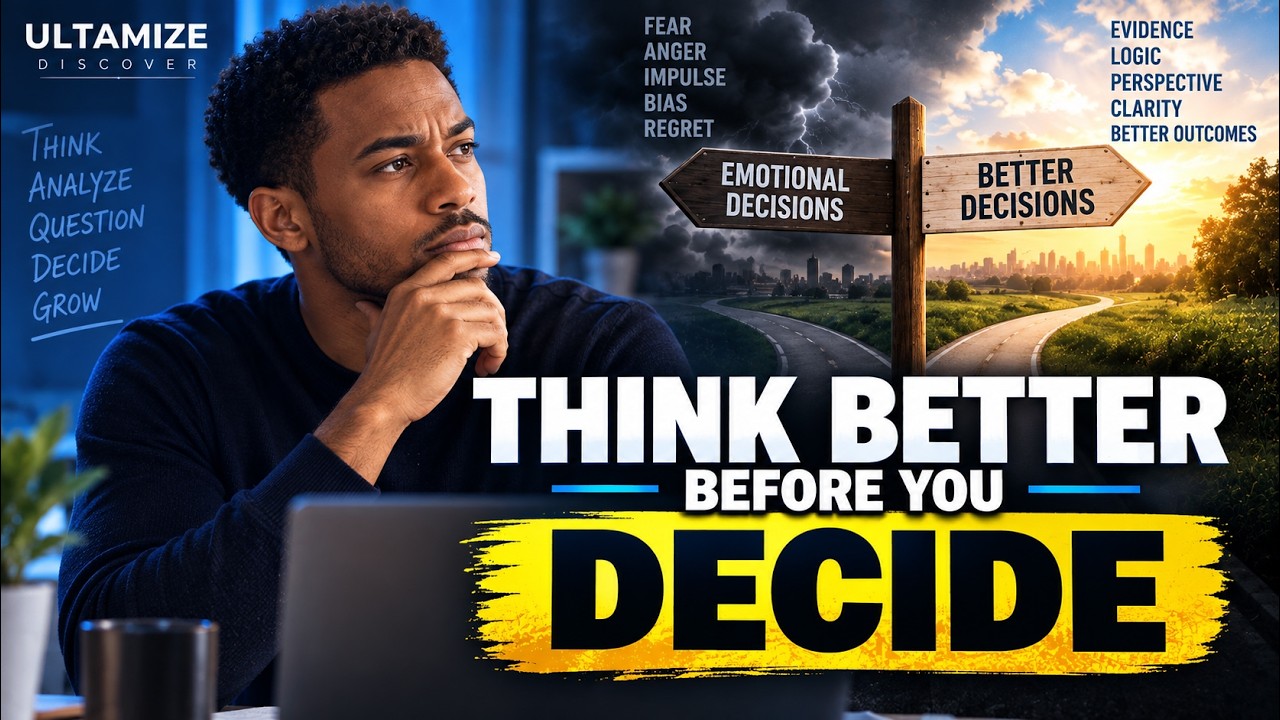
TJ Walker explains how emotions hijack judgment and offers tools to decide better. Don't choose when you're angry. Ask what evidence would change your mind to spot confirmation bias. Most people chase certainty when they should estimate probabilities instead.
Chapters
Today on Ultimize Discover, you're getting a short practical sample from the Ultimize universe. Use this on its own, take one idea and apply it today, or go deeper at ultimize.com. Ultimize is the world's largest personal development podcast, audiobook, and online learning network. Ultimize. Here's a simple question that can improve almost every decision you make for the rest of your life. What evidence would change my mind? Most people never ask that question. Think about it. If the answer is nothing, then you're no longer evaluating evidence. You're protecting a belief. That one question has helped me avoid bad investments, bad business decisions, and countless unnecessary arguments. It's also one of the fastest ways to identify whether someone is thinking critically or simply defending a position. Now imagine having dozens of tools like that. That's exactly what this course is designed to provide. Most people assume critical thinking is something professors do in universities, and that's it. They imagine complicated theories, abstract debates, and intellectual exercises with no practical application. I see critical thinking differently. I see it as one of the most profitable life skills a person can develop. Every major outcome in your life is influenced by decisions. The career you choose, the people you trust, the opportunities you pursue, the risk you avoid, the investments you make, the information you believe. Better thinking doesn't guarantee success. Nothing can do that. But better thinking dramatically improves the odds. Throughout this course, you'll learn practical tools for spotting bad arguments. Avoiding confirmation bias, resisting emotional decision-making, recognizing social proof, evaluating evidence, and thinking in probabilities rather than certainties. More important, you'll learn how to apply these concepts in everyday life. I've spent decades helping leaders, executives, public figures, and professionals communicate more effectively and make better decisions under pressure. One lesson keeps appearing again and again: Intelligence is not the advantage. Good judgment is the advantage, and good judgment can be improved. So if you'd like to think more clearly, make better decisions, and avoid many of the mental traps that capture otherwise intelligent people, continue with this course. The next few minutes could be some of the highest return learning time you'll invest in all year. Want a quick way to make better decisions? Don't make important decisions when you're extremely emotional. I know it sounds obvious, yet people violate this rule every single day. They send angry emails. They quit jobs in frustration. They make investments during moments of excitement. They make purchases because they're afraid of missing out. Then later, when the emotional storm passes, They wonder, what were they thinking? The truth is, they weren't really thinking, at least not in the way they imagined. One of the most important lessons in critical thinking is understanding that emotions don't merely influence our thinking; they often direct it. Most people like to believe they gather facts, analyze evidence, and then arrive at a logical conclusion. In reality, the process is frequently reversed. We feel something first, then we search for evidence that supports the feeling. I see this regularly in my work. A client may dislike a journalist, a competitor, a political figure, or a business proposal. When I ask why, they often provide a long list of reasons, yet after discussion, it becomes clear that the reasons came after the emotional reaction, not before it. The conclusion arrived first. The justification arrived later. This doesn't mean emotions are bad. In fact, emotions are essential. Fear can warn us of danger. That's a good thing. Excitement can motivate action. Empathy can strengthen relationships. Gratitude can improve well-being. So I'm not asking you to be anti-emotional or be stoic at all times. That's not the issue. The problem arises when we confuse emotional certainty with factual certainty. Feeling strongly about something doesn't make it true. Let me repeat that. Feeling strongly about something doesn't make it true. Feeling offended doesn't prove you're right. Feeling confident doesn't guarantee accuracy. Consider investing. During a booming market, people often feel brilliant. Every investment seems like a winner. Risk appears low. Opportunities appear endless. Then the market declines. Suddenly, the same people feel terrified. The facts may not have changed nearly as much as their emotions, yet their decisions often swing dramatically because their feelings have changed. Fear and greed become temporary dictators of judgment. A useful habit is learning to separate the decision from the emotion. Whenever you're facing an important choice, ask yourself a simple question: Would I make the same decision if I were calm? Now, that's not a perfect test, but it's surprisingly effective Sometimes the answer is yes. Other times the answer is absolutely not. The moment of awareness can save you from expensive mistakes. Another helpful technique is to delay major decisions when emotions are running high. An angry email usually looks different after 12 hours. A major purchase often feels less urgent After waiting 24 hours. A heated argument frequently appears less important after a good night's sleep. Time doesn't solve every problem, but it often reduces emotional distortion. Critical thinkers don't try to eliminate emotions. That's impossible. They simply recognize emotions for what they are: valuable signals but imperfect guides. Feelings provide information. They don't automatically provide conclusions. The ability to recognize that distinction is one of the most powerful thinking skills you can develop. Coming up next, we'll examine one of the most common thinking errors ever discovered. It's a bias so powerful that once you see it, you'll begin noticing it almost everywhere, including Here's a mental habit that can improve almost every decision you make. Stop asking, will this work? Start asking, what are the chances this will work? Now, that sounds like a small change. It isn't. Most people think in terms of certainty. They want to know whether an investment will succeed, whether a business will grow, whether a relationship will last, whether a strategy will work. The problem is that life rarely provides certainty, yet our brains constantly crave it. Critical thinkers understand that certainty is often an illusion. Probability is usually reality. I learned this lesson repeatedly throughout my career. Early on, I wanted guarantees. If I prepared a client for a major media interview, I wanted to know the interview would go perfectly. If I launched a new course, I wanted to know if it would be successful. If I tried a new marketing strategy, I wanted to know it would work in advance. Of course, nobody gets those guarantees. What I eventually realized was that success often comes from increasing probabilities, not eliminating risk. Good preparation doesn't guarantee a great interview. It simply increases the odds. A strong marketing campaign doesn't guarantee sales. It increases the odds. Exercising regularly doesn't— note editor, redo. Exercising regularly doesn't guarantee a long life. It increases the odds. That distinction changes everything. Many poor decisions occur because people confuse unlikely with impossible. They assume something bad can't happen because it probably won't happen. Then they're shocked when it does. At the same time, people often confuse possible with probable. They see a remote possibility and treat it as if it's likely. Consider air travel. Every time a plane crashes, millions of people hear about it. The event becomes highly visible. As a result, some people feel flying is extremely dangerous. Yet statistically, Driving to the airport is much, much riskier than the flight itself. The emotional impact of the event overwhelms the actual probability. 1.2 million people around the world each year die in car crashes. Typically, only a few dozen die each year in plane crashes. The same thing happens in investing. Someone hears about a person who became wealthy from a speculative investment. Suddenly, the opportunity feels highly attractive. What often gets ignored are the thousands of people who tried the same strategy and failed. The visible success story receives attention. The invisible failures don't. One reason probability thinking is difficult is that it requires humility, and let's face it, we don't like that as human beings. Probability feels uncomfortable. Saying, I know this will happen, sounds confident. Saying, I think there's a 70% chance this will happen, sounds less dramatic, sounds a little wishy-washy. Yet the second statement is often more honest. The best decision makers I've encountered tend to think this way. They rarely speak in absolutes. Instead, they talk about likelihoods, risk, trade-offs, and Probabilities. They understand that uncertainty is not a flaw in thinking, it's a feature of reality. A practical exercise can help. The next time you're making an important decision, force yourself to assign a probability, not because the number will be perfect— it won't— but because the exercise changes how you think. Instead of asking whether success is guaranteed, You begin evaluating how likely success is and what factors could improve those odds. You'll also become more comfortable being wrong. Now, that may sound strange, but it's incredibly valuable. If you predict an 80% chance of success and the outcome fails, that doesn't mean your thinking was flawed. 20% outcomes occur all the time. Good decisions can produce bad outcomes. Bad decisions can occasionally produce good outcomes. That's another reason critical thinkers focus on process rather than luck. The goal is not to predict the future perfectly. Nobody can do that. The goal is to make better decisions with the information available today. Thinking in probabilities helps you do exactly that. It replaces the false comfort of certainty with something far more useful: realistic judgment. Coming up next, we'll bring many of these ideas together and explore how to build a practical critical thinking habit that can improve your decisions for the rest of your life. By the way, quick question for you: have you ever noticed how easy it is to consume content and how hard it is to actually do anything with it? I mean, you can listen to 100 episodes, read 10 books, and your habits are exactly the same. That's the gap most people never close. So if you're listening to this and thinking, yeah, I want to actually improve, go to ultimize.com. We've got free courses there for you, either on communication skills or building better habits. And it's designed to get you to actually use what you're learning, not just hear it once. No cost. No catch. Just go to ultimize.com and start. Ultimize.
More from TJ








You're Not Being Judged on Your Work Yet: What New Hires Are Really Evaluated On


