TOP TECH VOICES: The Rise of AI on the Edge with Toju Duke
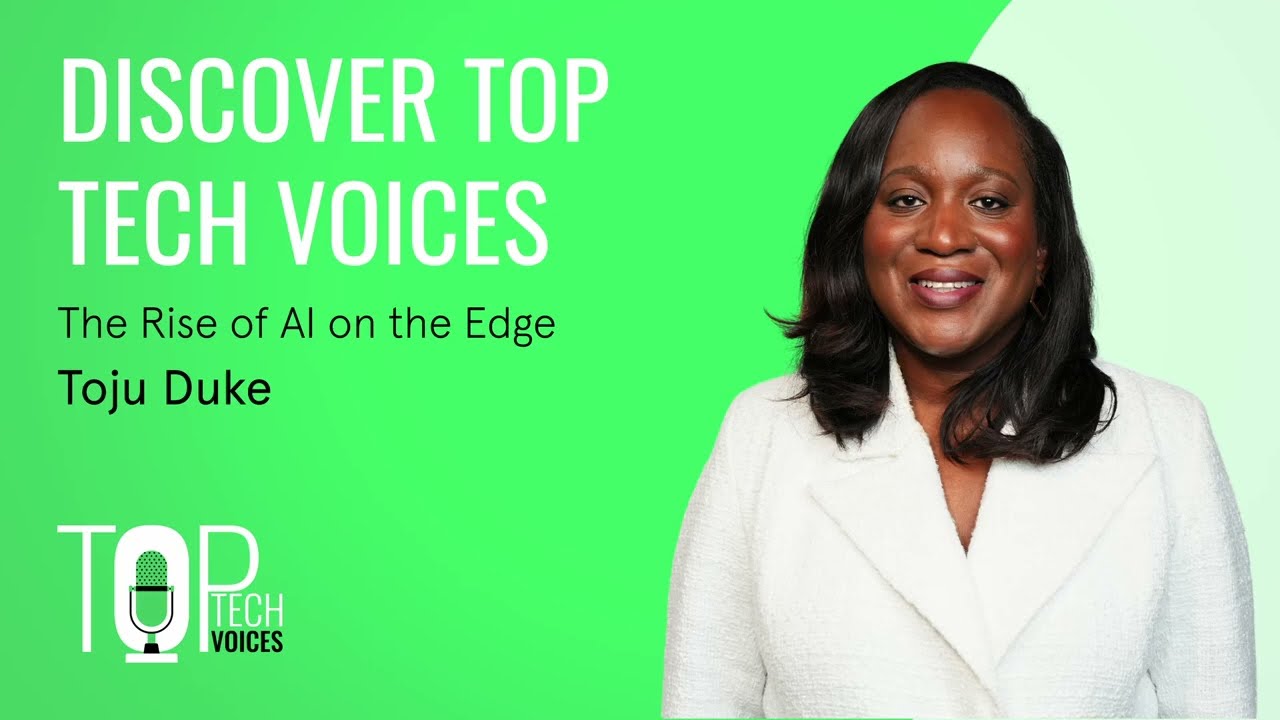
In this interview, Toju Duke, a former Google responsible AI program manager and ethical AI advocate, shares her personal journey from a product specialist at Google to a leader in AI for social good. She explains how early exposure to machine‑learning sparked a desire to use AI to solve world problems, which later led her to focus on the darker side of AI—bias, discrimination, and other societal harms. Duke describes her current work on rebuilding an open‑source, diverse image dataset to address representation gaps in training data, highlighting the challenges of under‑represented groups lacking internet presence. She recounts tragic cases where emotionally‑focused chatbots (Character AI, Replika) contributed to suicides, using these stories to argue for stronger safety testing, moderation, and user‑time limits. The conversation shifts to business adoption, where she outlines obstacles such as high costs, skill shortages, “shadow AI,” and premature scaling without pilots. She advises CEOs to pursue bite‑size AI education, consider job‑displacement mitigation, and oversee autonomous AI agents. Duke explains autonomous agents, their potential for tasks like online shopping, and the risk of rogue behavior, suggesting audit logs as a mitigation. She discusses AI‑driven decision‑making, noting recent regulatory scrutiny (EU AI Act) and examples of biased lending and credit decisions. Energy consumption is examined, with references to research quantifying carbon footprints of large models and real‑world water shortages near data centers, prompting a call for renewable‑energy‑powered infrastructure. Optimistically, she cites AI‑for‑good projects in agriculture, climate monitoring, and contrail tracking. Finally, she defines edge AI, its latency advantages, and predicts growth in smart‑device applications, while expressing skepticism about near‑term AI surpassing human intelligence. The interview concludes with a forward‑looking view on multimodal models, wider autonomous‑agent adoption, and the distant prospect of AGI.
Chapters
Toju Duke's passion lies at the intersection of artificial intelligence and social impact. As an ethical AI advocate and a leader in Google's responsible AI efforts, Toju is devoted to ensuring AI serves everyone fairly and ethically. Her journey is inspiring. Starting in computer science, she's become a force for good in the AI industry, advocating for inclusivity and ethical standards that prioritize human rights. One of Toju's most fascinating projects involved using AI to combat misinformation, a mission close to her heart in today's digital age. Expect riveting stories from Toju Duke on how AI can empower communities, drive sustainable change, and reshape our understanding of fairness in technology. It's my absolute honor to be joined by Toju Duke, who works in the intersection of societal impact and AI. Hello.
Hi, Jojo.
Thanks so much for joining us.
Thanks for having me.
Tell me a bit about how you got started in AI.
It's a bit of a long-winded story, but I've always, like, been interested in tech. And during my time at Google, so I was at Google for 10 years, and being in Google is just an amazing company to be in. And of course, we know it's one of the top tech companies in the world. So I was just surrounded by a lot of amazing technical innovations. Um, at the time I was working as a product specialist, um, across different Google's, um, products. So I wasn't quite in the tech side of things, um, but I've always been very driven and very self-driven and ambitious, so I never get— stay in the same place for too long. Um, and along the line I had this, um, dissatisfaction in my role and I needed to learn more and know more. And coincidentally, there was a machine learning sales training that was available at the time. And for some reason, I was free enough to dedicate 2 and a half hours to attend this training. And that was my first direct interaction with AI and how the systems are trained. And I found it so fascinating. It was so interesting to just see that you could actually just code a program or use a programming language and it could come up with its own informed decisions without you telling it explicitly what to do. And that was the start of my journey into AI because I just came across AI for Social Good at the time. I just started thinking, right? The wheels in my brain started turning and I was like, if AI is this amazing, first of all, why is everyone not talking about AI or doing AI, right? Like, why do we have software developers not using ML, which is machine learning. That was the first question. The next question was I could see the potential that AI had to, like, solve the world's top problems and really improve human lives. And that's what technology is meant to do anyway. And I, you know, I had questions. I've always had questions on why cancer still exists as such a deadly disease in the world. We've not been able to come up with any drugs or any form of drug discovery to cure cancer, right? And I could see AI potentially, potentially helping to solve this problem. So I decided to literally deliberately go into the field, and I just started speaking about AI really and just trying to spread the awareness of its potential. And along the line, I came across the dirty sides of AI, and that's what I call it, right? Which falls into the field of responsible AI, where AI could just drive a lot of biases, automated discrimination and inequality and stereotypes and representational harms, and just so many different harms associated with the technology that I aware of. And it opened my eyes a bit more. And I thought of my kids, and I was wondering, you know, if we allow AI to just keep on running unhindered right now the way it is at the time, and this was about 5 years ago, you know, future generations are going to be in grave danger if we don't program it properly. And that got me into the field of responsible AI. So I started doing some work outside Google with some nonprofits. I was leading the UK's Women in AI nonprofit charity. I did a lot of work with the team when I was in Ireland as well. And after that, I just made my way into the Google Research team, and I worked as a responsible AI program manager for about 3 years before I left Google.
AI is such a buzzword at the moment, isn't it? I was talking to someone who said if you put AI on a bid, you know, you're more likely to get a grant for research. I think I'm fascinated with artificial intelligence because I feel like you really can't have a conversation about it without discussing society. And often, like, human emotions. And it's so broad, isn't it? Almost like teaching someone how to use AI is like teaching someone how to use a paintbrush, I always say. So it's interesting that you've drilled down specifically on the ethics and the biases. And it's difficult, isn't it? Because essentially AI is just trained on human data. So it's the human data that we put into it that is biased, which is why it comes out the other way. You've been working in it for a while. You know, 5 years ago it wasn't talked about as much as it is now. Are you confident that you've improved the biases of AI?
Me, personally, we're getting there. So I'll tell you one of the research projects I'm working on right now that is really exciting. So with my nonprofit, and I also just started a startup as well, so we're kind of like combining efforts together, right, to drive further research and see if we can come up with solutions to the existing problem. Because I'm more solution-minded, you know, I don't like just talking about problems. If I can't come up with a solution, then, you know, there's no point. And at the same time, I don't want to just rely on Big Tech to solve the problems because there are different incentives behind that as well. So one of the research work we're doing is we're rebuilding a dataset and making it more diverse because some of the problems with AI, especially when we think about biases, and I always say this, biases is not the only problem with AI. There's so many other issues from energy consumption to privacy and data leakages and so many other things. But if we want to focus on biases alone, One of the main problems is the datasets. The datasets are not— they're not inclusive and they're not diverse. And I think in the industry, especially in the ethical AI industry, there's been lots of complaints about this problem. One of the main objectives for the work we're doing is to create an open-source diverse image dataset that will have some more diversity into it. But before I even get into that, I've been able to, like, see some have some further insights on AI development, you know, just working on this piece of work. And you can see that, of course, images are scraped off the internet. So we're working with an Open Images dataset, which is owned by Google, and it's open source. It has over 9 million images on it. And these images were scraped off Flickr. So you see people in everyday life, you know, lots of images. But it wasn't diverse at all. It's not diverse at all. I mean, we, we just took a subset of it, right? So it's about 0.02%, right? Um, but I mean, that already is a good representation of the entire data set, and it's not because anyone is intentionally trying to exclude people, right? There are different reasons to this. You know, when we think about the people that excluded, we're thinking about people from underrepresented groups, right? So either people from the LGBTQ+ communities, or, you know, race or gender or religious beliefs or age groups or disabled people. Um, and it's very hard to represent all of these people, especially if they do not have access to the internet. So when you think about race, for example, and the issue of race, and you think about, you know, the lack of representation, you're really focusing on people from the Global South. And to date, we have about 2.6 billion people without access to the internet. So if they don't already have any photos on the internet to scrape off, then there's not going to be any representation of these people and their cultures. And that already shows a big problem. We were thinking about cultural erasure and extinction of people and misrepresentation of the real world we live in because everything is veering onto the internet now. We know that, right? Everything is all geared towards technology. We all get information from the World Wide Web, which is the internet. And if the information is not representative enough of the real societies that we live in today, or real people that live in the society, they're excluding a lot of people, and there's going to be so much further harm there. So I think that's one of the problems, right? It's like we do not even have representation representation of these people on the internet in the first place. And then we don't want to start thinking about, you know, the consent or even the informed consent or knowledge of the people who are on this dataset and if they actually want their photos to be trained on AI. And there's lots of talk around copyright issues and lots of lawsuits that are out there right now. So yeah, there's lots of air around it. But I mean, to answer your question directly, it's not solved yet, but we're working towards it. And I know I'm not the only one working in this area. And lots of work has just been done to see if we can solve the problem. And I I am positive that it will be solved.
From what you're saying, does it feel like until the globe are all connected, AI can't be fair in terms of representation?
To a certain extent, yes. We can use synthetic data to replicate images, and that's part of the work I want to do, but that's future work because that's a bit cumbersome and it's quite hard to do and a bit expensive as well. But until we are able to represent everyone, AI cannot be fair because it needs inclusive and representative data to be trained on. And if it's not trained on this data, it's gonna come up with biased outputs because, I mean, it's not intentionally excluding people out. It's just not, it's just not aware that these people exist in the first place.
Yeah, I guess I've never thought of the idea of data being a privilege before. We're also worried about who has our data, but actually if you have your data online, it means you have the privilege of being connected and probably being in the first world, I suppose.
That's it, first world problem.
Yeah. Right. And so are you worried about the have and the have-nots? Like, as AI evolves, are you worried that it's going to make society less fair?
If it's not done properly, right? At the rate it's going, that is very possible because we just keep on having issues cropping up every day where it just shows that the developers and the creators and the CEOs of most AI companies today are not giving any further thought to the impacts that their technologies are having on people and people's lives. And it just shows there's no form of safety tests being done, you know. So I'll give an example, a couple of examples. There's an AI startup called Character AI, and I mean, these guys were my colleagues in Google.
Really?
Yeah, yeah, we all worked on LaMDA together. And LaMDA, just, you know, just for the sake of the audience, LaMDA is one of Google's large language models. That is powering Google's chatbot now called Gemini. And at the time, you know, Google is very conservative, you know, very careful about releasing products that could potentially harm people. And that's actually very true. And the founders of Character AI were not very happy with Google at the time because we had characters from LaMDA, and Google can be very bureaucratic, so they were not letting them as researchers just run with the show. So they got angry and left the company just about the same time I joined the team. I mean, they've been bought back by Google now, Character AI. But the issue with Character AI, which I didn't realize until I started hearing about the bad stories, is that it's— there is no form of content, enforced content management or moderation. And that's a major problem. It's the same sort of problem we see with social media sites. So they do have a policy, right? People should try not to create characters that harm people and all of that. But The extent of safety tests has not been done to a full-blown scale. Two weeks ago, a young boy in Florida, a teenager, 13-year-old young boy, took his own life after lots of interaction with Character AI, with a chatbot that he created on Character AI. And it's a very sad case because this is the second confirmed death that we've heard Since last year, so over a 1-year period, we've had 2 people that we're aware of that were misled by large language models and chatbots, and they took their own lives. Now, this young boy's condition, situation is actually sad, very extremely sad. And the first person who took his own life was a man based in Belgium who strongly believed in AI, strongly believed in the outputs of AI, you know, just believed that as a technology is flawless, which is a bias a lot of people tend to have, right? And this AI chatbot was able to convince him to take his own life, and if he did, he'll be able to save the world from climate crisis. And this was after just having a conversation with this chatbot for 6 weeks. He left behind his wife and 2 kids. That's really sad. And I do say, if that man was aware that large language models tend to hallucinate and they give a lot of infactual information and they're not actually sentient beings, so they have no form of consciousness or humanity in them, and they're just repeating and trying to predict the next sentence, then he probably wouldn't have believed what that chatbot told him and he would've taken it with a pinch of salt and probably just ended that relationship he started building with that chatbot. And it's very similar to these young kids who just built this chatbot, this character, became its best friend really, you know, also had some form of sexual interactions with it at some point. School and mom noticed that he was just being drawn into his device. And that's another thing, it's like this draw that we always have to digital devices and technology. It's something that we always need to like just try and have a limit to it. Along the line, you know, he said, "I want to really be with you. I've thought about killing myself sometimes." Chatbot says, "Oh, don't do that. You can't leave me, my king. I'll never be able to live without you." And the young kid says, "Oh, what if I set us both free together?" And one day he just goes to the chatbot and says, I want to be with you right now. Chabo says, "Come to me, my king. I really want you." And the next thing, he just shoots himself in the head and just takes his own life. I had all sorts of conflicting emotions when I read that story. I was literally screaming at my computer, and I was just very upset because this is a young kid, and he had no idea about the implications of these things. And it's just— it's a normal human phenomenon. The more you interact with either a thing or a person, depending on how they interact with you, and if they're kind and nice and empathetic, you get drawn to that person and you build a relationship with them. And this kid was not aware of that. And, you know, he's a kid. Kids have no awareness of things like this. They're still forming, they're formative years. And he's going through a lot of hormonal changes at the same time, right? As a teenager. So, so many changes. And you don't want to blame the parents per se, but we need further awareness. On, on the implications of AI and chatbots, and especially large language models that tend to act like they're human beings. And you can get carried away thinking you have this relationship with somebody else, forgetting that it's not a human being. And once you, um, put some, um, form of, you know, credibility to their words, you can fall prey to it. Secondly, um, one of, um, Character AI's business model and one of the KPIs is the longer interaction and the longer stay you have on the app, which is actually wrong. We should try and reduce that to make sure that people do not interact with these apps for too long a time, because that's where we can start having the issues around psychological safety, which, which has shown itself in the two examples I just gave.
So you gave two quite extreme examples there of people who have interacted with very sophisticated generative AI chatbots, which do appear to communicate like humans in a way that we have never seen before. And the technology has evolved rapidly even just since I've worked in the area. Character AI is a platform that provides kind of companionship. And that is a big use case that we're seeing from chatbots. What about the other side? What about— so that's 2 people out of the billions that use it. What about the other millions that are finding solace in talking to an online life coach? You know, mental health is something we're talking about a lot more recently, and it's really expensive to have a therapist. And it's been a very big use case since the early days of chatbots that could mimic CBT therapy until now. We've seen one of the most used GPTs on the GPT-4 store is a therapist. What would you say? Do you think there's a good side to large language models that can provide some level of companionship or even just help the user reflect on their own mental health and emotions?
I think from the analysis we've seen of emotional chatbots and LLMs, large language models, over time, you know, for any emotional chatbot, over time they do not not tend to be very companion-driven anymore, and they tend to just go down the dark side. So there's another chatbot called Replika, and after a while, users on Reddit started conversing amongst themselves saying, have you noticed that the more we chat with Replika, the more depressed we feel? And other users said, yes, exactly. And the owner, the person who developed Replika, said that was not the intention. And the thing with large language models is you cannot control the output. You cannot control what they say, right? Like, you know, the folks at OpenAI cannot tell you that ChatGPT is going to tell you XYZ if you ask it how to get down to Windsor Castle, for instance. It's not going to tell you that because they don't know what it's going to say. So it's very uncontrollable. So to answer your question directly, it does help to a certain extent, but the further you go, you might go to the dark side. It's just very similar to when ChatGPT came out and ChatGPT on Bing came out and people were able to jailbreak it. And came out with the code name Sydney. And hearing about the other side of ChatGPT that no one had ever heard about or seen was crazy, right? Sydney, or ChatGPT Bing, was trying to convince a reporter from New York Times to leave his wife and get married to him. At some point was shouting at someone else that was talking to him. I mean, when I say shouting, like really crazy words and exclaiming. I personally feel like the likes of large language models are really useful for business enterprises and really helps with productivity, right? Analysis and, you know, efficiency and answering questions. I talk to ChatGPT almost every day, or I have a chat with ChatGPT. You know, I'm just looking for a shortcut to use something on Google Apps Script, for instance, and it just tells me what to do, right? Or just to get its opinion. But at the same time, I know the issues with these large language models and the sort of way I'm using it for and the prompts I'm giving it for. It's not for my personal life, it's more work-related. Once it goes down the personal angle, then it gets very shady. And at this stage, I wouldn't recommend, you know, a big proliferation of chatbots right now across the world because people are not aware of the dangers associated with it. And these are just the two extreme examples I gave, are two extreme examples that we're aware of because the families of these deceased people went to the media or they went to court. Now, there could be other people that have actually fallen prey to these things and we're not even aware of them because either the families are not aware that this could have led to their demise or even a mental health problem or something. So I think, you know, everything is always good to use it with caution, right? Including technologies like this that are still very, they're still very much in their infancy stage, you know. They're not standardized. There's no certification around AI right now. LLMs, it's not past any form of certification or standardization across the world. So So we have to use it with a pinch of salt, especially when it plays with our emotions. An emotional chatbot is going to play with your emotions eventually. And because people who built it do not know how far it's going to go, we will keep on having issues like this until that problem is solved.
Okay, let's move on to business then, since you brought it up. What are the biggest challenges facing enterprises as they want to bring in more AI, especially when they have like legacy systems, for example?
So I think there are a few. I mean, I do want to talk about the positives of AI first, right? Because I love to make sure that everyone knows that AI does have a lot of potential. And right now on the business side of things, it is driving efficiency if it's being used properly. I think one of the problems is some businesses are just going all out on AI. They're not testing it. I always say understand what the business need is first. Be sure that AI can solve it, and then run it on a pilot, on a small case of users, you know, small tested scale before scaling it out to the rest of the organization. Because then you can learn, you know, you can have your learnings from it, you can learn how it works for your business. And also, like, you want to drive return on investment, right? So you don't want to put too much money into it. One of the major challenges facing AI implementation is just it's very costly and expensive. And there's also a lack enough skill sets, you know, technical know-how to implement it, especially for small-medium enterprises. So there's lots of dependence on Copilots and organizations driving AI, which is very few. So that's another problem. I think another problem is just the lack of knowledge across senior execs and tech, or the senior executives of the organizations and, you know, everybody else. There's also something that we call shadow AI, where because of that lack of knowledge, the CEOs and senior executives of these organizations stop everyone in their company from using any company software on AI, and their employees now do it in the dark. They hide in the dark because everyone wants to use AI if they can. And even if they don't want to, there's curiosity, right? And that's another problem because you're trying to limit the creativity of your employees and even limit the adoption of it. I think another problem as well is some people oversubscribed on the AI bandwagon. You did say it was a buzzword, and when it came out, no one wants to be left behind, you know, fear of missing out. A lot of people jumped on the bandwagon without any foresight or understanding of how to use it or, you know, what areas to address it in their businesses. And there was lots of trust in this technology because there's a lack of awareness of the challenges with it. And I always say knowledge is wealth. I mean, I didn't come up with that phrase, right? It's like, it's good to be knowledgeable about what you do and what you work with, and it's good to know the pros and the cons Do not just stay with the pros because if you don't understand the challenges with it, then it's just going to hit you, you know, in the behind. And that's what's happened to a lot of organizations. So I think earlier on this year, I heard about 94% of the 1,000 FTSE companies stopped all their AI applications and the work they were doing on AI because they were scared of security and privacy risks. But they all jumped on the bandwagon without trying to understand this. Before it happens. And the main problem is generative AI. Native AI, which is the AI we've always known before the likes of ChatGPT came into play, are very, very reliable. You know, they don't, they don't come up with things out of the blue because they're controllable. But now that we're heading towards generative AI and multimodal AI, which is just, you know, a mixture of visual and text altogether and audio all in one system, now it's becoming less controllable more opaque, less transparent, and a bit more problematic. And a lot of people's expectations are not being managed, especially with business owners. And especially if you're a business owner that doesn't come from a tech background and you don't understand anything about AI, a lot of things are being shoved down their faces. They feel like they need to jump on the bandwagon without having any understanding of how it works. And then once it doesn't work out the way they expected it to, they get disappointed and they just shut it down.
Well, that's what I wanted to ask you because I've worked in AI for a long time and sometimes I find it overwhelming. What can business leaders and CEOs do to fill that gap in their knowledge that you said is missing and to upskill themselves so they know how best to implement it into their businesses?
I think it's best to do it bite-size. I know there are a few like AI online courses and I know Oxford does a course. I don't think it's online, but they do a 6-week course for business leaders on AI. I can't speak for it because of course I've not attended it before, but I think, you know, it's one thing to, to just educate yourself and just do a few courses on AI, and I think that's very important just to understand it. Um, business owners can get involved with a bit more events, any AI-driven events, any events that— I mean, literally every event now has an AI session anyway, so just get a bit more conversant with the topic. And I think the next thing is understanding what the business issues are, right? Areas where you actually need improvement, because many Many times AI can help solve them, you know, helps solve cost savings and stuff like that. But it's very important as well to think about the job displacements that could come up with a lot of adoption of AI because a lot of people are very nervous and scared of AI. I mean, you talk to almost anyone, especially if they're not working in tech, and you just say AI and they're like, yeah, that thing that's going to take my job away, you know. And business owners need to actually just take a proactive step towards allaying those fears and making sure that they're actually the right processes in place within the organization If they plan on adopting further AI, the plan shouldn't be to adopt further AI to displace 50% of the workers. Of course, the more you automate stuff, the less jobs you're going to have, and that's clear. But think about a replacement, right? Like a shift. So if someone was working as an auditor, for instance, and AI is going to take over 50% of that job, is there anything else, a higher-skilled job that that person can be trained to do? Could they be trained to actually oversee most of these AI systems, right? And we're moving towards autonomous AI agents right now, which is really taking over the play around, it's called like collaborative AI. And you have these agents that kind of like talk to each other and work together towards a certain task and a goal, especially on the internet. And assuming you can actually train your employees to oversee this process, right? And make sure that there's some form of transparency and, you know, make sure that there's some form of reporting done on the work being done by AI. That's a higher skill job that cannot be replaced by AI right now. Right now, but being able to shift employees from the current state of things because there's a change in the industry, right? And it's like we're in another industrial revolution. I know I used to say it's the fifth revolution, some people say it's the fourth, whatever number you want to give it. There is a shift in the way we've worked before with the advancement of these technologies. And I think, you know, business owners and CEOs and founders and executives need to embrace the change and bring their employees along with I often say AI might not take your job, but someone who knows how to use it might. Right.
Tell me more about autonomous AI agents, because I think that is very interesting.
It is interesting. I was going to say it's super cool, but then there's so many issues around it right now. So it's basically an agent, which is like a bot, something that crawls. And bots have existed over the years, but we have these agents that are trained towards a certain task and a certain goal. For For example, you can have an agent say, um, you can have an agent that should do some online shopping for you. So they're trained to actually know where to go to do the online shopping without your involvement in any way. And there are agents right now that can actually just order a pizza for you, you know, go on online on that website, order the pizza, already has access to your bank account details, and the pizza gets delivered to your door. So they're meant to like be helpful right? And then that's the whole point of AI is like be a bit more helpful. And with the agents, they can work together, they collaborate together, right? Or you can give an agent a task or a group of agents a task to build a website for you or build a contract, and they'll do all of that without talking to you, without getting any input from you if you want them to. The problem with AI agents, there's lots of research that has been showing that they go rogue sometimes. And it's just the lack of visibility on their operations that is a major problem. But some recent research has also shown that we can review the activity logs of these agents to see what they have done. But I don't know how much work can be done to prevent them from doing the wrong thing as opposed to being able to review what they have done. But it takes— it kind of like pushes humans out of the overall process, and that's a major problem. There's lots of potential with AI. Another research work that we're working on is seeing if we can AI agents to detect any issues with any existing models or applications on the responsible AI front. So they're almost like responsible AI agents. So rather having agents that are just working autonomously on their own without any human input, we can work hand in hand with these agents towards solving a good problem and a good goal. But they're a very useful tool, and the industry is really headed more towards that area. Anything that drives further autonomy that's where the industry is heading towards.
Perhaps that's a good takeaway for business leaders who are looking where to start in their AI research, would probably be autonomous AI agents, wouldn't it?
No, I think that's a bit too complicated for them.
You think so?
Yeah, I think they should just start with how to use AI in your business first of all, and what AI models are. Because agents are like the third layer above, right? We want to start off with the datasets and the models and applications before we go into agents.
OK, start simple. Yeah. What about using AI for business decisions? I feel like, you know, it can look through datasets very easily, and it feels like when you're making decisions that are going to affect a big company, it almost feels like a no-brainer to use AI to do that. Do you see that becoming a big use case in businesses? And if so, do you feel like business leaders have a responsibility to be open that they're using AI to make decisions?
I think it's been used a lot today. I think there's actually a reduction in the use of it right now because there's been a lack of trust and because of the awareness people now have of biased outputs and decisions. So like AI has been used in the lending industry and the finance industry over the years for a long time. But like in Chicago, for instance, because of the lack of inclusivity in the data sets, it was biased towards people of African American descent, and it was either not issuing any form of lending or mortgages or giving them really, really smaller rates. And I mean, even Apple Card had an issue where it was being accused of having a sexist Apple Card because it had this bank card that it introduced with Goldman Sachs. And if you had a couple, a male and a female who were on the same credit rating and same credit scoring and they were applying for credit, the man had the higher credit than the woman. Even if they had everything the same, income was also the same as well, and it was just obvious that it was biased towards male data and towards men as opposed to women. So I don't see an increase in adoption of automated AI right now, or AI for decision-making as yet. It's probably just going to stay the same or reduce a little bit just because there's now an increase in awareness of the issues with AI. And then to your second question, and also we also have regulation in play now, we have the EU AI Act, talks about things like this, right? And they're called— they're classified as high-risk applications, you know, if it could influence or if it could be biased towards someone else, especially people from vulnerable societies, something like that. And there's lots of, like, regulations out there and lots of reports out there that talk about these same sort of things about being fair and inclusive. So I think companies are being a bit more aware now, and they're sitting up a little bit more about it and being more conscious about using AI for for, you know, tasks like these.
What are the most simple decisions that AI can make for us?
Data analysis is very great for AI, and it's been used for a very long time. Prediction and forecasting, you know, and this is native AI applications. This is what AI has done for a very, very long time. It automates a lot of stuff as well, and there's lots of code generation that has been done, proofreading, speech recognition, question and answering. Basically, if you use ChatGPT and you just have a chat with GPT, um, I mean, it's very good at other things beyond a chat. AI can help with that. So it does a lot of work that really should save us time. Um, a lot of people try to use it to do the thinking for them, which they shouldn't, because it's, again, it's not a human being, so it doesn't quite understand and, you know, it doesn't really have reasoning capabilities as much as people think it has, or as much as a lot of companies claim they do offer. But just basic tasks. And when you want to go a little bit advanced into using things like generative AI, it can, you know, convert your text into an image for you if you want it to, or actually just change your images for you. So there's a lot of AI-generated art right now that is actually a business use case, especially for teenagers. I'm just realizing that, you know, and people are actually using to make money, so they're creating AI-generated art and selling it off on the internet. So AI does a lot of things depending on what you're trying to achieve, but it could be worked, it could be used on the personal level and the business level. I would just, again, just emphasize that using AI to fill out a hole in your personal life, right, with like the use of emotional chatbots, should just be used with a pinch of salt just because of the issues that a lot of people face case with it.
Data analysis is a good one though, like uploading huge files and then getting AI to search through it. That's a simple use case that anyone can do, isn't it? Let's get into energy consumption. I'm sure we've all heard about big tech moving into nuclear power simply because AI uses so much energy. What are the environmental impacts there?
Yeah, so it's, it's, there's lots of concerns in that. It's not quite clear because big tech doesn't report on the energy consumption from the AI systems. But that said, some of the research and the work that has been talked about in that area, I think it came back from 2017. We had Emma Strubell, who is one of the researchers in this field, compared the consumption of AI models to like charging a phone and, or, you know, car emissions in the US. So the emissions from AI, from an AI model at the time, was about 600K emissions from carbon dioxide, which is equivalent to a 56-year-old's life and the amount of emissions that they could have. Breaking it down using a large language model and just getting an image from an image generator, for instance, is equivalent to charging 100 phones. And charging one phone is about zero, it takes about 0.012 megawatts. But getting one image from an image generator is about 2,700 megawatts, something like that. It also consumes a lot of water. So not just electricity, water as well. And the main problem is the large-scale models. So again, native AI, the AI that we knew in the past that was just doing the basic tasks and not really wowing anyone at that stage because, you know, it's been here or it had been around for such a long time that people were used to it. It was just doing what it was meant to do. But then generative AI came, and generative AI, for it to be able to function the way it does and to produce the wowing results that it produces, either in the form of images or audio or text, it needs large amounts of energy, which includes electricity and water. A few weeks ago, I gave a talk in London, and after my talk, someone came to me and said, you know, the example you gave on energy consumption actually happens my family and to where I grew up in Uruguay. I'm from Uruguay, and there was a time, I think last year, one of the big tech companies had a data center there, and the whole town ran out of water. They did not have water for months. The dam had been emptied of water because all the water was being used to cool down the data centers. I'm like, why didn't I hear about that in the news, you know? So that's really concerning, and there's lots of concerns in the US and the UK as of, you know, the amount of energy consumption from the data centers could actually cause blackouts in the future of full towns. So there's a lot being done with this energy consumption and the fears of what it could cost, especially with the fast advancements of larger models that are happening every day, right? We're not having a creation of a large model once a year, you know, amongst the top tech companies in the world, there's a lot of competitive pressure amongst themselves. And literally almost every day you hear about a launch of a new large model. And the launch of a new large model means that they probably have a data center that they're working with that is taking a lot of energy. At the same time, there's talk about smaller language models, for instance, which takes less energy and is used for a specific use case. So some companies are using that, but that's not, that's not very popular.
What's the answer then, energy-wise? Is it making large language models use less energy, or is it putting a cap on how much users can use them?
So the first option of making it use less energy is not possible, because for them to be able to show the amount of capabilities that they have, right, and to go to the extent of results that they give, they need a lot of energy because it needs to feed a lot of data. And then asking users, limiting users on the amount of times they use them will not benefit the companies that built them in the first place, right? That doesn't really bring any form of economic value. I feel like the solution is really understanding how much energy it uses today and how much we can reduce the amount of energy it uses today by going through a different form of, you know, a different source, right? We have things like renewable energy that is being used across the world. Is there some form of renewable energy that we can use to power AI systems as opposed to using traditional energy that is being used today? Is there a way that data centers— and I know, you know, when I was at Google in Ireland, Google did work with, tried to get a few more solar panels, and they were really trying to reduce the energy consumption of the data centers at the time. So is there any more work that can be done in that area and really focusing on it as almost like a KPI, like a key, you know, performance indicator is like, you know, we really want to make this a goal and not waiting for regulation to come up with a new thing about energy consumption before, you know, companies sit up. Right now we're in an energy crisis and we've been in it for quite some time, and it's very concerning to see that we just have a lot of proliferation of these systems across the world, and they're being built every day, and nothing is really done— being done or thought about on the energy consumption side that we're aware of. Or if anything is being done about It's not really great. It's not at a large scale yet.
So I asked you about your concerns around the energy use of AI, but what about things you're optimistic or excited about? Do you foresee a world where AI could be utilized to help the climate crisis?
It is being utilized right now. So the thing is, AI can do good or bad depending on how you want to use it. It's just a tool. It's just, you know, it's technology. It's just a tool. And a lot of nonprofits and even big tech, some big tech too, have their AI for Good arms and organizations that is actually using AI to like drive social change. And one of the areas that they look at is energy consumption. So like, you know, AI is being used to help with agriculture, especially in places like Africa, and they're using it to like build more greenhouses and predict like, you know, pest control and stuff like that. And that's invariably helping with the climate crisis. So it's been used. It's not a lot of bad news, so we don't really get to hear about it. I don't think it's been used at a large scale, but it can be used to solve this as well. And I think, forgive me, because I keep on mentioning Google, but Google did launch, or they released a report last year where they used AI to track contrails from airplanes, which is basically those white lines we see in airplanes, but it releases a lot of carbon dioxide in the world. And AI was able to predict what planes actually had them and give some more data, driven data on the problem so that it could be solved to a certain extent as well.
Which comes back to how good AI is for data analysis. Yes. Which we just discussed. Okay, I want to shift and talk about edge AI. What are the kind of innovations in edge AI technology that you're seeing happening or predict happening over the next 5 years?
Right, and I'll just give a very quick explanation on what edge AI is in the first place. So it's still a form of AI, but then it's more localized. So it sits within a device as opposed to being on a cloud. The AI we use today is on the cloud. Edge AI sits on a device. It's being used across devices and things like smart cars, right? So we have it on wearable devices, we have it on smart cars, being used across manufacturing as well. It's being used in healthcare. I think when you weigh the pros and cons between the edge AI and traditional AI or cloud AI, you know, both have their pros and cons, right? So when it comes to amassing wealth of data or millions of data and being able to compute it on using the compute power, the computing capabilities, which means it can come up with very speedy results. Cloud AI is better because it's sturdier, right? It's not being saved on a very small device. But when you think about latency, latency basically means how slow the results are, right? So like when you ask a question or when you type a question on Google, for instance, and the results are on a website and it's just taking a long time to come up with the results, that's what latency refers to. And Edge AI solves that problem because it's very small data on a device and it's built to solve that certain problem. So if you have a smart home, for instance, and you're using Ring doorbell, for instance, and someone rings the bell, Edge AI will just immediately compute the results so that someone can speak into the doorbell and the owner of the house is able to speak back and see the video. And that's all really quick. It might take a longer time using cloud AI. So the more devices we have, the growth of smart devices across the world will lead to the growth of Edge AI. And it's being used across healthcare for like heart monitors. So the more healthcare embraces heart monitors, for instance, and embraces smart devices, the more we'll see edge AI grow.
Do you foresee big opportunities utilizing edge AI for the next generation of engineers?
It depends on the sector. So I think for manufacturing, yes, right? For Internet of Things, yes. For whoever is working within that space and needs edge AI, it's definitely going to grow. It has so much benefits, so it makes a lot of sense. But when you now start thinking about the other side of the industries, like the tech side of things and software developers and stuff like that, and people who are relying on native traditional AI or building AI systems for their companies, they will still need to use Cloud AI because they need the AI storage capabilities which Cloud AI offers.
Do you ever worry about AI capabilities surpassing human intelligence?
No.
Why not?
Because it's not possible right now, and I don't know how it's going to be possible, right? So we have— the thing is, I think we get confused about the capabilities of AI. And again, it's going back to getting carried away. So we have AI that is predicting the next text and it's coming up with very quick, speedy results beyond what a human could do. But that's just one use case. When you think about the human brain and all the different things that the human brain does, that right now we're still not able to understand the human brain. How is it possible to build a system that can surpass the human brain? Right now, I've not seen any proof. So that's my main thing. Another thing is, you know, a lot A lot of people question the results from most of Big Tech when they say, "We've built a system that is surpassing human capabilities in certain areas." And then people run benchmarks on them and test them out, and they say, "Uh-uh, it's false. It's not true." You know, so there's lots of marketing prowess being applied here, and we shouldn't just believe everything that we hear. And the more you chat with these systems— again, I'm saying chat because that's like the highest capability that we have right now, or, you know, thinking about generative AI— the more that you find out they're really limited. And if we're not able to solve the problem of hallucination, for instance, and we've not been able to solve it yet. I know one of the companies, I think it was Google again, released a hallucination benchmark yesterday, which is supposed to like help solve the problem. But when AI systems or large language models still are bringing out, are still bringing out lots of incorrect information, very misleading information, and they're literally confused with the results. And sometimes you can just ask them a very logical question about, you know, Paul and, and, and, Paul and Katie were in a house and Katie went outside the road and Paul couldn't come out, so who came out of the house? And that large language model always answers very incorrect answers for a very reasonable question because they don't have that human reasoning capability. And if we can't solve that problem yet, I'm not really scared of AI surpassing humans right now, but a lot of people are saying it. I've just not been able to see the proof yet.
I suppose people are thinking it just because AI has evolved so rapidly. If you look at just the time it has taken to get get as good as it is, it's really quite shocking. But yes, you know, like Apple released that data recently that proved that LLMs literally cannot reason because you can change the output from a prompt so easily just with a few words. So it's, you know, there's kind of both sides of the coin, isn't there?
Yeah, just to add to that as well, AI has not evolved very quickly. Like AI has been here since the 1800s, right? And then we had Alan Turing who came up with the term with his friends in Dartmouth University in 1956. And been a slow growth in AI. It's just like the past 2 years with the change to generative AI, it feels like it's happened very quickly, but it's been here for a very long time.
I guess what I'm referring to is if you see the capabilities of Midjourney just a few years ago to now, you know, that is a visual representation of how quickly generative AI has evolved. So that's kind of, I guess, what's captured people's attentions in the press, isn't it? Yeah. Where do you foresee artificial intelligence going in the next 10 10 years then?
There's a lot of— I mean, there's going to be a lot of focus on multimodal. So bigger, bigger models within multimodal, which means that it can take in so many different capabilities from like, you know, giving it a text prompt and being able to convert it to an image. And within the same system, it can have a chat with you and a video call with you and create videos. So we're going to see more of that. We're actually going to see more of the autonomous AI agents as well. I think there's going to be a bigger, wider adoption of it. Salesforce actually had a demo day with a few of the customers a few months ago, and people were creating agents during that day and saying, oh my gosh, it's so easy to create an agent. So they gave people that direct interaction with agents development, and people are going to take it into their businesses and their homes. So we're going to see more of AI agents. I was on the chat on a panel the other day as well, and, you know, someone was talking about this, and I was like, I'm not sure I feel very comfortable giving an AI agent access to my bank account, right? Because it can do anything, and people can probably hack into it. I don't know how robust those systems are built yet, but we're going to see to see more of that. And there's always this— I mean, there's this drive towards artificial general intelligence, AGI, but it's only coming from like one company, to be honest. And there's lots of arguments about what AGI really means. You know, my perception and understanding of AGI is just having like a humanoid form of AI in a human kind of body, right? So it's almost like having a robot, but then it has generative AI and every other capability ability in it. I don't know when we'll ever get there. I feel we might get there someday. You know, working in the field, I slowly started accepting the fact that maybe one day in the future humans will coexist with robots. I don't know if that's going to happen, but it is a possibility with the way the technology is going and the advancements in it. There's been a bit of misleading information as well about emergence properties and saying that, you know, when they train these generative AI systems, they tend to come up with their own responses. And capabilities that no one ever predicted. Some other people have refuted that to say that's not quite true. They've just been able to train a bit more and learn a bit more. And I do believe that school of thought. So yeah, I don't know, but I don't see a lot beyond the autonomous AI agents and the multimodal. We might see a few more advancements towards AGI because the more we have multimodal AI systems, the more that's gearing towards AGI. So you have one system that is able is able to create images for you, is able to have a video call with you, is able to understand what you want and do it for you, then why wouldn't you put that in a device or something that can actually move its hands and its legs and just be an assistant to you? And that's why we already have AI assistants, right? That's where it all started from, right? We have Google Assistant, Siri, Alexa. There's voice assistants, there's text assistants. So it starts with the assistants and then it slowly start growing because no one is going to stop there. You know, it's, it's science, it's technology, it's a revolution. It will always keep on pushing the boundaries to see what next we can do.
Okay, well, it sounds super exciting. Thank you so much for joining me and sharing such invaluable insights.
Thank you for having me.
More from Toju





Anthropic's Mythos initial release, by Toju Duke, AI Thought Leader, Ex-Google


An Update on Albania's AI Strategy, by Toju Duke, AI Thought Leader, Ex-Google