Around the Horn - Episode #15
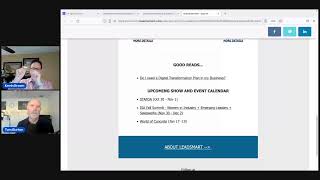
A ~30-minute conversational webcast between Tom Burton and Kevin Brown (co‑founders of Lead Smart Technologies) covering trends in wholesale distribution: increasing adoption of mobile payments and omnichannel purchasing, supply‑chain fluctuations (potential inventory glut), merger & acquisition activity in distribution, and strong buyer interest in digital transformation and CRM/customer‑intelligence tools. They promote upcoming webinars (notably Nov 9 with Brian Beck) and discuss positive anecdotal industry sentiment observed at recent trade events.
Chapters
Hey, good morning, Kevin. It must be Friday because we're here on around the Horn.
That's it exactly right. Another. Another week down. What, what number is this?
Number 15. Number 15.
So, yeah, and some people still show up. That's pretty cool.
Right? So there's at least two of us here.
That's right.
Oh, but yeah, we have, they're definitely, there's definitely more and more people showing up. So yeah, we, and we learned, we.
Learned last week what's kind of interesting, you know, this whole evolution of all this with, with how LinkedIn does things. Right. We, we don't get great information back, but we got some really neat comments after last week's broadcast ended from some pretty powerful people in, in the industrial world that, that we're on. So, you know, you don't have to click the. Clearly, you don't have to click the attending button to pop in and join us. So it's kind of neat to see that. So, hey, but before we get going, Tom, I was going to kind of do our weekly little bit of an intro to why we're here. So. I'm Kevin Brown, that's Tom Burton. We're the co founders of Lead Smart Technologies. We have developed over the last few years fairly innovative in industry or vertical specific CRM and customer intelligence solution, as well as some partner and channel collaboration tools. We get together on Friday mornings and we talk about what's going on throughout the world of wholesale distribution. Because there's so many facets of that across industrial safety, construction, building materials, electrical H vac, medical, food products, whatever it might be. We get all this data that comes into us every week about what's going on. So we decided to consolidate some of that. We send out an email every Friday morning with what we call around the Horn, which is the same broadcast that we do, and we talk about what's happening in wholesale distribution. So if you're watching us, whether it's live here Friday morning on October 28th, or you are seeing this on YouTube, Facebook and. Or LinkedIn live as a recording, send us a note. If you'd like to be on that newsletter, you can send us a note through a DM there DM direct message here this morning in our, in our comment section or helloadsmartech.com so that's my little plug for what we're doing here. I always like to kind of give people a little feedback on why we're here.
Like why the heck are these guys here?
That's right. Who are those two old dudes that just Chatting about stuff, right?
Yeah.
Good. So let's look at the news, huh?
Yeah, let's do it.
Good. So first one that we shared with people this morning, again, this goes out to about 8,000 people or so each week. So if you're not getting us, let us know. But you know, we put split things up into kind of news that's tied to the economy, technology and so forth and then then some stuff that's industry specific each week. And this first one that we posted, you know, you might kind of think, well, well, PayPal shares rise after Amazon ads. Venmo, who cares, right? I sell building materials or hard hats or, you know, medical devices. But you know, the reality of it is if you dig into that a little bit, what we're seeing is this migration that's kind of happening with folks about how they.
How they pay.
Right. How people want to buy. I was visiting earlier this week, I was in Denver, we're going to talk about that a little bit later. And I was visiting with a new one of our newer customers. It's a building materials company, you know, and they were talking to us about literally how they get orders from people that can be electronically driven, right. Through an E procurement process. It could be a spreadsheet getting sent to them with items that they want quotes on or, or literally written on a piece of drywall. Well, that's a pretty broad spectrum, right? Because 15 years ago or 10 years ago, you might have said, well, we get a whole lot of legal pad scribble of what people want to buy or quote, get quotes on. And you know, it might be even on a piece of plywood or something that they said, you know, scrap, that says check this for me. But every day we get closer to this place where, you know, mobile ordering, e procurement, mobile payments and so forth is going to become more and more important. And the beauty of that is folks in wholesale distribution that start embracing that early. Right. Are in a position that differentiates themselves to allow the customer to procure things, purchase things and, or I should say, or pay for things the way they want to, not the way we've historically done business.
Yeah, We've even seen that even with our partner Mobilico. Right. And their solution is it's more proprietary versus this is obviously, you know, Venmo being a much broader solution. But yeah, I mean the, it's all about convenience, right. So and Omnichannel, as we've talked about many times, I think that definition keeps getting broader and broader all the time because, you know, you could argue that Venmo is yet just another way, another channel for somebody to in this case, handle a transaction. But right, as we said before, Omnichannel isn't just about transactions. It's about how you shop and how you get information.
Yeah, couldn't agree with you more on that. And I think it's important for, you know, people to realize as we, and we, we beg this drum all the time, right, about you know, millennial buyers being predominant in the marketplace. If they're not already, they will be very shortly, depending on which research you read. And they want to do things a little bit differently. So having that not only Omnichannel research and purchase, you know, or, or quote, request options, but even that mobile payment option is going to be really great. And, and this ties into, you know, just, it just triggered in my head, Tom. It's kind of interesting and you know how this goes, right? I off I go on things, but it. We did a two weeks in a row. We had some information regarding wind supply and they're testing with drones. Right. So, you know, if you think about it, we're moving towards a place where you could be on a construction site or in a factory somewhere and something breaks down. You could be maybe it's a half hour drive or something like that into the closest distributor they're not in a position to deliver. You could in theory, right from your, you know. Right, right from your device, go order that part that is holding up a job place the purchase order. Drone shows up, drops off that bearing that's keeping a piece of equipment from moving, which has stopped the job or a process, and pay for it right from a mobile device. I mean, that's where we're headed. Right.
I guess that's really parachuting in. Right, that's parachuting exactly what you need.
But there's people testing all of that already. Right. And it just kind of goes to this conversation that we have kind of week after week that things are changing. Are we changing with it to. To address that what our customers needs are, and as we often say too, you know, what are our incoming employees expecting from us? So this whole PayPal thing, I don't want to spend all morning on it, but it's just kind of interesting, this adoption of this mobile payment platform. And to your point, you know, our good friends at Moblico have that built into their mobile messaging service as well, where they offer a unique mobile payment solution. So that's kind of cool too. So, Tom, let's jump past this. You know, I Think everybody's watching the economy closely as far as. But there's just some info on, on home sales and the drop there that's going on that's kind of be to be suspected or expected in that setting. But you know, there's trends about what's going on with global supply chain issues. And it's kind of interesting. There's, if you were to look at that, the, the value or the challenge that's going on, I should say right now in supply chain things. Right. I live here in Southern California. I've mentioned many times being able to, you know, I live about 40 miles south of the ports of Los Angeles and Long beach. And you know, this summer we had ships stacked up all the way down there. We are waiting to get in line to get into the port. That's easy. We're reading about that and we're seeing about that. Part of it is maybe in some facets of the economy things are slowing down possibly. But this is a really nice article with some trends that they're seeing. One of the things that I, I caught in there that there's kind of two critical points, but the first one that I, I recognize in there that I really liked was that the, the concept, it's kind of scary, right? That says, well, we've been short on everything. I've got a lifelong friend that's in the supply chain world as well. He's here from Hawaii, staying with us. He's, he's here at the house today and he was just talking about some of the vendors that he works with that are just still clobbered by supply chain issues in the electrical industry. But now one of the comments is that we could be in for a glut of inventory because all of this stuff is going to hit at once. Right. I thought that was kind of interesting. Do you get a chance to read that?
Yeah. No. And what's even funny, they say we may have a glut of ships, right. Because we're making, We've all of a sudden, right. Everyone scrambled to make ships or is making ships. Those are coming off the line. And so there may be more ships than there are, you know, and we start to reduce inventory, right. There'll be ships with nothing to do. So you know, we tend to, we tend to move from one extreme to the other.
That's right. Well and I think, you know, we become extremely responsive and maybe over responsive in some of those settings. But you know that the crux of that at the end of it was talking about later next Year things look we're starting would be starting to look much more positive and much more balanced. You know, balance is I think what we need in this. So hey Tom, before we jump on somebody, we don't have a name with this just says LinkedIn user commented here about the previous discussion we were having about job site ordering and stuff like that. So they commented there the value of uptime and uptime being that we're constantly work isn't being interrupted on a job site will open up revenue streams for suppliers who stay on the front end of this and don't know who that is that wrote that but thank you. Because could not be more in more alignment with that. Right. And that's some of the large national distributors have said this for years and years is that, you know, that's their role by having many warehouses with lots of inventory is they want to be the supplier that keeps you up and running and keeps you up and working. So thank you for that comment because I couldn't agree with that more is if you're on the front end of this stuff, you're going to be much more valuable.
We talked about this last week with Brian. Right. About you know, why why would somebody buy from a local or regional distributor versus Amazon. Well that's exactly why. Right. Is that ability to have that convenience and that just in time support and that, you know, hey, I need it right this second and having the right things at the right time. Right. That's not something that Amazon's ever going to probably do very well. So it's another way to differentiate. You know, like we were talking about last week on the right. When we were talking more with Brian.
Yeah. And I'm excited. Just back to that. For anybody that's with us today that wasn't with us last week, we had Brian Beck on who's kind of very well known expert on E commerce as it ties to B2B and distribution. Keynote speaker. If you didn't get a chance to catch that last week, it's on the lead Smart technologies page on LinkedIn as well as on our YouTube channel and you could watch. That's well worthwhile. We've got as you mentioned, this upcoming webinar that we're going to do about distribution and B2B distribution related to E commerce coming up. What is that the ninth? Is that what was settled on?
Yeah, the ninth. Yep. Good.
So we'll get that information out. We'll talk about it again next week and because that'll be early the following week. But we'll do the promotion that goes with that. But yeah, that's, that's key. And you know what's interesting with this is, you know, the reminder I remember you and I were in an event with one of our key customers in February where Ian Heller from the Distribution Strategy Group was talking about that in some of his slides. You know, you're not going to be able to call Amazon to come out to a construction site to show you how to use that piece of equipment. Right. Or to pop in to show you the proper use of a cutting tool or to fit test a respirator or whatever it is. So, you know, our traditional distribution, B2B distribution still has that great place in the marketplace. But I'm happy that the supply chain trends are changing. So that's really good news. Yeah. So let's talk about what's going on around, around the industry a little bit. Some good, good news popping up here, right? We just about every week we're talking about or posting something with some M A type stuff, you know, merger and acquisition. So Martin Supply is acquiring Quality Mill Supply. It was kind of funny. We're going to talk in a little bit about some of the events that I'm just coming back from having been for the last. I guess this week was fourth week in a row or either fourth week in a row or four out of five weeks that I've traveled, which is so odd with post coveted to travel that much because, and by the way, I don't like it. Just FYI as my business partner, so don't think that I like that. But as I was getting ready to leave the event I was at in Denver this week, which we're going to talk further about. And Eric Ruggles from Martin Supply was two tables over from me. We got to chat for a few minutes about this acquisition. It was funny, I was thinking about, oh, maybe I'll grab some lunch on the way to the airport versus here at the hotel. No, no, I just decided to eat lunch at the hotel. And there was Eric a few tables over and three tables over there was Tom Gale from Modern Distribution Management. So had some good chats at the, at the end of. The end of the event that we'll talk about shortly. But it's neat to watch this going on. Right there's. And some of the acquisitions are not that they're distressed companies necessarily. Some of them are just really good acquisition targets and, or mergers that we're seeing going on out there that are making companies stronger maybe. And I don't know enough about This, I didn't ask Alex about it when we were talking, but it could be in this setting that maybe there are some things that Quality Mill Supply did that were complementary that maybe Martin wasn't as good at. So we're seeing a lot of that. We see here at the last one there about in the roofing and metal supply arena. There's another acquisition there. So you know that to me is if we saw this happening constantly with only distressed companies it would worry me about the economic impact and are these companies getting squashed. But I think what we, the reality of this is many of these deals are not because there's economic factors. They're just good roll ups, they're, they're good mergers and or acquisitions. So it's nice to see this happening. And then obviously before I go on, I was going to talk about Applied, but any thoughts on M and A stuff?
Yeah, I mean I, if you, if you take a look at those articles that we've been publishing, you know, week after week on this, what it would be, it seems it's anything but, you know, trying to strap, snap up distressed businesses. It's either one of two things. You're trying to expand your, your product lines and what you're offering with complementary products. But I would say even more so. What I'm seeing as I look at these articles is how do I expand into new locations. Right. And we have customers where that's a big deal, right. Like how am I going to, you know, enter new markets and enter new locations and what a great way to do that by establish or buying a company that's established. Like if you look in the, the last one here about you know, acquiring the company that has two locations in Tennessee or Indiana or whatever, that's all about expanding your, your geographical presence strategically. So to me these, look what I see is a lot of strategic acquisitions occurring more so than fire sales by any stretch of the imagination.
Yeah, I think you're right. And you know, I was talking to somebody, we're going to talk about some of my travels here in a few minutes, but I was just talking to somebody at this event I was at this week and who's another company in the industrial space that's been on a kind of a, A, an acquisition, you know, growth focus for a number of years now. They've acquired quite a few companies and oftentimes it is a distressed company. But no matter how you slice it, you know, even if you're acquiring a distressed company in this environment, you still have some level of confidence in the economy because you're still committing capital, you're committing resources, probably some lending, you know, tools that you're going to use to get this done, you know, or leveraging capital in some way so that if you, if you weren't bullish on the economy, you're not going to be doing acquisitions in any way. And we, we announce these things every single week. Right, Good.
All right. Well, yeah, you were talking a bit about your travel. Our show list is getting, is shrinking. Our upcoming show list here is shrinking. But you've been on the road for the last, what did you said? 3 or 4 weeks or whatever the case be clearly.
Because it's, because it's been a lot more than that.
Okay, well it all blends together on this.
I think I'm at five, traveling. Yep.
Okay. So. And it's been pretty intensive and you know, I've asked you a couple times, I think it'd be worth sharing with, with everybody is, you know, as you have been sort of intensively talking to people and meeting with people week after week, what are you, what are you learning on the ground? What are you seeing? What are you hearing? You know, you obviously have been talking to a lot of people about technology, all that kind of stuff.
Yep, I think that's great. And you know, I'm going to go back to what we've been saying I guess for 15 weeks now in doing this broadcast on Fridays is that, you know, and you made a great comment. You know, far be it for me to compliment you too much, but you made a really good comment sometime last year as we're starting to feel that a little bit of constriction on the economy and more than the economy constricting was people talking about it. Right. And we were talking and you commented on self fulfilling prophecies. Right. Pundits can, that's what they do. Right. If you turn on the news, people are there to talk about both sides of the news. We're seeing that across the board and we can talk ourselves into a recession, which is I think what could be happening right now. And, and so it just makes me think a lot about that. And, and I, you know, to your point earlier. Right. And I'll talk about these specific events in a moment. But I've not just been going to events. Right. I've been in airport lounges and grabbing a burger somewhere and at the rental car place. And you know, you're, you and I are depending on the time of day and the traffic between three and four and a half hours away from each other. So, you know, I was up in your office a few weeks ago and spending some time traveling and, you know, talking to business people. I just am not hearing doom and gloom.
Right.
It's just, it's not that people are. I'm going to have my biggest year ever next year, but certainly nothing like what you would catch on CNBC or the Wall Street Journal or your evening news. It's just not what I'm experiencing. And I've been crisscrossing the country kind of recently, so that's kind of the first part of it that I'm hearing. Then I'll tie that more into the event. So in our business, we're closely aligned with a number of both trade associations and buying groups. Currently, specifically in the industrial segment, we've got a lot more of that coming into that arena, I'll call it industrial construction and building materials. We've got customers that we're talking with right now and dealing with that are in the medical arena and so forth. But we're partnered with a lot of these organizations because we want that close interaction and it's easier to get in front of a large group of people at these events and so forth. So I did at the beginning of the month, I did the NetPlus alliance, which is a wonderful partner of ours, Jennifer Murphy and her team there. In fact, San Diego for dinner next week with some of her team that's in town. But they have their great yearly event, it's called all in, that was in Las Vegas. So we had a booth there talking with their distributor members and partners and, you know, two themes, right. In fact, we have a. You and I have a call later today with one of their members and that we met at that show that's, you know, looking at using our software here shortly and bullish on business growth, right. Not slowing down, you know, certainly not afraid to be making investments in their companies. And I think I kind of will talk about two things. One is the, the theme across the board at that event from the people that I met with were, you know, we maybe a few of them I've seen, I've heard in the last, you know, say month or so of like, hey, we're paying closer attention, right? And some of the, you know, global organizations, publicly traded global organizations in the distribution world, I've heard rumors about, I say rumors, I've heard people talking about them cutting back maybe on travel a little bit. But those are companies that are impacted by B2C, not just B2B, but in the day to day distribution world, the 5 to 150 location, 5 to 100 location companies. Super positive attitudes across the board. You know, hey, we're, we're paying attention. We're paying attention to what I had lunch in Denver on Monday with one of our customers and they were commenting, you know, they're in the building materials world. They were commenting, hey, we're watching. You know, they do mostly commercial construction and if commercial construction ties up a little bit, they'll play in the, in the home building arena a little bit as well. But no doom and gloom. No. Oh my word, no layoffs planned. No, any of those things. So that's kind of the first takeaway, you know, last week or I should say this week or this week Sunday to, to Wednesday I got home late Wednesday night. I was in Denver with affiliated distributors at their national meeting for their industrial and safety group that's bundled group now together for that event. Just a fantastic event. Good, good vibe. Good. Same thing, right as NetPlus was a lot of good folks getting together, sharing ideas, talking about what's working. But I did not whether it was a cocktail reception, a dinner, breakfast or people at our booth was not at all a feeling of I can't. Well, and let me just cut to the chase, right? We were there to sell. I was there to sell our software, right? That's why I was there, meet with people, introduce what we do and how we help distributors and manufacturers digitally transform, right? Nobody, not one person said, I don't have the budget for that. Right? Not one person said, oh, we can't do that because we don't know what's going to happen in the economy in.
The next year or two, Well, I think it's very healthy. First of all, what you said earlier about people saying what we're keeping an eye on things or we're watching, I mean that's healthy to do anyway, right? Even in good times and bad times. So I think that, you know, if there's a bit of a, I don't know, wake up call, maybe too strong a word, but if there's something that, you know, all of the talk and shatter is causing all of us as business owners and business people to say, hey, let's keep a tighter eye and be more efficient and more fiscal responsibility, there's zero, you know, there's absolutely nothing wrong with that. I think, you know, in certain some industries, right, the party has gone way to the other other side for a period of time.
Yes.
But, but I also think related to that is, and I Think maybe you've. We'll talk about this as well is, you know, you didn't get. Not only did you not hear people that say, I don't have budget, but you see people actually looking at technology and looking to change even maybe more aggressively than we were a year ago when things were, quote, unquote, better. Right. And again, I think that's very healthy. You know, we've talked about this in the past. Right. Status quo is really easy to stick with when things are going super well and there's really no, you know, headwinds. But when you start to get a little bit of a perceived headwind and you start to. Again, it's all very healthy right now. How do I start moving away from. From status quo?
I think you're spot on with that. Right. And part of it becomes a mindset of how we want to look at that. It's something really triggered for me as you were talking about that. So I mentioned earlier. So I've got this. This friend that he's a few years ahead of us in. In high school, Tom, but he's my sister's age with. Clay's here and he's a manufacturer's rep in Hawaii. His agencies in the electrical market, they cover all the Hawaiian islands. And he's here on business. But he was here last night with us and we were chatting and having a glass of wine and. And he. Clay made the comment about something about during the recession and my wife made the comment, which one? Now think about that for a moment. Right. If you turn the news on today, there's just this, you know, headed to a recession. We might already be in all this talk. Right. But if you're in your 50s, you can look back to multiple of them.
Sure.
And here we are. Right. I don't know. You know, I don't want to say I don't know anybody, but I know a very small handful of people in the broad network internationally business associates that I have after being in my late 50s now I know a handful of people that were impacted by any of the last couple of recessions. Right. Does that mean that it didn't happen? No. But does that mean we should go into this with a positive attitude and, you know, I would use the word prudent for people that are keeping an eye on things to your point. Right. It makes sense. But let's not get wrapped up too far in that.
Yeah. Well, in. In recessions, people that come out of recessions stronger. Right. Look at opportunities to change and adapt. Right. In that. In that situation. And again, I think we're seeing that, you know, across the board. Which is. Which is, you know, really, I think, healthy along the way.
Yep. So I think, you know, you can almost compare that to what we just went through with COVID Right. We didn't. We weren't expecting. It was. It was a big change. Right. And there's companies that. There's companies that unfortunately went under. Right. But there are companies that were moderate companies that adapted and became stronger, and there were good companies that became far better companies through this because they figured out how to adapt and they're changing the way they do business. I was talking to a gentleman that runs a large distribution organization on.
I.
Guess it was Wednesday morning, we were chatting at this ad event in Denver and he was commenting about how, you know, forever, right. Running. You know, they're a large company that he works for, but he oversees all of procurement and all of their. They have a private label program as well in their company. I remember him telling me during COVID that he had had a plan that because he had become so proficient with Zoom, that for general meetings with a supplier that said, hey, we have a new nail gun or a new safety glass or whatever it might be, it was like, you don't need to come into my office to do a show and tell. Send me a package of them or just have me watch a video and let's get on Zoom. Right. I know what that nail gun looks like and feels like. I know how to sell a safety glass. I know all of these things. I can just do that on Zoom because this is a guy that, you know, he's probably got 50 people out there that would be willing to take him to lunch every day. And. And now he's cutting back and saving time on that. That just came because of COVID Right?
Sure.
So he's getting more hours in his day. Yeah. So. Oh, go ahead. I'm sorry.
No. So I think, you know, to me, that's a really healthy trend that you saw all the way around, and I think we're going to see that continue in the next year. But, you know, and I know we want to stay close to our half hour time frame here. So, you know, related to technology, we have a handful of webinars coming up that are really going to be focused on technology. So we have the webinar and yes, I agree on your Goodreads there. Right. That's a blog post we wrote that talks about, you know, what are some of the things to be thinking about when you're dealing with technology. But we've got the webinar coming up on the 9th, November 9th with Brian Beck, which will be really how, you know, taking what we talked about on our show last week to another level and how E commerce and marketplaces fit into your plan and how that kind of relates to the other, you know, items in your, in your tech stack, if you will, of what you're doing. So that's coming up on the 9th, and we'll be getting you all the information for that, the registration soon. And I know we're also going to do some other webinars around digital transformation and even just some more. You know, I know you had a, you said, you kept telling me, right there were people lined up at the booth wanting to talk to you and you didn't have enough time to get with everybody sometimes and all of that. So we're going to be doing a bit more about just lead smart and even sharing some customer successes. It was, you know, Kevin, you were on the call yesterday. It was super cool. We, we rolled out a new customer and how excited they were, you know, and not excited because of just the technology, excited about what that's going to mean for their business and what they're trying to accomplish. And I don't think we share that enough. I think we need to spotlight a bit more how the proper use of some of these technologies, and in our case, customer intelligence and CRM, can be just really, really transformational to the business. So we're going to do some webinars and show some of that, talk about some of the successes we've seen this year with our customers, how they're using it, you know, because I think it's real easy to talk about digital transformation. When it hits home, is when you really see how others are doing it and what it's doing for them, and then you get the ideas of what you're doing. And I'll just say one last thing is I'm hearing, even in the conversations we had, I certainly haven't been on the road like you have, but I'm seeing the level of questions and sophistication and the realization that people are looking at that, you know, technology isn't just about how to be more efficient or more productive, but how we use technology to really kick our business to another level. That's what excites me. Right? I mean, that's, I've been in technology my whole career and that's when I get excited.
So anyway, I think you're right on track with that. So a couple, couple things to go with that, you know, and I'm gonna. Wow. Second compliment of the morning for you. Done. Done for the month.
Yeah. Well, the month's almost over, so. Good.
Yeah, I'm safe. But, you know, you're this new quoting tool that you and the team have built that allows distributors to get super deep insights into, you know, how many quotes do they have open? Who are they with, what are they worth, what closed? What didn't close? Why didn't they close? Can we see trends on why some quotes. We didn't maybe get some quotes or win some quotes. Stuff that people have never seen. And that's, that's different, right? That's different than just saying I have a CRM or I have an erp. Right. That's. That's somebody that has taken available technology. This organization that was ooing and ahhing yesterday. Right. That was on that call. They're seeing how technology will drive revenue in their business. That's. It's not just about oh cool, we bought, you know, and I, I see this and we. You, you asked me earlier about what am I seeing with people. You know, so much in our wholesale distribution world is people have ERP systems, maybe have done a little bit of digital marketing, dabbling in E commerce, some doing really well, but many just dabbling in E commerce or getting ready to. I literally in the last. So this week we're going to go a couple minutes over Tom but this week and last week I was at the Affiliated Distributors PHCP event in Orlando last week, which is pipe, valve and fittings, plumbing, air conditioning, refrigeration, H VAC stuff. All of those packed together and event great event. And then this week was that industrial Industrial Safety Group in Denver was. I literally talked to probably four companies that are either approaching or past a half a billion dollars in sales who have one in particular who has homegrown ERP system. They built it never had a CRM in their business. Now if you start looking at an organization of that size, pick the number 1%, 3%, 6%. If technology can help you just move that needle a little bit, it is meaningful. Right? And that's what people are starting to look closer at doing. So this tool I mentioned earlier that you guys built, that's why we're going to do some more of these pieces. So we're going to. I would recommend folks that if you're, you know, watching today, if you have the newsletter, take a look. This is also on our website talking about building a digital transformation plan Tom, you were talking about webinars. So we're going to do a webinar in November where we're going to do a whole presentation about what does it mean to digitally transform. In fact, the title of it is Digital Transformation Made Easy. We've done it for Netplus alliance, we've done it for affiliated distributors and their groups. I think we're going to do it with ISA before too long as well. We're going to do that as a general webinar that we'll announce and that will tie into our webinar with Brian on E Commerce and. And then we'll do another session where we talk about features of CRMs and customer intelligence tools like we make. So that'll be great. We're missing on here though. Tom, I'm sorry to keep yapping here, but I'll just, I'll get these dates over and we'll get the team to add those. We've got this coming week is staff you can see on there Specialty Tool and Fastener Distributors association event in San Diego. We're not exhibiting there, but I'll be touring that. The ISA Fall Summit is in November and that is, we're helping sponsor that. I'll be at that event. And then what we're missing here that we've got to get added in is the week after that is Affiliated Distributors E Commerce event, which fortunately for me is back in San Diego. So it's just, you know, 45 minute drive down the road to get to that one. So. And then World of Concrete in January is coming up, so lots of good stuff happening.
Yep, yep.
Oh, and I haven't even told you this yet, but, and I'm not going to say who, but we've got a major organization within the distribution world that supports smaller distributors through reselling things and so forth. We've got their CEO that's going to join us sometime real soon too.
So. Okay, cool, cool.
I need you, I need better organized with. I've got the list of guests of people that said yes. We don't have them scheduled yet.
Well, I know we're going to have some good guests through the end of the year. Have some good webinars and anyway, we'll keep everybody posted. All right. We'll let everybody go. Have a good weekend. Good Friday.
Thanks, Tom.
All right.
Yep. All the best.
More from Tom



What does AI actually mean for a wholesale distributor #WholesaleDistribution


If your systems don’t talk to each other, your AI won’t either #AITransformation




This is why one AI agent isn’t enough for high-stakes decisions #WholesaleDistribution

