Around the Horn in Wholesale Distribution Episode 114
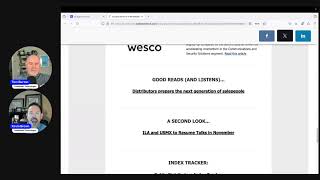
A livestream/podcast episode (Around the Horn in Wholesale Distribution, Episode 114) featuring hosts Kevin Brown and Tom Burton discussing weekly news affecting wholesale distribution and manufacturing. Topics include the U.S. economy and Fed expectations, China manufacturing, Red Sea/Suez shipping risks, Boeing labor negotiations, B2B e-commerce trends (Shopify/partners), generative AI adoption and strategy, sales best practices, coaching vs. training, and supply‑chain monitoring. The tone is conversational, advisory, and industry‑focused for distributors/manufacturers.
Chapters
Keep going, Keep going.
Music going. Turn the music back on. I'll keep dancing. Great morning.
Good to be home. Excited. You were gonna go. Be getting ready to go to the Dodger parade today or something.
Man, that would be cool, huh? Go Dodgers. Sorry to our friends in. In New York that we're hoping for, what they call it, a subway series there.
Subway series.
Yeah, yeah, yeah. It didn't happen. Freddie. Yeah. Freddie Freeman didn't like the idea of that, so that's good. Freddie's a Orange county guy here, not. Not far from us where Darlene and I are. So. Anyways, exciting to watch the Dodger win. I was. I know about you. I was trying to figure out how. How the Yankees could jump out to that 50 lead in that game when they had looked. No offense again to my Yankee fan friends and listeners that are with us, but they just were not. I mean, I. I think you and I talked about this, right. I felt like the Mets could have easily taken the Yankees and. And all of a sudden this, you know, they're. They're manhandling the Dodgers there for. For the first five innings of that game. I was like, this is.
Well, they won 11 the day before.
Yeah.
Right. So. But they. They definitely improved as they went in. You know, they got more disciplined in their.
They rallied when the chips were down.
Yeah. So they were. They were, you know, playing better offensively for sure. But it was clearly their defense and other things that may have at least pitching. Yeah, well, yeah, but I mean, they had 500 runs. Right. All of those five runs in the fifth inning were unearned from errors. Anyway.
Well, hey, you know, let's.
Sports talk show. You want to get into.
Well, there's, you know, pretty. Pretty famous. Pretty famous sports talk show called around the Horn as well. I don't know. Those charlatans trying to ride on our coattails over at espn. No, it's. I just. I hope that. That it's. The big rally and parade today is safe. And the silliness of burning a bus the other night after the wind, it's just crazy.
We had more fireworks here and like, firecrackers and stuff going off after the wind than we had on 4th of July.
Wow.
And it went on for like an hour afterwards. Yeah.
Were you in your new place? Fourth of July?
Sorry?
Were you in your new place? No, but.
Yeah, still in general.
Yeah. That's interesting. Anyways, look. Yes. Good news. Congrats to the Dodgers. And let's see what they do in the off season, who they keep who they get. But I'd like love to see him do that again. So hey, let's jump in and get started. As you said a couple of minutes ago, I'm Kevin Brown, this is my lifelong friend and business partner Tom Burton. We get together every Friday morning unless, what do we say, someone's in the hospital, someone's on an airplane or on vacation. I'm going to do a little vacation in December so we'll miss a week for things. But we get together each week and we talk about the news in wholesale distribution and manufacturing. We look at what's going on in the economy, the supply chain, manufacturing, distribution, e commerce, sales, marketing, mergers and acquisitions, technology, AI, cybersecurity. And what we try and do is review those news items of the week and break them down and talk about how those impact wholesale distribution and manufacturing and supply chain, which is the organizations and the type of companies that we work with. We review that newsletter, that newsletter that I mentioned around the Horn and wholesale distribution goes out every Friday morning, goes out Zero Dark Thirty. It's issue 114 today. If you are listening live with us on LinkedIn Live, YouTube Live or Facebook Live, then you're going to see that newsletter. You're going to see comments coming in from the audience hopefully and, and see our, our discussion live here. If you happen to be listening later in the day or in the future on Apple Podcast, Spotify, Odyssey, wherever you get your podcast, then you won't see that newsletter. If you don't get that newsletter and you would like to, as I mentioned, it goes out to over 10,000 people each week and, and you would like to get that, just send us an email. You can send that to helloadsmartech.com or you can go directly to the website for our podcast which is www.aroundthehornpod.com aroundthehornpod.com. see all of our past episodes there, see Tom's handsome face there. And you can sign up for the newsletter as well at that spot. So if you don't get it and you'd like to, that would be great. Again as we mentioned, we do this, try and do this weekly. We couldn't do this if we didn't have the sponsorship of the company that Tom and I both work for, Lead Smart Technologies. Lead Smart has developed a cutting edge AI enabled smart CRM and customer intelligence solution. When we say smart CRM, it's a very different solution than traditional CRM, that Big Brother type solution that we think about. But we try and take data from around an organization from ERP from marketing automation, e commerce and other silo data within your organization. Bring that together in a central foundational platform to your business. We use AI tools to help make decisions on how to serve the customer better. Gain deeper insights at what the customer's doing, what your sales team, marketing team and other teams are doing, and into your overall business. So that's what we do at Lead Smart. If you're in the wholesale distribution space or a manufacturer and you're trying to accelerate growth in your company and get a foothold into the digital age and digitally transform, we'd love to talk to you. Last thing of our housekeeping before we go today we're at, as I mentioned, episode or number 114. So we've been doing this over two years now and we're appreciative of the audience. The audience is growing each week. We've become the one of the top five podcasts in our space globally, which is just astounding to us that we're at that place. But the way you could help us, if you like the content that you're getting here, is if you're on Apple or Spotify or whatever it might be, hit that subscribe button and leave a review. If you're on YouTube, hit the subscribe button. You'll get an alert every time we go live. If you're on LinkedIn or Facebook Live, just click the Follow button on the Lead Smart Technologies homepage there and you'll see all of our past episodes and updates as well. And then feel free please. We'd love it if you would to share the idea of what we do each week with your friends. So Tom, did I miss anything?
I think you got it.
Okay. All right. You're going to take it away. I finished there. I'm done for the day.
Good, good. All right, so let's get on to the economy. Kick things off as usual with the economy and supply chain.
That's right.
So you know this article, the first one here, US economy grew to 2.8% pace less than expected. I think there were two other pieces of data that have come out since this article. One is the inflation data which was 2.1 and then jobs that came out this morning which were basically non existent. So now there is. Now I'm really up against the corner. I'm like The Yankees down 10 to nothing is I don't know if you'd.
See me salivating or not, but I can see the state.
There's now a 99 as of this morning that the betters in this world, a 99 chance that they're going to do a rate cut at the meeting coming up here next, I guess what, next week?
Yeah, so I looked this morning and I just real quick that the meeting dates coming up are in fact they are the 5th, 6th, 7th of November. So 7th is when the announcement will be. And December 17th and 18th they'll be meeting again. So December 18th. So you got two chances.
Yeah, well, so there's a 99 at least the betters are saying, right, that is 99 chance there'll be a rate cut of a minimum of a quarter percent. And I think that's where they're most people are landing. So I have a one, it's according to the betters, I have a 1% chance to escape this month. But if you look at those three pieces of data, the 2.8% which was slower growth, the 2.1% CPI index which is getting very close to the 2% and basically this anemic job growth that occurred today. Right. It certainly seems like that would happen. What's interesting about all of this is that bond rates are going up. Interest rates on bonds continue to go up. In fact, even I looked a few minutes before we came on here, they were up another 5 basis points today, which is a lot.
And that's the reverse of what.
That's the reverse. Right. You would expect that, you know, bonds would actually increase in price and decrease and in yield. So there is definitely people out there that don't think that the world of at least certainly longer term inflation is going away anytime soon.
Yep.
Which is exactly the opposite of what you would expect. So.
Well, the, the interesting thing, right, and this is, you know, we're kind of seeing this right now is we're living in a different world than we have been in past economic downturns. The stuff we see in the stock market. You know, every day we move more and more towards, you know, automated and computerized trading. There's different things that happen and I think we're going to kind of come out of this with what, regardless of what you call soft landing, whatever, right. Even if we miss a soft landing, it's not as horrific as people might have thought with all of that. But I think we are going to take a look. If we get into this cycle again, which we likely will, we get in the cycle again, we're going to probably have a little bit different view of how we'll get out of it than we have historically based upon the learnings from this time around. I did Though, want to comment? You know, it was interesting because you mentioned the jobs reports there, the struggle with all of that with the jobs report right now and the Fed's full of economists, so they're going to be looking at this as well is you've got the big impact of the two hurricanes impacting the jobs report and then the Boeing strike. So unfortunately the lockout in the Gulf and East coast ports is on pause right now. We're going to talk about that briefly later today, but it looks like that will probably be averted and it looks like the Boeing folks we'll talk about shortly will be going back to work. So that'll be interesting if we see if the Boeing strike ends on Monday. It would be interesting to see what that, how that impact is as we're starting to cycle out and hopefully no other hurricanes coming anytime soon.
Yeah, and I, and I can understand there'd be an impact, but let's, the hurricane issue was very regional, right. It was only in a small part of the country. So it's, it's hard. And Boeing, while certainly there's an impact, I don't know that they were hiring tons of people. So they're again, we'll probably get a revision, right? We'll probably get a revision in two weeks saying, oh no, just kidding, we really had 125,000 jobs or whatever. So take it for what it's worth.
Well there. But they also want to be looking at the loss in jobs and the unemployment data as well. And as that unemployment data comes in and if you stop and think about it, right. It's, you know, with the first hurricane was at Helene, I was in Orlando, you know, astounding winds and so forth, not much destruction. But when that took a left hand hook and went up through the Carolinas, you know, there are towns that were pretty much destroyed and businesses that were, you know, roofs ripped off and so forth. So I think when we start looking at unemployment numbers that that's going to impact there. So you know, we're, we're still kind of in this, you know, we've called it simmering before, up news, down news. My guess right now is we'll see a quarter point in next week and then maybe nothing in in December and then another quarter point or so in January. And I'm sure obviously you're hoping that we see a quarter point in January, a quarter point in February and whatever else they might want to do. But you know, the good news, Tom, is I've been, been trying to drop some pounds so I'm eating a lot less. So, you know, it will be maybe a smaller steak.
Okay. Yeah, they have a small steaks at Outback. That's fine. Yeah, you can get like a sirloin or whatever that, that works well.
Very good. Petite sirloin.
Yeah.
This is quick snack at Chuck's in Santa Barbara. Right.
So we'll get steak bites. That's perfect.
Steak bites. Perfect at Outback.
Yeah, exactly.
You know, Chili's has those too.
Yeah, Chili's is good too. I've heard good things. I think though, next week at this time, right. We will have obviously get the results of the Fed meeting, but maybe more importantly, we'll have the election results. So there's going to be, it'll be interesting.
Hopefully, clear and definitive election results.
Yeah, I think we will. I mean, yes, I believe we will have clear and definitive.
Let me, let me ask you if.
I have people that agree with them, but I think we will have clear and definitive results.
I think that the best thing that could happen would be that it's, that it's clear and defined of what happened. I want to ask you a question, though. I was thinking about that and I like the fact to not talk about politics on this show other than the impact on the economy and distribution. But I did want to ask you a question because in our first article there you were talking about what the betters are saying. Right. And Darlene and I were talking about this last night. My wife. And you know, all of a sudden what these online betting and, and I know that, you know, in the UK sports wagering and so forth is huge. Well now for years and years in the uk, you know, they've been calling all of the, all the major elections around the world through this and now you've got some major US based, what do you call them, just betting companies or what are you wagering?
Yeah, yeah.
But their predictions on things are phenomenal. And the results, you're, you're a Vegas cards guy. I'm 110 reverse of that. Not a card player, not a poker player. What are your thoughts on. And you're a numbers guy. So what are your thoughts on the. Some of those other resources? Because they're calling the election pretty significantly already that it. And all it's doing is magnifying what the, the regular polls are saying. What are your thoughts on that?
You mean as far as the accuracy or.
Yeah, I mean, is that, is that a relevant source to look to?
Yeah, absolutely. They're looking at other. A lot of the polling data is Just that it's polling data, people at.
A mall talking to people walking through.
A mall talking to them.
Right.
Mall, all that kind of stuff. So what they're looking at is a lot more, you know, they're having to underwrite those bets. Right. So they're looking at a lot more data and a lot more information and a lot of just looking at things multi dimensionally and.
Great, great point. So what you're saying, if I get this correctly is they're not out being hired to do a survey, they're underwriting their own financial position and they better be right. That's great. Hadn't looked at it that way. That's why I asked the question. Yeah, but that's, that's awesome.
But it doesn't mean they will be right. Right. It's like no different than, you know, of sports betting or anything like that. Right. You're not always right. But you know, and I haven't seen, I don't know if you've seen, I haven't looked in a week or so with some of the poll number or what some not pull the last I.
Saw things a couple of days ago, it put the Republican candidate pretty significantly ahead. And the factor that I'm interested to see in this, and again we were chatting about this yesterday and it's kind of the wild card stuff is when you have a candidate that's extremely polarizing but maybe their positions, you know, you're in alignment with their economic position. I'll just use that as a simple example. But they're extremely polarizing. A lot of people don't want to talk about that. And you know, I was, they talked about this a month or so ago on the all in podcast that you and I both talk about a lot is there is a substantial likelihood that there is a strong amount of voters that will vote on the Republican side that normally wouldn't necessarily vote Republican but that are based upon policy related things and a lot of it being economic. But the last thing they're ever going to do is allow anybody to know that that's where they voted. So that's kind of. That hit those hidden votes is something that will be interesting to watch.
Yeah. And again. Right. The election is not settled based on the popular vote. It's based on the electoral, electoral vote which are the. By the states which is again a lot of the, I mean you can have polling within a state to get an idea of what's occurring, but going back to even some of the betting stuff you're talking about, they're looking at all of the electoral states, the electoral college, all the different scenarios there and coming up with a But I, I do agree, I, I, whoever wins one way or the other, I would, I think we'd be better served to have it clear and defined and not down to like one electoral vote or something like that. And from one state or another it would, it would be, would be nice to have a definitive.
Absolutely. Yep. That's great. Well, let's move ahead. Let's talk about we've got an article from Reuters as we continue in our economy and supply chain segment here about China's manufacturing activity expands for the first time in six months. So, you know, some interesting data there from that standpoint. You know, there had been some big contractions in China. Manufacturing there had been sick of they talked about it six months. They've got all kinds of issues with construction in China now. The government's come in and propped all of this up and thrown boatloads of money into this at this setting. So it'll be interesting. I did a little bit more research about they were talking about the fourth quarter is off to a good start at least. And it talked about China's uptick in manufacturing and service activities signals a potential stabilization in its economy with some potential implications on the US Side of things. Right. It talks about if you China's economy strengthens exporters, especially in agriculture, technology and machinery could see a significant increase in demand. And so what we're sending there and we have a whole lot of farmers in this country who rely on, on sending grains and different crops and so forth to China. And that's fallen off. So those could be a particularly good factor. You know, if the supply chain, if manufacturing props up and gets a little bit better there, we can look at some little less pressure on supply chain issues. We're going to talk about some other issues related to shipping in a few minutes. But there's a global inflation impact to this too. If China's economy gains enough momentum, the commodity demand that we were just talking about a moment ago could increase, but so could then the prices and all of those price increases are going to trickle down across the board. So it's interesting. The other side of it that got me thinking too though was that, you know, we've had a huge investor pullback from investments in China. And, and if that balances out and it's going to take more than a month or a quarter of that because we've got to see what trickles out of the, of the government just completely controlling that stimulus. But we have to see what trickles out of that and it could, could trigger some additional good investment, global investment back into China.
Yeah, just it's like I said earlier, I don't know, I think we were talking before, I don't know who is buying, right. The manufacturing uptick. Is it, is it domestic, is it exports? Is it. Right. There was a lot of. There wasn't. There was. Seemed to be a lot of missing data kind of how that all.
Well, yeah, and that's a good point. And if we knew that answer. Right. Because if it is domestic, it's just, it's, that's all that stuff sitting in a warehouse somewhere that the government paid to get made and it's not, it's not being used. But there's still, you know, I listen, I was at the Affiliated Distributors Electrical Division national meeting this week and I talked to one in particular, one of our customers, one of the lead smart customers that was there and he popped by the booth just to say hi. We were chatting for a little bit and he was talking about meeting with one of their strategic manufacturers. Not just a manufacturer that they buy from, but very strategic to their business and they still have stuff that are critical to their business. That lead times are still 12 months. Right. So. And those are Chinese made products. So it's, it's. We'll see what plays out of this next, you know. So. All right, jumping ahead to again, we're in our manufacturing economy and supply chain side of things. This ties a little bit together with this article is from. I started subscribing a couple of months ago because these articles were popping up in other news sources. But there's a website called G Captain and it's all about. It's still literally the letter G&Captain.com and it's all about supply chain related to shipping. And it's, you know, if, and if you're a. I'll call myself a mariner with my love for the ocean and sailing and yacht racing. It's actually for me it's kind of geeky to, to read some of the stuff but in general the supply chain news that's in there is fantastic. And the point here was about this whole issue within the, in the Red Sea area and getting to the Suez Canal. It's, it's so bad with what the Houthi rebels that are. And it's interesting. Tom, as a side note, I want to get your thoughts on this in a moment, but it's interesting to see where this is early when this all started early in the year. It was supposed Iran backed Houthi rebels. And now it's just there is no question. And as you read articles related to this, it's, it's Iran backing all of this. And you know, what part of that ties back to the, the conversation we're having about the US economy or the US Elections, I should say, is one of the candidates had Iran kind of backed in a corner a few years ago with no money to back these things because of the embargoes and so forth that were there. So it's going to be interesting to watch this, this play out. But right now, literally, this article was about the German Navy is not even going through there. They're routing ships that would have used the Suez Canal to get to Hawaii for training exercises with the United States that they routed their own naval ships around this. Pretty astounding that, you know. And then this article called the US Effort, USF Navy's efforts. I'm trying to remember what did they call that Operation Prosperity Guardian, which was the US Navy's efforts there. Some of the experts there call it a complete failure so far. So that, that's going to be a big issue as we talk about supply chain issues moving forward.
No one wants to drive through the bad neighborhood where there's gangs and, and things.
Right.
It's that simple, simple part of it. And the neighborhood's not getting any better. In fact, it's probably getting worse.
So I'll get to grandma's house for, for, for Sunday dinner a half hour later by. But I'll feel safe.
That's right.
Great point with that. But let's. I did a little digging additionally and talking about what, you know, let's. And we've talked a little bit about this in the past. But you know, by the way, before I jump into that, I was just looking at a couple of notes that I have here. I hadn't thought of it this way before. I was thinking about it. You know, US Navy's trying to protect both US Interest and international interests by going, you know, trying to solve these issues and stop this problem. There was a, if you haven't seen this, there was a Great segment on 60 Minutes. I'm sure you could just Google Suez Canal Houthi rebels and you know, 60 Minutes, they had their correspondent on a Navy ship and multiple times they had, I don't know if you watched that one, but multiple times they had incoming drones coming at their, their ship that they were knocking out of the sky. And one of the issues Here is the economic impact of that we've talked about before is. I can't remember the numbers, but it's something like, you know, the. Then I'm sure it's not just the U.S. it's any foreign warship that's there. They're spending like $2 million in artillery to knock a $75,000 drone out of the air. Now, that's not sustainable.
Right.
So, but to talk about what's coming through there is, you know, we get in the US Just trying to look at the numbers. Was that from the Middle East? Most of the oil that's coming into the US is going through there to the amount of 1.2 million barrels a day of crude oil from the Middle east is coming into the US the vast majority of that goes through the Suez Canal. As we talk about electronics in 2023, $400 billion in imported electronics and machinery from East Asia. Not just China, but East Asia. And the vast majority of that went through the Red Sea to get to both the US And Europe. So we talk about textiles, we talk about automobiles and vehicle parts, all of those things, and tens of billions of billions of dollars coming through that canal. Everything that we use in manufacturing from minerals in the US the vast majority of minerals and metals coming are coming from the Middle east and would be going through there as well. So, you know, we talk each week about supply chain issues. We've had guests on the show of talking about how closely they're watching their supply chain now. And I think now is the time that, you know, if, if we're doing hiring in our business, you know, hiring some true internal supply chain experts. There are, we've run across recently, had some discussions with some people working on some pretty amazing AI tools related to supply chain. Now's the time to be monitoring our supply chain better than ever before.
It would seem to as well, though, going back to the previous article. Even if China's manufacturing capabilities are picking up, if they can't get it here.
That's exactly right.
Right. If they can't get it through the neighborhood, then it doesn't really matter or it's not going to have a major, major impact on, on some of the supply chain issues. So obviously it's the manufacturing aspect of it and how you actually get it from point A to point B.
How do we get to grandma's house for Sunday dinner?
That's right. And where does dinner come from?
Perfect. Okay, that's very good. All right, so let's dive into our manufacturing distribution segment that we do each Week. Just a quick article here today. It looks like the Boeing strike may be coming to a quick end. Not a quick end, but an end. I talked to no less than three, I think maybe four or five different wholesale distributors over the last few weeks. We didn't talk about this. This is conference and event time of the year in wholesale distribution. If you're part of either supporting your industry associations or part of buying groups. We both supported our partners, Both at the net+Alliance and at affiliated distributors and events. You were at an event. It's funny. Funny. Thomas, a side note I think about that this morning is I haven't seen you face to face in four or five months, three or four months at least. And we missed each other in San Antonio on Sunday, but like in two hours or something like that, probably I was laughing about that. I think you were on a flight as I was leaving and you were there to support the Net event. And I'd been speaking earlier in the morning at that event. So we got to get together soon even, probably even before the state. But, but I had an opportunity in Chicago over the last. I did three weeks of events with affiliated distributors there and talked to quite a few different wholesale distributors who do business with Boeing. One shared with me that this was two weeks ago that they were already up a million dollars in revenue just from the strike. So pretty impactful. But you know what, if you're a machinist, your average wage is I think going up to $119,000 a year through this deal. Not a bad gig.
Yeah. And I, I heard this morning, I don't know, probably has changed by the time since I've heard, but they potentially had another. They were going to have another vote, but one of the things that the union was really asking for was a pension. And there was no pension included. There was a increase in some of how they handle their 401k but there was no actual pension that was being offered to the union. So I don't know that it's a slam dunk that this is going to get ratified and move forward.
It looks pretty. Yeah, I read three or four different articles on this. It looks pretty promising from the standpoint. I think their first. I think the vote is on Monday. The. And there was. I kind of gathered. So I read some stuff from both Reuters and Barons this morning. And the Barons was a. From today and the first deal was like 97% or something like that of the union was, you know, had. Was not in favor of ratifying. Then they got up to some 60% now. And if I read it correctly that this deal, the union itself is suggesting that they ratify what they were doing though with the, they called it the defined benefit pension which was frozen about a decade ago, isn't being restarted. Instead, Boeing will match 100% of up to 8% of an employee's 401k contribution. The company will contribute 4% of employees base pay and that's 20% of base pay going to 401k if an employee contributes just 8%. So that part of it seems similar what they've already done, but the wage piece seems to be likely to be ratified. And you know, there is a point in time too that the unions have to look at these things as saying how is the rest of the world looking at us and how much damage are we doing to not just the country in the world? And at the end of the day, Boeing has lots of other problems. Right. And you probably don't want to become their biggest problem right now in this setting. And you've got a CEO that's trying to keep the company alive and looking at selling off divisions of a company. And if you're the labor union, you know, for the biggest part and the core of it, but you're causing damage to the economy of significance. You don't want to be on that side or not very long at least.
I, I just don't think that's the view that the lens that they're looking at things through. But anyway, hopefully on Monday this can, can get resolved and yeah, and they've lost over a billion dollars in the last month from crazy.
All right, let's dive into our E Commerce and marketing segment.
Let's do it.
Okay. B2B5B2B marketing lessons practitioners can learn from trick or treaters. So I funny, you know, to think of that, but I really like this article.
I thought the article was really well done. I thought that it wasn't just, you know, kind of a clickbait sort of and there was some real good information in there. I don't know if we want to hit on all five of them.
Let's hit on them. We don't need to talk about them at length, but let's hit them. First one was show up with consistency and with a plan. And the, the comparison here was that, you know, older trick or treaters are seasoned veterans and they know which houses give out full size candy bars and they create a route to maximize their sugar intake. So similarly, B2B marketers can benefit from a clear, consistent strategy they need to target the right neighborhoods by focusing on high value accounts or channels where prospects are most active. From there, they must maintain a consistent presence to create brand recognition and trust. All makes good sense to me. You know, know where people are feeding. You want to hit the second and third ones?
Yeah, go ahead. I don't have them in front of me.
Include a variety of Treats Collaborative and communicative are two primary adjectives attributed to B2B prospects and buyers and trick or treaters. As kids prowl around for treats after school, they seek out houses that offer a variety of high value offering read full sized candy bars. And similarly, B2B buyers want diversity in the assets they consume when they ask about their top content. When asked about their top conference content preferences, blog posts, webinars, research reports and infographics all ranked within 1 or 2 percentage point of each other, talks about having a house that stands out in a crowd. Kids know that dark houses are a waste of time and instead favor brightly lit, well decorated homes. To put that into marketing lens, 80% of people prefer to buy from brands whose actions align with their values. Brands that market themselves and make their presence known will fare better than their dimly illuminated partners. I like this because you know, this is more than and we, we hear about this at trade events we're at all the time and you know the focus and push on E commerce. This is more than just saying, okay, I checked the box and I, I bought a third party, you know, e commerce solution and brought it into my business, right? And now I have an online offering or you can place an order online. This is about standing out in a crowd, right? And it's a, it's a bloody ocean out there in this setting within wholesale distribution and manufacturing. So what are we doing to stand out? And then it says personalize your approach to each costume. It says, just as an 11 year old in a scream mask warrants a different reaction than a six month old in a pumpkin onesie. Each process prospect should receive a tailored approach. Whether you're addressing a C level executive or procurement specialist, tailoring your messaging to resonate with specific audiences boosts engagement and credibility. So Studies show that 89% of marketers experience positive ROI from personalization and 60% of customers are more likely return after a personalized experience. Tommy, why don't you unpack if you don't mind. Just, I'll read the last one in just a second, but why don't you unpack personalized experience briefly in E commerce?
Well, it's not just E commerce Right. Yeah.
So marketing in general, I should say. Yeah. Thank you.
I mean I think we talked about this in a previous episode a couple weeks ago is a lot of times personalization people think oh, you put my name on there. It says yeah, whatever. But, but, but really right. It. And I know we're going to talk about our favorite topic AI here in a few minutes, but no, we never do that. It's really understanding. Right. Who it is that you're t. You're the company and the people within that company that you're talking to and ideally probably knowing them a bit better than they know themselves.
Right.
And then personalizing the best that you.
Can.
Not even just the message, but you know, it goes back to the content they were talking about. Right. The what content is most relevant to that company based upon where they are. So I'm not saying it's easy. Right. No, back to the. Go back to the trick or treater thing. Right. You have to kind of, you know, look at. See where, which houses, which neighbors, what.
Areas.
May make the most sense. You might have to do some research on that. The same is true with from a marketing perspective is knowing what those things are there.
So know your audience and know what.
To be about relevance than it is how do you become ultra relevant? You become ultra relevant by being more personalized towards that to that organization.
Great.
Good.
So last. Last one. Be aware of sugar overload and keep it balanced. Parents raid their kids Halloween buckets for a reason. Too much sugar isn't great and neither is overwhelming prospects with endless emails, pop ups and sales pitches. So they talk about a balanced approach. So I like that.
My favorite one.
Yeah, very good. The. I did. I like this sometimes. Right. We. Some of this stuff can, you know, get a little drab and a little bit, you know, difficult to consume over and over again. But anytime we can start looking at, you know, this and this ties back to everything, you know, this is talking about. About marketing and specifically digital marketing and so forth. But you know, understanding your audience having a plan executing against your plan goes across all facets of your business, specifically sales and marketing and E commerce as well. So. Good stuff.
So. Well, it's interesting. I just. When I was reading that article, I was thinking back to my trick or treating days and well, you. You know the neighborhood we lived in. Right.
So that you're thinking about when. When you put all that dish soap in the Naples island fountain.
Yeah, that. That time. Yeah.
Okay. Oh no, that wasn't you. That was another friend of ours.
Yeah, that was another person, but I'm.
Glad I wasn't there.
But there was one of the things you would always do right. On when you were trick or treating is you would identify the houses in advance that you thought would have the best stuff and then you would go there first. Even if they were out of the way, you would go there first because you didn't want them to run out. Right. So you wanted to be one of the first people to get, you know, some of the good stuff and then maybe go back later, even a second time if you could. And it's, it is interesting, right. When you kind of take this parallel between those two things. There's actually a lot to learn between those two that are there.
I could see you right now if you were, you know, a 9 year old or a 12 year old that you would have your lead Smart Channel cloud app on your phone and you'd be using the geoplanner tool within there and the mapping tool to, to plan where your houses that you're headed to are, right?
Oh, I would. And I'd have AI telling me exactly.
Yes. The propensity that they're serving. Yeah, serving the right stuff. That's great. All right, enough of Halloween. So glad I wasn't with you during that time. The next article, Fast Simon unveiled a new no code Shopify B2B solution. I Tom, I in all transparency, I haven't investigated this enough to know yet the depth of what this, the capabilities are with this. But I will tell you, I have been wondering for a year or more when Shopify was going to really come and try and make a play in the B2B world.
Right?
When you, when you look at what Amazon is doing with Amazon business and so forth and you look at that from that standpoint that what their impact is. You know, historically Shopify has been a simple B2B or a B2C tool get us get a store up and running. But it's become their, their marketplace of apps to plug into. Shopify is probably top five of any online platform, not just E commerce, but whether it's, you know, smartphones or Microsoft Dynamics or Salesforce App Exchange. In that setting their app exchange is phenomenal. It's huge. It was just a matter of time before there was a big, big deal. Now this is this Fast Simon it's describing as a no code tool is from one of their partners. But I think this has been long awaited and we're going to see a lot more of this coming from them.
Yeah, I had a conversation with a E Commerce vendor at the Net plus show. And I asked him, I said, who is your biggest competitor? And he actually said that Shopify is becoming one of his biggest competitors.
Okay.
Which was not the answer I expected.
Yeah.
And this is a total B2B E commerce play that's there. Yeah. So I mean Shopify, I have a lot of experience with Shopify. It's you know, much easier to use in a lot of ways but you know, does it. Again, I don't know enough about what this product does. I've never set up Shopify in a B2B environment, tried to tie it into my ERP, all of those types of things. So I don't know, kind of at the end of the day what the logistics. But I asked him, I said, why do you think Shopify is so prevalent? And his answer was it's inexpensive, relatively inexpensive, relatively easy to set up. And there's a lot of people that know about it. And that's why it's getting traction in the B2B world even with wholesale distributors, which again, I wasn't expecting that answer.
Yeah. So they're talking. So I'm glad you brought that experience there. So they talk about customer specific product publishing, price lists, search by sku, part number, manufacturer number, product finders, boost store performance and SEO. Now I'm very confident that if we had our friends from Optimizely or any of the other, you know, full stack e commerce companies, the probably the first thing that's going to come out of anybody's, anybody's mouth is yeah, but this isn't ready for primetime. From a standpoint of when you talk about somebody that's got, you know, tens and thousands, if not hundreds of thousands of SKUs with challenges with their product data and so forth. My reason for sharing this today is, and I'm gonna, I've been involved in a Shopify store myself before and there was, you know, 2020 SKUs on it is all. And I'm gonna guess your, your experience with Shopify is probably sub 100 SKUs. So now when we start. Go ahead. I'm sorry.
No, that's right. It's not thousands.
Yep. But now we start talking about tens of thousands or hundreds of thousands of SKU with, with, you know, with description and data challenges where they're needing to use a, you know, a PIM or a product information manager and other tools. I don't think that then this is going to be able to hold a candle to whether it's a unilog or an optimizedly or whoever it might be. But my thinking on this is, and it's just funny to read this article, is it was only a matter of time. I've thought about this for a while, but where's Shopify here? And here they are. Here they are through a partner. And my guess is, you know, Shopify is looking closely at this and say if we can get some traction through this partner, you know, and for all we know, they've got, you know, 100 engineers working on this right now to come into this space. So we'll watch it. You know, that's what we try and do here, is keep an eye on things that are changing and, and news that are relevant to manufacturers and distributors. So I could see this before we jump ahead. It's just triggered for me. I could see this be a play for manufacturers to jump in easier because they've got a finite amount. Everybody has a finite amount, but a far more limited amount of SKUs than, than a distributor would have that's representing hundreds of manufacturers. So good. All right. Technology, cybersecurity and AI B2B companies scramble to reap gen AI benefits. We're hearing more and more about this. Tom, do you want to chime in on that to start?
Well, I mean, again, we've talked about this before, right. Is a lot of the, I'll call them early adopters or people that have jumped in with AI and business have not. Have not gotten the results that maybe they quote, unquote expected.
Yep.
But, and I think this article talks about this. It's not necessarily because AI is bad or AI doesn't work. What it usually ends up coming down to is that either, you know, people wise or infrastructure wise in the organization, you're not prepared for taking advantage or using AI. And that's what they were pointing out in here is, you know, some of the reasons that are that they're struggling. And you know, one of them that is very common is AI because of its. If it's. Of its need for data. Right. And it's fueled off of data. It's very hard to run a really good AI strategy with 50 different, what we call point products or individual products, all with siloed data that are not really harmonized between themselves and driving that. And so then you end up with all these different sort of scenarios and data sources and so forth, and it becomes noisy and messy versus productive.
It's hard to find signal. It's hard to find signals about what's happening with your customer and your business and your industry when you have data. That's, and I love the term that you use harmonize. When you, excuse me, have siloed data across your business, that's not harmonized. Right. And that's what people are doing right now. That and I heard this affiliated distributors industrial meeting is that in one of their industrial and safety meeting, one of their, their roundtable networking meetings was the discussion that some people were saying hey, we're not getting return on investment from our yet from our AI investments. And I was talking to a distributor about that that mentioned it to me and I said, you know, I, I, I, my guess is that's going to tie to two or three key components. One is they, they first off they don't have a plan. Right. Which this article talks quite a bit. There's no structured plan for how this is going to align in their business long term. Two is they bought a point product that maybe, hey, this is a nice tool to help, you know, product recommendation for inside sales. Well that's a point product. That's not a platform that goes across your business, that brings AI across all facets of your organization through all sources of silo data. It doesn't take a look at, you know, a lot of things like that. And there's, there's tons and tons and all we're going to do is continually see more and more of these, as you referred to one off point products that are software that can't move across your whole business. It can't be expanded upon. There's, you know, not enough people that understand how to build on it even if they were allowed to, versus a platform. But it really ties back to, you know, putting tactics and strategies in place. This article says resetting strategies around customers and building talent that can blend human and machine competencies. Right. Buying a piece of off the shelf software that's not expandable within your organization, that tells an inside salesperson, hey, you could sell this product to that account. That's not a strategy for AI, that's I bought to your point. I bought a one off product and I hope for the best.
It's a tactic for AI, it's not a strategy. But AI inherently because of its need for data and its use of data and what they're doing almost inherently requires more of a strategic approach, tactical approach in order to get the ROI expectations that you're, that they're looking for. Yeah, so anyway, it was, look, this is all part of the process, right? A lot of early adopters jumping in and, and you know, trying things early, which is fine. But I mean we've seen this on all kinds of technology and new innovation. This, this happens all the time.
So yeah, I was just looking at some. So January 1, 1983, the Advanced Research Projects Agency network, ARPANET and the Defense Data Network switched to the transfer control protocol. Internetwork Protocol. Right. So the official start of the Internet was 1983. It was probably 85 or more before it really started trying to see business uses. And guess what somebody that said hey, I bought a dial up AOL email address is. And now I have access to a. What was the first browser? Was it Sun Microsystems who had the first browser? Tom?
Oh, there's Netscape. Netscape.
I'm sorry, Netscape. I wasn't Netscape from Sun.
No, no.
Anyways, the, I was very analog still at that time. But, but you know the same conversation right at the end of the day was oh, we, we went and got, you know, the Internet, you know, an Internet connection into our business and, and now we have access to the Internet. It hasn't changed my business yet. You know, 18 months in to these types of things and we're at the same exact inflection point for that that says look, you needed a strategy of what you were going to do in your business not to go buy some one off product or something like that that was supposed to change your life. It was what is this going to do for me in 12 months, 24 months, 36 months or even more important when I succession plan with my family members that are taking over our independently owned family company, what does it mean to my grandkids? Right. Those are the, those are the conversations that should be happening in, in executive meetings, if not board meetings now.
Yeah. And anyway there's a few things I could go into but I'll save it for, for, for later on that. But it's, it's is part of it is that and I think this is such a fundamental paradigm shift, if you want to call it that with AI applications versus traditional software tools that you purchase. When you look at an AI application, you almost have to look at it the same way as though you were hiring an employee. You're looking at that application as to what job you're quote unquote hiring it to do. And that's not how people generally buy software. Right. They buy software based around well I need a tool to do so. And so I need a tool and tools are not necessarily data driven. But when you hire an employee, what's the first thing you do with an employee? You try and Train them on as much information as you can about. And you generally aren't siloed. I mean there is certainly siloed aspects of it, but you want them to know your business. You go through onboarding and orientation and all of those things so that that employee can be as effective as possible. When you look at an AI application more as in a digital employee that has been hired to do some job and then you think about how you onboard and employ and what is required for that, it starts to, it starts to switch the paradigm, thought process, how you do it. You can't use AI with the same thought process that you've used traditional legacy software tools. So that's.
Anyway, that's sounds like a book you could write.
Well, we're working on a new workshop on this, so.
Yep, absolutely. We did some work together on that yesterday. Well, we're, I mean let's just call that what it is. Right. We're got a couple of major, you know, billion plus dollar companies that we're presenting that to shortly that help them understand on their digital journey. So and I think that before we move on from this, the we got an article coming up talks about culture and adopting emerging technologies is this is a pivot and it's a mindset and let's just, you know, we're hearing that, you know, depending on futurists and you know, there's quite a few. I, I like to. Sometimes I worry about the word futurists because I think people don't necessarily put as much stock into that. But I have a good friend, Sean Dubervack who's a futurist, but he's also got a PhD in economics and I don't know how many other degrees. Right. So super, super bright person and. But there's people like that out there, right that are talking about, you know, AI having nothing having been invented. I'm not saying Sean said this but I mean he's a big proponent of this statement I'm going to make. I heard from Zach Cass who was one of the early folks at OpenAI and the ChatGPT folks would commercializing that. You know, the comment was look, AI could have an impact on us that's greater than anything since fire right was discovered. But let's just say it was only as impactful on as the. The the Internet is. Has been to us. The world is a completely different world since 1983 when the Internet became available. Right. It's a, it's a completely different world. So what would we do if I a wholesale Distributor or manufacturer. If I looked backwards into my business, if I was around in my business during that time, what would I have done differently in how we implemented using the Internet? Right. And what would I have done faster? What plans and what architecture and what goals and what's infrastructure? What would I have done differently in adopting the Internet in 1983? Or let's just say it was the 1990s to, to impact my business, to get return and investment. What would I have done with my people? What type of hiring would I have done? Look at that now. Let's just say it's only going to be as impactful as the Internet was versus exponentially more. Now's the time to set a long term plan for AI and be not just trying to grab a piece of software that says it's going to do this, but what are foundational AI tools to my business.
Yeah, I agree with that. I mean, I think you want to skate to where the puck is going.
Yeah, very good. Right. And.
The AI is not going away. It's only going to get more prevalent and better. But the winners are going to be the people who I believe prepare now. Because yes, AI in and of itself right now is still in its early immature phases.
Yep.
Right. But it's improving and changing every single day. So anyway, this kind of ties into this next article, right. Which is about culture and talking a bit about, you know, hey, are you risk adverse or are you kind of a pioneer and a maverick? And when it comes to adopting technology, you know, even if you're very risk adverse and you know, we have been at least smart, we've not released a lot of AI stuff.
Right, thank you.
Mainly because I'll just be for myself. Right. I'm not generally a conservative person related to, to technology, but I am a bit conservative when it comes to commercializing technology that others are paying to use. Right. And making sure it's at a place that it actually is going to provide at least a reasonable value based on what we're actually presenting or doing there. And AI has been on some of the things we've been working on, not quite ready for that commercial use yet. But I'm not, it's not a matter of, it's not that I believe, oh, AI is not going to work. It's. And as we tell our customers, right. The best thing we can be doing, even if you're risk adverse, is preparing foundationally so that as the technology matures and become more predictable and reliable, then you're not behind the curve.
Right. I had that article open I was trying to look at and it started to play music. So sorry about that. I think this is, this is good. There was a good chart in there that talks as well about if you want to read this article, it's from Supply Chain Exchange. Good chart about you know, different adoptions and related to technology and emerging technology and gen AI in the supply chain world. So you know, the respondents to the survey said that they saw it as one of the most potentially transformative emerging technologies over the long but so many of them it was rated as one of the least currently important technology. And that just is so backwards right that you're hearing people saying that. So I guess the takeaway is investigate, learn, become knowledgeable, bring people together. We talk about this all the time about having, whether you call it a SWAT team or a task force or whatever of a group of people, people in your organization that are working on these things and don't just start throwing money at you know, to your point earlier at point software products or one off software products. Look at the foundational AI related technologies and then look at those siloed pieces of data that we talk about. We've got disparate data.
Right.
And, and I'm so appreciative. Tom, you brought up the point too about you know, with the company that we work for at Lead Smart is it's interesting. I, I've, I've watched pretty closely in the last year or so some of the companies that we bump into in the marketplace that claim to be AI related companies that are doing, making announcements either about AI related tools that are super and big announcements and stuff are super, just call them superficial. Right. They're not, they're not game changing AI tools. And then others who have made announcements, significant announcements about things that they do but they've but six, eight months later haven't even launched them yet. And so and you lead product at our company and I'm very appreciative of the fact that you've not wanted to come out and you know, we're showing some things that we're building that are pretty advanced and pretty amazing to some key customers but launching them before they're ready to fully baked and ready for prime time is, is, is not the right thing. But I think right now what people need to be doing is figuring out is who are the technology providers that you understand, you know, understand this and can be your partner and your guide versus just somebody that's going to sell me something and go away.
Yep.
So good. All right, let's jump ahead. We got a few other articles to cover today sales and M and a segment how to increase sales without discounting. Some good key points in that some of them if you're a sales leader you've probably heard quite a few of them before but I liked a few of the things that they mentioned in there that are helpful talking about alternative strategies and one of the things that talked about we think about bundling and so forth but talked about trying to do maybe embracing a non discounted limited time offer. So maybe there's something special you can offer in a short term but it's not lowering your price for the long term just to get a deal but it talks about things like brand loyalty and customer experience and product quality and there's a few others in there and you know sometimes Tom we post or you're all run across articles and ask you to put them into our newsletter and they seem maybe rudimentary thoughts but sometimes the most rudimentary thoughts are the things we need to hear. Right. Because we veer from the stuff that we know. We just need to be reminded.
Basically what this article has said is hey, before you just go discount, take some of these ideas and brainstorm see if there's another way rather than just dropping your price and you know, kind of the race to the bottom.
Discounting is the easy part. Right. So we had another article from Forbes 5 key challenges for salespeople to survive and thrive. This was good. This had some great stuff. We're again in our in our sales and M and A segment it says market knowledge to anticipate the customers tomorrow. Now that sounds so simple to me. But then if you stop and think about it, I can't tell you the amount of times when I was both on the manufacturing side and and prior to that a man working as a manufacturer's rep in the industrial segment of going to facilities with a salesperson to try and help them and do some coaching and product knowledge and seeing some end users with them where you know, I always use the term they walk my and no one's ever argued this with me that that most salespeople walk by more business than they have. But the big issue is when you start asking about, you know, how many plants do they have, how many buyers are in this facility, what's their big initiative for the year, how little of that they know. And I I have experiences really the ones that really resonate with me are being in the auto industry where you know, I've been with with salespeople where they'll they'll take me in to visit and there's, there's one buyer that they're seeing, but we're in the buying office and there's like eight buyers in different cubes and leaving. I, you know, would ask somebody, well how many of those buyers other buyers could be representing departments that could also use our products? You don't know. So. Right. Understanding that talks about market knowledge. Anticipate the customers tomorrow, what's going on in their business. Collaborating inside and outside your business as a team. Salespeople shouldn't be self sufficient. Right. It's a collaborative effort that includes in this day and age, it really needs to include the customer. They talk about leveraging virtual channels and digital tools. Sometimes we have salespeople that are adverse to digital tools because they think it's going to impact their income. So fourth was getting customers power from data and analytics. We just were talking about that. It references AI suggestion. AI based suggestions about competitive brand threats, renewals, product offerings, what they aren't buying versus what they should be buying. Those type of tools and then being able to adapt was the fifth one to constant market changes. So good reminders, good thoughts in those. Any thoughts for you before we jump ahead?
Well, I mean there was kind of a summary of those things though. But one of the things I think really becoming truer and truer every day. Right. As a salesperson, we've talked about this of course, is that your job is to be more of a consultant than it is a salesperson. But really where your value becomes is not only just knowing about your immediate prospects business, but the more that you can know about the businesses that they sell to. Right. And the more insights that you can provide to them. Which again if I really want to be valuable. Right. And I do my homework, which isn't that hard to do. So if my customer is, is, you know, Acme Contractor. Right. If I'm selling to a. But Acme Contractor is selling to a whole nother set of customers as well or in a whole different region or a whole different scenario. The more I can know about not just Acme Contractor, but what ACME Contractor needs to do to be successful, the better off I am going to be and I will be invited in to the conversation rather than pushed away.
It's a great point about being invited into further conversations with your customer. Right. When you're an asset to them, you get invited to bigger picture things.
And the beauty of this is, is the ability for virtually any salesperson and I was talking about this who was I talking about, I think this was talking dirt Beverage about this a couple days ago is more and more right. With again with AI and some of the other things, you can hire a salesperson and through the technology and the tools make them super effective and super knowledgeable. Much, much faster than you could. Right.
Learning curve. Learning curves are shrinking.
Right. Right. So anyway, that was kind of the key takeaway. Good article, I thought.
No, I like that. Good, good thoughts with that. All right, so on to our segment about people and leadership. You mentioned Dirk Beverage. Dirk helped us get the thought process to add this segment earlier this year. Appreciate that. And so thank you for that, Dirk. As we look at this, we go to what did I miss here? There we go. Smart. Brief.com shared this article. Industry pioneers bust five myths about coaching. You had a few thoughts on that when we were chatting before we went live today. Want to share some of those?
Well, I think the article, in the interest of time, I'll hit this quick, but what the article was basically saying, right. Is don't, don't look at coaching and training as the same thing. A lot of times people think, well, coaching, I'm just training somebody how to do something. And really with coaching, what you're doing is helping that person become a certain, you know, to achieve a certain skill level and, or achieve a certain outcome by having that skill level. You can train somebody all day long and they may or may not have that skill level and be able to get that outcome. And coaching is something that has to take place over a period of time to accomplish that. Right. You can train somebody on how to be a. Here's how you become a good golfer or a good basketball player, but somebody, if you're not coached and work towards that outcome, you're never going to become a good basketball player. So I thought that was a good. One of the key points in there is the difference between coaching and. I do believe more than ever. Right. That we, all of us as companies, we need more coaching help regardless, you know, going back to our technology discussion and all of those things because of just so many things that are going on and so many changes that are there.
Well, the best of the best in all things in the world use coaches. Right.
Okay. Yep.
Right. So you won't, you don't find an Olympic athlete that doesn't have a highly, highly skilled coach and that coaches, you know, taking the someone that's already good and going from good to great, so to speak, and they're typically, they're not taking somebody at an elite level an elite level of coaching. They're not taking somebody and saying, you, I'm going to teach you how to pole vault. They're going to say, I'm going to take you from this level to this level, which is world record breaking, even though it's only a half an inch of a difference. Right? It's the elite of the elite of the world. And I say that and it's like, I don't have a coach, but I probably should, right? And for what, you know, what you and I are trying to accomplish with our company and the business initiatives that we're working on and I guess we do. We've got Will with our EOS implementer at some level in there. But this is good and it really, I think this article one is taking advantage of coaching versus training. I had this discussion with one of our, one of our customers, it was Tuesday of this week and he was talking about, you know, the, the forecasting and, and budgeting for pipeline growth, the tools that we have within Lead Smart Channel Cloud, our technology tool. And we were talking about, you know, how to use that with his team better. And one of the things that I brought up is, you know, when you have that data that's on a foundational technology platform to your business and you know, we talk about, you know, the difference between CRM and other technology tools and smart CRM, which is very, very different. If you want to unpack that ever and learn more about that, I'd welcome a conversation with any of you. Is but foundational software that's triggered around smart CRM where you have the silo data in one place, the salesperson has done their forecasts, you've worked with them on their forecasts and budgets. Now our meetings become meaningful. And what I was talking with this particular customer about that the other day was now coaching becomes very different. Whether you're meeting at him at Tim Hortons at the side of the road or you're in a conference room working with him or a team that data all in one place. Everybody's the old saying, right? Singing from the same hymn book becomes very different in game changing in what we can accomplish in our business. Good. All right, Tom, as we move through this, still in our people and leadership segment, we won't go deep into this, but LinkedIn has debuted an AI agent to source candidates that'll be kind of cool. I'm going to dig into that myself a little bit more and, and learn about that. So that was kind of it for those articles. Each week we publish a industry Scuttlebutt that talks a little bit about growth and M and A. And I should have done this earlier. If you're listening on our, on our podcast and not seeing us, we're reviewing the newsletter that we publish and send out every Friday. It's called around the Horn. And wholesale distribution goes out to about 10,000 people. If you'd like a copy of that, just email us@helloadsmartech.com or go to www.aroundthehornpod.com and you can get that information. Subscribe there. So, Tom, site one landscape Q3 results rise. That's a landscaping wholesale supply company. Granger talked about Q3 sales earnings climb, but margins slipped. Wesco on the electrical side of things reports strong, close to its third quarter. So a little mixed results. We could have put others there as well. So the, the other side of it, though, is we have each week a segment called A Good Read. And that Good Read talks about distributors Prepare for the next generation of salespeople. It's an article from Sanitary maintenance actually@cleanlink.com Cleanlink.com is a sanitary maintenance magazine website. And that is mostly for the janitorial and facility maintenance side of things. And great article I thought there that's why we put it in with a Good Read. Talked about the difference between traditional salespeople that are baby boomers and, and maybe a little bit younger that are moving towards the latter part of their career. And what do we need to do as we start talking about millennials and Gen Z's and all of these others. So anything you took out of that that you wanted to share before we jump?
No, I think it just aligned with a whole bunch of other things we've talked about today.
So, yeah, very good. It was good. It's worth a read at that from that standpoint though, as well. It just talks about, you know, what people are thinking about in younger generations and finding meaning and purpose in their job. And we've got to be looking and thinking about things differently. And you know, we talk to people all the time, Tom, about, you know, I think the number right now is 62% of B2B buyers are also millennials. And that number is going to be coming to that next generation soon, too. So they work differently, they buy differently. And it's safe to say that if the 62% of B2B buyers are such, there's probably 62% or more of your incoming salespeople are going to be that as well. And they do things differently. So that's it. Last piece we had today in our news segment was and it's just we have a segment where we revisit some topics in the past. It looks like now we've got some clarity on when the Longshoremen's association and the east and Gulf coast port folks are going to be back to the table talking and hoping that that pause that they have on that particular strike not only remains a pause, but they come to an agreement. And with all of the other things that we've talked about today related to supply chain early on, that that isn't an impact on supply chain. So that's about it for the day, huh? Good stuff. Sounds good. Yep, very good. Well, we appreciate everybody being with us. If again, as we talked about earlier today, if you like what you hear when you join us, whether you're listening on the podcast, you're watching us live and looking at the newsletter, if you like what we do, wherever the location you're gathering this information from, punch that subscribe button or the Follow button, get the alerts that the show's going live. And certainly if you have an opportunity to do a review, whether it's some notes you want to leave on the Lead Smart technologies page on LinkedIn Live or Facebook Live, share with us your thoughts about the show. Maybe forward this episode if you like, to some friends that might want to come each week. Certainly if you connect on LinkedIn with Tom or myself, we'll send you an invite as well, regularly. If you're on the podcast formats though, Apple, Spotify, Odyssey, Amazon, whatever it might be, hit that subscribe, leave a review and that'll get us out in front of other people that can gather that information. So finally, in closing, we couldn't do this each week without the sponsor of our program, Lead Smart Technology that Tom and I work for. We shared a little bit about what we do today with foundational AI enabled smart CRM that brings that silo data from your business together for actionable insights. If you would like to talk with us about that, we'd love nothing more than you to use that same email address, helloed smart tech.com reach out to either of us on LinkedIn and we'd love to share discussions with you about your planning for your digital journey as well. So Tom, that's about it for me. Any other thoughts before we go?
Nope, it sounds good. I think we're ready to wrap.
Yep. Have a great weekend, be kind and do great things.
Thanks everyone.
More from Tom



What does AI actually mean for a wholesale distributor #WholesaleDistribution


If your systems don’t talk to each other, your AI won’t either #AITransformation




This is why one AI agent isn’t enough for high-stakes decisions #WholesaleDistribution

