The Secret to Consistent Sales Wins with Dave Lambert
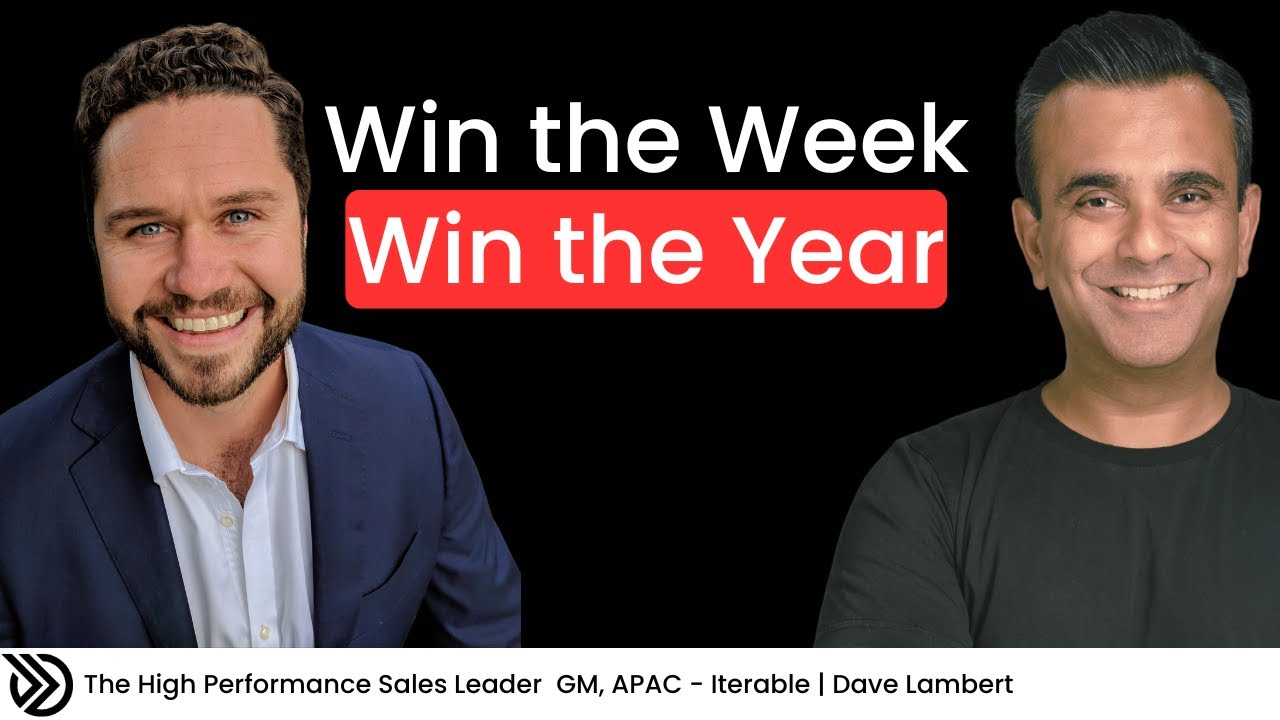
Dave Lambert, GM at Iterable, built his career jumping between roles, industries, and countries. He focuses sales teams on weekly controllable activities and calculates exact outreach needed to hit quota. His approach: hire for adaptability over experience, say no to distractions, and make performance decisions with data, not emotion.
Chapters
What did we do in the beginning? We simply worked out what did we have to do every week, Monday to Friday, repeat. What did we have to do to bring the quota in? What are your sources of pipeline? I bet what you have is a couple of BDRs and some account executives. How much outbound do they need to do? Be very conservative. Imagine nothing happens through partners and nothing happens through Through marketing, how many people, new humans every week do we need to contact? How does that convert into meetings, into opportunities? You basically go from your quota and you think about the conversion to get there. And that will tell you exactly what you need to do that is within your control. It's just the boring basics. Somehow make it fun.
Welcome to the High Performance Sales Leader Podcast and my guest My guest today is Dave Lambert, and Dave is the general manager of Iterable, and he is building out in region where he has recently achieved President's Club in 2024. And prior to that, he was the VP of APJ for Medallia and was with them for 9 years, where in 2018, 2019, 2020, '21, '22, he achieved President's Club as well as Global MVP. So Dave, thank you so much for joining us today. I've got a ton of questions and just want to get into your story.
Thank you, Pri. It is my absolute pleasure to be here. Thank you for having me on.
Now, one of the things that I noticed when we met is that you didn't have the typical SDR, AE, enterprise sales leader. You've had a very different journey starting out with consulting, you know, in Australia, then London School of Economics, then the Valley, and now in Australia. So How did that come about? Tell me about it.
I mean, very good question. That's the same question that the co-founder of Medallia, Amy Pressman, asked me when I was interviewing with her in Palo Alto. You know, this Australian boy who like grew up in Tamworth. And she was like, it was actually a very interesting interview because she said, and I think she was trying to see how I'd react, but she said to me, I think you've thought very linearly about your career and actually you haven't really taken much risk. And it really struck me because it was the opposite of how I have, how I thought about my career in that I think about my career, if I think back on it with hindsight, I think about it probably in 4-year stints. And those 4 years can be within a company as well. Like I think you could have multiple 4 years. Which is what happened at Badalia. But yeah, I started my career 17 years old as an auditor at Ernst& Young as a trainee. And then I worked out, I think that I worked out how to be a professional. I think I also worked out I didn't want to, didn't want to be an accountant, which was a great thing, probably, probably to learn early. And if I think about everything along the way, it's always a mix of performance and luck. I think that's the spectrum that I kind of think about. How much is because of the past and it's a result of that, but also you have to, or at least in my mind, you have to go, there is luck being played here. And when luck happens, maybe it's because of the performance, maybe, but also maybe it just happened. Like step through that opportunity if you can kind of see it and maybe you didn't see it happen before. So yeah, then I got into strategy consulting because I don't know, I just thought that would be That would be exciting, right? Solving problems, talking to boards when I probably shouldn't have, you know, in my 20s and all that type of stuff. Learning to storytell with data. Then I got another lucky break in a SaaS company as product marketing. And I think that kind of taught me about the SaaS thing. You know, that's kind of interesting. Like, how do they do that? And then along the way, like, if I think about how I got into Medallia, it was about leveraging the good stuff from the past, the things that I legitimately could hang my hat on. You know, they were looking essentially for a very analytical person with strategy experience. That was me. So I did not have to change my resume at all for that role, which I think is very important. But then when I was in there, I started to think about All right, what's this next, like, what's the next thing in here? And that's when I realized sales at the right company, particularly in B2B SaaS, is not a dirty word. And it was prior to that, I would say. It can be very strategic. It can be very, it's a puzzle that is solved as a team. I like board games. I like video games, things like that. So I think it's cooperative. While you are competing against something else. And that's when I started to think, hang on, how do I use the next 4 years, like the first 4 years at Medallia, to get closer and more important to this sales engine? And then, you know, a bunch of other things happen. But if I summarize it, think about your career in 4-year stints. Take what you've got, you know, to get the next job and then work out while you were there, What am I going to learn in the next 4 years to get to the next thing?
That's brilliant because I think the theme that I'm hearing is really about stepping into the opportunity that's in front of you and then becoming that next-level person of whoever you can be until the next opportunity presents itself, whether it's internally or externally.
Exactly right. Exactly right.
So you have done the triple jump. I love that concept. Tell me for people who are going to listen to this, what does that mean?
What's that? Yeah. So the triple jump comes. So I'm now in B2B SaaS. It's fantastic. I love it. But there was a time when I thought I was going to be a strategy consultant the rest of my career, and I was excited by that. And what you do if you're a strategy consultant, you get to a certain level of experience, you go do an MBA. So I went and did that. I was lucky enough to do it in London. And they make you think very hard about your career before you get in. You know, you have to write big essays, you have to convince them, all that stuff. And then I remember at the opening speech, I don't know who it was, maybe it was the dean, I don't know, somebody. And they said, we know you've spent a lot of time thinking about your career. and what you'll do, please forget about that, right? You now have one of the luckiest windows ever where you have 2 years of time to really think and explore things. And the next thing that person said was, think about the triple jump. And I'd never heard of this before. And the triple jump is changing roles, changing industry, changing country. Maybe somebody can think up what the quadruple jump is. I don't know, right? But that kind of stuck with me and I was, it kind of became a goal, which I thought was really interesting. How do, what would my triple jump be? Now, when I, when I left my MBA and my first role at Medallia out of that, I really did a double jump, I would say, because the triple jump, if I look at my, my peers and my classmates and all that stuff, the triple jump in itself is very hard to do. But I think the double jump is doable. I think a one jump is easy, right? Or should be within everybody's grasp. But like, can you get the double jump? And then can you do the triple, the third jump in your new role? Which is exactly what happened to me. So I got to move to California. I got to go into an incredible scale-up, a B2B SaaS company, which was a life-changing experience for me. But essentially, I got that job because I was doing the role that I had experience for before. So that was like the legitimate entry into there. And then it took 4 years, right? Like, I don't want anybody to think like you can go change this in a year or 6 months or, you know, that type of thing. You've gotta chip away at it for some time and figure it out. But that's when I got You know, into different sales roles after that within Medallia. So that's the triple jump. If you can do all 3, incredible. But I, yeah, I think it's really exciting if you can think about the double jump.
Yeah. Well, I think what's very evident given the fact that you've lived in, you know, different continents, you've worked in different industries and you've worked in different roles, And I said this to you when we met, is that you come across as a person who has a high degree of behavioral variety. Now, the concept of behavioral variety comes from neurolinguistic programming, which is the psychology of success. But basically, it started with them studying what makes the world's best fill-in-the-blanks— athletes, pilots— what makes them the best. And One of the concepts was behavioral variety. That means you have high adaptability to the situation. And a couple of years back after COVID, there was a term called VUCA, V-U-C-A, volatile, uncertain, chaotic, ambiguous, which came from the Navy SEALs. And though we are not in COVID, the aftermath and the market conditions of ambiguity Volatility, uncertainty, that's really where leaders who have behavioral variety have continued to thrive. Whereas the person who's been at IBM for 17 years or been the account executive selling to public sector for 17, they have really, really struggled. So I think that's no surprise why You've been successful doing what you're doing.
Wow. You know what? I think it's very interesting what you say because there was a time, probably 15 years ago, I was very much into the Myers-Briggs personality test. I'm extroverted, right? I get my— yeah, exactly. And I forget exactly what I am, but you know, if you Google personality Myers-Briggs BuzzFeed, they tell you what animal you are. And so, I'm not the lion, right? I'm not like what a lot of, I think, people in my role usually are. I am the fox. I think it's got to do actually with adaptability. And yeah, so I think there's something about that, right? I also think quite politically, and I'm okay to say that out loud, Because, and I say this to my team all the time, the world is completely unfair.
Hmm.
That is my frame of mind. That's my frame of reference, is that the world is completely unfair and that is how it operates and you will not change that. However, if you therefore take it as it's unfair, Then you would always try to work out what matters to other people and finding your way through that. Now, why I'm okay talking about this on a podcast out loud, it's because I think a lot of people fall into the trap that being political means you're like— I like Harry Potter, right? Like back in the day, means that you have to be like Voldemort, right? You have to be evil. And I think there is, because I practice it every day, I think there is a way that you are Harry Potter in that world where you are not doing it to be self-interested yourself. I think that is the evil political way when you are trying to understand how to influence others, essentially. I think there is a way if you are very focused on a greater good beyond yourself, Which could be your team, your region, your company, if I just think from a professional perspective. And that is so true about me. Like, I am constantly thinking, what matters to this other person? What is their context? How do I, how do we achieve what we need? We, not I, you know, through that adaptability. So that's very much how I think.
Yeah. And based on what you said, I would say that Myers-Briggs, I'm an ESTJ, and I'm very outcome-oriented. And my goal is always, how do we get to the other side but take everyone else along? Now, whether you need to use influence or you do it yourself, you work through others, getting to the other side with everyone still happy and having a sense of they've achieved what they want.
Yeah.
One of my earliest managers said, Pri, you help me achieve what I want, and you will achieve what you want. And that was really good coaching at a time when I'd had barely 3 years in the workforce. And I'm like, okay, whatever this person needs me to get done, I'm going to focus myself on getting that. And true enough, I got breaks a lot faster than others who were focused on other things. Moving on from that, tell me about as you step into a new business or region, you've worked in different regions. Now you've spent time, you're building Iterable in the region. How do you figure out what is going to drive success for you week in, week out? Taking strategy and execution and then marrying them together.
Oh, very good question. Okay, so what is the definition of strategy to me? I think it is who, what, how, right? Who are we targeting with what and how? That how is so important. But actually, when I think about strategy, the big— I don't think— I think less about what are we going to do. I think way more about what we should not do. That is actually how I think about strategy because I think most people don't think that way. They think, what are we going to do? And they don't think enough about what are we not going to do. So for example, we are not going to go after Japan and Korea out the gates, right? Because of all these reasons, or we're not going to go after that vertical for this reason. It's like things like that. So when I think, like, when you talk about strategy, most of my thinking is about what are we not gonna do? And I ultimately, I think that just helps you, you know, through focus. There's not, there's too many things that you could be doing and I, yeah, that's gonna impact your, your win rate, all that type of thing. From an execution perspective, it is not rocket science, but how I think at all. So we have been very, well, I don't know if it's fortunate, right? Because I think a lot of it is because of performance versus luck, as I was talking about before, but it has been an awesome 18 months at Iterable. And what did we do in the beginning? We simply worked out what did we have to do every week, Monday to Friday, repeat. Monday to Friday, repeat. What did we have to do to bring the quota in? And so what do I mean there? If you're getting things off the ground, like maybe you don't have big marketing budgets, maybe you don't have a partner network that you can use. What are your sources of pipeline that you have today? I bet what you have is a couple of BDRs and some account executives. Like they're in control. Work out, and if you're in an outbound business versus like more of an inbound play, like I've very much been about outbound, how much outbound do they need to do? You know, for that source of pipe, what do they need to do? And imagine what do they need to do if the other sources of pipe are not gonna play anything, right? Like be very conservative. Imagine nothing happens through partners and nothing happens through Through marketing, for example, like don't, unless that's proven. And so that's what we do, right? Like how many people, new humans every week do we need to contact to try to say hello? How does that convert into meetings, into opportunities? What do we think our win rate's gonna be? You basically, I think it's bottoms up, right? You go from your quota and you think about the conversion to get there. And that will tell you exactly what you need to do that is within your control Monday to Friday. And you just measure that. You just do it and you measure it and you see if, you see if the guesses, I think when you're getting things off the ground, you're guessing a lot, you know, because you don't have this history of data to rely on. And you're seeing, were my guesses correct? And like, what do I need to change? So yeah, sources of pipe, what's in your control, what do you need to do Monday to Friday? It's not rocket science, but that it's the boring basics and it's getting the team excited to do that because they believe it will produce results.
Yeah. Well, I can just tell that you've got it down to a really fine granular set of a few metrics that you look at every week. And by managing, you know, if you win the week, you'll win the month. And if you win the month, you'll win the year, right?
Exactly right. Exactly right. Like what the, what ChatGPT could do, it could tell you to like get, like get started. You just do that, you know, like it doesn't, it's just the boring basics. And in past lives where we have gone wrong is we skipped over those basics in our control. And people maybe don't want to do them because they're not that glamorous, I would say. And I think that's the biggest mistake. It's just get everyone doing the boring basics, grind through them, but somehow make it fun, you know, somehow make it like that's the achievement that you're doing it together.
Yeah. Well, you know, I became a sales rep In the '90s. And one of the things I've had, some of the best but very basic set of principles that have guided me throughout. And one of the nuggets that my first sales manager dropped, and he said, if you look after the numbers, the numbers will look after you.
Right?
And that's still operating today. Look, you just manage what's in your control. You work towards that number. Everything else will look after itself.
I completely agree. I completely agree.
So, going beyond the numbers, you know, what do you, how do you go about setting an operational rhythm or a principle or values from which the team is actually being driven or driving itself, right?
Yeah, great question. Because both Medallia and Iterable, are very values-driven organizations. And I think that's part of the magic, that they have values that are great, you know, that actually, well, great from my perspective, right? Because they're not going to align for everyone, but they align for me. And then using those values every single day to kind of drive what you're doing. So what do I mean there? Medallia, and iterable growth mindset is a value at both of those companies. And I think I was very lucky at Medallia because they were very growth mindset oriented. So Carol Dweck, the inventor of the mindset, I mean, she was in the office every now and then, you know, her son worked.
Oh, really?
Yeah. Her son worked in the company. You know, one of our co-founders was just believed, and it was like so fine ingrained in what we did. And I love that, right? Like, when I looked at Iterable from the outside and I saw that was a value, that was something I wanted to understand how real that was before taking that plunge. And why is growth mindset important to me? It's because it's actually not about the outcome at all. It's about the effort and the work that it takes to get there that you celebrate and that you focus on. Even if the outcome sometimes doesn't come out right, like it doesn't go your way. But yeah, and it's also, I think it's very important in high-growth scale-up companies, probably also startups, because it's about how the individuals see challenges. So do they see a challenge and they just go, if I can't do it, it's, I'm going to, I'm going to do something else. Or do they see the challenge as a challenge? that they can chip away at. And so coming back to your question, I think the values at the company is very important, working out if it is truly lived, and then really operationalizing that in terms of how we're working. So the other value that I love at Iterable is trust. Why do I love that? It's because I'm in a very competitive segment. All right. I work in martech today. At Medallia, it was not as competitive. I would say it was a different type of thing going on. And the story I tell myself is in segments where there is tons of competition, you can take, you can take a path where you can win by overselling. Right? Or saying things that are kind of stretching things a little bit. And the new customer won't know for some time. They'll be locked into a contract. They've made the decision, all that stuff. And I think in our segment, and my bet is in highly competitive segments, trust is probably one way that you can win because trust is probably pretty low. From between the buyer and the vendor because of years of these competitive games that go on. And so I actually love that, like my time at Iterable, like that value of trust, even if we will lose a deal by telling the truth and saying, that is not us, we do not do that, we cannot deliver that ourselves. I think like you win more than you lose when you play that game. So I think, yeah, focus on the values of the company, see if they're real, and then try to operationalize the ones that you think are great. That's, again, I don't think it's rocket science, but that's definitely, it's very important to me.
Well, absolutely. And I think that when I see companies operationalizing values or living by principles, you know, we, One of the companies we've worked closely with is AWS and their leadership principles. I literally know people who will think through a situation about the principle, and it will direct behavior. I think it's like, wow, you've got this behemoth of an organization and some person somewhere on the globe thinking through a situation with a principle. Operationalized values are really powerful. I get it. How important is the type of person that you hire in your early stage team, right? When you're building out a new region?
Yes, I think it is more important than their experience and skillset. So I, at this stage of a business's growth where, yeah, where you are like huddling together as a team trying to win as a true team, And you're trying to figure out a lot of different stuff where everything is not baked. I care less that somebody is the perfect candidate from an experience perspective and a skill perspective if I don't think that they fit, call it the values and the way that we operate and what we really, how we need them. I don't need them working weekends and things like that. I just need them like really invested and believe in this thing and care about figuring it out, being a self-starter, all that type of thing. I will take somebody like that with enough experience that I think is coachable because they'll figure it out and they'll work with their colleagues to figure it out. I will take them over the perfect candidate with all the experience. So yeah, it's the type of, it's that that's very important.
What do you do when things are not working out? You know, you are seeing that things are just not what you expected. What do you do with those situations?
Yes. So it's hard. I think it's hard to do what I'm about to say, but ideally you don't knee-jerk reaction, right? You don't try to change everything too fast. I think you You think about, like, what, like, should we, are we just going through a bit of a patch right now? You know, like, is this kind of the opposite of luck, I guess, right? Like, we're having some bad luck, but actually, if we just keep pushing, like, are we working on the right things? Like, this Monday to Friday thing that we're doing, like, should we? Should we not change that, right? Like, just keep it going because we're in an unlucky patch right now and actually performance is on our side. So it's hard to do, but I think the first thing is, like, just pause for a second and go, hang on, should we change anything? And can you find any data to support that? I mean, look, I come early in my career from a very analytical background. My learning from that is that you don't need that much data to actually make most decisions. You know, I think you need like less than half the data, whatever that means, to make most business decisions because everything can kind of be, most things can be undone. You know, it's so like a low-risk bet, I would call it. So I think it's like, don't have a knee-jerk reaction. Try to assess some data. You know, like you are going to go through these things, you're going to lose deals, all that stuff. If I just think about losing deals, you go back to why do we think we lost that, right? Like, what can we learn? Like, what can we learn from the underperformance or the scars? Like, we've earned that thing.
Yeah.
Like, you earn your losses and you should, if you are not learning from those things, like, yeah, like that's a huge miss. So Yeah, don't have— try not to have a knee-jerk reaction. And honestly, I think the leadership above you is so important because at the places I've worked, my leadership has been very supportive. They hold us accountable, but they will give us enough time to figure out, do we need to change? Or do we— is there a reason to hold on? And if you can convince them, if you think about that adaptability, you know, that political kind of storytelling thing I was talking about, then I think that's very important because you could have leadership that forces you into quick short-term decisions. And I think that's very bad.
Yeah. Well, Dave, this has been an absolute masterclass in really putting all the building blocks in place. And I can see starting with your own journey, And the variability that you've had, and then the success that you've had with the adaptability that you've brought through the just success of club after club after club, and then global MVP, and again, building it again at Iterable. Your insight and just how you build the blocks through people and process and perspective and culture, that's been incredible. So thank you so much for today. I really appreciate it.
Thank you, Priya. I've loved it. Thank you for having me on.
Thank you.
More from Tom




Why GTM Leaders Still Struggle with Pipeline Visibility in 2026 | AI vs Traditional CRM





How to Build High-Performance Sales Teams | Direction Alignment Commitment (DAC Framework)

