What Makes the PERFECT Account Executive in Complex Enterprise Sales
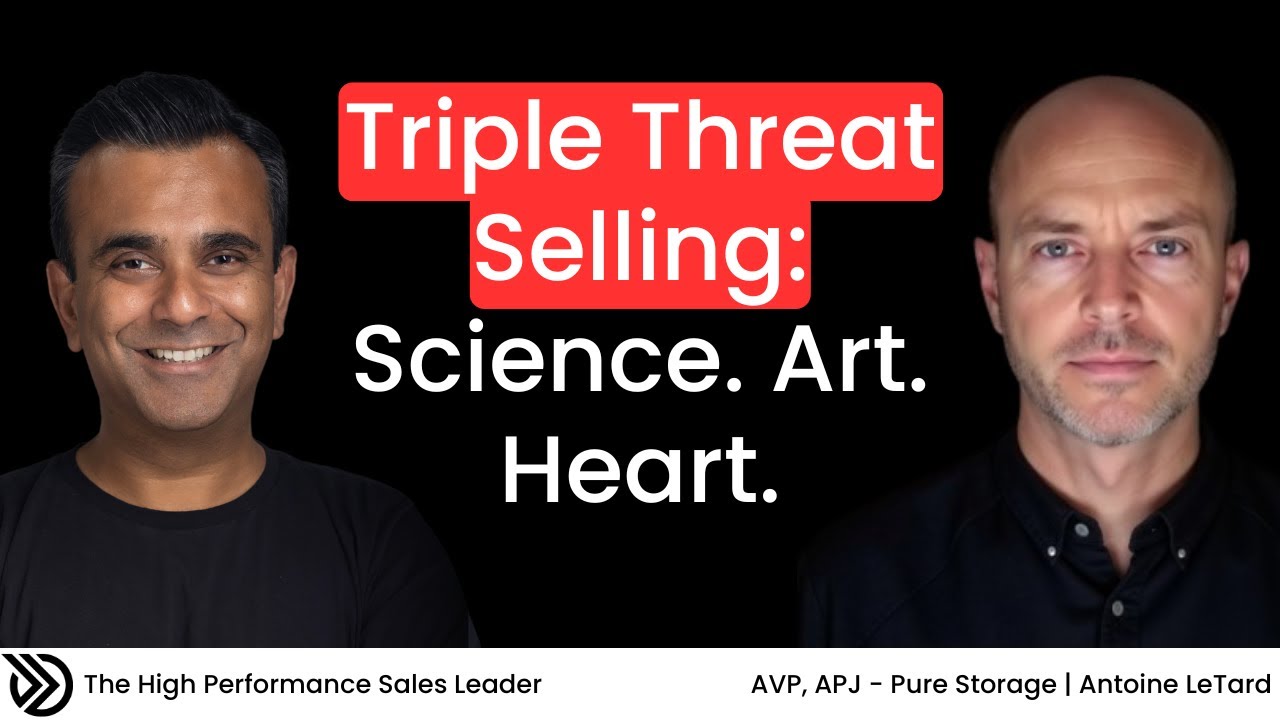
Antoine Letarde outlines the "triple threat" framework for top account executives: Science (processes and tools), Art (storytelling and insight), and Heart (curiosity and service). Modern enterprise sales require all three because buying cycles are now multi-stakeholder and heavily scrutinized. The difference between a salesperson and a sales professional comes down to coachability and a growth mindset.
Chapters
And so, I started thinking about this idea of the triple threat. And the triple threat to me is, you know, understanding the science, which is the process and the methodology, leveraging your art, which is ultimately your experience, and then the way in which we connect with people, the humanity within us is ultimately the heart. And the heart is the center for curiosity and service and humility in how you show up and connect with others.
Welcome to the High Performance Sales Leader Podcast. And our guest today is none other than Antoine Letarde. I met Antoine a number of months back, and I was just really taken up with his views on selling, leadership, and life. And I wanted to invite him to come and join us. Now, Antoine has had a significant career In the software industry, he was the country manager at RSA, then went on to lead the APJ region at AppDynamics, and from where he then went and led Rubrik. And most recently, he started as the VP of Strategy and Operations at Pure Storage. So, Antoine, thank you so much for joining me today.
Priyank, thanks so much for having me on the show. I know that we've been trying to get this date in the diary for a long time. And we finally did it. So here we are, and I'm ready to get into it.
Fantastic. Now, what really struck me about you was that you talked about the combination of the head and the heart, the sales leader as well as the sales professional, and how so much has changed at the customer end. So can we jump right in and tell me a little bit on what has shaped that view?
Yeah, sure. Absolutely. I think, you know, more recently, I read a report by Gartner, which was the B2B Buyer's Guide. And in that report, they spoke about how complex the customer's buying process has become, how difficult it is for our champions to buy the software or technology that they need to buy to achieve business outcomes. And in this report, they spoke about not just the complexity of the buying cycle, but also the number of people that are engaged in the buying group. So, the number of stakeholders that the champion needs to align and gain consensus from has changed significantly. And along with that comes the challenge of organizations being really conscious about how they're spending their money, what they're spending their money on, and whether or not technology they have in the environment can do what the organization needs to do in terms of its outcomes. So the way in which customers buy it becomes very, very difficult and complex. And so that's kind of what sets the scene, or I guess the precursor for the conversation about this idea of Sales being not just about the head and the intellect and, you know, whether or not you understand your technology really well and whether or not you can align that technology with the business outcomes of the customers that you're trying to serve, but rather about how we go and connect with those customers and whether or not we align in using playbooks or methodologies or processes to help us help our champions. Buy the technology that we're trying to sell to them. And so, I guess for me, the pivot has come. It's not just about the head or the heart. I think it's also about the science. And so, I started thinking about this idea of the triple threat. And the triple threat to me is, you know, understanding the science, which is the process and the methodology, leveraging your art, which is ultimately your experience, and then the way in which we connect with people, the humanity within us is ultimately the heart. And the heart is the center for curiosity and service and humility in how you show up and connect with others.
I love it. And I really like the concept of triple threat because, truly, I think I get in my job on a day-to-day basis, across my team, to see well over 100 account executives and 10 or 15 leaders every single week. And you can tell very quickly where something is missing And I really like the framework. So tell me a little bit more. So we're in a poly— a multi-tool platformed environment, both on the seller and the customer side. And yet you have people who are chronically underperforming. So let's unpack that and tell me your thoughts around this.
Yeah, good. Good. So I think If you think about the science for a second, the science is the tools and the processes and the platforms that the organization make available to you for you to be effectively successful in what you're doing. I think when I first started selling, my go-to weapon or capability, I guess, was the fact that I could build really good relationships very quickly with customers. Back then, the buying process was quite simple, quite linear. CFOs were less interested in what the CIOs were spending their money on. And selling, I think, back then was a lot easier. If you fast forward to today and based on the, you know, the scene that we set at the beginning of this call, sellers need to think more critically and intentionally about how they're going about establishing themselves in their sales campaign. And that comes down to the process or the playbook. You know, a lot of organizations invest a significant amount of enablement in helping sellers do the necessary research. So when they show up for the first meeting with the customer, they show up with already firsthand knowledge of the customer's environment that they're operating in, the challenges that are experiencing in those environments so that the conversation with the potential champion is more about discovery of how those pains or challenges are manifesting in the organization, as opposed to doing the research in that meeting, which is discovery. And the research itself sets you up for an enormous amount of success, because when you start doing your own personal PG, and you follow the frameworks that an organization has put in place, you know that you're developing and qualifying high-quality pipeline. And once you've qualified high-quality pipeline, then you put it into the process of tracking where you are through whether it's a methodology or a framework or a playbook to know exactly what combination of entry and exit criteria you need to achieve in order to move an opportunity forward. And now, to a lot of people, that might be a very mechanical process. It might feel very uncomfortable. That's where the art and the heart come into it. And I think the individuals, the sales execs that understand that a playbook is a guide to helping them be successful, which is quantified on previous success and their experience and their ability to share insights with their prospects and their customers and be able to tell stories. And then wrapped around that with the ability for them to connect authentically and curiously and always acting in service of the customer is ultimately what I've seen the sales execs that are achieving great deals of success versus those that aren't, who are not relying on processes, frameworks, or tools, who struggle to tell stories or connect customers with insights on what they've helped other customers with and really don't go into any customer conversations with any sense of curiosity or the intent of serving that customer to help them solve their most pressing business challenges.
That resonates so deeply with me, especially with what you said around serving the customer, because we are operating in a world where a company is, you know, trying to achieve its top-line objectives and growth objectives. We've got reps who've got a territory and a target, and they've got to hit that number quarter in and quarter out. And you have to comply with that environment. And it's so easy. I've heard closing statements. It's all about, it's my quarter, it's my number, it's my this, and it's my that.
Yeah.
And beyond a point, the customer doesn't care what it is because if you're not acting in service to the customer, you are not going to get that.
100%.
The question I have is, one of the best pieces of advice that I got from when I was a second-line manager from my regional head of APAC, and he said, Pri, when you help your team achieve their goals, you will achieve your goal. That stuck with me. So I've got these things that people have come along and deposited into my life that some just really stuck. And I said, you know what, I'm already operating this way, but I'm really going to go hard on delivering this. And the result is people feel emotionally safe when they know that you're not taking, but you're giving. And that's the concept around serving.
Yeah.
So how can we ensure That the orientation for the outcome is meeting the customer's need, and that then in turn, they will turn around and help us to achieve our quarterly objectives. So how do you do that?
Oh man, it's like, it's such a multilayered question that, because I think, you know, if we think about how a lot of sales leaders, sales managers come about, it's because They were typically like the top salesperson in the team. And so their natural next step for them was, hey, let's put this high performer into a sales management position. And I think the one thing that we don't do very well in the tech industry is help individuals get ready for that next step in their career. And so, you know, if you want to get into sales management because you think you're going to make more money or because you think the title is going to bring greater credibility to you, I think you might need to reassess your intentions for why you want to do that. And I think the point that you made there, Pri, was around you get into sales and sales leadership because you want to help others be more successful. You want to coach them to the same levels of success that you experienced as a top individual contributor. And so, if you take that down then to the individual contributor and the account exec and look to make it a about the customer, the tone for me is always set at the top. And so if you've got a management team that are focused just solely on the number and don't necessarily pay too much attention to how you get that number, that's the kind of behavior you're gonna get in the field. However, if the tone at the top is set from the perspective that you're looking to grow and build long-term strategic relationships and the AEs are aligned to building business value for those customers, then it does matter how the AE engages and the AE's behavior will change in accordance with the way in which they're managed by their first line manager and the way in which that first line manager is managed by the second or third line. If the organization is oriented around building long-term strategic relationships, then the behaviors will be aligned and managed and coached and developed in that way. And so I think that's how you get the AEs to start thinking about. It's great for the commission and the paycheck and receiving a purchase order. There's nothing quite like, you know, that high you get on an afternoon when that purchase order comes in. But the purchase order is just the beginning. You know, somebody once said to me that a customer is not a customer until they actually renew. And so AEs need to start thinking about like, what is the long-term strategic value that I'm gonna bring into this relationship with my customers? And align that with the problems that you're helping the customer solve.
Yeah, yeah, absolutely. And I think that's really where, when I talk to leaders and sellers who I believe have made that switch, we had an episode not long back with Brad Perriette, who's at SentinelOne, and he talked about customer centricity and that he tried to be a certain way when he first started in sales and then just decided to be more authentic. You know, build some relationships and customers started feeling like, oh, this guy is actually trying to help me. Let me help you back, you know, and let's help each other. And then you get that. And so, he ended up presenting that at kickoff. And then, another one was Jason Leonidas, who is running GitHub. And he talked about, you know, the super seller. So, the super seller who becomes the sales manager. Yeah. And now, all of a sudden, it's not about your number, it's about these people in your team and customers, and you really need to focus on that. So the point I'm making is that you have underlined a critical thing. It's got to start at the top. So it's very hard to do that unless that is flowing down through messaging through the organization and enables salespeople to do that. But I do think that that switch has to come on at an individual level.
Kind of stuff.
You know, tell me, have you seen situations where someone is leaning too much on one versus the other? You know, it's too much, you know, too much art and not enough science or too much heart. Yes.
Yeah, yeah, absolutely. I mean, you know, if you look at how organizations enable their account execs, it's very, very process heavy. It's very playbook heavy. And it's easy for young sellers to come into an environment like that and follow the process or follow the playbook. And when it gets translated out into a customer relationship, it could feel very robotic. It's like, well, I'm stepping through a process and I need to do these 3 things before I can get to doing these 3 things. It feels unnatural and unauthentic. If organizations could balance out the Here is the process and the playbook. And how do we pair that with your experience and some of the insights or the stories we can arm you with so that when you go and meet with customers, the application of the process or the playbook becomes far seamless and almost invisible to the customer in that you're guiding them through a buying process and you're helping them achieve their own personal goals that will obviously be aligned to achieving the organizational goals. I have definitely seen AEs and sales execs that are very intellectual. You know, they understand the technology back to front and they're very, very eager to share that with customers. They're, you know, in the tech industry, we teach our sales teams to be experts in what we do. And if you're, if you're too heavily reliant on the intellectual part of it, you wanna run in and you wanna go and tell your customers all about the great things that your product can do without really understanding first what challenges the customer is going through. And if you kind of over-rotate that just to a level of curiosity where you go and sit down and you just wanna understand everything you can about the customer's business, you miss the opportunity then to actually turn the opportunity you've come across into execution. And so any one of those aspects on their own, on the far side, on the hard side, You never progress anything. On the art side or the intellectual side, if you're just using your brain, all you're doing is telling the customer what you know. And on the process side, you might come across as robotic. And I think the opportunity for a lot of account execs and sales execs is to figure out how to balance both the execution of a process with the experience that you bring in and the quality of exchange and value you can deliver for your customer. While making it a really authentic and really kind of collaborative environment for the customer to explore how the 2 organizations can work together.
Yes, that absolutely makes sense because you brought up a very simple, but I think a profound distinction between a salesperson and a sales professional. Right? Can you unpack that for us?
Yeah, I posted about this on LinkedIn a couple of months back. And the thing that got me thinking about it was, if you think about a professional athlete, you know, think about Usain Bolt as an example. I think everybody knows who he is.
Absolutely.
He was an athlete who was going after the major prize. He wanted to be the best he could possibly be in his particular field. And what that meant was he spent an enormous amount of time with coaches, with specialists, with doctors, with physiotherapists to try and understand how he could get the most out of his body, whether it be, can he shave hundredths of a second off his starting time? If he had to change his running style, what would that mean for him reducing his time to get around the track? And so, you know, if you think about it from that perspective, He was training to be the best he could possibly be in his particular field. If you flip that around into the sales industry, a lot of individuals get into sales because they're really good at relationships and they believe that their relationships will be the key to their success. But they're actually selling themselves short. What they're not doing is looking for ways to develop and enhance the skill set that they need to be really effective at what they're doing, to be the absolute best that they can be. In their respective field. So the difference between a sales professional and a salesperson is a sales professional takes their career very seriously. They might engage with coaches or mentors. They might read books and podcasts. They're incredibly coachable. They're always looking to learn from people. They take advice on, they look for feedback, they thrive on feedback. Conversely to that, a salesperson might not read, they might not listen to podcasts, they might not visit with coaches and speak to mentors, generally quite closed off to coaching because they believe or they know that they think they know better. And they believe that they can be successful in doing something that they've always done in the past. And so, when you think about that in the context of the industry, the individuals that are hungry and thirsty for knowledge, that are coachable, that have a growth mindset and are always looking to get better, become a real differentiator for their organization. It's not just about the technology anymore. It's about how the technology is creating value for a customer. Salesperson would likely be talking about the product, would likely be trying to position the product and not necessarily understanding how their product can unlock value and potential for the customer that they're selling into. So fundamentally different. One invests in themselves as a salesperson in the career. And on the other side, One believes that they've reached their potential and capacity as a salesperson and they don't need to learn anymore to get any better.
Fantastic. I am so glad that you've addressed this because I would say that I meet a lot of people who do not invest in themselves on a consistent basis. And yet the opportunity as an account executive or even as a sales leader is an incredible opportunity because you have the ability to earn an income, you have the ability to learn amazing skills. And the gift of that is not only just money, but it's also personal growth. Because where you have personal growth, I'll take a minute to just say that I got into sales in the '90s in Xerox, and they were amazing at teaching you how to sell. There were 2 baptisms. One was the baptism of fire, learning how to push products. I became a very good product pusher eventually by year 3. But when I went into selling Oracle consulting services, it was a whole different ballgame because you didn't have a product.
Yeah.
I had to be reborn as a solution seller who had to discover before you actually prescribe anything. And the whole nature changed. And so, all of a sudden, now I had to be educated on so many things that I could actually have a meaningful conversation with the customer. So, I think that professional development is greatly undervalued.
Yeah.
And I think that it is that multiplying factor because you can tell the moment you're talking to a seller or a leader, who has invested in the— like when I'm speaking to you, I need to spend 5 minutes with you, and I know you've invested in yourself, the concepts, the ideas. And I think that that becomes really evident when customers are meeting sellers or they're meeting sales leaders where that investment has not been. So thank you.
Yeah, yeah, yeah. I think, you know, like everyone has an on-ramp into sales, you know, whether it be through like understanding the product and knowing how to pitch and position the product itself. And that's the starting point. Or whether you come from a consulting background and you really understand a customer's environments and how to position your product for value. I think there's a number of different on-ramps into the sales profession. I think the point that I really want to make is that don't settle for where you are and the skills that you have. Continually look for ways to get better. Be open to feedback. Be open to learning from others. Be open to recognizing that there are a multitude of ways in which you can continually enhance your skills. And I think the most successful salespeople know that if they open up their toolbox and they have a number of different tools and skills in that toolbox that they've developed and learned over time, they will be far more successful than those individuals who open up a toolbox and might just have 1 or 2 tools with which to go about navigating the sales process.
Brilliant. So one last question before we wrap up. So beyond sales success, I think you've outlined an amazing 3-legged stool, as I would call it, you know, the science, the art, and the heart. Because I believe that if you are missing one of 3, you're not going to— you're going to have an imbalanced career, so as to speak.
Yes.
But let's say you've built that stool. How does this help build a life of intentionality and fulfillment?
That's a great question. And I think it requires intentionality to first start thinking about the legs of the stools that you want to build. And I think the intentionality starts well before you start thinking about science, art, and heart. It starts with asking the question really about, am I prepared to open myself up to learn, to enhance and unleash the potential that I've yet to realize? As an individual, I think self-inquiry is really important because self-inquiry brings about a certain sense of awareness about who you are, what's important to you, the values that you hold close, and whether or not you think more critically about where you want to end up in your life. And I think once you've gone through that self-inquiry, then you can start to think about, well, what are the things that I need to do more intentionally in order to become a better sales exec, in order to become a better sales leader, um, and in order to become a better sales manager, because I think, you know, management and leadership are 2 fundamentally different, uh, different roles and, and I think can be interchanged very easily. Only then, once you're aware, can you start asking like, what do I need to do to be a better husband, better, better father, better friend, better community member? So, I think it all starts with awareness. The awareness of what's important to you, and then being very specific and applying your time, energy, and attention intentionally in the directions of the things that you know are going to contribute to your own personal and professional success.
Absolutely. And you've articulated it really well because I think at the end of the day, you've got to look beyond your quarter and the number, which we spend so much time looking at, talking about. Just like you said, being a father, being a father, a son, a spouse, there is a life that is supported by the work that we do. But we spend so much time at the work with the number that we're not thinking about the life.
Yeah.
I'll close with this bonus question. I call this the golden question because in a week, whether I'm talking to an APAC VP, a founder, a CXO, or an account exec, I ask them, what do you want from your life in the next 3 to 5 years? That is called the golden question.
That's a great question. What do I want from my life in the next 3 to 5 years? I think I might turn that around and say, what do I want my life to contribute to in the next 3 to 5 years? Because I think it's easy to say what you want from life, but what do you want to give back to life? Who do you want to give it back to? And what kind of impact do you want to have on your family and the people that mean the most to you? What kind of impact do you want to have on the people that you work with and the customers you serve? And what kind of impact do you want to have on the world at large? You know, what, what do we have to offer? And I think what we have to offer is our untapped potential and the way in which we provide that untapped potential to all of those people that I spoke about and all those environments is to ask ourselves the question. How great are we willing to let life be?
Antoine, if this was a performance review from meet standards, you've gone to complete exceed standards, right? So, you've taken my— so, we'll call that the Platinum Question. Mine is the Golden Question. I love it. You've leveled it up because, and I'll tell you why, because so many people get caught up on quota, territory, OTE that I try and elevate the question is, hey, what do you want? And you will be surprised. 8 out of 10 haven't done the thinking. They're not able to articulate clearly that I'm trying to buy my kids property. I am trying to send them on an education. I want to do this for this one.
Yeah.
I'm trying to elevate it to a level 10 conversation, but you've given it the much, much higher one. So thank you.
I appreciate that, Priyank. Thank you.
Well, as I expected that this was going to be a holistic conversation, and you've elevated it. So I can only say thank you so much. I appreciate you. And somebody is going to benefit greatly from listening into this today.
Yeah, thank you, Priyank. I think you also do a phenomenal job of bringing industry leaders onto your podcast to share their skills and with anyone who's willing to listen. And it's been a real pleasure being on the show. And, you know, unfortunately, I can't help but bring anything but heart to what I do. And I'm glad that you've provided that platform and created the conditions for me to share that. Thank you.
Fantastic.
More from Tom




Why GTM Leaders Still Struggle with Pipeline Visibility in 2026 | AI vs Traditional CRM





How to Build High-Performance Sales Teams | Direction Alignment Commitment (DAC Framework)

