Trae Stephens on Anduril’s Origin, Peter Thiel, & Palantir DNA
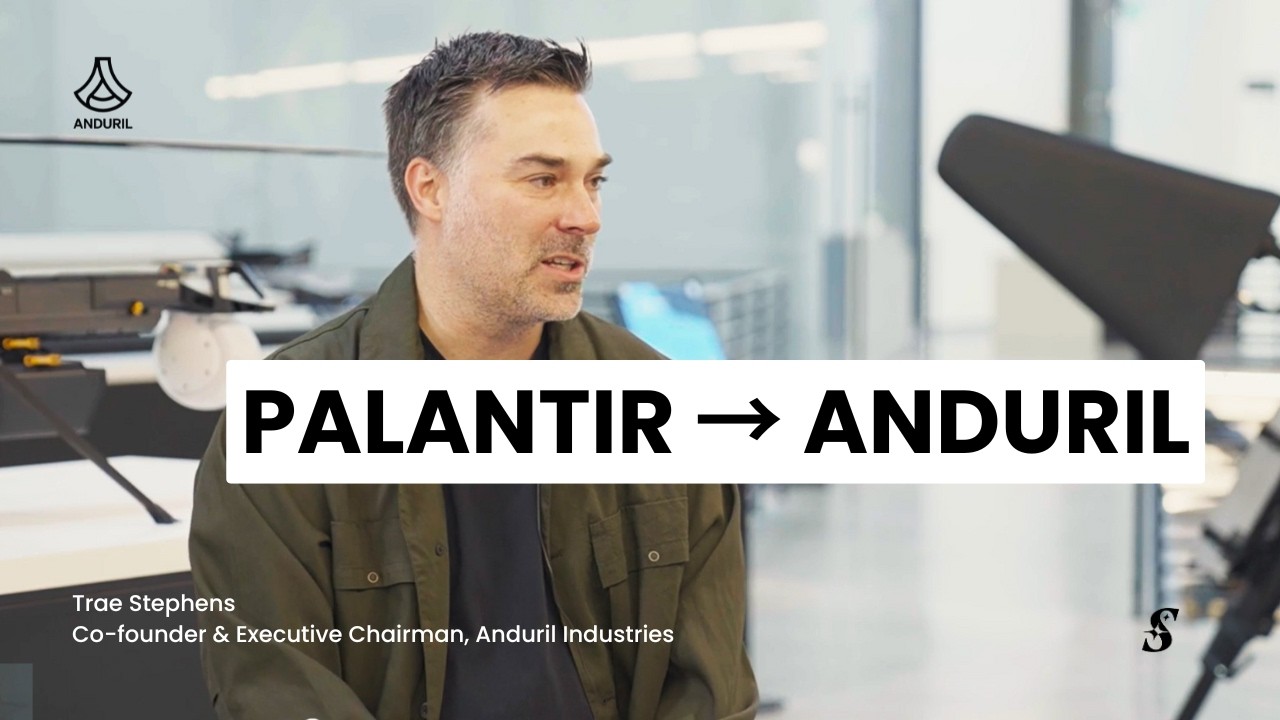
Trae Stephens, co-founder of Anduril Industries, explains how the defense-tech company is software-defined, not hardware-first, built by people from Palantir and SpaceX. Anduril is opening a 5-million-square-foot factory in Ohio and uses just-war theory to guide autonomous weapons development. Stephens credits Peter Thiel's thinking on concentration and zero-to-one ideas for shaping the company's strategy.
Chapters
Well, you know that I'm Sam and Jack's little brother, right?
What?
When we started Anduril in 2017, it was kind of the pariah of Silicon Valley. People will think about us as like a hardware company, but the core of everything that we do is actually software.
Our interview with Alex Karp, when we were walking around the office at Palantir.
He's got to keep moving, right? Yeah, exactly. Got to keep moving. Can't sit down.
Once you mentioned that, I've been thinking that the whole time. I'm like, I don't know if I even feel comfortable in this chair.
3 of the co-founders were from Palantir, and then a bunch of our early team were from places like Tesla and SpaceX, where there was already a lot of government intersect. From day one in Anduril, we were starting from where Palantir was in year 10. Defense as a sector is multi-domain, and so you have things under the sea, things on the surface of the sea, ground vehicles, aerial vehicles, and space. The Anduril strategy is we want to cover the whole gamut. The most annoying lesson I've learned from Peter Thiel is that he's always right. When he talks, you need to take it very seriously.
Trae Stephens.
Good to be here. How's it going?
Welcome to Sorcery.
Thank you.
Thanks for having me at Anduril.
It's a, it's a much cooler place than most places in Silicon Valley.
No, it's really cool. I remember I was meeting with David Yulovich like a couple years ago, and we were talking about another, um, like hard tech defense tech company down here. I'm not going to name names, But I was really excited about it and he was like, Molly, that's not cool. You need to go to Amberl. And now that I'm here, I'm like, okay, I get it.
I get it. Although to be fair, this weekend you did interview Dan Wright from Armada in front of an F-117A, which is pretty cool as well.
It's pretty cool.
Yeah. We don't have an F-117 here, but we do have a lot of other cool stuff.
Close, right?
Yeah, pretty close. Pretty close.
You're building the future F-117s.
That's right. We've got the Fury, although you can't really see it. It's just down, just downstairs. But yeah.
Well, it's great. I, um, I talked to a couple people, uh, in preparation of this, Dan Wright being one of them, Moritz, uh, Eric from Altimeter, Jack Altman, who you were just on his podcast. And—
Well, you know that I'm Sam and Jack's little brother, right?
What?
Yeah. No, I'm not. I'm just—
it's just a joke. Oh, okay. I was like, okay, it could be a cousin.
Could be. You never know.
That's cool.
Very overt.
I'm gonna have to like actually look through their family lineage. So you recently just had Pete Hegseth here. We just got back from the Reagan National Defense Forum. I wanna know what is the current state of the defense wave and where are we in the technology of war?
Yeah, I mean, there's a lot going on in defense tech these days, which is kind of crazy thinking back to when we started Anduril in 2017 as kind of the pariah of Silicon Valley. It was like not something people were doing. It was incredibly unpopular. And now all of a sudden there's like almost nothing as popular. Maybe AI slop enterprise SaaS companies are slightly more popular, but defense tech is right up there. So I think there's a tremendous opportunity given the kind of cultural waves shifting inside of the department where they're really interested in engaging with innovative companies. And Anduril had the unique privilege really of being there at the very beginning and kind of shepherding that wave.
And what was that like having Pete Hegseth here?
I mean, it's fun. Secretary Hegseth is, you know, he's incredibly charismatic. He understands the problems that are going on right now, and he really gets kind of where Anduril fits into that equation. So not only, you know, the Secretary, but also his entire senior leadership was here. And so being able to interact with Undersecretary Duffy, Undersecretary Michael, General counsel, you know, it was a really cool opportunity not only for, you know, Anduril's founders, but also the entire team who got to all interact with him during that day as well.
That's exciting. So I want to talk about the origin of Anduril. I hear there's some story about 007 that you're very close with that I need to hear more about.
Yeah, so I was a senior in high school when 9/11 happened and ended up going to college specifically trying to go into the intelligence community. So after 4 years at Georgetown, I got a job in the IC and had this expectation that I was going to show up and somebody was gonna like throw me the keys to an Aston Martin and I was gonna have, you know, a watch with laser beams. And instead I sat in a cubicle in a windowless concrete basement with 2 other people who didn't work. They just sat around and talked about sports, like local area sports all the time. And so my James Bond dream was Completely, you know, untrue. And then about two and a half years in, I bailed and went to Palantir. And it was like the first time that I had exposure to like really crazy visionary people who wanted to change the way that we were doing things inside the defense intelligence national security apparatus. And so it's kind of cool now in a position where we are, where I don't know if you saw Top Gun Maverick, but. you know, basically the bad guy general says like, you're a dinosaur, Tom Cruise, the future is autonomy. And it's like, wow, they're actually talking about Anduril now. It's like a full circle moment.
In the midst of all of this, there's obviously a lot of excitement. There's increased competition on the private side. Public side has its own bottlenecks. I'm curious, where do you think defense tech stands for the competitive state?
Defense as a sector is multi-domain. And so you have things under the sea, things on the surface of the sea, ground vehicles, aerial vehicles, and space. And kind of all of those domains are critical for the Department of War to have dominance in. And so, you know, it's the Anduril strategy is to go multi-domain. We don't have like a niche approach to delivering autonomy or attritability in any single domain. We wanna cover the whole gamut. And this is the way that traditionally defense companies have done work. This is the way Lockheed Martin, Northrop Grumman, this is how they do their work as well. And we believe that there's a lot of shared autonomy components that can cut across all of those domains that give us an interesting competitive advantage. And you see like in Silicon Valley, even companies that are being started that are attacking each of those layers as well. And we welcome the competition. We think it's really great to have more companies in the space that are You know, moving away from kind of the semi-communist, centrally planned economy way that the department has been doing business for really the last 30-plus years.
I recently had Bradley Tusk on the podcast, and he's all about the regulatory environment, political advisement. He thinks that the recent investments in private sector companies from the government is somewhat— someone might say communist. Strategy. Do you think that— what do you think about the investments in like Intel and MP Materials from the government standpoint?
We have to be competitive on a global stage. And there's an argument that the government needs to get involved in order to make that work. You know, China is playing a subsidy— subsidization game with all of their kind of domestic national champions. And they're also running a very effective 4D chess strategy with the Belt and Road Initiative, which has put the United States and our allies and partners in a weakened position since they've devised that. I don't know if you've had the opportunity to read The 100-Year Marathon. It's a brilliant book and basically talks about how Chinese culture has taken a very different approach to Western culture in the way that they are seeking dominance. We have a tendency to show our strength at every stage, whereas the Chinese strategy for a long time was, Bide time, don't show your strength, and then once you're at a position of dominance, you can strike. And this has been the success of Belt and Road, is that they've gone out and they've done this to the point where, you know, they're now threatening us for global power dominance, which is really important for our ability to set standards and be global leaders and, you know, enforce ethical pathways of deterring conflict. And so I think, you know, the strategy that the government is taking, you could criticize the very specific aspects of it, like should we have taken ownership in Intel as part of a Social Security strategy or something like that? You could criticize the specifics of that, but we have to secure raw materials. We have to maintain access to cutting-edge semiconductors. You know, there's all of these things that we have to do, and I'm glad that the Department of Commerce, Secretary Lutnick, and others are thinking critically about how to make that
In American Affairs, you wrote, the factory is really the weapon.
Right.
Could you share more about that?
Yeah. You know, for decades and decades, the United States was the global manufacturing powerhouse. I mean, we had the ability during World War II to outproduce our adversaries. And, you know, you had companies like Ford that turned over their production lines to build bombers for the Allied war effort. You know, fast forward to the last 30 years, the fall of the Soviet Union, We've atrophied massively in our manufacturing chops. We offshored a lot of manufacturing work to lower-cost labor locations like China. And not only did they soak up a lot of that manufacturing capacity, but they also developed advanced tooling and know-how to build the things that, you know, we use every day, whether it's, you know, the microphones that we're wearing today or the iPhones that are in our pockets. And so at this point, even if there was complete labor cost parity, we still don't have the ability to just magically reshore a lot of these critical components that are going to be important to the next 50 or 100 years. And so, you know, we're in this place where we really need to reindustrialize. It's incredibly important. It's incredibly important culturally, geopolitically, strategically. And, you know, this is what Anduril is really focused on right now. is bringing back our ability to not build hundreds of things or thousands of things, but tens of thousands of things or hundreds of thousands of things efficiently, scalably, and to do it in a way that enables us to retain that magazine inventory advantage against our adversary. And so I think that's really what I was saying with the factory is the weapon, because without the factory, you have no weapons.
Yeah. In previous wars, World War I, World War II, The United States had to utilize non-traditional weapons factories to create weapons. So are you doing everything here internally, or are you also outsourcing and finding different ways to manufacture?
We have a lot of manufacturing partners. Obviously, we're not building every subcomponent of everything that we're building. So we're, you know, working with other vendors, we're working with other machine shops, we're working with other manufacturers, and then we're pulling it all together generally in our own facilities. But, you know, we're in the first quarter of next year, we'll be opening our soon-to-be 5 million square foot factory campus called Arsenal One, just outside of Columbus, Ohio, which is where we'll start ramping up our collaborative combat aircraft, the autonomous fighter plane production. And we have other facilities around the country. We have, you know, shipyards, we have loitering munition assembly that's happening in Atlanta, Georgia. You know, we do some stuff right here in Costa Mesa at our headquarters. So So I imagine that there will be multiple factories across not just the United States, but across allied and partner nations as well, where we're ramping that manufacturing muscle at the same time.
What was it like to open up Arsenal One? I know it's under development, but choosing Ohio, where you're from, what was that like?
Yeah, at some point when we got down to like the final 3 states, I realized that the bias was going to look really bad to the company. So I just kind of sat back and I'm like, You know what, I don't wanna push this. I think Ohio's great. Obviously, as a native Ohioan, I thought it would be awesome to land there. The reality is that when it comes down to just the competition for, you know, where we were going to end up doing this, and that was some combination of facilities, the access to utility scale, you know, power, water, things like that, as well as a labor force that could scale with us as we grew out to that 5 million square feet. Ohio just had the most competitive opportunity or offer for us. So we kind of natively ended up going there. You know, when we did the ribbon cutting earlier this year, I brought my mom with me since she's just— she lives right down the road. And, you know, having her meet the governor and having the governor thank her as if somehow she was the one that convinced us to go to Ohio was somewhat entertaining.
Opening something so large like that, does this feel real? I mean, Prime's have existed for a very long time, but you're known as the new Prime. So how does that feel? How does that physicality feel?
Well, I'm certainly experiencing the realness of it with all the LinkedIn messages from my high school classmates that I haven't heard from in 20 years that are now looking for jobs. So it feels pretty real. Now, I mean, one of the cool things to remember is that Ohio is the birthplace of aviation. And so in some ways, it's like you're starting with the Wright Flyer and then coming back with fully autonomous fighter planes to be built, you know, less than an hour drive. away from where the Wright brothers were building the first airplane. And so there's a tremendous history. GE Aviation, GE Aircraft, where they build the jet engines, is also right down the street, about an hour away from where we're setting up the factory. So it's a cool kind of cultural moment, I think, not only for us and what we're trying to deliver to the department, but also to the state of Ohio.
It's interesting because when the company was started, like you said, it was It was seen as a pariah. You kind of, I would say, like got a lot of support for a while, but now it seems like there's some backlash coming back. So what do you think people get wrong about Anduril and what do you wanna correct?
Well, I tend to not really think about what the media says. I'm not super concerned about, you know, the Wall Street Journal or Reuters or whatever. Like honestly, they just looked kind of silly talking about, you know, crashes during test flights. It's like, That's what happens, guys. That's what happens when you move fast. If you're not crashing when you're testing, you're not testing very hard. So not really concerned about that. I think broadly across the defense industry, this is a pattern that you saw happen with both Palantir and SpaceX as well, is that the big players, the primes, they don't really pay attention at all until their lunch is being eaten. And then the moment they realize their lunch is being eaten, they're gonna get more aggressive. And so that was always our expectation. I'm under no illusions that, you know, we're going to be gladly welcomed with, you know, a big hug or something by the companies we're competing with. As far as, like, what people get wrong about Anduril, I think that people will think about us as, like, a hardware company where we're building all of these big systems, many of which you can probably see in the background of the camera here. But the core of everything that we do is actually software. And that was the original idea for the company when Matt, Brian Palmer, Joe, and I started talking about building this company, it was always we want to build a software-defined and hardware-enabled defense company rather than a hardware-defined and software-enabled company. And so most of the people that are sitting around in this office today are writing software, actually.
Sorcery is brought to you by Brex, the financial stack trusted by more than 30,000 companies, including 1 in 3 venture-backed startups in the US. Nearly 40% of startups fail because they run out of cash. Rex is literally built to help founders avoid that. Unlike traditional banks that let your money sit idle, chipping away at it with fees, Rex is designed to help you spend smarter and move faster. Their all-in-one solution combines checking, treasury, and FDIC protection into one powerful account. You can send and receive money globally at lightning speeds, get 20 times the standard FDIC coverage through their partner banks, and even high yield from day one. With same-day and even same-hour liquidity, access your funds Companies like Scale AI, DoorDash, ServiceTitan, Hims, Anthropic, Flexport, Robinhood, and Plaid trust and use Brex. Start today at brex.com/sorcery. That's brex.com/sorcery. In today's high-speed business world, staying ahead means using the smartest tools possible, including the powerful capabilities of artificial intelligence. Meet Turing Intelligence. Turing builds customizable AI systems designed to solve your mission-critical challenges no matter what. From expert guidance to tailored projects, Turing helps top companies realize AI that's more capable, more adaptable, and more effective. With Turing, discover how AI can accelerate your business growth. To learn more, visit turing.com/sourcery, spelled S-O-U-R-C-E-R-Y. That's turing.com/sourcery.
We always had sort of an unfair advantage in that, you know, 3 of the co-founders were from Palantir, and then a bunch of our early team were from places like Tesla and SpaceX, where there was already a lot of government intersect. You know, I spent 6 years at Palantir learning how to sell to the government, made every mistake you could possibly imagine. And so we didn't have to do that. You know, and from day one in Anduril, we were starting from where Palantir was in year 10. And so kind of a great cheat code.
What was your biggest lesson from Palantir?
I mean, there are so many. I wouldn't say that there's any one. It's kind of like death by a thousand cuts. Like, you know, you have to hire a strong government relations team because your customer is not the budget appropriator. Like, they're not the same. So you have to be able to work the administration. You have to be able to work Congress. You have to work political appointees in the department and the customer, the person that will be using the tech at the end of the day. And so you really have to understand that stack. You know, there's a long history in companies that are doing business with the department where they have these massive advisory boards of retired generals and things like that. It was just clear that that's never worked. And so that was never really part of our strategy, thankfully, because these are lessons again learned from Palantir. I'm super grateful for, you know, the trailblazing that was done by people like, you know, Elon, Gwynne, and Tim at SpaceX and Karp, Cham, and Lonsdale and Aki and others at Palantir. So I just feel really lucky to have been able to benefit and stand on the shoulders of those giants.
One thing that was kind of the central focus of our interview with Alex Karp when we were walking around the office at Palantir.
He's got to keep moving, right? Got to keep moving. Can't sit down.
Once you mentioned that, I've been thinking that the whole time. I'm like, I don't know if I even feel comfortable in this chair. This is hard. But one of the things that was like core to our conversation was like moral and ethics around this, right? Christian Garrett. He's a big fan of you. We've done so many interviews with him at this point. He's great. But his— one of his questions he wanted me to ask you was about the just war theory and Saint Augustine. So how does that play into all this?
I mean, since the very beginning, this was always a big part of the conversation that I was drawing the rest of the team into is, you know, just war theory, which was developed, you know, over 1,000 years ago by Saint Augustine. Talks about how you engage in lethal defense activity in the most ethical way possible. And if you look back at the course of all human civilization, you had this massive ramp-up in lethality. So we started with hitting each other with rocks, and then it was like, at some point somebody was building and making a knife, and then someone makes bow and arrow, and then you have catapults that could do One-to-many destruction, trebuchets. And then you have the advent of gunpowder, so you have guns and simple bombs. And that just kept going up and up and up until the atomic bomb in 1945. And at that moment, I think humanity looked around at each other and they said, I don't think we want to do this. Like, global nuclear war is a pretty bad bet. And so from then until modern day, you see the climb back down the ladder. And so you had precision-guided munitions. You know, you see like some of the counterterrorism work we were doing was literally shooting non-explosive AIM-9X missiles into windows to take out individual targets without blowing up buildings, no collateral damage. We've become really, really good at being accurate. And so people are constantly talking about kind of the freakout of the intersection of AI and defense and autonomy and what does that do from an ethics perspective. The goal is take humans out of dull, dirty, dangerous jobs, so we're not putting our men and women, brothers and sisters in horribly dangerous situations, and become as accurate and precise as possible. And that's really what just war theory is all about. Principles of discrimination, principles of just cause, like how much— how good is the information? Do we know for sure that this action that we're going to take is actually going to address the problem that needs to be solved? This is very— it's a big part of Anduril culture. We talk about these things internally a lot. And I think we would only do something that we fundamentally believed would be better, more just for humanity.
Where do you get pushback on that?
Well, I mean, there's a lot of pushback from, you know, people who don't necessarily understand why defense is important. You know, pacifism as an idea is only possible inside of a governing system with a monopoly on violence. Like, you can't be a pacifist without a government monopoly on violence. That's just, like, not possible for humanity. And so I'm glad that people get to have these positions, these kind of anti-national security positions, where they can sink down into their comfy couch with their hot chocolate and talk about pacifism, because it means that someone out there is willing to risk their lives to protect their ability to be pacifists. So I'm all for it.
Do you have any cultural commentary on what's going on in America right now? Peter Thiel put out that letter to Mark Zuckerberg in 2020 on the rise of pro-socialism, and we're seeing that in New York City with Mom Donnie. How do you think that bleeds into like where culture is going? I know that you're like, you're a little bit more outspoken on this, whether it relates to religion or the rise of like social media and like AI girlfriends and that kind of thing. But like, where do you see all this playing out with that?
I think culture is really hard to predict. I mean, we've seen big shifts even in the last 10 years that I don't think I would have expected. You know, there's a lot of surveys that show that for the first time in modern civilization, you have more women— or more men in the most recent generation, Gen Z, going to church than women. It's like that has never happened before. 10 years ago, if you had asked me like, do you think Gen Z will have a rising church attendance and it will be more men than women? I would have— I would have gotten that answer totally wrong. So I'm not sure that I would be able to predict this stuff necessarily. But I think, you know, you've probably seen the meme like, you know, hard times create serious men, serious men create easy— I think that's kind of the moment we're in, as people realize that, man, being serious is very important. And there's more important stuff out there than monkey JPEGs and, you know, AI slop. Yeah. And I think it's an opportunity for people to step into a good quest. And so I'm hopeful at least that we're in a moment of a transition from slop to good questing.
And Anduril's amazing marketing definitely helps with that.
It does. Yeah. I mean, when we started the company, the idea was how do you build like a, you know, an Apple for defense rather than the traditional model? So if you were to ask a normal American citizen, like, who makes the F-16? They would probably know. They would be able to envision in their head what an F-16 looks like. They would have no idea who built it. It's just like not a not part of cultural knowledge. Our goal at Andoril is we want everything that we build, everything that you see, to invoke Andoril—not just the product or the thing that it does, but who made it. And the reason that that's important is that it needs to serve as a halcyon call to people that you can build effective things, low-cost. Things, attritable things, you know, innovative things that are moving the needle for humanity. And they can be beautiful and they can remind you of human— the, you know, the grasping of human potential. And we've been really lucky that we've brought on an incredible team around this. Shannon Pryor, who heads up our comms PR department, Jen Bucci, who runs our design, Jeff Miller, who runs marketing. I mean, these are world-class people who didn't come from defense. Importantly, they came from, you know, automotive design and Snap. Jeff worked at Snap. Shannon worked at Hulu. I mean, it's like we're pulling people from consumer businesses to build a consumer profile for a defense company. And that's really never been done before.
Sorcery is proudly sponsored by Carta. Carta is transforming the private marketplace, connecting founders, investors, and limited partners through software purpose-built for private capital, trusted by more than 65,000 companies in over 160 countries. Carta's platform of software and services lays the groundwork so you can build, invest, and scale with confidence. Carta's fund administration platform supports over 9,000 funds and SPVs, representing nearly $185 billion in assets under management, with tools designed to enhance the strategic impact of fund CFOs. For more information, visit carta.com/sorcery. That's C-A-R-T-A dot com slash S-O-U-R-C-E-R-Y. Some of you may not have heard this yet, but our sponsor Public just launched something called Generated Assets, and it brings AI into investing in a way I've honestly never seen before. Here's how it works: you type in an idea like AI-powered supply chain companies with positive free cash flow, or defense tech companies growing revenue over 25% year over year. Public's AI then dispatches a swarm of agents that scan every single US stock, evaluates them, and instantly builds a custom index around your thesis. What really stands out is how clearly it explains why each stock is included. And before you invest, you can even backtest your idea against the S&P 500, so you're making decisions with real context, not just guessing. And beyond generated assets, Public lets you invest in stocks, bonds, options, crypto, all in one place. They'll even give you an uncapped 1% match when you transfer your investments over from another platform. If you want to build a portfolio that actually reflects your thesis, visit public.com/sorcery. Paid for by Public Investing. Full disclosures in the description.
So given the fact that you split both sides, how do you manage your time between Anduril and Founders Fund?
I don't. I, you know, I'm— I have an awesome team around me. My EA Elena has been with me for over 10 years and she's an absolute rock star. I have a chief of staff, Ellie Untermeier, who Literally goes wherever I go. So if I'm in San Francisco at Founders Fund, she sits right next to me and makes sure I'm on task. When I come down here to Andro headquarters, she sits right next to me and makes sure I'm on task. So it's just kind of whatever task is at hand at that moment. It's just a lot of context switching between the two. And the Founders Fund team has always been really cool about this. I mean, if you we have no build program. There's no incubation policy or anything like that at Founders Fund. But You know, Peter started Palantir. I started Anderle. Scott Nolan started General Matter. Delian Asparouhov started Varda. And it's just kind of part of the culture. We're totally fine with the splitting of time and concentrating our efforts into things that we're the most passionate about. So I honestly just feel really lucky that I have a team at Founders Fund that is super supportive of this crazy model.
I know you're super bullish on Armada and that's going to be the next big company. What are your favorite companies right now that you've recently invested in? What are you most excited about?
Yeah, I mean, the Founders Fund strategy is to be highly concentrated into a small number of companies. And so aside from the ones that I just talked about, which are the ones that our team built themselves, I'm very excited about what Varda is doing, very excited about General Matter, which is a nuclear fuels company.
We did a great interview with Scott on General Matter and went out to Paducah for the groundbreaking.
Yeah, yeah, yeah. It's super cool. I was out there for the dinner the night before. I'd never been to Paducah before. Which is weird given that I'm just from like 2 hours up the road. Also excited about Armada. I think edge compute for AI is going to be really important in this next decade. Cognition, the AI coding company, is a large position for us. There's a company called Forge that's doing AI workbooks. I don't know if you've met Marky Wagner, the founder there, before, but I'm super excited about that. I don't know. I mean, I could run through like the entire Founders Fund portfolio. I think there's, there's a lot of cool opportunities out there. The important thing is the kind of the word that I would give to young founders or aspiring founders is don't be an aspiring founder. Like, standing in front of a whiteboard and writing about— writing down a bunch of AI slop ideas is not a good way to start a company. Like, you need to, like, have an idea that's novel, that's original, and it should keep you up at night. And that's the only reason you should ever start a company. And I think Founders Fund is kind of uniquely focused on that. And that shows in returns. Much better returns when you have highly passionate founders working on something that they were, like, almost called to in a vocational sense.
From your time at Founders Fund, what's the biggest lesson you've learned from Peter Thiel?
Oh, I mean, the most annoying lesson I've learned from Peter Thiel is that he's always right. And it's really, really, really annoying. You know, I can't tell you how many times he's said something and the whole team just, like, kind of rolls their eyes. And then 5 years later, you know, Donald Trump is president. And you're like, oh man, Peter does not miss. This goes back to your point. And, you know, he was talking about what happened with Mamdani 5 years ago. Yeah. I mean, that's crazy. So, I think the number one lesson I've learned is that when he talks, you need to take it very seriously because he's probably onto something. Concentration in venture is a really important one. This is like the idea that you don't want to have 1,000 investments in a billion-dollar fund. You want to have like a massive amount of concentration in the top few positions in that fund. And that's something that has been really useful to us from a returns perspective. And then more related to Anduril, it's the zero-to-one. Everything he talks about in his book about avoiding competition, it really does not make sense or would not have made sense for Anduril in 2017 to go and compete in these highly you know, crowded marketplaces. We went and targeted an area where there were no venture-backed players at all. And that gave us an incredible head start and helped us really build the business that we've, we built today.
Wonderful. Trae, thank you so much.
Thank you. It's good to be here.
Hey, it's Molly. If you enjoy our interviews, check out our newsletter, sorcery.vc, where we deliver a once-a-week top deals and tech headlines email and also go deeper on our podcast interviews. Subscribe to Sorcery! today, and don't forget to subscribe to the podcast on YouTube, Spotify, Apple, or wherever you listen. Link in description to sign up.
More from Trae

Trae Stephens – Anduril’s AI Weapons, Palantir Myths, Antichrist and War with China | SRS #245