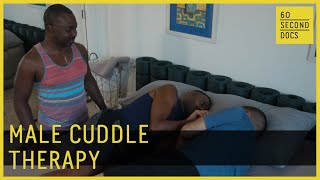
Ayité Okyne on Cuddles Therapy, Oxytocin, and The Power of Touch on Tub Talks With Damon

In this Tub Talks episode recorded in Hollywood, host Damon interviews Ayité Okyne, a touch‑intimacy (cuddle) therapist and author of On Being Seen: Chronicles of a Touch Intimacy Therapist. The conversation opens with light‑hearted personal questions about Okyne’s body image, leading into a deep dive on cuddle therapy: how intentional, consensual human touch triggers oxytocin, lowers cortisol, improves heart rate, and mitigates loneliness, depression, and “skin‑hunger.” Okyne explains the physiological basis of touch, the mental‑health consequences of touch deprivation, and practical ways people can incorporate meaningful touch into daily life (e.g., hugging, barber visits, pet cuddling, dance, yoga, touch‑focused groups). She describes her professional pathway—event‑producer turned therapist, two certifications (science of touch and art of cuddling), session structure, consent forms, clothing policies, and boundaries that keep the work platonic. The dialogue explores men’s cultural conditioning toward stoicism, the difficulty many men have accessing emotional intimacy, and how vulnerability can be cultivated through small, somatic exercises. Okyne critiques U.S. cultural taboos that sexualize touch, contrasts them with more tactile European norms, and discusses the broader societal impact of reduced oxytocin on empathy and civic engagement. She shares her experience running a large nudist community, handling erections non‑sexually, and maintaining group rules. The pandemic forced a year‑and‑a‑half hiatus, during which she studied and taught Tantra online, framing Tantra as mindful, present‑focused energy work rather than purely sexual. Okyne talks about self‑care as an introvert needing solitary recharge after intensive sessions. The interview closes with promotion of her book, links for virtual sessions, and encouragement for listeners to start their own safe, non‑sexual, oxytocin‑focused gatherings.
Chapters
Hello, welcome to Tub Talks with David, on location in Hollywood, California. And my wonderful guest today here in the tub is cuddles therapist and now author, Adite Okanne. Did I say your name right? Correct. Okay, Aite is the author of this amazing new book which I want people to get. It's just coming out now in 2025, On Being Seen: Chronicles of a Touch Intimacy Therapist. We're going to talk about what a touch intimacy therapist is and what this book is about because it's amazing, and what you're offering to our world, especially today, is so important, right? Before we talk about that, I want to know, Aike, what do you like most about your body?
Let's see. I think I love my smile.
Yeah. Show the people. Show the people. That's a great smile. Do a lot of therapy just with that smile.
Yes. I think it's disarming, and I think I don't look myself without the smile. Yeah. Yeah. So I love my smile.
Do you ever catch yourself in the mirror not smiling? Or say, like, who's that guy?
When I'm not smiling, I always wonder, just like, you need to smile. Yeah, smiling doesn't take very much and it makes you feel good.
Yes.
Yeah, so I love my smile.
Yes. Okay, anything else you like or appreciate about your physical appearance right now?
Um, I think I like my body proportions. Yes. Um, I have grown into what I call my dad bod.
Hey, Jeffers!
And I still like my body.
Yeah.
It's not the way I used to look when I was 25, but I still love it.
How old are you now?
I'm 53.
All right. Oh, me too.
Yeah.
Oh, good. I love being 53.
Yeah.
Yeah.
53 is great.
Yeah.
Yeah.
So I love hearing about people at all ages feeling grateful and good about our bodies and our proportions. Because I think so much of the world around us, both in the queer community and in the general community, at least in the US, is geared towards you shouldn't like your body, there's something wrong with you, and you should try to spend money to fix something that doesn't really need fixing or shaving or shaving or whatever.
Yeah, because we're sold a certain, a certain, uh, optimal body type. Yeah. And we all try to achieve that. But all of us are very different. Yeah. Each of us has their own body type, and it's all beautiful. I see hundreds of bodies all the time, and everybody is beautiful. Everybody has something beautiful about them. You just need to be open to seeing what it is.
That is a beautiful way to see it.
Yeah.
And I often feel here in Los Angeles that Something about the industry here really works against that. But I agree with you. I mean, I see bodies. Yeah, anyone is beautiful. Now that doesn't mean I'm attracted to every single body.
Exactly.
But all the human body itself in its natural form is a beautiful, magnificent object.
Absolutely.
Um, but then the environment, the culture, I think here in Hollywood, the industry, yeah, tries to tell people otherwise.
Yes, it is like, this is what is beautiful, this is what you should look like. But that's not always achievable, and you're not even meant to be that way. So just appreciate what you do have, find out what you find beautiful, and celebrate it. Yes, so that's what I do.
I love that. Okay, so let's talk about the Cuddles Therapy and how you are helping and serving our community.
Okay, let's—
so what is couples— I'm sorry, what is Cuddles Therapy?
So cuddle therapy really is using the modality of touch to help people with— who might be touch deprived, who are looking for affection, people who might be depressed or lonely or have some trauma or even PTSD. Because what happens is when we touch people, the body produces more of a hormone called oxytocin. And oxytocin makes— gives us this feel-good energy, and it just improves our mood. So touch and cuddling help all of that. It also helps reduce a hormone called cortisol, which is our stress hormone. So cuddling and touch helps reduce stress. It also helps with, you know, heart rate and heart blood pressure and all of that. But we won't go into that right now. But touch and cuddling have tremendous health benefits.
It really does. So if one has too much of cortisol going through their body, they could be at greater risk of—
Well, stress increases your blood pressure. It's just not good for the body. And so having to lower the cortisol level is actually good for your body. It regulates your nervous system and all of that, and it just makes you be more healthy. It gives you some wellness that you otherwise wouldn't have.
Right. So lowering cortisol levels is really important for the body. And then you also mentioned there's a lot of emotional, mental health benefits of regular touch, regular oxytocin.
Yes. Yes, because we are built to be social creatures. I always use this example of monkeys. You always find monkeys touching and playing with each other and picking out things, and it's all because it's good for the body. Human beings are just like that. If you go long periods without meaningful touch, you begin to see the effects of that. Now, you can become irritable, you can become depressed. There's so many different ways that lack of touch can show up in your life. And we want to reduce the incidence of those. And that's why I tell everybody, find little ways to get touch with people. People. And you can find such in so many different ways, like hugging people to say hello, um, going to the barber, getting your hair washed, getting a massage, cuddling with a pet. All of those things help, yes, but none is as good as meaningful, intentional human touch.
Yes.
That's very important.
So without it, we can feel touch-starved.
Yes. We actually call it touch deprivation.
Deprivation.
Or skin hunger.
Ooh. And then someone who is touch deprived or dealing with skin hunger may present irritable. Yes. Depressed. Yeah. And come to treatment saying, I feel very lonely.
Yes. And loneliness is a very insidious thing because it has been shown that loneliness can be as serious as smoking 15 cigarettes a day, and that's the effect it has on your body. So I always ask people, like, try and make connections. For me, in my business, Connection is a very big thing. Yeah, making connections with people, meaningful connections, that's what's important.
How do you do that? People might be like, well, that sounds good, but how does one do the regular sources of touch and care in their lives if they don't have that?
So there are many ways, and I outlined some of those in the book. Um, you can go to like, you know, dance lessons. Yoga sessions. Um, there are actually other groups where they focus on touch. You can find those in many major cities. But even with people you interact with, touch them.
Yeah.
And make it meaningful. I'll ask all of you viewers, like, if you touch yourself this way Let's do it. Just touch yourself very casually. It feels very different from touching yourself slowly, lightly, and intentionally. Your body registers it very differently, and that is what you're looking for. You're looking for meaningful, intentional touch.
Am I doing it right?
Yes, just gently, slowly, slowly with your fingertips. And the tips of the fingers have lots of nerve endings, so they're able to sense a lot more than other parts of your hand.
Yes, so that I feel better already.
Good.
Yes, yes, it's a wonderful thing. Yes, it is. So we're wired as social animals, right, to be able to gain benefits in oxytocin from gentle consensual touch together. That's exactly how we're wired.
Yes.
It seems to me that so much of the way we talk about the body, or the way we even use the body, is usually in terms of something very goal-directed or oriented. Yeah. So like sports sometimes offer contact, right?
Yes.
And we're going to talk about men in general, but it seems like a lot of men who don't know how to ask for gentle consensual touch may get it through some sort of contact, aggressive sport. Yes. Or sex, which is great. Sex is great.
Yeah.
But a lot of sex to me in the gay community sometimes feels very goal-oriented. Yeah. You know, very much about fucking or orgasms or very much about achievement.
Yes.
Which sometimes leaves out this touch. Yes. Beautiful power of human touch.
Absolutely.
What do you say to folks who might be having a lot of sex but saying, you know what, I still— I don't know why I have all this sex and I still feel lonely.
That is it. You can have as much sex as you can or want, but if you're not getting intentional, meaningful touch, you will still be craving for more because the body wants that meaningful, intentional touch. And without it you just feel unsatisfied. For a lot of people, touch deprivation comes across as feeling horny, but that isn't what it is. What you really want is meaningful touch, and when you don't get it, you'll still be wanting more. That is why when you have, uh, you know, a very conscious sex, you, you come away from it just feeling fulfilled and satisfied and just like, oh, I could live in this moment. Yeah.
So that, that kind of sex is often— can be deeply fulfilling. Yes. When you feel that euphoria.
Exactly.
Sometimes that's like the oxytocin working in all the good ways. Yes, yes, right.
And you'll notice that oxytocin working when, after you've had moments like this, or even just like cuddling, you kind of feel sleepy or just, you know, feel like dozing off. That's just the oxytocin working in you. It just gives you that feeling of calm and ease, and that's what that does.
Okay, we're getting a little background noise.
Sorry about that, folks.
We're in an area where there's vacuuming, so sorry. How did you, how did you learn about this? How did you come to understand and practice the power of healing touch in the human experience?
So what happened was some Some years ago, I was— well, okay, I'll give you the backstory. I used to be an event producer and director, and, uh, the office that I was working in Los Angeles closed down and I was left without a job, and I was looking for something else to do. I knew I didn't want to go back to events, but I wanted something that was more fulfilling, more rewarding and less stressful, but I couldn't figure out what it was. And a friend gave me the book What Color Is Your Parachute? And it helped me hone down what my skills are, what my work style is, and all of that, but it didn't tell me what I wanted to do. Then I came across an article about touch touch therapy, and it really fascinated me. So I started doing research on it, and the more I read about it, the more I found it fascinating. And then I found there was one person in LA doing it, and I thought I could be the other person doing it. And so I got certified, and that's how it all began.
Certified how?
Certified for touch therapy.
Okay, so this is a natural certification? Yes. And so what is the, like, what is the teaching? Is it—
so the teaching— so I did two certifications. One of them was like the science of touch, so what touch does to the body. Yeah. So that was one certification. And the other one was more about the art of cuddling. Like, did you know that we have like about 80 different cuddle positions? Exactly. So that was what that was for, like So somebody can come in with one, you know, looking for some one thing, and you can actually put together a series of cuddle positions that help that particular need. And somebody comes looking for, say, affection or looking for grounding, and there are different set of cuddle positions that you can use.
Wow.
So that's what that was about.
Okay, so you learned about that.
Yes.
And then you started a practice here.
Absolutely.
How did you— how do you begin a practice doing cuddles therapy?
Very difficult, because cuddle therapy is still a very new thing to a lot of people. Yeah. And so there is some resistance For some people, it's, "I don't want to cuddle with a stranger." For other people, "Oh, that must be sex." And it's none of those things. Cuddling with a stranger can be uncomfortable, but in my practice, I started with several practices to create connection before we actually even begin cuddling. So we could do things like some soul gazing and start with that and just begin lightly touching. And I usually start with very, um, low contact cuddle positions, and then we work up to deeper cuddle positions so that you feel more comfortable. So you don't just go spooning with a complete stranger. That doesn't happen. So yes, and, um, I said I set up a website and, um, that's how I started. So people started finding me online and booking for services and so on. So that's, that's pretty much how it started, but it's still very difficult because it still needs a lot of education, right?
So you're doing a lot of educating your clients what this is, what this isn't.
Yes, and educating educating the public. Like, you know, when somebody comes to me, for example, they need to look— sign an agreement about conduct. So we are not— we're coming clothed, and this is not a naked session. And then we are going to keep our clothes on, and that's what we're going to respect. And I'm also going to respect— we also go through consent and boundaries before we begin the session. So we talk about all of that before we begin. Like, if you don't like your hair being touched or your ears being touched, I want to know about that.
Yeah, yeah, beautiful. Do you ever get people who say, well, I don't want to wear clothes? Oh yeah, all the time. How does that— how do you manage that?
Well, unfortunately I keep clothes on because it's a very slippery slope. And this is supposed to be platonic cuddling. So we want to keep it platonic. We want to keep the focus on the benefits of cuddling and not being sidetracked into something else. That's why the clothes are on. Okay.
Can that oxytocin be accessed with clothes on as well as it can be when it's just skin to skin?
Yes, it can be. It can be. Skin to skin is better, and so I try to create a lot of contact with skin, the available skin on the body outside of the clothes. But even just, even with clothes on, the oxytocin is being produced.
Right, okay. So that oxytocin is accessible and it can flow even with clothes on. It doesn't have to be a skin-to-skin post-op event for people to really receive the benefits.
Correct.
What are— can you say like, what are some of the not so positive experiences you've had as a cuddles therapist? If you can, I don't know.
Most of— actually, just about all the experiences I've had have been positive.
Okay. Um, is that because you're very clear and very boundaried and structured?
That helps. Yes. I, I've just had one incident that made me feel uncomfortable, but that's just about it. All the experiences I've had have been good, some better than others, because some people are more comfortable with touch, other people are less comfortable with touch. Other people are also just not comfortable with another person, and so you need to navigate all of that. But, um, I don't— I haven't had any horrible experiences, no.
So when people are with you and feeling good, I would imagine then emotionally they start to share with you.
Yes.
Their feelings, their thoughts, even their trauma.
Yes, yes.
How is that for you?
So, it's almost like being a therapist, but I'm not a therapist. I can't offer any advice. What I do is just listen. I'm creating a space for people to come fully as they are and just hold that space for them. So, I listen to what people are saying and give them space to do all of that. And some people have, you know, big emotions. Some people cry sometimes. Yeah, I had a client who had lost his wife of 34 years, and for 4 years he hadn't had any meaningful touch. We came in and started cuddling, and within a few moments, he just started crying. And for the next 20 minutes, that was all he could do, just cry. And then he told me his story, and I just— my heart just went out to him because nobody— he said since his wife died, nobody had touched him like that before. And this was not sexual. And moments like this just make me feel so blessed to be doing this. Just grateful to have been such an influence in his life. So, yeah.
And you mentioned he had a wife.
Yes.
So he— was he straight?
Yes.
How, again, maybe misunderstanding, but how often do straight guys seek out?
Not very often, but they do come. Okay.
So you, so it's not limited. We're not talking about, cause we're not talking about sex. We're not talking about being limited by sexual orientation. This is about healthy touch and all that groovy oxytocin.
Yes.
That's beautiful. So you're helping people. Do women ever come to you?
I've had women, but I don't focus on women. My focus is on men because men are more touch deprived than women.
Okay. So let's start then. That leads us right into this wonderful book. Let's talk about men on being seen. Um, and some of the issues you talk about in here, some of the specifics for men, um, in terms of some of our, our struggles with these ideas. Say more about this.
So Men have been raised to be very stoic, be very self-sufficient, and not to express emotion, not to be vulnerable. And that is a block to being intimate, to finding intimacy with anybody, because to find intimacy, you need to be vulnerable. If you're not vulnerable, that intimacy can't go any deeper. And that is what a lot of men have problems with. Now, men who come to me, most of them have these problems, these issues, and we try to work through them little by little. It doesn't have to be anything major. But just learning to be vulnerable one step at a time, one little thing at a time, just to one person, and just open up. Because what happens is when we're vulnerable with somebody else, we give them permission to be vulnerable with us as well. And so it goes back and forth until you just get deeper and deeper and deeper into intimacy. Now, just to to be clear, when I mean, I say intimacy, it is not sexual intimacy. We have about 12 different types of intimacy. You have like emotional intimacy, spiritual intimacy, physical intimacy, intellectual intimacy, and so on. So my focus really is on emotional, physical, and spiritual intimacy. Intimacy, that those are the ones that I focus on. So it's not sexual intimacy, but intimacy so that it's about knowing somebody more deeply. And you can't know anybody deeply if they have blocks and barriers up. If I can't see your emotion, I can't know you. I don't know what's going in your head because I'm not a mind reader. Reader. Most people aren't, right? And so that's why we need to develop vulnerability to be able to develop intimacy.
And yet so many men are separated from their emotions.
Emotions, yes.
Um, and certainly, you know, I don't think that's different significantly for gay men or queer men.
No, it's not.
Uh, you know, sort of that, that disconnect between between the persona— Correct. —and the real feelings. Yes. How do you help people connect in that way to their own emotions and intimacy?
That's a tough one because everybody comes with a different story. And so I use their stories and find ways to help them discover their emotions. And it could be, it could be things that are more somatic. That means having to do with the body. So for example, I had a client who really wasn't comfortable with touch, and he didn't want us to to do any touch, but I asked him to just put his hand on my lap, and we did that for a while. And after a while, he started opening up, he started feeling relaxing into the touch, and we talked about his life, and we talked about ways in which he could begin to You let people in. So for example, you tell me something that other people don't know about you. Tell me something that you would prefer not to come out. And it doesn't have to be anything major, just something little. One thing at a time. And then you begin to get more comfortable with the idea of sharing your emotions, sharing what the inside of you is doing. Yeah.
So you encourage them to start to dig a little bit into something? Yes. A little deeper? Yes.
To the surface? Absolutely.
Uh, something that they haven't told other people? Correct.
Yeah.
So is it then— do you see them on an ongoing basis?
Now that Here's the thing, a lot of men come in as and when they need it. It would be nice to have people who come in— I've had people who come in on a regular basis, but most people tend to come and ask and when they need touch, when they feel deprived, then they come in. Okay. Yes.
So they wait till there's a problem. Exactly. Before coming to see you.
But it would be nice if people would make it a their regular, uh, habits. But for me, I'm happy if people don't come to see me. That means they're doing good and they're getting touched where they need it, and that's great for me. Wow. For me, my job is to make my job obsolete. I want people to be able to get as much touch as they need so that I'm not And yet I'm glad you're here, and I don't think that's going to happen anytime soon.
I feel like perhaps our culture is going in the other direction. Correct, it is. It is.
The culture unfortunately is making people a lot more conscious about touch because touch has been so sexualized. Yeah. So for example, when a man touches a man, strangers, the one man could think, um, is he coming on to me? Is this supposed to be sexual? Same thing when a man touches a woman. A lot of it comes down to how it is interpreted. And because people's mind goes straight sex when it comes to touch. People decide not to touch at all because I don't want to be misinterpreted, I don't want to be misunderstood, and so I'm not touching you, I'm going to keep my distance. And because of that, we are touching less and less, right? Especially in this culture. We have— we do have other high-touch, uh, cultures where people touch a lot. Like in the US, we found that people touch much less than, say, people in France or people in Spain. So we also have to think about what this is doing to our society, right? We need to start a conversation about this and get people conscious touching each other, right? Because it's not just okay, it's good. It's good.
It's healthy.
Yeah.
That, you know, I feel in other cultures, in Europe, it's more natural. Yes. To touch your friends. Yes. Have naked conversations with your friends in the bathtub. Exactly. And that's part of my— why I started this series was just saying, okay, can we normalize something? It might feel a little awkward and weird. Can we just normalize this idea of like saying, hey, you're amazing, let's take a bath and be have a conversation about life. Yeah. And some people have been on board with that, some people are definitely not. Yeah. But I think for a lot of Americans, that has been a barrier. And the, the body dysmorphia has been a huge barrier for some of the guests who have wanted to be on here. Yeah. And also just that idea of not being able to separate nudity with goal-oriented sex. Yes. You know, it's like those, you know, again, like, not accustomed to seeking connection and touch that's not goal-oriented. That's correct. Penetrative sex.
That's correct.
So, so men, I feel like straight men especially, are having a really hard time with this idea. Yes. And I say straight, like some of the straight men I know, or some of the straight men I work with in my therapy practice in New York, are terrified.
Yes.
Now, of approaching a woman, or, you know, touch, or just casual hugs. Yes, because they want to be Me Too.
Yes, exactly, exactly. What do you think about that? It's, it's unfortunate because, um, I take the Me Too movement very seriously, but we also have to be careful of not throwing out the baby with the bathwater. Yeah, touching without consent is not okay, but doesn't mean that we don't touch at all. That's the difference.
So finding that nuance. Yes, because, right, touch without permission, without consent, has harmed a lot of people. Absolutely. Especially a lot of women. All right. And we do not want to ever repeat or replicate that. That's right. At the same time, weaponizing touch or canceling people because they are seeking touch is not the way to go either. It's hurting— that is hurting people too.
And it's not just hurting people, it's hurting society because we're creating a culture where touch is not accepted and then creating a society which is more grumpy, which is more impatient, which is more— what's the word I'm looking for— tolerant. Yes, we become more intolerant, and that's what it's doing to society, right?
Because when we have not enough oxytocin, I think then that can impact how we connect. That also limits our ability to feel empathy and compassion, and then to act in ways or vote in ways which are— say, well, what happens to that group doesn't impact me. Yes. And I think there is a through line. People may disagree, that's fine, but I really think there is a connection to be made between lack of oxytocin and Sorry. And acting in ways in other people. Yes. Yes. And voting in ways or voting for policies. Correct. Which other— Correct. People.
Yes. There's less empathy and that's not good for society. Right.
And we are seeing, I feel like we're seeing the impact of that now. We're in early 2025 doing this interview and boy do I feel like we're both 53. I feel like I am seeing this manifest. More so than I've seen in my lifetime in this country.
Oh, for sure. Oh, for sure. Yeah, yeah. So we need— we really need to start conversations about touch. Yeah, we need to start normalizing touch. Yeah, nudity.
Oh, okay. Well, that's my— that's my thing too.
No, I've run a nudist group. Like, I, I've founded and run Nude is good.
Let's talk about that.
Okay, so, um, I, I went to my first, uh, nude beach, uh, I think it was in 2011, and I was terrified going in. I was like, oh, I'm going to be showing my body to all of these strangers, and it's— but by the time I walked halfway through to the beach and found a place to go with my friend. Well, another thing, I was like, all right, I haven't been naked with this friend before and we're going to see each other naked. That's gonna be weird.
Tell me about it. Yeah, I know.
And so my plan was I was going to take off one item of clothing at a time, and then when I felt comfortable, I'll take off my wear. By the time we got to our place and set up, I was the first to get out of my clothes. I thought it was just the most beautiful thing ever, and just feeling the breeze on my skin, the freedom, I just thought, oh my goodness, this is amazing. And that opened up a whole new door for me, and a little A while later, I had— I was in a nudist household. My roommate and his partner were nudists as well, and we just had a nudist household, and that was great. And so when we're having visitors, it's just like, all right, this person, uh, nude or textile? And we'll have to decide whether to wear clothes or not for that guest.
But that was fun. Wow.
Yeah. And when I moved back to Los Angeles in 2014, I was looking for a group of people that I could do that with. And so I decided I'll start my own. And so I started that back in 2015, I believe it was, 2016, and it's grown and grown and grown. Now we have hundreds of members.
And when you say, like, where is this, an in-person gathering or people's houses? Or—
yes, so I used to host most of the gatherings in my home. Like, every month we'll have a gathering, and, you know, we have the big gatherings and we have smaller gatherings like movie nights or game nights. Um, and then, um, we were on Facebook, and of course Facebook started, you know, clamping down on that, right? So we moved on to another platform has created an app, and so that's where the group lives now. Okay. And actually, even today we're having an event. Oh yes, thanks. So it's, it's, um, nudity needs to be separated from sex, from sex and sexuality.
So when you get— you said like dozens of guys, hundreds of guys together?
Oh yes, we usually get Between 20 to 36 people coming at a time. Wow. Yeah.
Now again, I think the question I have about people is, you get 20 to 30 naked guys together. Yes. Someone's going to get a hard-on at some point. Someone's going to get a boner. Okay. Does that— what does that mean? Or does that— does anyone like, oh my God?
No, it's not like, oh my God moment. Like, erections are normal. Yeah. Men get erections at the most inopportune times. And it's just like that. You'll get a boner, it's gonna go away. Yeah.
So it's not really encouraged to act on it. This is not a space—
this is a social nudist gathering. Does anyone ever push the boundary and start to, um, occasionally people have tried to, but people in the group know what the rules are. Okay.
And so people abide by So you really get people to be invested in holding the same space within the confines that they agreed to. Yes. Beautiful.
And you have people who come in who actually will be offended if things went further. Yeah. Because that's not what they had in mind. Yeah. And you make them uncomfortable.
Is there non-sexual touch, like oxytocin stuff going on? Yes.
Okay.
There is a lot of non-sexual touch. So that's permitted, but just not— It's not sexual. Sexual stuff.
Yes.
It seems like sometimes a difficult barrier between, you know, the healthy, you know, between, as we were doing, soft oxytocin, and then sometimes people get turned on. And why don't you do something about that? Right.
You may want to do something.
You can do it after the event. Okay.
So take the person home.
So it's letting them know you're not shaming anybody for being sexual or turned on. Like, this is not the space. Here and now. You do this, or whomever, wherever, on your own. That's correct. Beautiful.
That's correct.
And so, I mean, it seems like then you're holding energy for this. You're holding space for this. Oh yes, oh yes. Um, does that— what's that like for you? I mean, it seems like you're doing a lot of giving and holding energy with people. How do you take care of yourself?
Ah, that's a good question. How do I take care of myself? Well, I found that even though I enjoy being around people. I enjoy creating space for people. I enjoy bringing people together. I'm very much of an introvert, and I need my me time to recharge my batteries. And so a lot of time it is just being alone, having some quiet, and using that time to to recharge because being around people drains my batteries and I need to recharge them. So, um, as you know, a lot of people in my group know that when I hit my— well, first of all, the events have an end time. When is that end time? It's time to go. And I've hit my wall I need to pack up and then shut everything off and have my quiet.
That's my routine. Wow.
Yeah.
Wow, that's so wonderful to know that. I am similar, and it's always a balance. Yes, right? Holding space for others, which I love doing, and I really get a lot in my heart. I get so much out of that. And I also have kind of an off switch where, okay, it's like, now I live alone, I need my own space, I need to close the door. Recharge.
Yes.
And if I'm out of balance in one of those areas, I'm, you know, I feel it. Of course. Yeah, it's constantly learning that. Yes.
And constantly being aware of your body and being aware of yourself. Yeah, that is very important because if you don't focus on it, you just get lost and just lose all your energy. Yeah, yeah.
Um, going back a little, what happened during COVID to your practice? How did that work during a time when we were being told not to touch each other, to stay away from each other?
That was very difficult. That was very difficult. Um, I had to stop work, um, and I lived alone, and so for a year and a half I didn't touch anyone. What?
Wait, wait, you were touch deprived for a year? Yes, yes.
And I was just like craving touch. It was, it was difficult. It was difficult. But what I did within that time was I started learning about Tantra, um, and so I, I took courses that. And then I began also giving workshops on Tantra, um, online. All of this was online. Okay. And then when things opened up, I started giving workshops in person. Yeah.
Wow. But you went a year and a half. Mhm.
What was that like? Oh my goodness, it was It feels like you want to get something and it's within, it's just out of reach, just out of reach, and you're trying to stretch and reach it and you're not getting there. And you just keep putting in the energy and hoping that you get some connection, some touch, something, anything. And not getting it. Well, but the good thing was I got to be naked the whole time. Uh-huh. Yes, because I was not going anywhere, nobody was coming to see me, and I was naked the whole time.
Were you here in Los Angeles? Yes.
Yeah, yeah, cuz I didn't need to wear clothes day or night. Wow, that was amazing. Wow.
And so when you say Tantra, Yes. Can you explain to folks who don't know what does that mean and what is, what's the invitation that offers us?
So Tantra is about energy. Everything has energy and it's about harnessing that energy to do creative stuff or whatever you want to do with it. Now when you come down to, it's also about being very mindful and present. So it's things like, for example, if you're eating something, focus on your chewing. And as you chew, focus on all the different flavors that you can taste. Come down to that minute detail. You're that present. So it's not just chewing your food and eating and just swallowing it. But just paying attention to every little thing. So that generally is Tantra. Tantra is about— it's a Sanskrit word for weaving. So it weaves a lot of different principles. Now in Neo-Tantra, which is what most people in the West know about, that is more sexual. They just took one little aspect of Tantra and focused on that. And, but that still keeps the tantric spirit there because it's all about mindfulness and presence. It's about sensuality. It's about eroticism. And so on. And people think, you know, tantric is just like sex. Tantric is not just sex, and actually sex is a very small part of it.
And sometimes it's not a part of it. Exactly. Or certainly not— I mean, it can be, but I think people in the West have heard about tantra, like in the '80s, Sting, the singer, was talking about tantra, like he was talking about being able to fuck without coming. And that's sort of how I heard like that term, you know, it's edging. It may or may not have anything to do with that. We're talking about, I think you're describing a way of being present and aware and available for sensation. Exactly.
Yeah.
And that our bodies are so wired to experience pleasure, but we usually don't talk about it.
We don't just talk about it. We don't even focus on it. So for example, when I do my tantric experience massages, I tell people, I want you to bring attention to sensation. So I'm going to be touching you in different ways, and I want you to focus on the sensation that you feel. It does two things. One, it heightens the sensation for you, and two, it makes you present, it keeps you present. So as I'm touching you, you just like focusing on what it is that you're feeling. And you're going to be feeling different things in different places, and that's what I want you to focus on and be that present. Wow. So you're not just lying there and somebody's doing something to you while your mind wanders into all kinds of places. Wow. You just stay present and focused, and you're going to have an experience that I can't really describe. Beautiful. Yeah, beautiful.
Thank you. Such an important— especially now, but always— but such today. Yes, yes. During these times, I believe it's so important that we think very, very seriously about prioritizing our body, mind, and spirit. Oh yes, oh yes. And, you know, I, I have been talking— more than one person recently has been telling me, well, I feel guilty about feeling good or about feeling relaxed during these turbulent political times when there's so much pain. Yeah. And what would you say to that if someone says, you know, I love what you're saying, I just feel really guilty right now if I feel good?
Feeling good is what life is about. That is pretty pretty much, I would say, the purpose of life— finding pleasure. If you find pleasure, grab onto it with everything you've got. Don't feel guilty about it. A lot of times society makes us feel guilty about anything that is pleasurable, even sex, and that is is in my mind wrong. We need to be holding on to pleasure, looking for, finding, holding on to pleasure, anything that is pleasurable. So if you're able to find it, please, please, for all that's good, hold on to it.
Don't feel guilty about it. Beautiful.
Especially now.
Now, if these ideas appeal to you, if you want to learn more about this, please get this book. The link is right there down below on Being Seen, because this encapsulates so much of your work, of your experiences, and your approach. Which again, I think this was written before the Trump administration, but even more relevant and necessary now. It's just like, you know, I feel very challenged by what's happening, and I don't really know what the answers are. Are. I just know that it is so important that we take care of ourselves, that we get to the other side of this in one piece. I believe we're gonna get through this and we're gonna see the other side of this. The question is, what shape are we gonna be in? Exactly right. Are we gonna be like driving a car with the emergency brake on? Yeah. Meaning we're gonna get where we're going, but we're gonna be really bad shape by the time we get there, ravaged by loneliness and drugs and alcohol and depression and anger. Yes. Um, or can we get to the other side of this from a place of grace, a place of friendship, and even some laughter? Yes, yes.
Because I, I told myself that this time around I'm not going to get onto the crazy train. Meaning, meaning I'm not going to get, you know, just angered or frustrated by things that are going on. It is, this is going on, take a deep breath, move on. So I used to be a news junkie. Now I'm not. I find something else to do. Yeah, all I need to know is what's going on, just the basics of it. But I'm not invested in it, and I'm not going to get my emotions all turned up because of that. Yeah. And so I try to keep myself on an even keel, and that is how I'm hoping to get through to the other side. Me too. Yeah, me too.
Yeah, because that is the hope and the challenge.
Yes, it is. Yeah, because if we don't do that, you could get to the other side just completely frazzled. Yeah.
So if someone's watching this video and wants to learn more about— they're going to get the book, and then when they want to learn more about you or see what you're doing, I'm going to have the link to your website right there. Now, do you ever do virtual sessions if people want to work with you online?
Yes, I do virtual sessions depending on what the issue is. Okay. Yes.
So if you're not in this area and you want to work with Ahiite, That information will be right there. Yes. And you were going to say something. No, I was going to say that, yeah, I forgot what I was going to say. Depending on the issue. Yes. Or someone's in a different state or something.
Yeah, some things require actual physical practice. Yes. And that will be in person, but other things we can do virtually. Great. So, yes, just check the website. Great.
And if someone watching this is in an area where they're like, that's a great idea, I want to create a safe, naked, connective, oxytocin-centered, non-sexual place and don't know how to start, how would you suggest someone do that? Can they ask you, or would you suggest they— is there somewhere online where someone could be like, this doesn't exist in my area the way you did and said, I want to start this because no one else is doing this?
Yeah, um, I'm sure there are some resources, but I would say I would say start small. Um, when I started, I think I had 6 people, 5 or 6 people. I just invited 5 or 6 people over and we just had a lovely evening and they enjoyed it. And the next time I asked them, if you know of anybody who might be interested, bring them along. And that started growing little by little.
Is this like a movie night? Or—
yes, yes, movie night, cocktails, games. Wonderful. So it's really simple. Very—
I mean, it's— you have to be thoughtful, but it also— don't overthink it or overcomplicate it to the detriment of actually ever doing it. Yeah, yeah. It's like, it can be done.
It can be done. Very easy.
Anything I haven't asked you that you want to make sure people know about you, about this amazing book, Little Holy up again. Anything about your work, your life, your book that you want to make sure we cover today?
No, I think we covered quite a bit. The book is available on Amazon, so you can get it, a print copy or the Kindle copy. I love the COVID They're all on Amazon. But no, I think we covered quite a bit today. Okay.
Well, I'm grateful to you. Thank you. Thank you. And you know, I'm also grateful— I don't watch the news either. I have I'm now doing the 4th season of these Tub Talks, and what I didn't realize when I started was how every single guest— what you all have in common is everyone's doing something to contribute health and happiness into the world. So when I get discouraged by the news, I'm literally going back and watching some of these Tub Talks because it gives me hope that there are people who are thinking clearly and activating health and connection and joy. Yeah. And, you know, we're going to keep doing that even during the hard times. So if people want to see more of that, subscribe down below, and they're all free, and there's like 170-something episodes of that. Wow. And, you know, just to continue this discussion about how we can join in that. Yes. All right, everybody, thank you for watching. Have a great day.