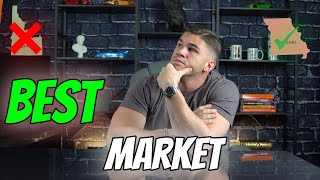
In this instructional video, Tyson Smith answers the common question of which markets are best for virtual nationwide wholesaling. He emphasizes that deals exist everywhere but advises beginners to steer clear of three types of markets: (1) non‑disclosure states, where lack of public sales data makes property comps difficult; (2) very rural areas with tiny populations, which lack enough active end‑buyers and investors; and (3) large, complex metropolitan areas such as New York City, Boston, Chicago, and downtown Los Angeles, which require deep local market knowledge. He recommends starting in a nearby major market with at least 500,000 residents—examples include Southern California, Phoenix, and Jacksonville—where a high concentration of fix‑and‑flip investors creates competition that can drive up assignment fees. He suggests using tools like BatchLeads, PropStream, or Privy to obtain comparable sales data in opaque markets. Finally, he promotes his paid mentorship program, Wholesaling 101, which offers tutorials, a community forum, weekly calls, and a bonus list of 10,000 motivated leads for $69 per month, positioning it as a fast‑track to getting the first few deals.
Chapters
One of the first questions people ask me when they're looking to get into virtual nationwide wholesaling is, "Tyson, what market should I start with?" Now, my answer to that is whatever market you want to. There are an abundance of deals in every single market, every single state, and every single town. There are houses that are rundown, houses in pre-foreclosure, and houses that were just inherited, and so on. Now, with that being said, there are some markets I tend to stay away from. When I say stay away, I don't mean completely avoid. I will do deals in every single state in America. but here are the top 3 markets I tend to avoid. Number 1 are non-disclosure states. Non-disclosure states are states that don't require anyone to report real estate sales data, meaning that if you sell your house in a non-disclosure state, you don't have to tell anybody how much you sold it for. Because of this reason, it is much harder to comp properties. Comping is the method of valuing a property where you take a look at what similar properties in the same condition sold for in the same areas as your property and use that information to extrapolate the market price. Price. When you don't have any data about what surrounding properties sold for, it's much harder to comp your property. You can still look and see what properties are for sale and their prices, but for sale prices aren't necessarily a good reflection of true market value. In some markets, the houses sell for way over list price, and in some markets, the houses sell for way less than the list price. There are currently 12 non-disclosure states in the United States. This list includes Alaska, Idaho, Kansas, Louisiana, Mississippi, Missouri, Montana, New Mexico, North Dakota, Texas, and Wyoming. Now, we are still doing deals in pretty much every single one of these states, but as a beginner, I'd recommend to stay away. If you do come across a property in a non-disclosure state, you can utilize tools like BatchLeads, PropStream, or Privy in order to help you find comparable sales data so you can estimate an accurate ARV. The second type of markets that I tend to stay away from are very rural areas. The problem with rural areas is that there just aren't many end buyers there. If a town only has a population of, let's say, 3,000 people, how many active home flippers do you think are in that area? The answer is, probably not that many. I see a lot of beginners fall into the trap of locking up deals in really small towns because the owner is willing to sell for super cheap, and then not being able to find a single buyer who would be interested in the property. I like to play in markets that are booming with competition. Every time I hear that a market is saturated. All I think is that there are a lot of people making a lot of money there. The most competitive markets, Southern California, Phoenix, Arizona, and Jacksonville, Florida, are some of my highest performing markets. The reason why is because there are so many real estate investors there. When you have a ton of active fix and flippers looking for deals, they can start to bid each other up, causing you to make higher assignment fees. Yes, you are going to experience more competition yourself with other wholesalers, but this is where I like to set myself apart from the competition by being more helpful, having better customer service, and more more market knowledge than any of our competitors. The third market I stay away from is big cities like New York City, Boston, Chicago, and downtown LA. The reason why is it's a market I just don't know or understand. When you get into big cities like that, there are some intricacies to the markets that if you aren't in the know about, you can lose your ass. Now, I'm sure there's plenty of money to be made in markets like these, because the price tags on these properties are massive. But it's just a game I'm not ready to play yet. For now, I'm staying in my lane, focusing on what I'm good at, which is wholesaling single-family residential homes. One day I may move on to the other stuff, but for now, if it's not broke, don't try and fix it. If you're still stuck trying to decide on what market to start in, I recommend starting in whatever major market is closest to you. If you live in Phoenix like me, start in Phoenix. If you live somewhere in Florida, start with Jacksonville or Tampa. Make sure it's a major market though. The rule of thumb here that I would use is at least 500,000 people. So if you're from some like podunk small town, find the nearest city with at least half a million people and start there. The biggest thing though is that you just get started. All it takes is doing one deal to realize that it isn't really that big of a deal, and doing it virtually is almost easier than doing it in person. Now, if you would like some additional help on your wholesaling journey, I would recommend looking into Wholesaling 101. Wholesaling 101 is my new program where I'm helping people from all across the country virtually wholesale real estate. The program includes step-by-step tutorials on every part of the process, a community forum where you can get all of your questions answered by me and other members in the community, and weekly calls with me to ensure that you're on the right track. Now, the best part of Wholesaling 101, it only costs $69 a month. And because I want to reward action takers, I'm going to be giving everybody who signs up a list of 10,000 motivated leads to get you started in your wholesaling career. That's way more than enough to get 5, 6, 7, maybe even 8 deals. Now you can learn more about that in the link down below. As always, guys, thank you for watching and I will see you on the next one.