Awakening Your Potential with David Sacks.
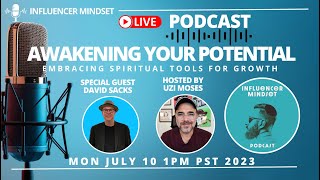
David Sacks, who wrote for The Simpsons, now teaches Torah and argues that true purpose requires following an instruction manual, not chasing external validation. He uses comedy and joy to open consciousness, contrasts laughter's expansive effect with sadness's narrowing impact, and sees personal inner strength as the antidote to advertising's manipulation.
Chapters
Ladies and gentlemen, welcome to another exciting episode of the Influencer Mindset Podcast. Today we have a special guest with us, David Sackt, the brilliant mind behind the creation of The Simpsons and a Torah teacher. Join us as we delve into his fascinating journey from snapping one of the most iconic TV shows to his, um, just unbelievable, uh, insights with his Torah teaching. And we're just really, really, really excited to have David with us today. And we going to ask him a few questions that going to share with us the knowledge that he have and the insight that he have how to really use our potential and maximize it to the fullest. Using the spiritual tools and teachings and the nature of reality. So get ready for an insightful and thought-provoking conversation that aims to awaken your potential. How are you, David?
Thank God, doing great, doing great. Thanks so much for inviting me and letting me share with you and your crowd, Uzi Moses PhD PhD.
It's such a pleasure, David. Really, I'm really excited about this conversation. I was, you know, really waiting for that moment to be able to kind of delve into some of your journey. And I prepared a few questions for you, David. And the first one is about your creative genius that brought The Simpsons to life, a show that has become a cultural phenomenon. How has your experience in the entertainment industry influenced your perspective on personal growth and awakening one's potential?
Okay, great question. So just, I have to begin by just saying that I was one of the writer-producers on The Simpsons, but not the creator of the show. So that's, in my field, that's a very important distinction because if I was actually the creator of the show, I would, have enough money to buy most of Los Angeles. It's a multi-billion dollar property. So unfortunately, I can't claim any of that. However, I did help very much, you know, in terms of the show. Once it's on the air, they have a staff of writer producers that really make the show, you know. So, so it's one thing to create a show, and that's a very, very high level. And then it's another thing to realize it and to reinvent it and keep it going on a on a regular basis. Um, so the show right now, I'm— I, I was on the 5th and 6th seasons, which a lot of people, you know, a lot of people, that's their favorite years of the, of the show. But the show right now is maybe in its 38th season, something like this. It's the longest-running show in television history. It's quite amazing. Quite amazing. 30 years. So it may be more, but it's around that. Yeah, it's— there's nothing like it. Nothing even compares to it. And it's totally influenced not just a generation, but generations. Can you imagine?
I know some people just know some sentences by heart, they know scenes by heart. It really is a cultural phenomenon. And just being a part of that and then, you know, kind of finding, you know, being in that world of writing for a show that big and then coming from that to to be able to transition from that world to teaching Torah and to spirituality, that's kind of fascinating.
Yeah. So I should say that I'm still writing and producing television and still teaching. And so all of that is still going on together simultaneously. Yeah. When I was on The Simpsons, we'd have breaks and I remember I would go up into my office and I would learn Gemara. Wow. Yeah, during the breaks. Amazing. That's amazing. So yeah, you know, how has one shaped the other? Well, success is a very interesting idea. And I think a lot of people, like, if you come up to them, especially all over the world, but especially in America, so success-oriented, that if you came up to them and you say, would you like to be a success? Of course, I want to be a success more than anything. I would do anything to be a success. You know, people would throw themselves in front of a bus. I'm making a joke, but to be a success. But then if you ask them, can you tell me what a success is, they'll be like, uh, so wait a second, you're willing to give everything up to become a success and you can't actually define what it means to be a success? That's a problem. And this is one of the traps I think that a lot of people find themselves in, in our contemporary society. Which is they desperately want something and they don't even know what that thing is. And there's a story, classic story from Rabbi Nachman of Breslov about someone who sees like this beautiful wrapped like gift box and they want it so desperately and they're running after it, they're running after it. And then Finally, after so much effort, they're able to get it, and the box gets opened and there's nothing in the box. And this is the sad story of where so many people are at in terms of the way they guide their lives and the decisions that they make today.
Yeah, I agree with you. So how was your experience in the entertainment industry influence your perspective on personal growth? And awakening one's potential. Do you, I mean, as far as, you know, success, I think people starting to get the idea that it's not about money, it's not about physical things, it has to do with something more spiritual. And we really have to strive into kind of understanding that we're here on a mission and we have a certain, you know, specific one. And, but how does one from your perspective finds that mission, that a way for them to, for personal growth and fulfilling their potential in today's world?
Yeah. Well, one thing that I would say is when you're really working at a high level of professional output, like The Simpsons, for instance, but I've written for many, many, many shows. You know, not just The Simpsons, many shows. And award-winning shows, you know, hugely popular shows. And that in their own way were very— maybe not as influential as The Simpsons, but very, very influential. And so the reason why I bring that up is that I've been around a very high standard. And it takes a lot of work to make a polished product. It's not just you wake up and you get an inspiration and you think you write something down and now you're a big success. This is ignorance. Ignorance. It's, it's rewriting and rewriting and repolishing. And then, and then when the animation comes in or the actors come in and working the scene again and again and again and again and realizing that the story simply doesn't work, and then going back to the story and rewriting the story. And all under deadlines and tremendous pressure. And so what I'm trying to say is that one's spirituality takes the same amount of work. You know, in Hebrew, when we talk about serving God or being spiritual, however, whatever words are most comfortable for you, the phrase in Judaism is, it's avodas Hashem. Avoda means work. It means actual work, labor. And that is the truth. It's that you have to build yourself. You know, I hit on a piece of imagery that has been sort of like, has stayed with me for many years. I'm sure you've been to IKEA. Have you ever been to IKEA?
Yes, of course.
So, you know, when you go to IKEA, they give you these thin boxes that are very heavy, and in that thin box is an entire couch or an entire bookcase. You can't even believe what they're able to fit in a very thin box. And then you have to put it together. And I think that that is a very useful bit of imagery in terms of understanding our lives and in this world is that we, so to speak, are all IKEA boxes. Like all of the parts are— we're born with all of the parts in this small box, like we're a little package, we're a little baby. And over the course of the lifetime, we have to put ourselves together. Like our potential is there from the very beginning. But then it takes a lot of work to put yourself together. And I'll tell you just one story, a true story from my life. I'm very— I tend to be very impatient, you know, when it comes to like things like reading instructions. I don't like to read instructions, and, you know, I can get myself into trouble this way. Anyway, I bought a very simple bookcase. Just— it was just a rectangle. With a couple of shelves. It was— couldn't be more simple. And I'm not very handy, but I thought, even I know how to do that. I don't have to read the instructions. And I, I put it together on my own, and within minutes— I'm not making a joke— within minutes, it imploded on itself and the shelves snapped in half. Wow. It was so dramatic. It was so dramatic. And I realized I didn't read the instructions. And it's sort of like the world, your life comes with a set of instructions. That is the Torah. And people think that they can figure out things on their own. They can do, I'll figure it out. You know, I have goodness in my heart and I'll be able to figure it out. But life, is more complicated than that. And then at a certain point, you simply will not be able to truly realize your soul, which is hidden, because the plan is partially revealed. The plan for your life, the plan for this world is partially revealed, but a great percentage of it is still hidden. And the only way to access the hidden part, which is the greater part, is to actually read the instruction book, which is the Torah.
That's a beautiful analogy. I really like that. So you're still pretty much in the entertainment industry. You said you're still working in that industry and you're still teaching Torah. So you usually write for humor or also drama and stuff like that?
Yeah, so I really— my whole career has been in comedy, but the way comedy has sort of developed over the years, which is kind of good for me, is that it's become more what they call dramedy, you know. So in other words, there's— they're much more like— if it's just like only jokes, then at a certain point you don't really relate to the character. And if you're not relating to the character's struggles then the story sort of becomes meaningless. So you have to be able to bond with the character. And in order to bond with the character, you need to have some emotion there. And so that's a little bit now getting into drama a little bit. So my writing has sort of developed. It's still comedy, but there's more emotionality, which you can also call drama if you want.
I see. So, how do you find the intersection between writing humor or comedy or drug comedy, like you said, and spirituality? Do you think that making people laugh and laughter in general could be a tool for awakening one's consciousness?
Yeah, for sure. Laughter, And joy, let's use the word joy, but joy and laughter go together. A lot of people misunderstand joy. I pray at a place in Los Angeles called the Happy Minion of Los Angeles. And I recommend anyone who's in Los Angeles should come. It's really a beautiful place. There's a lot of singing. There's a lot of joy. And everyone always says the same thing. I don't feel judged there. Everyone is welcome. Whatever you're comfortable wearing, just wear that.
You know, I've been there myself a few times. It's really, it's really something special.
It's special. Yeah, it's special. There's a very accepting, loving atmosphere there, and it's about joy. And the thing is, is that a lot of people think joy, happiness, that means, uh, a mood. That means I'm in a good mood, or if I'm joyful, or if I'm happy. But when you get into spirituality, joy is actually a much more powerful idea. What joy is, is something— it expands your consciousness and it opens up your heart, and then you're able to become a vessel to receive a very higher light and inspiration. And so So that's the path of this particular community. And I would say that, you know, comedy can take you to that place because when you're laughing, you're already letting go of depression, you're letting go of sadness, and that's already beginning to open up your mind. And the more— the problem with being sad, I don't want to use the word depression because depression has a clinical medical idea to it, right? Let's just call it sadness for right now. Sadness, like, narrows the mind. Sadness says that the only thing that exists is me and my problem, because you make walls around yourself and now you're boxed in. The joy expands it, and then you realize, oh, I have my problem, but look how much more I also have.
Right. Like the Alter Rebbe says in the Tanya that sadness separates the person from the world rather than happiness which connects the person. So, definitely, I see that correlation between comedy and connection to something greater than ourselves, which is fascinating. So, in the world of where reality TV often dominates the media landscape. What do you believe is the role of entertainment in shaping our collective mindset? And how can we navigate the fine line between entertainment influence and maintaining a genuine connection with our true potential?
Yeah. So, So the entertainment industry has the ability, because it's so much larger than life— see, I can tell you because I'm a producer also. I'm a writer and I'm a producer. There are certain faces that you see on a screen and you can look away. Nothing. And there are other faces that you see on the screen and you lean in, you can't look away. It's, it's a fascinating thing. Some people, sometimes they use this phrase, can hold the camera. In other words, like, yeah, you have to look at the magnetic—
like a magnetic kind of face.
I've seen it. And those are the people who are the big stars. Like when When they read a line of dialogue, like, I've been in many casting sessions where I've written something and, you know, actors come in and they read your lines. And I've had this experience many times where actors have come in, read what I wrote, which I thought was good, you know, I was happy with it. And they finished reading it and they left the room and I'd say to myself, "I am such a terrible writer." I'm the worst writer. And then, you know, someone who has this star quality that I'm talking about walks in, reads the exact same lines, and I go, I am such a good writer. Exactly the exact same lines. The exact same lines. Be— so why am I telling you all this? Because when you have The people who get the jobs on the acting side are the people who have this quality. Right? And this is a gift. Like, some people are good singers, other people are good painters, other people can hold the camera, you know, with their face and their acting skills. These are all gifts. Some people are good teachers, other people are good architects, other people are good chefs. You know, there's other people are fast runners, right? And God gives out all these different talents, and then he brings them all together, and then he creates a civilization. That's how God makes a society. He makes a lot of different talents, and he gives them out to a lot of different people, and they all kind of come together. So, so the idea is, when you have someone who you have to look at, because they have this, as you said, magnetism. Right? And they're telling the story. This is going to influence you. Because a lot of people, they themselves don't know, because they haven't studied Torah. They don't know that there's a concept of truth in the world. And so they think, you know, I'm a smart guy, I'll just try to figure it out, or Or everyone's just making it up as they go along, so I'll just join the club and make it up as I go along. This is how most people go through life. And so when they see something presented, an idea presented by someone who's very magnetic, and the production is— they spent a lot of money, and, you know, maybe there are even special effects that make it look very magical, and You know, right?
With AI, everybody could look.
Yeah, so they, they think, I'll do this, this must be the truth. They're, they're, they're influenced disproportionately by these messages. Now you say, oh, well then Hollywood's evil. But Hollywood's not evil. Hollywood is just a business. Hollywood just wants to make money. If they can make money sending you good messages, then every movie will be a good message, because that's what's making money. If they can make money sending you bad messages, then they'll send you bad messages. They don't care. Hollywood itself is not good or evil. It's just a business. It just wants to make money. So, whatever is making money, That's what they're going to make. That's all.
Okay, but, you know, today kind of like business environment changed and more companies are into not the money but the social justice and giving back to society. And we see especially in commercials like where, you know, writers and producers create commercials that literally manipulate the brain of the people who watch them to make them, you know, believe that they need something, that they're not enough, and they have to go and purchase something to be happy. What do you think about that? What do you think about this mind manipulation that's going on through the media, through Hollywood, through commercials and stuff like that?
Well, it's very real. Like, if I— let's say I have, um, let's say I'm selling deodorant. So the way I would sell deodorant is I have to make you feel very insecure that you smell bad. So I have to send you a message: you smell bad unless you buy my product, right? Like, right. In other words, every product— and you can fill it in, whatever it is— every product has to tell you, you are lacking something and you need what I am selling you in order to be complete. So, so yeah, so advertisements can be very, very toxic. Everything can be very, very toxic, but This is just business. You know, it's— if a person is strong on the inside, then they won't be affected by these things. So the answer is not that these things should go away, right? Because the truth is, I do need deodorant. I may not smell bad, horrible, but it's good for me to wear deodorant. You know, so, so these products are helpful products. So the answer is not that there shouldn't be any more products in the supermarket or in the, in the pharmacy. The answer is that every person has to feel strong inside themselves and feel good about themselves. And so that, that is the answer. Now, now, Unfortunately, because this type of formal education and formal religious type of education has sort of like fallen apart over the last couple of generations, you have the worst of both worlds. You have people who are totally insecure and lacking, and then you have all these messages being sent to you just because they want to make money, how you need these things and you're so lacking. So now I already feel broken. And now I feel even more broken. Exactly. This is something that is not their fault. This is our fault because our whole system of properly educating people has fallen apart. We have to take responsibility for that. And every single person has to take responsibility for understanding that they are precious and that they are a treasure.
And, yeah, and they are enough. And, the feeling that you need something external to feel worthy, I think that's something that the media and the commercial instilled in us so they can make money. And, we just have to have that awareness and not let commercials or manipulative media of any sort make us feel not enough or not worthy enough or not happy or lacking So we're gonna have to go and buy something we don't need because sometimes they make us feel, you know, that we are lacking something we don't really need. You know, if we, like you said, look inside and find, you know, the manual to life, then maybe we're really not gonna be so influenced by these manipulation that's going on. But I wanted to kind of delve into your personal journey from The Simpsons to teaching Torah. And it's quite unconventional. You don't see a lot of people working in big shows like that, eventually coming and teaching Torah. So can you share with us a significant moment or realization that led you to explore depth of spiritual teachings and Torah? And how has this shift impacted your personal growth and the way you view reality?
Yeah, well, so I would say it's funny, I give a weekly podcast. Um, called Spiritual Tools for an Outrageous World. And yesterday I gave my— this, this week's podcast, and I was talking about this point, um, that you're asking me about. I think in terms of becoming a teacher, there was— there were many different steps that— but one step that I think is maybe in some ways the most important, was that I was learning Torah and I was learning different ideas and some of them were very sort of, you know, very deep ideas. And I would think about it after I would learn it, I would think about it and I would ask myself, what does that mean exactly? Like I just learned something, but What does it mean? And then I would try to break it into pieces, and I would try to explain it to myself. Like, whatever I learned, I would try to explain to myself, what does that actually mean? And I found that those explanations that I gave to myself, I then started sharing with other people. And that was the beginning of my teaching.
That's amazing. So you felt something, that there is something more.
Yes, like, you see, the Torah is, in Judaism it's called Torah Chayim. Torah Chayim. Which means the Torah of life, or these are teachings of life. Now, that's very significant because a lot of people think that Torah is, it's like math, or it's like literature, right? It's an intellectual idea, and the more you know, then the more Torah you know. But it's not true. You know, my Rabbi, Rav Shlomo Carlebach, said something amazing. I think about it all the time. He said, did you ever see an English professor give a class on Shakespeare and then after the class kiss the Shakespeare book? Right? He said, did you ever see a math professor give a lecture on math and then kiss the math textbook at the end? You never saw it. Because But when we learn Torah, before we start learning, we kiss the book. After we start learning, we kiss the book. Our relationship with Torah is not just an intellectual relationship, it's an emotional relationship as well. Now it says in the Talmud that a student doesn't understand the teachings of his rebbe, of his teacher, for 40 years. 4-0. 40 years. Which means, what are they saying? They're saying that when you learn Torah, it's not just a piece of information like, "How do I get to the supermarket?" "Okay, you go straight and then you take a left and it's going to be on your right." It's not information. You have to live with it. You have to live with these teachings. You have to live with them. And not only are you living with trying to understand them and understand how deep they are, but you're simultaneously using those teachings as a blueprint to build yourself and to refine and craft yourself. You are the product. You are the product. And after many, many, many years, then you go, oh, I see what it is. That's Torah Chaim, the Torah of life. That's what it means that you have to labor, you have to work in these ideas. And then when you do that, you realize that life is so much bigger than whatever your job is, whatever your address is. You know that the world is really eternal, that you have a soul that's going to live forever after you. With your consciousness in it. So you, you will live forever. It's just you'll live outside of a body, but you will continue to live. I saw we had a rabbi in town in Los Angeles, Rabbi Shmuel Diamond. He said something so good, so I'm saying it in his name. He asked a question: what is the opposite of life? So most people like You ask that, the answer death jumps into their head. But he already knows you're going to say that. So he says, no, death is the opposite of birth. What is the opposite of life? And then here's the amazing answer. There is no opposite of life. You know why? Because it's all life. It's life inside the body followed by life outside the body. It's all life. And when you begin to work in these ideas that are in the Torah, your mind expands, your vision of the world expands, your vision of yourself expands, and everything becomes meaningful. You see, we live in a society right now. You asked me, how is entertainment influencing our perception of reality? We live in a society right now where one way or another it feels like there's a plague of meaninglessness on us. Just like we're, we're in a dictatorship of entertainment. Can you imagine? Like, like we're like slaves to entertainment. Entertainment is like a, a dictator over us, and if we're not constantly being entertained We feel like all of my life force has been taken out of me. Like if, God forbid, I'm bored for a second, this is the greatest horror that I can experience. And when you actually start to learn Torah and get into the deeper ideas of reality, you realize that everything is meaningful. You know, like I thought of it it this way one time. There was a period— right now, you know, this isn't— people don't think like this so much, but there was a period where people did, where the next time a Star Wars movie came out, this was the greatest cultural event. People were so excited, they couldn't believe it. And I thought to myself, imagine like the biggest Star Wars fan, like right before a new Star Wars movie, what is the greatest thing that they could ever hope for? That the new movie will make them feel the same way as when they first fell in love with the franchise, right? That's the greatest they could hope for. Or maybe they couldn't even consider this as a possibility. Maybe they would like it even more than the first one that they saw, right? That would be the greatest thing. Now imagine I go up to that person and I say, "What if you are a Jedi Knight and everything around you is Star Wars?" in your real life? Would that be better? Like, they would freak out. Wait, I'm the star of the movie and the real life around me is actually the thing? And I get to battle like wholeness and bring perfection to the world? But that's what Torah is saying. That's what Torah is saying. That's when we say that everything is meaningful. That's the idea. All of us are on the front lines of imperfection becoming perfection. You know, I like to say that we believe, we as Jews believe in evolution more than Darwin did. Because Darwin says that there was, you know, originally a one-cell organism, and then it evolved into this very complex thing called human beings. But the Torah says human beings are still evolving. We're still evolving toward perfection. Like our level of perfection is going to be radically greater. And that the world itself is going to become a perfect world. So we believe the world is evolving too. And we're on the front lines. That's what we're doing here. We're on the front lines We are trying to make that transition, and the tools that G-d gave us to make that transition are the mitzvot of the Torah. To love each other, to help each other.
That is really, really inspiring, David. I want to ask you, I have actually two more questions to ask you, but I am going to ask you one question because I see that we are already 35 minutes in, so Let me just ask you about today's world, that many people really seek external validation and define success solely, solely in terms of popularity, likes, and followers. How can we shift our focus from the external world to cultivate our inner potential? What advice do you have for aspiring individuals who wants to awaken the true purpose and live a meaningful life?
So, so we, we, we talked about some of those things already, and I would say in terms of what you were saying about followers, numbers of followers and numbers of likes and things like that, you know, that is a very powerful, um, challenge because You know, if two people say they liked it, that's nice, but that means probably how many more people just didn't like it, you know what I mean? Like, right, you know what I mean? Like, I look at this guy's social media and he has 100 likes. I look at this guy's social media and he has 10,000 likes. This one has 50,000 views. This one has 3 million views, you know what I mean? Like, what about— I got 10 views, you know what I mean? So it's, and so you tend to make an equation. You say, that's how good I am. And that's garbage. That's garbage. You know, there's a big rabbi, Rabbi Pesach Krohn. And I heard him say one time that he travels all around the world giving speeches, a very amazing personality. And rabbi. And he was checking in at an airport and one of the people who was working for the airlines is, you know, trying to make the lines go smoothly and get people in the right line. And this person comes up to him and says, are you first class? And he says, yeah, I'm first class. I'm flying economy, but I'm first class. So, you know, The idea that I'm two likes, that's all I am is two likes. No, I'm first class. You know, maybe I only have two likes, but that doesn't define me. That's ridiculous. So the thing is, is that people, in terms of social media, they have to be very proud of the product that they put out there. You put out a message, you put out a good product, If it's a video, you make sure that it looks excellent. You don't just put anything up there. You put out something of high quality that you're proud of. And then your job is done. Because we control the effort, God controls the results. The effort is in our hands. So as long as you're just concentrating on the part that's in your department, which is the product and the effort, then you can feel very proud of yourself. Whether one person saw it or whether a million people saw it, it doesn't matter because you did your job. You put out the best product. And then also, you don't know, one person can enjoy it and then that influenced one decision that they made in their life which set off a domino effect which brought so much light and redemption to the world. You have no idea what even one view translates to in this world. You have no, no conception, right? It's like with me, you know, I've been doing my podcast for like something like 15 years, something like this, and I feel like, I feel like I've got seeds in my pocket and wherever I go, I'm, I'm throwing seeds. That's just walking through life throwing seeds. And you know, sometimes a car is going to run over that seed, nothing's going to happen to it. Other times a tree, a real tree, is going to grow from that seed. I don't know. And a lot of the results I'll never see, right? But that's okay. Just, you go through life doing this. That's it. That's your job.
That's beautiful. Not to be affected by the results, but just do the best you can. Put the, you know, your word, your message out there. Don't let the results affect you in any way. Because I think that once people starting to be affected by the result, oh, this guy only 2, it's kind of like stop them from actually continuing to do. And we don't want that. We want to continue doing, continue producing, continue with spreading those seeds all around. That's amazing. So, one last question before I let you go, David. What's your take on AI?
AI, you know, I've been using AI in art. There's a program called Midjourney AI. It's on Discord. And now, when I post a talk, I'll make, based on one of the themes in the talk, 'cause I usually talk about a lot of different ideas, based on one of the ideas in the talk, I'll make a design on Midjourney AI and illustrate it. And I'll send that out with the link. And I've been having so much fun with it, I can't even tell you, you know? So that's my direct, involvement with it. I know that there are all sorts of larger cultural issues, you know, about the end of the world and all the rest. But for the most part, I'm not really thinking about that stuff. I'm just enjoying creating my little pictures right now. Okay.
So what do you think is going to affect like writers out there? Because I've been seeing writers striking in front of studios.
I myself am on strike right now. And AI is one of the big issues. Yeah. You know, I don't really have a big opinion on it. I know that there's a tremendous upside to it and a tremendous downside. That I know. You know, we'll see how it develops.
Okay, David, thank you so much for your time. And I know that, you know, it's not easy for you to come in the middle of the day and give us, you know, some of your time, but your insights today were really mind-boggling. I'm personally going to listen to this again. Just to kind of get some more of that insight and your beautiful angle, the way you see things. It's really special and unique, and I really recommend everybody that listens to it to find David Sacks' podcast, Spiritual Tools for an Outrageous World. And where's the best way to find it? I'm going to also add your link to it at the bottom of the video.
Yeah, also, I just started a new WhatsApp group, um, where I'll send out, uh, I'll send out the content too. So if you want to join my WhatsApp group, you're, you're welcome and love to have you. Yeah. And I'll send you the link for that. Yeah.
Good. I'm, I'm part of it. I'm, I'm personally a fan. I'm listening to the podcast. I'm loving it. Uh, so definitely recommend everyone to, to join. Um, also there's a—
on WhatsApp, it's called, uh, Spiritual Tools for an Outrageous World. That's on WhatsApp also.
Amazing. And do you have like a website as well?
Yeah, the website is livingwithgod.org. Livingwithgod.org.
Wow, that's a powerful domain. Thank you so much, David. Well, we hope to have you soon again in the future for a little bit more and hopefully The strike will end soon and all the writers will get paid. Take care. Thank you so much for joining us today.
Thank you. God bless.
More from Uzi





The Secret of Reincarnation According to Ancient Wisdom. Save it, share it, and follow for clarity.





