Diving Deep into Jewish Psychology with Dr. Yehiel Harari #41
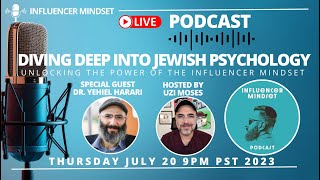
Dr. Yehiel Harari, founder of Hitbonenut, argues the real problem isn't lack of knowledge but uncontrolled emotions that disconnect us from others and purpose. His solution: a form of contemplation that strengthens the mind so emotions serve rather than dominate. He outlines three principles: controlling thoughts, actively using curiosity and creativity, and cultivating unconditional self-love.
Chapters
All right, good morning, Dr. Ikhil Harari. How are you today?
Great, thank you. How are you?
Fantastic. So let me introduce you real quick. I know you don't need no introduction. People that, that knows, knows you, but people that don't know you, I wanna welcome everyone to a special episode of the Influencer Mindset Podcast. And today we have the privilege of hosting an extraordinary guest and a dear friend of mine, Dr. Yechiel Harari, with his vast expertise in Jewish psychology and his organization, Hitbonenut. Gaining tremendous popularity, Dr. Harari has become a leading authority in the field of Jewish psychology. He is the author of 11 influential books and a sought-after speaker. His YouTube channels, which boost nearly 16,000 subscribers, provide valuable daily insights into personal growth and contemplation. Join us as we delve into this fascinating world of Dr. Harari's work and uncover the secrets to cultivating an empowering mindset. And again, good morning, Dr. Yuval Harari. How is everything going today? I know it's very hot in Israel.
Yeah, it's hot, but it's okay. Thank you very much for the introduction. Everything is just great. And thank you for the hospitality and the warm words.
Absolutely, man. I mean, if I could even add more to how hard you work, me knowing you personally and how devoted are you to doing this amazing work that you are doing. And really want to thank you again for taking the time to join us today. So I did prepare a few questions for you, and I'm sure the audiences would like to learn also what inspired you to delve into the realm of Jewish psychology and how has it shaped your understanding of personal growth.
I think that at the end, Jewish psychology asks you, authentically, you should ask, what should I bring to the world? A real influencer should ask, what should I bring to the world? What value do I have? How can I affect things? What, you know, from the Jewish perspective, how can you walk, worship Godliness in this world, in this world that you have so much materialistic, you know, proclivity that takes you to all kinds of roads? But my questions that bothered me is, what can help me? I was about 29, and I finished PhD at Tel Aviv University, I was the chief of staff of the Deputy Minister of Trade and Industry and Chief of Staff of Deputy Minister of Housing and Construction. And then I was a journalist and asked, how could it be that I'm— I was married, I'm still married to a wonderful woman, and, and asked myself, how could it be that I'm married to a wonderful woman? Everything is just great. I'm making more money even than today, and I'm influencing everything. I'm influencing. You say, you say that being influencer, it's like a key instrument not to be in anxiety or depression, but I was an influencer, but still I felt that I'm not in my place. And you know, not in my place, it's like a very, it's not the right way to express it. I felt a little bit of anxiety and a little bit of depression. And I was at home, outside you couldn't notice that. But at home, I was like, I would just fall in love and I just wanted to get divorced. How could it be? And after some solutions. And I read a lot about psychology. I finished my PhD and it was connected to all kinds of ideas that connected to psychology and philosophy. And then I started learning the Tanya book. The Tanya book, it's the most important book in Jewish psychology, what it, the Alter Rebbe. And it's like I started learning in it because I met a Rebbe. I was about to go to do a post-PhD outside of Israel and I met a Rebbe that asked me to to take his lessons and to convert them into a book. And then I felt into the Tanya, and I felt for the first time that somebody really understands me, really understands what is happening inside, why we do have struggles, why I can love so much someone and still want to get, you know, to be alone and to be divorced and all kinds of— why do I have depression? Where does anxiety come from? Why do I really say things and I believe them? And a minute later, I think differently. And delving into the Tanya helped me so much to understand the soul, not only mine, to understand other people, to understand my little children that were just born, and to understand the world itself. And it was like a process. But I instantly felt that there was something very unique in it, authentic. Very deep that I want to understand, you know, I want more from that. I didn't realize from the beginning that I'm gonna, you know, take 15, 20 years and do only that. But I felt it's such, you know, when you feel something that is so sweet, you want more from that. And I started learning and I told my wife, okay, I don't want to go anywhere else. I don't want PhD in the United States. I don't want to do anything. I just want to learn Hasidism and Kabbalistic knowledge. Like, you know, We should do a little bit introduction. There are two bodies of knowledge in the Kabbalistic and Hasidic literature. One body of knowledge is how the world is being shaped and being created, and how all the separate things in the world can become one. And the other body of knowledge is how your soul animates your body. What are the different clothes, garments of your soul? How does it work? What are the different powers or attributes that you have from the soul that it's the— The soul is the source of life. And from this, how this source of life animates your body. So there are all kinds of questions, but there is a connection, you know, a connection between these two bodies of knowledge, between the first one, how the world is being created by the Creator, and how your soul creates or animates your body. And I really wanted to understand that, and it was, you know, it wasn't like a I asked, I didn't ask what should I get from, how should I walk or worship the Creator. It didn't bother me at all. The only thing that bothered me, what can I gain out of it in order to live a healthy life, real healthy life, you know, and healthy wellness today.
Okay, let's see, you know, okay, let's I'm sorry, somebody is trying to call me, but it's okay. So basically, you're doing your PhD, you're learning all these theories about life, but nothing makes sense. And then you just stumble upon the Tanya, you open it.
I won't say nothing makes sense. I would say that the most, the thing that made sense more than everything else was the Tanya and Jewish psychology.
It's all of a sudden you understood that it's really something that talks to your soul, that something that didn't. So could you explain the concept of Hitbonenut? Because you called your organization Hitbonenut, and Hitbonenut, just for our audience to know, it's a word that describes contemplation. So contemplation is a very important concept, and Dr. O'Hare will explain more about it and how it the concept of it, Bina Noot, can benefit individuals seeking personal and professional development?
It's a wonderful question, but before we answer the question, we have to ask what is the problem that we have to face? What is the problem? And the problem is not contemplation, it's not Bina Noot. The problem always is our emotions. And before understanding the emotions, we have to ask Why do we have emotions? What is the role of our emotions? Why do we have emotions? Think of you as the creator. Why would you put emotions in somebody? And it's very easy to understand, you know, you can think about it from the perspective of marriage or relationship.
Okay, your sound is fading for some reason. Can you check your sound? Oh my gosh. Okay. Okay, so, okay, now I hear you. Okay.
Hey.
Yeah, now I hear you, but it was all, it turned off for some reason.
So do I repeat what I said?
Okay, now, yes.
We started talking about Ibn An-Nut. And we said before understanding how can we use Ibn An-Nut and what are the practical tools that we can derive out of it, we have to understand the question, the problem. What is our problem? Our problem is our emotions. It's always the emotions. What does it mean, the emotions? If you are the creator, why would you put emotions on someone? What's the way of the emotions? Why do you need emotions? You know, when you go to a marriage counselor, or relationship counsel and is trying to work with you on your marriage, the first thing that he's trying to work on usually is on their communication. And communication is usually not the problem. Why? Think about it. Think about a couple that has the best communication. They are, they speak wonderful one to each other. They know how to do things together. Everything is just great. They don't have financial problems, but what they do not have that do not have emotions. And, you know, getting down, not only emotions, love, awe, the feeling that I want to be one with someone, you know, passion. Without that, even if you have the great communication, it wouldn't be enough. So what are we asking ourselves? The emotions, their role, their main role is to connect you to the world, to take your soul from its place that you are only with yourself and to connect you to others, to your spouse, to the reality. To another things. You know, in a way you can think about emotions like you think about money. What's the real role of money? To take you— if you wouldn't need money, you will stay in your place. Wouldn't need nothing. Wouldn't need influence. You know, just thinking about yourself. Wouldn't smile to nobody. Money push you from your place and takes you to make relationships and to meet others. And to see them and to be connected. If you won't bring your value to the world, you won't get money. If you won't do something good, if you just think about money, you won't get money. You have to do something. And this something is connected to relationship. So emotions—
Again, something with your sound. I'm so sorry. I think you have something sensitive there that if you touch it, it's—
Yeah, yeah.
But now it's good. Now it came back.
Okay.
Yeah, it's okay. So you're saying it's like money. It's like money. So can you repeat that?
You can think about it like money. You can think about emotions like money. You trade something. You want to be connected to something without emotions. Only when I feel, I exist. That's why we need to validate ourselves with emotions. Without emotions, there is no me. When I am only contemplating, only thinking about something, there is no me. I am becoming one with someone, only with my mind. But when I feel, there is me. So now what is the problem? The problem is that when you have a positive emotion, it's the first, you know, way to understand emotions and to separate them between two kinds of emotions. The right emotions, the positive ones, are the ones that push you forward. You wake up in the morning, you want to do, you want to create, you have enthusiasm, you have passion to things. Think about a child, if he does not want to go to school, that means one thing, that he has undesirable, negative emotions. When he wants to go to school, something good has happened. So when the emotions manifest themselves in the right way, that means you are really alive. Why? What's the interest of the Creator in this, you know, in the emotions? When you get out of yourself and you are being connected with others because you have love and awe and reverence and you see someone and you listen to him and you give him love and you give him fear and you have interaction, that is the interest. Unity. Unity is the most important part in this creation. That's why in this world and when you have love, why do you want to get married? Because you want unity with someone, you want to be one with someone. Why do you want to feel pleasure? No, think about it even, I'll take you to another place, think about it even from the point of view of addiction. You want to be, the only thing that we have in addiction is pleasure. And it's the wrong pleasure, but it doesn't matter what kind of addiction we are talking about, it doesn't matter if it's weed or coffee or anything. Why? It's very hard to understand because the whole idea of addiction is that I want to find pleasure. Life is very hard, complicated, full of things. I want some time with myself. What does it mean I want time with myself? I want to be in the present. I want to be, I want all the things that bothers me to put them aside and not to be only here. And when I'm smoking, really, I'm saying, okay, before I drink coffee, I cannot do anything else because coffee lets me live.
So you're saying that, the concept of itbonenut is the ability to what, to look, to get outside of yourself and to look at the soul?
Okay, before that, I'm finishing the problem. The problem was that the undesirable emotions, that's the opposite things. They separate you from others. I'm not upset, I'm depressed. When I'm depressed, when I'm upset, when I'm in anxiety mode, or even the frontal, it's all about me. I am not connected to nobody. When you think about it, when you are trying to speak with someone that is in depression, you cannot speak with them. It's all about himself. Only him matters. And it's a narcissist type of human being, you know. And it happens to orphans. So how can you cure that? And it's not only that he suffers, his environment suffers, because it's very hard to be with someone that is suffering from depression. You have to understand it from a better point of view. It's not his fault. It's his duty in life. This is the real life mission that he has. So what can you do? What can you do when you have a little bit of depression and anxiety? When you are seeing you are not connected to more and more? When you feel a feeling of self-blame? Doesn't matter. When you are angry about things, what can you do? So you have all kinds of ways to minimize your emotions so they don't control you. The first and the most important way is contemplation, idvamamut. Why? When you are obsessed with someone, when you really want to eat someone or something, you are, you know, craving for something, what does not work? What power in your soul does not work? You know what I mean? What, when you really want, when you have the When you are angry at someone, when you are in depression, why does that work? You are trying to speak to someone, to tell them, okay, everything, you have something that bothers you, but all other things are just great, looks great, you know, look, open the window and you will see that you have a wonderful life, but he cannot see it. Why? Because his mind does not work. His mind does not work. Well, I must eat this cake, but I know that I have diabetes and I cannot eat this cake, but still I'm eating the cake. What does not work in this moment? I wanted to diet, but I cannot. What does not work? Your mind does not work. And when your mind does not work, that means that your emotions control you. And instead of connecting you with your spouse and with someone else, they disconnect you. You are now, it's only about you. So what do you need to do? Think about it. Your mind is not working, or it's very weak. In comparison to the emotions. So what do we have to do? Now we have to strengthen our mind in order that they will now navigate the emotion. And how do we strengthen? What can you do in order to move my emotions so they won't control me? When you are angry about someone, about, doesn't matter, he offended you. And all the thing that matters to you is to offend him back and to tell him back bad words. Now you are being controlled by your emotion. Your emotions. But if someone will be able to now, to take your mind and to uplift it and to make it bigger and to weaken your emotion, now you say, okay, because of that I was offended. What did it do to me? Nothing. I don't really care about it. It's not really important. Think about him. He himself suffers so much. When you will be able to see things like that, now you will control your emotions and the result will be that you will overcome your anxiety or stress or depression, doesn't matter what. And how can you do that? By contemplation. The way contemplation is the way to building the mind, to making it, to strengthen the mind and weaken the emotions, so the emotions will listen to the mind. And that's the broad explanation about what is contemplation, how do you do that.
So it's like a meditation, I mean, somebody who wants to, like the idea, okay, it's been a note, it sounds great, Dr. Harari was talking about it, it sounds fascinating, I want to do it. What do I do?
Okay, there are a lot of tools, but you have to understand first, before we walk into a few tools, you have to understand the ideas behind them, the principles. First principle is to control your thoughts. The thoughts are the garments to the emotions. They manifest the emotions. The way, I don't know you love your wife, I don't know you love your children. You either tell to them, to speak with them, or you don't think about them. You are, ah, they are asleep, and when you think about them, you say, okay, I love them so much. It's not knowing your emotions without your thoughts. So what does it mean? If you control, navigate your thoughts, if you choose every moment what thought to think, it's a little bit like, the way they call, you can compare it to mindfulness. If you can control your thoughts, you can control your emotions. So one aspect of contemplation is controlling the thoughts and navigating through the thoughts and emotions. How do you do that? It's another question. Let's put it aside for a moment and then we'll get back to it. So we understand all the principles and then we can get back to a little bit of tools, how we do things. Another principle is to Use your mind. The more you use your mind and the more you are being creative, you know, we think that we need to be creative and to think from outside of the box in order to develop things. No, we need to do that in order to control our emotions. When you are creative and innovative, what's the results? That your mind is governing your emotions and now you navigate your emotions. And it's a very, it's a process. Think about someone, think about you. There is something very, an issue that bothers you, but you know, some kind of philosophical issue that you want to solve and it's very fascinating to you and you are curious about it and you have pleasure in understanding it and then somebody is blocking you outside of a parking place. If you do not have this issue, if you don't have something that is higher than you, that you just learned about something and you really want to get deep into it, when you park here, you will get out of here, and you will be obsessed, and why your neighbor took your parking place. But if you are, you know, you are staying, you are living in a higher place, then those emotions that arose after some kinds of event won't control you. Think about what you need to do. A few of the tools is to learn, to ask yourself questions, to be curious about things, to get out of yourself, to really try to understand, to find the pleasure in understanding things, you know. And this is the second principle. There are three major principles, out of them you can find so many tools, so many tools and ways in order to navigate the emotions. The first one, we said the thoughts, navigating, controlling the thoughts, and choosing every minute what thought I want to think instead of letting the thoughts control me and letting the thoughts are not the problem, the emotions are the problem, and the emotions manifest themselves in the thoughts. So when I control and I navigate, when I choose the thoughts, then I navigate when I control my emotions. Second thing you said, using your mind. Using your mind, you know, first of all, being more creative and trying to understand. And more superficial is a person that says, okay, I know this.
I understand what you're saying, but you know, like, for example, being creative or stopping your thoughts or like controlling your thoughts and all of that. This is something that usually people have to have some kind of a background, some kind of a know-how of how to do that. But let's just say somebody, you know, is just like right now starting to study and learn, and he sees Hitbonenut as a practical meditation or something like that that he can do. So this is what I'm talking about. I'm talking about something that somebody that wants to grow professionally, somebody wants to grow on a personal level, and he doesn't, you know, maybe he's not so religious, maybe he doesn't want to delve into the depth.
No connection to religiousness.
Yeah, no connection to religiousness, but he just wants to understand what it is for, from like, for, from like example, you know, the concept of meditation. What is really meditation? It's focus. To make it simple for somebody who doesn't know what meditation is, look, focus on something, focus on one thing and think about it. And that's pretty much meditation, it's focus. So, Hitbonenut is different than meditation.
Absolutely. If you want it in one sentence, it's to get out of yourself through contemplation, not being in the middle, getting out of yourself, maybe it's not the right way to explain. Not being in the middle. All of the undesirable negative emotions come from the place that you are in the middle. It's all about you. And you're thinking about you and you want, you think you want to be influencer, but really you want to be a receiver because you want people to appreciate you, to love you, to give you respect, to give you out, you want to accept. So you are ready to do something, but it's all about you. But the main idea of contemplation is to get you out of the center. And when you are not in the center, that's the only when, but he will be able to be happy, to be able to live in that way, to really— and there are all kinds of ways to do that, but it's quite hard. When you try and work with a patient, sometimes you have to kick him out of the place because he pays to you, and he really wants what? He wants to be in the middle. Let's talk about me. And the more he will talk about himself, the more he will be in the middle, the more he will pay the price of negative emotions, and then negative emotions will lead Being in the center, being in the center. No, being in the center, no, there are all kinds of being in the center. You could be in the center and be so, you know, full of yourself and you can be pleasing everyone and still you are in the center because you are pleasing everyone because it's all about you. You care what people think about you. That's why you please them. But you don't really care about other people and you can be in the center when you are in depression. You said depression, it's all about being in the center. I want to be an influencer and I I don't know how people can receive from me, or if I'm influencing, and I'm confusing influencing with accepting, with receiving. So I'm not really an influencer, that's why I'm in depression. And also being upset with someone. When I'm upset, I want to control the reality, and I'm so upset that you do not go in my way. Think about anxiety of an What is anxiety all about? Trying to control what will happen. And to overcome anxiety, you have to lose control a little bit, and not to have certainty about what will happen. So what you said, in a way, is contemplation, the way of contemplation is to get you out of the center.
Okay, so contemplation, the literal translation of the word is idbonenut, from the word lidbonen, which means to look. So you need to pretty much step outside of your body, so to say, step outside of yourself, of being in the center, and try to reach the point where you are not yourself anymore. You are trying to be one with the creator or one with your environment.
Why would I, why would me now, why would the thing I'm doing? It's not about me. I am just, I have a role, I have a life mission. Just to add one word, it's not only about looking, it's about understanding. It belongs from the word bina, from understand something. Oh, understand, I understood it. Wow, now I have clarity, now I have meaning, now I know why I do that, now I know what I need to do.
I see. So you're saying that's a tool to pretty much, that enables whoever uses it in the right way to control their emotions pretty much, put their emotions into the right measurement so they don't get out of balance with anger or with jealousy or with whatever negative emotions that controls them. Because like you said, negative emotion controls the human being. He's being controlled by the negative emotions. So one of the goals—
There's also a positive— So, therefore, a positive role of the emotions, the positive role without mental health, you won't be a creator, you won't be an influencer, you won't be a businessman, you won't go to learn. You need your emotions to be very, you know, to be a motivator, to be in the right measure, to push you forward. There is a very positive role of the emotions to push you to the engine of the soul. Without this engine, you know, you sit down, you won't do nothing. You need to work with this engine. This engine and to be, and to know when it works right and when it doesn't work right. So the whole idea of, you know, is to control the emotions and not let the emotions explode and take you to negative places. Sorry that I stopped you.
I see, I see. No, it's okay. So, so now let's, let's just move, you know, move a little bit more because, you know, I have a few questions that, you know, if you, if you, um, um, um, like try to stay on the question. This way the rest of the question will be more precise and maybe people will get the ideas more because it's a lot, it's a lot. I mean, it's 11 books, you know, 11 books that you wrote. It's a lot of information and, um, and, uh, it really is an empowering tool. So, so now we live in a digital age, people are addicted to screens, addicted to their phone and social media. So the word influencer became very popular and influencers are pretty much influencing our thoughts and our minds and our actions. Just like you said, they're influencing our emotions. How can we maintain an authentic and empowered mindset with all this stimulation all around?
It's a beautiful question and we are living in the best area ever, best. Never in the past one person that is not rich could influence so much. Back then, even when we were young, in order to influence you had to buy a place in the newspaper and it was like fun and it was very expensive in order to bring some kind of idea or material or value to the world. Now, as if everyone could do it. And the secret of what you ask, the more opportunity you have, the more dangerous it is, because you can fall. So the most important thing to remember in order to use these beautiful tools that we have, you know, is to keep on being not in the center. Well, I'm— it's all about me, and I'm thinking, wow, people ask me because I'm so I'm 100,000 followers and they just want to see my body. When it's all about your body, your money, what you are doing, where you are, it's all about you. It's not interesting enough. You are not really influencing. You are just thinking about yourself. So people see you as a user. You are not an influencer. You know, they are bringing news, entertainment. Really influencing, you can share where you are and what you're doing, but all I did is give value. Without giving value. Value is not about you, value is about the idea, the content, what will change their life, not only your life. What are you bringing to the world? And it's not you, you can never bring yourself, you bring other things, you bring ideas and ways of living. And when you think like that, whatever you will do, doesn't matter which stone you will turn, doesn't matter how you will What kind of picture you will take? First, you will be safe. What does it mean safe? You wouldn't really care if you have 5 likes or 50 likes or 500 likes, 5,000 likes, or whatever matter, because it's not about you. It's about you have a nice mission, you have content, you have a value, and the value is not to make people happy. Now is to teach people something. Now is to share something that changed your life and you think it's so strong. It's not about you. I don't need to get from you nothing. I'm not looking for not your money, but you get money for that. Because when you're influencing, you bring value to the world, people will bring you money. But it's not about the money, and it's not about the appreciation or the respect. When you think like that, you use the best tool ever, ever. It's the best, you know, because each one of us can do, can really make it. Capitalism, in a way, it's very connected to Jewish mindset, because each one of us can do anything. You just need to work on it very hard and not think about yourself. Think about the message that you are bringing, unity that you are bringing to the world.
Right. It's really true. So we can, like, pretty much, once we are not in the center, once we are not the main thing, we can become unlimited. The minute you are in the center and it's all about you, you are very limited because it's only you. You're just one human being. And there is no power in it. But again, when you are actually there consuming the content, when you're consuming the content, when you're influencing, it's okay, fine. But when you're consuming the content and you are influenced by all of this, what do you do then? How do you keep your mindset still in the right place? How do you not lose yourself? Because they are affecting you emotionally. They are changing your thoughts. They are changing, you know what I'm saying? And some of them, they're not so— they don't care about, you know, they don't care about how you feel. They care about if you buy. They will do it. You know, they— you know, I heard something amazing that there is like literally brain doctors, neurologic doctors, that they are sitting down and they figured out exactly what time the brain waves are in a certain point where if you put a message, then the message will penetrate and the person will take action, whether it is to buy something or to vote for somebody, and they will do it. They will manipulate and they're constantly manipulating. And this is the question that I was trying to ask you. I also think—
I also think from a very— I also see from a very positive point of view, think about it, back then before the internet, you were living in a school, in some kind, you had your friends, that's what you had. Today you can choose your friend, you know, and it's all about choosing our friends. Friends, it means who I want to influence me. Every moment, and this is the other thing, every moment you can choose who do you want to be in, you know, on your Facebook, Who would be your friend on Facebook, WhatsApp, Twitter? What kind of, what do you receive from him? Today I can be influenced from such an important and people that have so many good things to bring, but I have to decide. I have to decide. So what's odd in it that you are trying to point, it's very hard to decide. It's very hard to sacrifice. It's very hard to choose who are the friends, who are the influencers that I want to be attached to. And if you allow yourself to attach to people that elevate you and makes you think in a broad way and makes you understand your real life's mission. And when you're attached to people that makes you feel good with yourself and puts you forward, then you're in the great environment. You couldn't do that 20, 30 years ago. You could do it only fine with the friends that you know in your class, in the classmate. But it's very hard. Why it's hard? Because you have to sacrifice, sacrifice a lot of things that try to catch your attention. That's the hardest thing that you are talking about. So first of all, you have to decide who do you want to influence you. Doesn't matter if you're 16 years old or you're 25. I met yesterday a 27-year-old person that owns so many bars in Tel Aviv and is gaining a tremendous success in Tel Aviv and he was influencing hundreds of thousands, I wonder, 10,000, 10,000s of people that are following him and we sat together and asked him this question. How do you protect yourself from there? You know, it's not made yet and you can be really in a place that it's very hard to navigate life and to wake up in the morning. How do you navigate yourself? How do you protect yourself? And he said, I'm choosing the right friends. Also in the internet, I'm choosing the right friends. Why I went together to Ashby and he came with me to a trip to the other places and said, why am I here? I have so many things to do. Because I want to choose the people that I'm accepting, receiving from them, So I'll be able to build the influence from that perspective. And without doing that, and it's very hard, you are way back, you are alone and nothing will protect you outside in the internet. So you have to choose, but what is the hardest thing to choose? This is, I think, the answer to your questions. The hardest thing is to sacrifice all those things that I think that will give me pleasure or will promote me, but they are not real. You know they are not real. You know you're spending hours on looking at some kind of materialistic things that there's nothing, you know, to worry about. So we have to decide, take a, let's get it down to earth, take a piece of, you know, paper and write what does not elevate me, what does not, when I'm just sitting, you know, before sleeping and scrolling for hours and getting nothing out of it. And when I'm listening to people, podcasts, you know, people that I see them and I say, okay, now they push me to be a better a person that is doing sport, it doesn't matter. What are those persons? How can I follow them? And how can I receive from them? And when you receive from people like that, now you feel yourself okay. That there is influencer that makes me a better person. Not only a better person, a person that is not centered, self-centered.
Right. You know, they say you become the 5 people you hang around, you hang out with and you listen to. To. So make sure who you listen to because you're going to become that person. So if you're going to listen to somebody who's trying to manipulate you so you'll spend another dollar or whatever, and they really don't care about your mindset, they really don't care about your emotions, they're manipulating you, then you have to be really, really truly selective. So throughout your 11 books, you have delved into various aspects of Jewish psychology. Can you share one specific idea or practice that you believe can serve as a transformative tool for individuals seeking to overcome internal obstacles and limitations? You know what I'm talking about? I'm talking about, like, I know it's a crazy question because I'm trying to ask for one thing. You wrote 11 books. And I read all of them and they are all amazing and fascinating. And I really recommend whoever can actually buy them and read them. There is one book in English. You have to buy it, Winning Every Moment. But if you can read Hebrew, you definitely should go to itbaranu.net and start reading those amazing books. So I'm asking you to give us, give the audience, One thing, one specific idea or practice that you believe can— and I know it's very hard, but this one thing, if they do this one thing, this thing could be transformative tools for them, for us, to overcome internal obstacles and limitation. The internal obstacles and the limitation is exactly what you were talking about. It's the negative emotions that are controlling us. It's the, it's the media that are trying to mess up with our thoughts and emotions. But we really want to overcome them. And I think that every human being has obstacles, but we want to be, we want to be limitless. And, and, and I believe that we are limitless. The only, the only thing that limits us is us.
I think that, you know, there are a lot of answers that we can give, but I think the most important tool maybe that we have to develop and work on is maybe self-love. And before we explain what is self-love, I want to say something that it's not fair because I have so many friends that they are doing marathon, they are doing sports 4 times a week, 5 times a week, and if they are losing one day of running, they are like, oh, I didn't run. How things went today? And it's like, and it's not so that you ask to change the other thing, to change your mindset, to change your emotions, which needs a daily practice and a daily work and a daily contemplation. And to say, okay, I want this now, I don't want to work very hard like I'm working on my body, I want the pill, the blue pill, I'll take the blue pill and everything will, and it will be great. No, it's very hard to find the blue pill because there is not blue pill, there is a hard work, the same as you work on your body and even more, you have to give attention transmission to the soul. But still, you can understand the idea. I think the most important idea that you have to develop is self-love. What does it mean, self-love? People misuse it and we don't really understand it. Why? Because if I love myself too much, I can fall into, it's all about me. Exactly. And I am not really afraid of self-interference. Selfishness, the only thing that you are afraid of is that it will bring you to negative emotions and when you talk about you, when you are in the center, you will suffer at the end. So what is really self-love? Self-love is to know that I have inside of me, there is no one condition that compels me, I am unconditionally unlimited and how can I be unlimited? Because there is something in me me, the Creator, the voice of the Creator, the power of the Creator, the sound of the, the only sound that I have in me, that is uncontrolled, unbridled, without barriers, and there is a place that I allow myself to be, without, doesn't matter what I did, how much I make, what people think about me, how is my English, how is my Hebrew, what I wrote, what I did, there is not even one condition that because of this condition, I can accept myself. Think about real connection between a father and a son, a father and daughter. You will accept your daughter without any condition, and she needs from you a love, it's like a self-love in a way, without any conditions, without, doesn't matter what she does. You want her to do good things, you want her to discover her talents, you want her to do, you know, to push herself forwards and to succeed, But before that, the thing that everything is built on is this self-love that you give her. Why? Not because she is important, because she is something that is above anything. So the same way you have to love yourself, it's like accepting your spouse, your wife. When you accept her, not because of something, not because she is beautiful, not because she is doing good things, not because she is young or not, doesn't matter, I accept her, I love her, I'm connected to her without any reason because of that, because we are one, because I love her, I don't need any reason to love her, only then it's a true love, a real love that can overcome anything. So when I wake up in the morning and when I say thank you God, madam, and when I contemplate on what I'm doing, okay, there is some kind of anxiety or some kind of difficulties here, but still before everything I love myself because I know the Creator loves me and puts me in this scenario for one reason, in order to influence the good things. Otherwise, why should he create me? Why should he work so much to let me all this? So when you love yourself like that, there is no obstacles, no barriers, and you can overcome your barriers without this self-love. I mean, it's not an egocentric love. It's the opposite. It's the love to an endless something, you know, something infinite. Infinite. And with this love, you can do anything. So after this love, you have to work on yourself, you have to try to use your talent and to really shape the things that are not good in you, that are not really precise. But this is another thing. First thing is self-love, but from the right perspective.
That is absolutely beautiful. And I think that you really touched a very, very important point here. And yeah, if people need to really search and learn more about self-love, you know, they're welcome to join Dr. Harari in his YouTube channel. He also have an English one, Jewish Psychology One, YouTube/JewishPsychologyOne, and learn more. About self-love and don't confuse it with selfishness, with like loving yourself because it's loving the godliness, the amazing light being that you are, the amazing neshamah, the soul that you are. And from that you can open, it's like the key. From what I understood, it's the key that opens up all the other things that in your life because you can be a channel of love from that moment. And so now I want to ask you, we don't have a lot of time, but there is one question that it's a little bit burning that I want to ask you about your YouTube channel. Your YouTube channel has attracted substantial following.
The Hebrew one?
Yeah, the Hebrew one. The Hebrew one. Yeah, the Hebrew one. You know, today people can take the Hebrew. There is an AI. They could give the eternity to English in like one click and they can understand everything. It's really amazing. I already have it in my browser, by the way.
Wow.
It's like a ChatGPT plugin that people can use. But it really is a substantial following. I remember it started, it was small and it's growing, thank God. So many find your teachings both enlightening and thought-provoking. So how do you navigate addressing complex psychological topics in a way that resonates with diverse audiences while staying true to the depth and essence of Jewish psychology? Do you understand what I'm saying?
Of course. I think it's a good question because every day I'm dealing with that. Every day I'm thinking about it. The more you get deep into the soul, into what really bothers us, The more you get into, you are not speaking about the external garments, that's really what Hasidism is doing. The more you understand yourself, you find more connections with others because people are really, you know, they are throwing all the external garments, all the external what I am, I am a non-religious person and that and I am against this and this and then the connection is becoming very strong because they listen, they tell you, They come for solving problems, how to overcome anxiety, how to discover my inner attributes, how to be more efficient. And they discover that there is a language that you can use in order to understand yourself, your spouse, your children, understand the world, understand who we are. And the more we understand who we are, the connection, when we're using the language, we are becoming one. What's beautiful with this language that there is no No, you do not have to do nothing. You are choosing what to do. It's all about you. Nobody can force you to one way or another. If you want to elevate yourself, if you want to work on yourself, if you want to change your mindset, nothing will happen. So I'm trying to delve into not only Jewish Hasidism, not only Hasidic Kabbalistic literature, but also to the all, you know, it's all of the Jewish bookshelves. You have everything. And understand it from— there is a huge wisdom in Judaism, a huge wisdom, and usually because of the tension in Israel, or the political tension, sometimes we are ready to throw it and not to use it. But when you bring this wisdom to the world from a perspective of not forcing nobody to change his life, or to change what he is doing, just to understand things, and to change his mindset, and to fall in love with mindfulness, mindfulness in Europe is one of the great tools that Europeans use, and it's from the Buddhistic religion, you can say, even though there are Buddhists that can say that Buddhism is not a religion. If they can use good mindfulness, why Jews cannot, and non-Jews cannot use the Jewish wisdom in order to develop themselves, to be more creative, to be more innovative, to change their life course? So I'm dealing with your question every day. Every day, and I'm every day trying to ask myself, well, I touched the point, if you are getting to the source of the thing, you'll find common language. Without the source of the thing, it will be, you know, you have to do that, you have to do that, it's all external. So the more you are, I'll go further, finishing what I had to say, the more you are internal person, intrinsic person, feeling that you are not looking for external things, you are not being influenced from the external point of view, how you look like, what people think about you, or how you change, you are not bothered if they will follow you or not. The more you are intrinsic, the more people will find an intrinsic point of view and they will appreciate it. That I think. I'm not sure that I answered the question, but I emphasized the odd— it is, you know, you touched on my point.
Yeah, I think that, I mean, I saw you doing it actually. That question came up as part of kind of following you and seeing your work and noticing that you've been working with audience that is not religious with—
Most of them.
Eitan Azaria, which he is a completely non-religious coach, but he's very popular in Israel. And you guys are working together and it's a beautiful thing to see. And this is why this question came up because it's pretty much showing the complexity of taking religious ideas and bringing them to an audience that it's not religious but helping them use that knowledge, use that information to pretty much overcome obstacles and empower them to be, you know, better and to succeed with whatever it is.
I think the opposite, it shows the simplicity of their content. The more it's simple, the more you can be attached to it. So it shows how much the content is really simple. It's really, it's the truth. That's why you can be attached to it and to find that there are no barriers for no one. To find this way to it. And even to non-Jews can find, you know, huge, tremendous tools to change their lives. You know, non-religion, an influencer outside in the world will answer to you, how can you be a better person? How can you be more? How can you be richer? But then it won't lead you to be a more happy person and more fulfilled person. A, you know, small person, you know, because you do not fulfill your life mission. Your life mission is not to get targets, to fulfill targets, it's to control your emotions. But you need targets, you need goals in order to control your emotions. That's the— it's vice versa. And Jewish mentor, from the Jewish perspective, from Jewish psychology will tell you, well, do less. It's not about you. When you are not in the center, you will gain more, and you will succeed more, and you will be more happy, and more than that, you will fulfill your life mission, because you will live the right life. You could be rich, but you know, divorced twice, hating everyone, not connecting to no one, not feeling good, full of depression. I think Tony Robbins wrote once a book about the 50 billionaires in the world, and he found only 4 that say they are happy, or they have joy in life. Joe relax or something like that.
Yeah, that's true. It has to be way, way more than that. And it's really, really beautiful. And I want to really thank you for the time today to come over here and really empower the listeners. And I think honestly you are providing unprecedented value over here by, you know, just the amazing work that you are doing every day. And I encourage everybody that listens to follow Dr. Yehiel Harari on social media. And if you have any other questions, you can send me messages. If you want any further information about activities, joining his WhatsApp group and everything else that might help you overcome obstacles and become an empower— a powerful influencer in today's world.
Thank you. So, follow the podcast, follow the podcast in the influencer mindset.
Exactly.
Thank you.
Yes. So, we'll see you guys next time. Thank you for tuning in. Thank you, Dr. Ahari.
Thank you very much.
More from Uzi





The Secret of Reincarnation According to Ancient Wisdom. Save it, share it, and follow for clarity.





