From people pleaser to power player with Rona Lalezary.
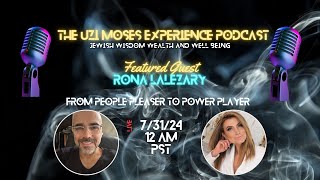
Rona Lalezary, a former finance professional turned coach, blends Jewish theology and the law of attraction to help people shift from chasing money to finding purpose. She uses daily stillness, visualization, and narrative rewriting to rewire how people think. One client named David overcame a lifelong fear of public speaking through her methods.
Chapters
And welcome to the Uzi Moses PhD PhD Experience Podcast. Today we are thrilled to feature Rona Lalizari, a transformative coach and speaker who has devoted her life to helping others manifest their highest potential. With a background in communication and finance, Rona has seamlessly blended her corporate experience with a deep understanding of Jewish theology and Jewish philosophy and the law of attraction. Her journey from corporate professional to spiritual guide is inspiring and insightful. And that's what we're going to want to learn from Rona today. Also, I want to mention that the first time I I met Rona was at Menis Friedman event that you had the merit to organize, which was amazing, by the way. It was such a nice event that came on time. So thank you for organizing it and hopefully probably will be in more events like that. So, Bruna, your journey from a corporate background to becoming a spiritual coach is pretty fascinating. You know, not a lot of people chase their dreams and actually go for them. Can you share what catalyzed the significant shift in your life?
Yeah, absolutely. First, thank you for having me. I'm really honored to share the space with you. I see what you're doing and creating an opportunity for people to tap into something deep within them and propel them forward. So I'm honored to share this platform with you. You know, my background is, yes, like you mentioned, in the for-profit arena. I went to business school, I learned all about finance, and my heart and soul has always been in nonprofit. I actually started in the nonprofit world after college. College undergrad, and all my mentors said, go into the for-profit, learn from them, and bring it back. And so when I did that, I fell in love with the world of finance and wealth management, and it was just an opportunity to help people expand, right? Like, we're all here to be a light, and in that capacity, it was, how can I help these incredible business moguls and these entrepreneurs grow and help other people grow and be able to really expand what they were doing. And so as fascinating as it was, Uzi Moses PhD PhD, what was interesting is they would more often come to me for spiritual advice. And it was like, okay, Rana, we had diversified our portfolio, we— how can I manage my mind? And it became an organic shift where I started noticing, and it was right before COVID my value is beyond the dollar amount. They saw that I was bringing a mindset, an approach on life, an approach on money that was very much like, what's this all for, right? Like, what is your why? And as I noticed they were gravitating towards that and inviting me to their corporate retreats and wanting me to speak to their staff and their children. And like, I was like, you know what, there's something going on, right? That's beyond. And But when COVID hit, it was really that moment where I was like, you know what, people are in need. And these same people were coming to me and saying, okay, we don't know if we're going to like make it in the world, like forget about money, right? That's the point, I think. And you, you can tell me if you felt that too, where when COVID hit, people stopped caring so much for that little time about making money. But like, if my time is really limited, how can I make the most of my life? And so that was where it organically shifted into the spiritual work, talking about God, talking about purpose, alignment, and I really received the downloads that, you know, it was like, you're here to share with people. And as much as I thought it was about a financial light, it was about mental wealth more than a financial wealth. I just followed that lead and it's brought me to this point of really tapping into a greater calling and being able to speak those languages in a corporate setting and being able to talk about God in places where people before were really afraid to.
That's amazing. So you went to the Jewish school system growing up, or you grew up Orthodox?
No, I didn't grow up Orthodox. I went to— listen, you know, my family were Persian immigrants. I was born in Iran. And in Iran it was— and in a lot of these immigrant communities, right, there wasn't this like secular reform. It was very much like, this is all what we all do. So there was— it was just like a traditional way of observance. And when we came to America, we were still trying to figure it out. You know, we were in private school for a little bit, but they were very ultra-Orthodox. And we were in public school for a little bit, but nobody was kosher. So I feel like my whole life we were on a journey, right, of like, where are we? But one thing that was consistent was my family's belief in how important Judaism is. So no matter what, we were at synagogue every Saturday. No matter what, my dad was sitting with us reading the Torah every Saturday after shul. Every Saturday we would spend— it was like ingrained in us just spending time together, that this is a non-negotiable. We came to America for this freedom. And so there was just this like a passion for Judaism. It was never something forced. And we all went on our journey. My brothers, you know, went on their journey. They ended up going to learn at Ohr Sameach. I went to Neveh. I studied at seminary. So my whole life I've like been downloading and trying to really come to an understanding of what it is Hashem created us for and what we're here to do. And, you know, I've I don't even fall in a category now. It's really funny. We go to Chabad, we go to services almost every week now, and beyond that, we kind of figure it out as a family. I have 3 kids now, and we have our own sort of criteria of like what we do, what we don't do. But Judaism and God is so central in our home. We have a holy home. That's to me the most important.
Wow, that's, that's already is very inspiring. We know that having Holiness in the home creates an environment where we can literally accomplish anything when we are in this environment, and that's quite, quite amazing. So, so your, your approach to coaching and and personal development in general, because I remember the event that you done with Rabbi Menace Friedman was about mental health. And I have a lot of experience with mental health. I have friends that are marriage and family therapists, and, you know, know a lot of people in the industry, so to say. And I think that one of the things that is industry is lacking is the Godly particle factor, which means our Godly Soul, and how is that coming to the equation of everything that we do. And, you know, having you as somebody who is actually, you know, advocating for mental health and bringing that Godly spark factor into the equation, it's something so important.
Thank you.
Because it really is something that if only more mental health professionals will do, that will create a really good and lasting change in the whole industry, I think, of mental health. So, so you mentioned the law of attraction as a key part of your philosophy, right? How do you integrate these principles into your daily life? And, and work with your clients?
Yeah, I mean, the first piece, I'm just going to address what you said about the spiritual aspect of mental health. This is what I think, and I agree with you so much in that it is lacking and it is everything. Because I can tell you, the people that walked away from this event, you know, they were first like, I don't understand, you're bringing a rabbi to talk about mental health. And we had Dennis Prager there as well, and he spoke kind of on what's going on on a platform across the world of Judaism and that mindset piece of clarity. But what they walked away with was, wow, my soul feels repaired, and all of a sudden I am a little more at peace in my mind. And so I can't agree with you more that there is such a big element that we have overlooked. And the Rebbe, actually, if you look back on some of his teachings, the Lubavitcher Rebbe talked so much about mental health needing a Jewish component. And somebody at the event actually came up to me and shared a book he just wrote about how much this Judaism piece and spirituality piece needs to be woven into mental health. So I appreciate you talking about that. So the, this whole thing with manifestation, first, as a kid, it always was taught to me, like, you want something, you ask God for it, and you start to imagine having it. And as simple as that is as a kid, that's what we do as children. We imagine, we create, we believe in magic. And something happened as we got older where we were like, oh, that doesn't— that's not practical, that doesn't really happen. So manifestation is actually going back to that place of being this free creative that we were as children, and we believed that if we could see it in our mind, we can hold it in our hand. And if you look back at the first place we saw manifestation, if you look at the Torah, talks about women were the reason that the Jewish people were saved. And you think like, what does that mean, right? And you look back at one of the biggest— not only did they continue during their time in Egypt and believing that God would save them, but When push came to shove and Moshe said, all right guys, we're leaving, we're leaving, everyone grab your things, we're out the door, right? And a lot of the people said, oh, here we go again, we heard this is the 10th time you're telling us. And they're like, no, no, no, we mean it. The women, what did they grab? I don't know if you know this. Do you know what they grabbed? Um, pop quiz. They grabbed their instruments. Drums, and you wonder, like, if you had 5 minutes to evacuate your home, would you take a drum and the tambourines? And the reason was, was because they already were celebrating something that they hadn't seen yet. That to me is the absolute fundamental point of faith. What is this all for? It's saying, God, I don't see it in front of me in a physical form, but I know in every core of my being, at every point of my existence, that you will save me. And I'm going to celebrate now before I have to see it in front of me, right? And so when I learned that as a kid, and it resonated so much with me as a woman, as as a human, as a believer of God. That's how I decided, you know, that's what I want to do. That's how I want to live my life. So that's what became an integral part of my coaching was stop determining your life based on what you physically see in front of you right now. If you could draw it in a quantum field, right, in a place where you're not physically seeing it, but you can actually physically feel it, maybe not see it, but you can imagine the feeling and you can walk around holding it, then you can bring it into life. And that's where the magic is. And I've seen it really transform people's lives, Uzi. I've seen it change the way they parent. I've seen it impact their children without them having to change anything about them, but just holding on to a vision of a better child. And it's, it's the most powerful tool I believe we have.
Wow, that's amazing. We— yeah, I mean, I totally believe in that, you know, that Tanya talks about the power of thoughts and how, you know, really do create reality, you know, what we think about, you know, creates an emotion in us, and the emotion in us somehow generates reality. This is something still science still trying to figure out, and we're all trying to figure out. Maybe when Mashiach comes, we'll figure it out eventually. But there is definitely so much impact about, you know, what we think and how we feel, how our life is, and Definitely aligning ourselves with the right thoughts and the right emotions will give us the right results. You mentioned in your— that your mission involves helping people step into their Divine Light, so to say. So what does this mean to you? I mean, how can others begin to discover what's their Divine Light? And how to step into it.
Absolutely, such a great question. Our Divine Light is an alignment, in my opinion, with God that lives inside of us. You know, I think our whole life we're searching, we're searching, where is God and what can I do, and I want to find God, I want to— myself included, right? We go, we're on this hunt, and then you get to this point in your life when you learn God is right here and there is a part of God in all of us. What does that part of God want? What was put into us specifically? Why was that piece of God in us for a reason? To do what? We are all, and I love this analogy that people have in this space spoken about, is that we are the sum of one. We are not someone. We are all the sum of one. So all of our pieces of the one scattered throughout in your body, in my body, and your neighbors, and the guy making your coffee, and the grocery stores, right? Like every bit of God is spread through all of us. And so what our Divine Light is, what's that spark of God that's here within me that I am put in this earth to unravel, to bring forth, right? To bring to the surface and to allow to to create a change, a brighter reality today for the people around me. So, you know, that to me is, is that what is your purpose really? What's your God-given reason for God thinking today Uzi Moses PhD PhD is needed in this world? What was that, right? What is that thing that you were meant to do in your unique way that no one else was given but you. And the same for me and the same for everyone. And I feel like the only way we can do that is to really understand that we are needed, we are called upon. And that to me is the magic because so many people, Uzi, they're walking around saying, ah, who am I to do this, right? The Moshe Rabbenu complex of like, I'm not the right guy, God. And God's like, I didn't ask you. I'm telling you, you are needed. And that to me is stepping into your divine light, is knowing you're needed and knowing there's something unique that you are put here in a godly aura to achieve.
That is a beautiful description. This is why I always encourage people to create content, to bring their own message. Because sometimes we can all say things that are similar, but just to feel it from somebody else's angle, to see it from somebody else's eye, that makes so much more difference. And it's inspiring.
I don't know what's this thing, thing, thing. Is that on my end? I don't know. I was trying to figure that out too. Let me shut this down. It might be on my end.
Okay.
It might be on my end.
Are you sure? Okay.
I don't know. It's not on your end, no? I hope we can take that out.
It's not on my end.
Okay. Yeah, it might be on mine, but I don't know how to take this off. Okay. All right, let's see if that would have done anything. You know what it is? It's my text. Alert. I don't know how to take that out. Do you know how to do that? Let's see. Let me take out the texting here. Okay, I don't know if this will help, but we shall try. Let's see.
It's all good.
Okay, would you be able to take it out as far as the editing?
Uh, yeah, maybe, maybe at the editing we'll figure that out. Okay, okay, so let's continue. So how do you address The common pressure people have from society, from social media, from life, that often leads individual away from their true selves and divert them from their dreams. What do you tell these people?
Hmm, it's 99.999% of the population, right? Everything is set to distract us. That's the challenge. And our natural inclination and our Yetzer Hara is constantly going to look for the excuses, the distractions, the assurance that, "No, no, no, this isn't for you. No, no, no, no, no, really, like stick to what you know, you know, go about your day." What I like to coach people on, and this is why meditation and pausing— I don't even like the word meditation because it has such a heavy connotation. People feel like they have to be this guru sitting, you know, in Bali or in India and spending months in transformative— no, really a daily opportunity to pause and just sit in stillness. 5 minutes, 10 minutes, whatever you can give me. And I couple it with a prayer. The way that I coach on kind of setting these rituals is the first part of the day is a conversation with God. You're outside on the grass. I'm sure you know that he's Buddha that they talk about, but there's this— you have to pause. I think I'm getting disconnected. Can you hear me okay? Yeah, I think I'm okay. Sorry about that. So this idea of stepping outside every morning, having a conversation— I'm going to try to change my internet. I think I keep getting paused. Let me try to switch this to It's okay.
Sorry, somehow this platform captures everything even though it feels like it's getting cut off.
Yeah, but looks like a conversation with God. So many people, they don't stop and take a minute to say, you know, what Yeah, the reception is not so good.
Can you hear me? Okay, we're gonna see what happened here.
Okay, so we lost Rona for a little bit, but she's gonna come back. We are still live. And we are waiting for Rowena to come back. We had some reception issues.
Let me see if she's coming back. Sorry about this, guys, but it happens.
That's what happens when you go live. So it's advantages and disadvantages of going live. Obviously, at the edited version, This is all gonna be removed and you're just gonna have a smooth conversation with Arona about, you know, all those amazing things that she's doing and how you can become a part of this amazing transformation that we are all going through. Through right now, this time.
Let's see, Rona, Rona. See, where did you go? Wow, sorry.
All right, Rona is back.
Hi, my apologies. Let's see if this works better. All right, okay, all right, let's see how this does. This is a new platform, so we'll work with it. Um, so should I just keep answering the question?
Yeah, let me just remind everyone, we were talking about How, you know, how the pressure that the everyday person have from society, from social media, sometimes leads a lot of people, divert them away from their true mission, from the true selves, and from their dream. And I think that part of what Rona is doing is to help those people. find their— their right path. And that's the question that I asked her, and I will go back to Rona to let her explain how she deals with that.
So one of the things I was mentioning too, all of this stuff is a distraction that's trying to pull us away from our purpose. And it's a distraction brought on by the Yetzer Hara, the evil inclination, by our own struggles, our internal animal-human struggles with our soul, our Godly soul. It was always created for us. I mean, God created us in our image, it says, right? And it means the animal and the Godly. So we are always going to have the pull and the pulling tension. For me, what I realized is the key to letting people really explore what that is inside is the daily pause. And like I mentioned to you, it's not a huge meditation, 20-minute sound bath. It's really carving out 10 minutes a day. And for me, it's something I do non-negotiable. I walk outside every morning barefoot on my grass, and I start my conversation with Hashem first. And I say, you're the one who put me here. What am I to do today? You gave me a certain life. You gave me certain skill sets. You gave me certain gifts. Guide me in seeing it. And then I close my eyes and I just, I'm still for 10 minutes. Sometimes I can do longer, sometimes I can't. But if you're not carving out 10 minutes of still time a day in however way it works for you, you're not able to listen to your soul. There is just too much going on. So to me, that's a non-negotiable. You want to know what you're here for? You need to stop the the outside noise and really start amplifying this. Start listening. What's coming up? What's coming up to the surface? And understand, right? Where are these feelings? What's happening? Am I listening to some calling or am I just keeping brushing it away, brushing it away? Right? So that to me is critical.
Right. You know what they say today that our cell phones, it's like a baby's pacifier. Pacifier for adults.
Wow.
Remember how it used to be that to get a, to get a kid out of a pacifier, used to either, used to either burn it or put something disgusting on it, and then you give it to them, and then once they eat it, they spit it out and they don't want to pacifier again. This is where we are right now with, with our phones, you know, and, and we need to find that trick that you're like, okay, you know, but, but the way it works, it's actually the opposite because those companies, those huge companies like Apple, Amazon, Google, they do everything to keep us hooked and they know the psychology of how the brain works and they know and, and they keep us there. So we really need to wake up and be careful. Limit the time and try to focus on our missions and our goals. And I'm telling you, and at this time of day, this time, you know, of our society, you know, the time of where we live, this is the real epidemic. This is the real problem. People waste literally lives. And I'm accused of that as well. You know, sometimes I'm like, I can't believe I just spent So many hours on my phone on that day. So yes, so absolutely very, very important point, Rona, and thank you for that. Can you talk about a particularly transformative experience you've had while working with a client, You know what I'm saying? Like, absolutely.
I can give you a great example. And just on that point about the distraction, something I tell my kids and I implement it myself. If you're going to go on, you know, your phone and you want to be careful before you go on, set a timer, right? Like my teenage daughter, she has a phone. Anytime she's on it and I let her use you know, Safari, let's say, to just roam around. I said, you're setting a timer, 10 minutes. So if you want to control that, I tell people who go on social, look, it's nice. It's just a release. What's happening? Give me a quick little gram, right? Set a 10-minute timer and stick to it and say, I'm going to give myself 10 minutes to just be mind numb. And that's fine. We just have to put the parameters, you know, that's all, all of this is, you have to be the gatekeeper. You have to allow the mind to be controlled by your will. And that's something we just think, oh, let the mind tell us what to do. And if I'm feeling, I do pull the brakes and you take control. And so on that note, with one of my clients, David, I always use the name David just to preserve, obviously, to keep his information confidential, but similar to many people, right? He came to me saying, I'm not good at social, public speaking. I hear that I'm not good at so many things. I'm not good at working out. I'm not good at being a mom. I'm not going to be the judgment, right? I'm not. And he's labeled himself for his entire, at least I would say, 25 years of— he's a 40-year-old man and he's been labeling himself for the past 25 years as I can't speak in public. And I said, all right, well, let's talk about this. Where is this coming from? And look, I'm My job is not to sit someone on a couch and go back into the trauma of their life. I highly, highly believe in therapists and what they do is critical. My job is to take what I know that you've struggled with and rewrite your story, right? So I said, let's figure out where is this coming from. Have you had an experience that told you that? Where are you playing this story? And he said, yeah, I could actually remember when I was about 12, I had a really difficult project. I was supposed to speak in front of my whole class, and at that point I had studied and I worked hard and I practiced every single night. And then the moment came and I'm standing in front of, you know, 3 of our classes. They all came to our class. The 3rd grade class is in front of me and I'm supposed to present, and I couldn't remember any of my lines, and I started sweating, and the kids are laughing, and it was an absolute traumatic event. Somebody could look at that and be like, okay, that's not trauma. But guess what? The body interpreted that as trauma. And the first thing I tell people is if you're feeling something, give yourself grace that there is a reason you're feeling it. So if it felt heavy, you need to go in there, lean into it. We're not fighting it, we're not judging it. And I sat there with him and I said, let's lean into that moment. What happened? Right? And we literally sat together and it was like, I was like, tell me the story, what happened? He was like, my palms were sweating, right? So he gets into this whole story of what happened, and what he didn't realize was that he has been reliving that experience since he was 12, now as a 40-year-old man, almost every night, several times throughout the day in his subconscious mind. Because what happened at that time, because it was such an very powerful experience where he's sweating in his palms and the heart is racing. So it's that physical and an emotional, the physiological combination. So it wired his brain into something about an input will create an output, right? Our brains, especially as kids, are constantly being rewired. And so he had told himself at that point, if I speak in public, this is the output. I'm going to be embarrassed. I'm going to have these effects. And every time he's told the story since, to his mom, to his friends, He has told his brain that he's actually living it over and over again. So his body thinks he's lived that experience thousands of times. It doesn't know the difference. That is why, Uzi Moses PhD PhD, I'm so passionate about what stories we tell ourselves, because your body takes the cue from your mind. It will think it lived an experience that you could have just saw on TV, but you had such a reaction, right? So my job is to say, all right, let's replace that story with a better story of when you spoke in public, and you tell that story all day long over and over, get excited, get chilled, talk about it with the most joy you can. And what actually happens, and this is scientifically backed, I encourage everyone to read Dr. Joe Dispenza's work, his brain gets rewired. The more you retell a story, you can actually change, and they can track this, right? So now he has a whole new operating system. Because what we did is we sat down and we said, all right, give me one story that you spoke in front of a group and it went well. And we did digging. This is where we dig, Uzi, because what happens? The Yetzer Hara comes in and says, no, no, no, don't listen to Rona. Remember how embarrassing you— you're not a public speaker. You're not, you're not, you're not. And I had to really like hold his hand through it. I said, what is one? I just need one. And he was able to remember a retreat he went on for this actual, this same company he's working for. And he happened to be in a room with everybody at this retreat and nobody could figure out a problem and he figured it out. He rose, he got up, he talked to everyone about it. Next thing you know, they start implementing his idea and the boss was like, that was amazing. What happened though? He didn't let that story make it into his brain because he just said, ah, that's nothing. Remember me at 12? So what I do is I catch those experiences and I say, no, no, no. We're going to rewire. We're going to pick that story. That's going to define David. And we went over that story. What were you wearing at the retreat? What did it look like? Who was nodding their head at you? How did it feel when your boss patted you on the back, right? So now you pull up those experiences and his homework with me, every day you tell that story 100 times to yourself. You write it down, you replay it. Literally, I had him track and he had to text me 100. And now he has rewired his brain and he feels much more confident to speak in board meetings, right? So that's the type of transformation that happens.
That's amazing that, uh, you able to take him back into the pretty much that traumatic event who is keeps replaying in his brain again and again and again. And, uh, and it's, it's amazing how sometimes people don't pay attention and they are stuck in a loop that happened in their childhood.
And the loop, that's exactly it, that's exactly it. And you know, they don't realize that they have the power to change it, right? Because unless somebody comes and says to you, yeah, Okay, what happened again?
Yeah. Right, it's happening again, the reception is not the best here. I guess today, maybe next time we should just do a frontal podcast with people that our guests that are in Los Angeles, I think it's better, so we don't have to go through this, you know, technical issues. But hopefully, Rona is coming back, we're gonna bring her back.
Let's see, Ilona, are you coming back?
Okay guys, again, this is the live version of the episode with Rona Lalazari, a very inspiring mindset coach from Los Angeles, from Westwood, Beverly Hills, not sure exactly, but from the city of Los Angeles. Very inspiring stories, very beautiful approach to healing.
Looks like we're going to have to do a part 2 for this episode, as we are keep getting disconnected.
So, yeah, stay tuned. We're gonna do, we're gonna probably have to do a part 2.
But let me see if she can come back on. Up, so we can at least finalize this properly. Okay, ladies and gentlemen, I have few other questions to ask her. We'll see if she's gonna come back. If not, guys, we're gonna have to end here, and then we give it 2 more minutes, and then we're going to have to do, to redo this podcast. Voilà, are you coming back?
Okay guys, so looks like we are, looks like we are about to, we're gonna wait a little bit. A little bit more, we're gonna wait a little bit more.
We're gonna wait for Rona to come back up to our online broadcast studio. But looks like, looks like it's not working this time. Some, for some reason reception is not Good.
So anyways, guys, thank you for joining me tonight, joining me today at this live broadcast. Stay tuned to the edited version, and we are going to see you at the next episode.
Thank you for joining us and have a wonderful, wonderful rest of your day.
More from Uzi





The Secret of Reincarnation According to Ancient Wisdom. Save it, share it, and follow for clarity.





