How Not to Let Our Traumas Define Us.
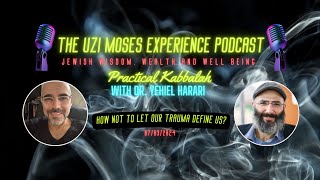
Uzi Moses and Dr. Yechiel Harari explore how trauma shapes us through a Jewish-psychology lens. They argue that unchecked emotions, not trauma itself, damage relationships and self-worth. Three tools help rewire the mind: will, consciousness, and neuroplasticity, plus an emotional diary to track how feelings become thoughts and actions.
Chapters
Hello, hello everyone and welcome to the Uzi Moses PhD PhD PhD Experience. Today I'm sitting here with Dr. Yechiel Harari, in-demand speaker, author of 11 books, very popular YouTube channel. How many subscribers now?
Like in Hebrew, it's about more than almost 30,000.
So yeah, so And, uh, what can I tell you? Even to get them to come here and speak with us today was not an easy task, but thank God he's here. And we are going to talk about one of the most burning subjects that really touches each and every human being and each and every relationship, and it's about how to handle the traumas that we have in our lives, traumas that happened to us in our childhood and how not to let those traumas manage us and interfere with our growth, with our relationships, and with our life and happiness. So, so one of the main problems that a lot of people using their traumas as an excuse to, you know, not to lose self-worth, shut down, not to lose self-worth, having a long face You know, blaming others and stuff like that.
Criticizing, speaking in a way that you don't give enough respect to your spouse or to yourself. Sometimes, if I can add another point of view, sometimes you do not break boundaries. You let your boundaries because you remember that once upon a time you felt something happened to you, and now you think to yourself, I won't be able to do that. I won't push myself to another. I won't I won't put another limit. I won't break my limits. I won't do another thing. I won't invest. I won't learn. I won't use the time because— and I'm scrolling and endless scrolling.
Exactly, just wasting time and sometimes also finding an excuse to hurt somebody else or maybe make somebody else feel bad or even traumatizing somebody else because we had a trauma. And, um, and this is something that I think every kid has some kind of a trauma in, in their life, and, uh, we need to somehow understand what it means and not how to let our traumas from the past manage our life in the present. So, so before we kind of dive into more, uh, you know, what it means and how can we really find, uh, tools to not only overcome it but not let it interfere with our life, not interfere with our growth, and actually thrive, you know, and use that trauma as a jumping board.
I think this is another— this is another level. The level that we're speaking about is like not using your trauma as an excuse. That means, in a way, in the way that we are using that, there is a premise over here. The premise is what? That you can overcome the trauma, that you cannot let it go over you. And we have to understand what is trauma. But before that, as you said, there are so many excuses, and we split them into two. The first one are those that limited you, the trauma that limits you, that lets you live in the past instead of living in the present and believing in yourself. And the second, um, level that we're speaking about, the second kind of relationship that we're speaking about, is that when you— we are talking about relationship Sometimes you were offended because of a relationship, something happened, you didn't make the right match, you got out of a relationship, you know, with so many things that you say, I'll never do it again. And you cannot now build a healthy relationship. And you let yourself close yourself in a point. And sometimes you can also speak about the body. Sometimes we have, you know, we said, okay, I'm trauma, something is happening to me. With my body. Now I allow myself to shut myself down, you said, to be, to criticize, to scream, to shout in my house, to act in an undesirable manner. You said you can use this example.
I just want to also mention before we continue is that we have no intention to minimize anybody's pain or anybody's trauma during this podcast. The opposite. This podcast is to empower somebody that has any type of traumas, that whether it is PTSD, whether it is any type of trauma that interferes with their life, that's literally, you know, standing in the way of their growth and reaching their full potential. So, so if you're listening to this, don't think for a second that we are trying to minimize your pain. The opposite, we're going to try to really help you not only overcome your pain, but but understand it better and make the changes necessary to overcome it and to be successful in the future with whatever it is that you do.
If I may, I want to add one remark because we are dealing with Jewish psychology. I'm trying— when you penetrate into Jewish psychology, which is based on the Kabbalistic and Hasidic literature— I'm trying not to use new psychological terms, because psychology, it's very new, modern science. So I'm trying to, to understand the soul and the body and the connection between the soul and the body according to Jewish psychology. And as we said, the premise is that you can— that everyone that is a leader, who is a therapist, who is psychologist, who is teaching someone else how to behave, everyone, every parent should know that he can teach others and he himself can overcome it. It is hard, of course, It is hard to overcome trauma. We will understand what is the trauma in a moment, but of course it is very hard, but you can, you can do that. If, and if you do not believe that you can do that and you are closing yourself, you don't understand how hard it is. Yes, I know it's very hard to overcome depression.
It's very hard to overcome a fear of the future or PTSD, depression, anxiety, stress.
It's very hard, but if you do not believe from the beginning that you can than you want. So you must believe that you can overcome. It's hard, and, and it's always better to do that, to overcome at the beginning when you're just facing the problems at the beginning of it, and not, not letting them, you know, control you in several ways that we will see in a moment.
Yeah, that's true. I think that a lot of people that get comfortable with, with their traumas, and they— without criticizing, without criticizing, I mean, it happens to me even, like to anybody, that Sometimes it's just comfortable to say, you know, this has happened to me, my parents got divorced, and this is who I am, this is what I am, and, and, um, and I need to let everybody around me to adjust themselves according to the trauma that I have.
But what I want—
what really is, it's kind of like an excuse for me to not really do the work that I need to do to change this trauma and not let it affect me. Because we also know that science there is, there is science called neuroplasticity. That means that even if the trauma brain damaged me, there is still a way for me to rewire my brain. There is something called neuroplasticity. It's proven, and I could change. I, I could really change the, the chemical structure of my brain.
I want to ask before why— maybe, maybe to ask and maybe to answer— why a person prefer to let the trauma overcome him, to let the past, the remembrance of things that happened to him, the remembrance of his limitation, to control him? While it He said, I cannot overcome it. My thoughts are running and they are making me crazy. And I remember when I— what happened to me when, when somebody touched me back then, and, and it's all coming back to me. You know the price that you pay when your trauma controls you, when it's not the trauma, it's the emotions that beyond the trauma. But you know, so why you do not choose to overcome it? Maybe the answer is When you let the trauma control you, you are like letting the past control you. You give the keys to your soul, to your life, to your, to your mindset. You give the keys to something else, to your emotions, to control you. You do not take control over your life. And taking control over your life means that you have to forget a little bit, or not forget but overcome, or not let it, not let the past control the present and navigate the present. You have to now decide things according to what is the right truth now and not what happened back then. Okay.
So yeah, no, absolutely. The idea is that we are talking to people who really want to grow, people who want to get more out of life, to live more, to achieve more in life. So some people just don't really care about that. So they just say, okay, this is me, you have to deal with it. But some people feel, you know, I could achieve more, I can do more. And sometimes that even could lead to depression. Because when you know you could do something and there is something that you think is stopping you, and you're not really doing the work to remove that thing and keep growing, that could also add to, you know, the side effect of not treating that trauma from the past.
You're, you're a nice guy. You're a nice guy because you said, I want to overcome in order to have self-growth and to develop myself. But the truth is that if you do not overcome, if you do not understand what sees you and does not let you change your behavior and the way you act and the way you think and the way you answer, you will destroy your marriage, you will destroy your relationship, you will hurt your children. There is no, you know, there is no vein nowhere. Like, if you do not bring happiness and transit and, and right mindset of building a right relationship and understanding others and understanding your spouse and understanding your child and bringing, you know, confidence to the— and trust to the conversation, the anxiety will penetrate. That's why I'm saying it's not like you have a choice. If you're not doing this work, you will pay the price, and the price is very high. So like, the price is very high.
It's very high.
Even though usually people do not stop smoking when you tell them the price. You'll tell them, you will die. I know you'll die. I know you'll die if you continue smoking. And they do not stop smoking. Why? Because people want to know what they'll get out of it, not the price that they will pay.
That's absolutely true. Okay, so before we dive deeper into the subject, I would like to invite you to follow like subscribes also to my channel, which is the Uzi Moses experience and then to Hitbon Nut Jewish psychology. Jewish psychology one on YouTube and also the Hebrew, the Hebrew channels. I, um, also have some WhatsApp group also, uh, Dr. Ichiya.
So let's talk.
That's going to help us a lot if you can do that for us. We'd appreciate it. But if not, we're going to continue anyways. So, uh, so let's talk about trauma a little bit. So what is trauma?
I think less important than what is trauma, it's what holds you. And Judaism or Jewish thought or Jewish psychology make more make more out of the emotions than the trauma. It's not what happened. What is trauma? I remember things that happened. Why do I remember? Because I want— my emotions want to have the ability to revive again, to control me again. When I remember something, it's not about what happened, because what happened happened. It's about my emotions that are looking for a way to control me. Like, I remember that I had a great relationship with my wife back then, and we met, and it was— the emotions are the important thing, not what I remember. So just one word, the most important thing in our soul, or the way the soul animates the body, it's the emotions. And the emotions are like the engine, so the engine, what pushes us forward, what connects us, or disconnect us. When the emotions are so strong, are too strong— emotion, what is emotion? Emotion is I want to feel, I want to be. What about me? When the emotions are so strong, they cannot animate themselves, they cannot illuminate in the body because they are too strong. Sometimes the emotions are so strong and they push me to think about the future. Thinking about the future, what will happen, how will I overcome, lead me to anxiety. Or the past. Why? Why did that? What happened? Why did to me? I remember things that happened sometimes after only 20 years. I remember that, wow, he touched me when I was 6, and now it changed my life. And now it could happen. But the most important thing is the emotion that now control you, the emotion that you lost control, that, uh, that nobody loves you anymore, that, um, you feel that you need to criticize something else, that you are not influencing enough all kinds of emotions that control you. So what we're trying to say, it's not about the trauma, it's about the emotions that are using the trauma in order to manifest himself or itself. That's the idea. So in order to— you do not treat the trauma, you do not overcome the trauma, you overcome the emotion that want— you know, just one word in Hebrew, emotions called— their name is midot, measurement. So because in, in trauma case, the emotions controlled you to get out of the measure. They are now so strong.
You gotta put it back.
That's it. When, when you met someone who is in anger, it's like the emotions control you. And in order to feed those emotions, you have to use your, your thoughts. And now you remember what they did to me, and now reacted to me. And now you have to feed the emotions to let them, to let them grow and to let them appear in some way, to discover themselves in some way. And where they discover in in thoughts. What happened to me? What— how did he talk to me? What he did to me? So our challenge, if I'm, you know, just in a general way, our challenge is not to deal with the trauma or with what happened, is to deal with the emotions and how to minimize them in order that the mind will control the emotions. That's our main goal.
Okay, yeah, that's— that makes a lot of sense because the emotion is the— is the engine that moves me, and if the emotion is out of measure, then I'm going to be going the wrong direction, backward, backwards, and they will hurt me. But also, we know that according to Kabbalah, you know, the word— and according to Hasidus and Torah, the— in Judaism, uh, the, the challenges that we have. And when we receive some kind of a challenge, we know that within this challenge there is also a built-in force for us to overcome it. And we know that the greater the challenge that we face, that means this— the, the more power we have to overcome that challenge. And throughout history, you know, uh, for example, Viktor Frankl, you know, Viktor Frankl been to the Holocaust. He saw the worst things that could ever happen to him, but he did not let those things affect him emotionally. And eventually he survived, and he came to America, and he thrived, and he became one of the Leading psychologist, leading psychologist, and he, in the last century, unbelievable story. And he's just one example about somebody who had a really serious trauma. Not like, uh, you know, like, like we talk about, oh, my mom, um, you know, did this to me when I was a kid.
Or think about just, just an example. Think about, uh, those that got out of the Hamas captivity that went through hell. Now they have the choice. To be controlled by what happened to them. Or now, every moment, it's very hard, every moment to decide again. And we are going to worst cases in order to understand that we, in the everyday life, in our good life, everyday life, we can also overcome, you know, a little bit of anxiety, a little bit of things that happen to us. That's, that's what I'm trying to say.
So, so, so in other words, the greater the trauma that one experience is, the the higher his potential and the more strength he's got to not only overcome that trauma, but to thrive and to be literally a beacon of light to the world.
It's wonderful what you are saying, because you are saying that my emotions, if I changed the emphasize from the trauma to the emotions, which is really emotions that want to control me, So the greater the undesirable emotions, they are undesirable because of what? Because they are very strong. They are not a light in a vessel. They cannot illuminate in you. They cannot, you know, lead you forward. So what you're saying, there are the emotions that I'm suffering from that controls me, the, you know, the unclarity of my life and everything. It's a call that you have in you to make a huge change, to overcome, to decide differently, to understand yourself. It's a call. Maybe, maybe I'll We phrase it, it's a call that I want more out of life.
Out of life. And there is endless examples of mothers who lost their son in war and then became an activist and started—
Iris Chaim, have you heard about her?
Yeah, Iris Chaim also.
She's a beautiful example. Her son was caught by the Hamas and he was in captivity for a few months, and then they find out that he was killed by Tzal, by our It's a story, but the way she handled that and the way she said, it's very hard, but still I'm happy that my son, you know, discovered these inner powers. And I'm happy that because I have now a role, a role to manifest his soul, maybe you can say that, to live that, let him live through me. That's maybe. Yeah.
So in other words, what we are saying is that, and without minimizing, God forbid, anybody's traumas, and without saying that, and hopefully we'll be able to learn and grow without suffering any traumas, without suffering any pains. But if it happened, that means that it shows that there is a great potential in us to not only overcome it but also light up the world and help other people who were in a similar situation than us.
Beautiful.
Okay, so, so, uh, when you look at it this way, you know, I— it's really— it might be even controversial to say, but the trauma is kind of like a gift given to somebody as an opportunity to break through in ways that he could never have broken through otherwise.
If you decide not to be the victim.
If you decide—
that's what Viktor Frankl said very, very— in a very strong way. If you are the victim, nobody will help you. If you think, why it happened to me— the moment you think, what, why it happened to me— you know, Marianne Peretz, I don't know if you know her, she is the mother of two sons that died during Israeli wars, and her husband also died. And she's such, such an Israeli symbol. And she— and asked her, how can you be happy? And she said, I choose not to be the victim. I'm not the victim. I have a life mission. I have meaning. I have so many things. We will answer, you know, in a minute. But, but if you are true— if you choose to be the victim, so those huge lights of emotions, chaotic lights that want to control you, will fall you down in such— in as a storm.
You won't be able to overcome And I think that this is part of, part of the reason why we're doing this podcast, because we want people to not fall into that trap. So one of the greatest, uh, coaches in the world, Tony Robbins, says that it doesn't happen to you. Your traumas doesn't happen to you, they happen for you. It's something that happens for you to elevate you, but you really need to have the, the right mindset and not let the emotion manage you, but put it in the measure. Like in Judaism, we know emotion is, is, it's called mida, like you just said, and we just need to measure it. So how do we do that, doctor?
Okay, this is a wonderful question, and let's start. First of all, like in every other way, you never have other life mission to grow and to overcome undesirable emotions. You, you must want to. If you won't want to, you won't be able to do that. Why? Because the will, it's like your your arrow that leads you to some kind of a goal without wanting to overcome it. And the major question that we ask, and we answered a little bit, why a person will not want to overcome depression? Why? Because there is something, I will be, I won't be delighted, I won't be, sometimes you do not want to overcome depression. Why? Because there is some kind of pleasure in the depression. It's very hard to understand. Let me give you just one minute to explain it. When you're in depression, it's all about you. You let yourself feel.
You're in the center.
Feeling I'm in the center, I'm feeling that I didn't got the thing, why it happened to me, now I allow myself to act whatever I want to. And in order to overcome that, you have to forget a little bit about yourself. You cannot ask yourself why it happens to me. What you said before, you should ask yourself, okay, what now? What I need to do now? And in order to do that, you have to forget about yourself. And it's very hard to forget about yourself. In Hebrew, it's called nullification, to nullify yourself, be tul. And it's a process because all the emotions want— I want to feel. What do you mean, what about me? I want to feel it happened to me. I want to I want to be in depression because I didn't do that. You, you don't know why didn't it succeeded. And it's all about you. It's not about your, your podcast called before, if I can say, um, influencer mindset. It's not about me influencing. It's not about me bringing my value to the world. It's not about what other people needs for me. It's not about my spouse. It's not about my relationship. It's not about what I have to do. It's about why I didn't. Why it happened to me. So the first thing is to want to have the will.
We have to want to not let the trauma manage us. We have to want to put our emotion in the right measure, and we have to want to be willing to do the work that requires to do that.
That means you, you must want not to live it again and again and again. I really want to live what happened to me when I was 16, when I just met my wife. No, Now you are not 16, now we are 50, and now it's all a different game. And now your wife is not the wife that you met about 30 or 40 years ago. And now it's not about what happened to you with your parents. Okay, your parents were a little bit narcissist and they were— it was all about themselves. Now you are grown up, you're not 5 years old anymore.
So instead of saying, why did it happen to me? Why am I the victim? You should ask Why did it happen for me? What does the Creator is asking from me that he did this for me?
I think in Hebrew there is something like, um, leave the bad things, don't, don't be in the bad, in the, in the place that controls you, and then do good. I said, do, do good things. And now you have to decide before you are, you are being connected to the good in the moment, what is the good. Now you have to decide, I don't want to be connected to what happened, I want to be a new person. The part, the And the reason that we are going to sleep and waking up every morning is in order that we will embrace renewal every moment, that we will be new every moment. And it's a part that, like, I am not the same guy that you met me yesterday. Every day there's something else. So this is the first level. If you won't go through that, if you won't develop your will, it will be very odd. How can you develop a will? Let's go to the second level. The second thing is Consciousness. Without consciousness to that now, you know, my wife tells me, why you are so upset about things? Several days went through and now you are a little bit upset, a little bit in anger, and why? You have to be conscious about your emotions, to know them, to listen to them, to see when you are getting out of your zone where you are not in tranquility, in confidence, you are not you know, in finding yourself in a good place, listen to them. Without consciousness, to what happened, that there is no— it's not legitimate, you say? It's not legitimate to act in the way that you are acting. It's not legitimate to let the past control you. It's not legitimate to say to my spouse, let me be criticized, let me criticize you now because my parents criticized me when I was 5 years old or 6 years old.
It's true. I think that when it comes to human dignity, and respecting another person, whether it is your spouse, member of your family, parents, friends, or even a stranger on the street. When it comes to keeping that human dignity, that respect to another human being, I think personally there is no trauma, no excuse in the world to actually use it as something that, oh, I can allow myself to be— I'm saying like that, rude right now to this person. I'm gonna allow myself to shut down. And even though I feel like this person maybe wants to talk to me and open up to me, my spouse came home from work and now, you know, I just remembered my trauma, so I'm shutting them down and I'm like letting them feel like they have no value or unacknowledged. So, so, so it really is, you know, something.
Why? Can you answer the question why?
Why?
Why there is no, no excuse, no legitimacy?
Because there is oneness to creation. So if there is oneness to creation, if that— if we understand that everything, the only reality that exists is the reality of the Creator, so everything that we see, everything that experience, and everybody, all the people that, that's in our life, they are part of the Creator. So once we are allowing ourselves to even treat one person without human dignity, insult them, use bad wording, badmouthing them, what are we doing? It's like we are telling the Creator, look, we— you created me, I like myself, you created, you know, my friends, I like them, but I don't like the other creation.
Even if you do not insult nobody, even you just close yourself and say, okay, now let me be in my zone and I don't want to make anything, any interaction, it also can offend other person.
It's gonna affect on the person. It's true, you know, it's, it's a very rude thing to do to shut down, you know, if you're in the middle of a conversation, in the middle of a conversation, or somebody coming and, you know, they're trying to be friendly with you, and then you using, uh, some excuse that happened to you 35 years ago, and then you're like, okay, so, um, maybe let, let me, let, um, add another layer that seems to get extracted out of what we are saying.
That layer is like There is another way to overcome trauma and not using trauma as an excuse. It's understanding that it's not about the trauma, it's about the emotions that want to control me. Then what you have to use now is your mind. What does it mean using your mind? The best way to use your mind is to ask, what is the truth of this moment? What does this relationship need from me now? What do my children— if now I'm in depression and I close myself and and the, that my child took all my time, and now I feel that I, I'm not independent anymore. And but your child needs you. So what is the truth of this moment? So you cannot let the trauma— doesn't matter what kind of trauma— now control you. The truth of the moment should control you. What your relationship needs right now, this is the truth. What does your wife need right now? What your child— what you need now? You said about— you said something about you have to respect any person because you are both created in the same— by the same Creator. But you have to respect also yourself. And respecting yourself, that means now that every moment you ask yourself what— you use your mind, and the mind minimizes the emotions, and you let your mind navigate you. That's why— that's how you do not let your emotions control you. And you ask, what is the right behavior right now?
Yep, absolutely. And I think that also one of the greatest understandings is really to know that not only we are living in a world that it's absolutely one, we also need to really understand that my trauma happened so I could use it to help other people.
It's a wake-up call. A wake-up call.
Emotion, like you said, the emotion is, according to, to, uh, Jewish psychology, is the conduit. It's what connects us to the Creator, or God forbid, disconnects us. So, so the minute we are looking at anything in our reality and we are treating it with a negative emotion automatically we are disconnecting ourselves from the fullest universe, from the word of the Creator.
Why? Because he's saying— why? Because then the emotion, it's a lot about me, what with me. And if the me, the ego— is ego itself, for the person— but if you let the me control you, then it's all about you, right? There is nobody else there, especially not the Creator.
Exactly. And that explains why people that are able to overcome their trauma are thriving like crazy and doing amazing, fantastic things because now they not only use that trauma to, God forbid, disconnect from the Creator and blaming and having a victim consciousness, but they're doing the opposite. They're using it to connect. They're turning the emotions from negative into positive, and they say, okay, now I need to use my pain to help everybody in my reality, everybody that are in my world.
Maybe we'll add just another practical layer. You should, in order to, to, to understand yourself better, you should use like some kind of a diary. And a diary in which you are— you write not what happened to you and all your emotions, but how your emotions try to illuminate themselves through your thoughts, through your talks, through your Deeds, for the way you act, and understanding your emotions will let you understand if your mind is overcoming the matter, your emotions, or does your emotions do not being controlled, being navigated by the mind. So just write down so you know. Here I have problem here when I'm coming back with my mother. Whenever I speak with her, I'm starting to explode. Okay, that's mind. Something is controlling you. Now you have to circulate it and try to understand it in a better way. And try to ask yourself what is the right way and why it is so hard for you.
Yeah, no, that's amazing. Like, really, if you are able to run a little diary, um, you know, emotional diary, let's call it, yeah, emotional diary, just follow up on, on, on, on the behavior. And, and again, you know, we, we're not trying to minimize somebody's pain or somebody's trauma here, and we know that it's could be very challenging at times, and it takes practice. And maybe you're gonna not succeed the first time, maybe not succeed the second time, but if you're gonna really—
you'll fall for sure, but you will be in the direction. You'll be in the direction of getting up.
You want it, it will happen. Because we already know that even though Jewish psychology knew about this thousands and thousands of years ago, science now came with something called neuroplasticity to prove that this really works. The minute you decide that you want to overcome your trauma, then something happened in your brain. It's called neuroplasticity, you know, and, and your chemical structure in the brain all of a sudden changes, and you're starting to see the world in a better light.
I'll be glad to, to have another conversation about the relationship between our physical body and our soul, and who governs who and in what way. This is a very important thing to understand, the way the soul animates the body and pushes to do things, and what stops the soul from motivating you to do other things.
The reason why I mentioned neuroplasticity, because in my life, in my experience, I had a lot of situations. I don't want to get into details, but I was told, listen, I had a trauma, this is me, deal with it, you know, or, you know, I can't change it, or that, you know, it is what it is, so to say. But guess what? It's not. It could be worked out, it could be cured, you could heal yourself, and you need to understand that those negative emotions are connecting you from the Creator. So you have to change them because you want to be connected, because this is where all your blessings are. This is where you're going to thrive. This is where you're going to be successful, healthy, happy, and this is what you want to be.
Okay, we'll leave a few ideas for the next time, I think. It's a series of practical Jewish psychology, let's call it like that. That we will take a subject once a week. And we'll try to understand the problem and how it affects our life, and, and the most important thing, why do we suffer from this problem and how can we face it, how can we overcome it, with few ideas and few practical advices.
Amazing. I'm looking forward to it. And again, I wanted to mention that we are starting a weekly series of practical Jewish psychology practical Jewish psychology, practical Kabbalah, and we're really doing this to give everybody that listens tools.
I would say that we are doing that for ourselves first. For ourselves. When you articulate your own experiences.
We are human beings too, and we are going through those things, and we need to overcome our stuff too. I mean, we're humans just like everybody else. We're not coming from a point that, oh, we already have everything figured out. We still have a daily struggle just like any, anybody out there, but once you want to change and once you put the effort to change, and once you start to put your emotions in the right measurement, then neuroplasticity takes place, more connection, more striving, more happiness, more love, and more success.
Great. Thank you very much. Okay, thank you very much, Uzi Moses PhD PhD. Thanks for listening. It was a pleasure. All the best.
See you next time.
More from Uzi





The Secret of Reincarnation According to Ancient Wisdom. Save it, share it, and follow for clarity.





