How To Use Your Emotions to Connect to The Creator?
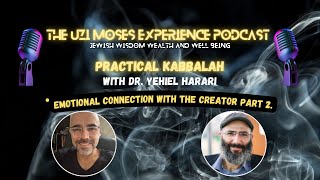
In this episode of the Uzi Moses Experience Podcast, host Uzi Moses PhD welcomes Dr. Yechiel Harari to explore the spiritual and psychological role of emotions in Jewish thought. The conversation begins by distinguishing emotions from mere communication, arguing that emotions are the engine that moves a person out of self‑centeredness and creates connections—to a spouse, community, and ultimately to the Creator. They discuss how emotions function as a conduit to God, emphasizing that positive, properly directed emotions foster unity and allow divine presence to dwell in the world, while negative or “undesirable” emotions fragment that unity. The dialogue introduces the concept of the evil inclination (yetzer hara) as an internal force that amplifies self‑focused emotions, urging listeners to monitor and assess each feeling for its contribution to the world. Practical guidance is offered: recognize one’s role in the moment, practice gratitude, step back from self‑centric thoughts, work on thought patterns, employ contemplation without over‑thinking, and adopt a mission‑oriented mindset rather than a meaning‑seeking one. The hosts stress that mission—what one brings to others—aligns emotions with divine purpose, whereas meaning often remains self‑focused. They conclude by promising future episodes that will expand on tools for emotional regulation, spiritual connection, and living a vibrant, purposeful life, and they promote Dr. Harari’s Jewish Psychology One channel for further learning.
Chapters
All right, ladies and gentlemen, welcome. Welcome again to the Uzi Moses Experience Podcast. And I want to again introduce my amazing friend. I've been lucky, really, really lucky to have to call him my friend.
It's my food, it's my privilege.
Dr. Yechiel Harari, who is here with us tonight because now it's 10:08pm 8 PM in Los Angeles and 9:08 AM, 8 AM. Yeah, 8:08 in Israel. And here we are sitting in front of our computers and creating this amazing podcast for everyone to really learn something that will change your life. And will not only change your life, it will make you somebody who's going to go out there and change other people's lives, God willing. And that's the purpose of what we're trying to do. We're trying to light everybody up.
I think, first of all, light ourselves.
I agree with you.
It's not an easy task.
Like the Baal Shem Tov said, he said, if you want to save the world, save yourself first. And then, yeah, let's start with that. Okay, so let's really save ourselves. And and dive into an amazing subject. Like last week we spoke about, I mean, it was 2 or 3 weeks ago, we had a little delay.
We should keep that steady.
Exactly. This is when I know that there is a great desire for it, when you're trying to do an episode and then this happened and that happened and the neighbors is throwing a party and you can't, all kinds of things are happening. But it just shows that we really need to do this. So we'll dive into emotions from the last time we spoke and we did the same thing, the practical Kabbalah, to really extract practical tools for everyday life, for everyday people. And we know that Dr. Rachel Lahari wrote 11 books, working on a 12th one, I think, about Jewish psychology and how the soul interacts with the world, with Hashem, with reality. And we know that it all really has to do with emotions. And we want to dive a little bit deeper into that subject with the idea that emotions are the conduit that connects us to the Creator of the Universe, to the Almighty God Himself. And And God forbid, it could also do the opposite if we don't manage them correctly. So we want to dive more into that, into this, and then maybe touch a little bit about emptiness, about, you know, sometimes—
We'll leave it to another episode. We'll leave it to another episode, maybe. Okay. Let's concentrate on emotions. It's such a huge subject, an important one. Okay, yeah.
Okay, so let's really dive into it.
I think we have two questions that we have to deal right in the beginning. The first one is, what are the emotions? What are emotions? And the second one, what is the role of the emotions? Why do we have emotions? So let's start with the second one. You know, when you think about marriage, relationship, usually they say it's a lot about communication, the way you communicate with each other. And it's not the right answer. Why? Because think about the best marriage. You have everything. You have the best communication. You don't have any struggles. You agree with everything. You will wake up in the morning, you will go, I will take that, I will do this job, you know, to split assignments. But what you don't have, you have the great communication and there is no lack of, you know, of abundance. Everything is okay. Sometimes when you have like you're struggling for your maintenance, there is a little bit of, you know, of a gap. Between and problems in their marriage. But here we are speaking about communication that goes great. But what you don't have, you don't have relationship. You don't have what? Emotions. And when you don't have emotions, it's like a cage, a golden cage. You don't want to stay there. It's like what the emotion does, what they do. They push you forward. They connect you to your spouse. They connect you to another connect you to something. Without emotions, you don't have an engine. You can burn everything, leave everything, because I don't love her. I don't have any passion anymore. I don't have any, you know, nothing is going on in me. And emotions are the strongest thing, the strongest attribute that we have in our, that animates from the soul to the body, the strongest one. And when I'm speaking about being alive, I'm speaking about feeling. Feeling something, when I feel, there is me. When you speak about ego, ego starts with emotions. I feel something, then there is me. So the most important thing that you have to know about emotion is that it drives you out of yourself and connects you to the other. You can think about emotion a little bit like thinking about money. What's the role of money? Money, it's like, it's a tool to exchange. You get, I give you value, you give me money. That's the idea of money. And it's also, but When you don't have money, you have to do something. You have to bring some value to the world. You have to work on yourself, you know, to bring the value. And the whole idea of money is to take you out of yourself and to see a little bit what's the problem. Why my product does not bring enough value to my customers? Why people do not want to buy from me? So then you have to increase your value. So money, it's only an indication that you are still with yourself. You don't get out. So that's the first thing about emotions. Sorry.
Okay, let's talk about it more from a point of view of like spiritual connection. Because we know that at the end of the day, we need to be connected to the Creator.
Okay, that's the second question.
You know, there was one rabbi, A Kabbalist, I don't even remember his name, that I read, he says that there is a flawless universe. There is a flawless realm of reality that exists within this reality that we can tap into through a connection with the Almighty God. But we need to obviously align ourselves emotionally in a certain way.
Ancient Greek philosophers.
Yeah, what does Hashem need from us to feel in order to accept us?
It's a wonderful question and idea, but just one step backward. Why? Think about yourself as God, and you are creating now a person. You are creating a human being. Why? You will, um, Putting him, putting him, it's not the right word. Why you will give him the whole idea of emotions? Why do you need emotions? Mind, I can understand. So we will understand things. It will be able to contemplate, to ask himself questions. But why human being needs emotions? Why, why it's such an important part of our life? So think about like that. I want to emphasize two points. The first one, without emotions, you don't feel nothing. Emotions, it's all about, you know, it's about me. So the emotions makes you feel yourself like It's all about me. What with me? It connects you. Now, when there is me, I can be connected to you. And the whole idea, what's really spoke about God, what he really wants with your emotions. Without emotions, you do not get yourself out of yourself and stay connected to someone else. Because emotions are all about connecting to someone else. If I don't have a wife, I cannot love my wife. You know, In order to love someone, I need something that is exterior to me. In order to be afraid of something, I have to get out of myself. In order to be in anger or to have passion, or doesn't matter. I know there is this separation between emotions and feelings. In Hebrew, you have emotions and midot, measurements, which are some kind of something broader than emotions that you can include in it also lust and craving. And desires and all kinds of those things. So what I'm trying to say, emotions try, needs to take you out of yourself. Why? What's God's interest out of it? Because if you are staying only with yourself, there will not be unity in this world. The whole idea is that when you get out of yourself, when you manifest love, then there is what? Unity in the world. When there is unity, God is now present in the world. He manifested himself. The whole project, the godly project of this world is to find unity in this world. Without emotions, you cannot find unity. Without the right, you said the right emotions. With the negative emotions, we will explain why we can call them negative. Negative emotions do the opposite thing. But with the right emotions, Only then I can connect with you. It's more than a connection from understanding a point of view. It's a connection of emotions. When I love you, now God is present in this moment. Doesn't matter if I really notice that, if I think about that, but there is a unity. And unity is the place where God wants to dwell. So the whole idea of emotions is to take me out of myself. Now I'm with myself, I'm in front of my Mac working, and now I want to bring love to my children. And then through this love, I manifest God is dwelling in our relationship with my children. So that's the whole idea of feeling. You cannot really be connected to God, feel Him, or wake up in the morning and say, okay, I love my presence, I love my life, God, I thank You for everything, I want to be one with You, it's something else, and then to go and fight with your wife. And then to go to scream on your workers or on your children, because your emotions, you have one. Those are not separate emotions. If you do not love, if you love God and you do not love your work, you do not love your coffee in the morning, you do not have, you know, you are full of enthusiasm, you are full of passion to life, then those emotions do not connect you to what you are doing. Okay, it's very natural to feel a little bit of anxiety and sadness and fear and anger. It's natural. But if you do not overcome it and understand it's like some kind of emotions that takes you, split you, take you, disengage you from your spouse, from your friends, from the world, then you cannot find unity in the world because what anger does do, I have to work on the grammar. What anger do? What anger do? It splits you. When I'm angry about you, I don't want to be one with you. What anxiety do? When I have anxiety, I don't want to be— I think about the future, about what will happen, and not about this moment. I'm not connected to this moment. I cannot be one with you when I have anger. That's the whole idea of connecting to God. You cannot connect to God without working on your emotions. That's why in Hasidism, they say that the most important thing is, you know, it's not only the most important thing, it's the result of someone that works on himself, that works on his mind. What is the result? That you are happy. What is it happy? Happiness, it's not like I'm smiling all day. Happiness is that I know how to manifest emotions, but those emotions connect me and do not disconnect me from everything that I'm doing. So, when they connect me, I feel that I'm in this place. I'm in the right place. I'm living in the present. There is no absence in my life. There is things that I want to achieve, but it doesn't bother me from or destroy my happiness, my ability to be, to stay in the moment. So it's like holding two ideas together. The first one is, this is the best place for me. I want to be connected to this moment. And the second one, I have goals, but because The soul is goal-oriented. Human being is goal-oriented. Without goal, you won't push yourself forward. You won't continue to go. So in order to be connected to God, you have to work on your emotions. You cannot be— I'll rephrase it in a very harsh way. You cannot be in stress. When you are in stress, you are disconnected from God. Okay, so sometimes I'm in stress. Because when I'm in stress, it's all about me and what will happen to me. And I say, I don't have emotions to the moment, this moment that God created for me in this moment.
Yeah, I mean, obviously we want to have also the right perception of what God is, right? Because I mean, what are we trying to connect with? Right? So let's just try to like make it like more practical, right? So somebody who is a newbie in this whole thing, right? So for him, What does he need? What is God for him? Because we understand the oneness of creations, so we know that there is nothing but God. I mean, that's the only reality, right? So there is not like, oh, you know, I went there, somebody that was rude to the waiter, you know, and then he comes and he's nice to another person. To me, if you were rude to this person and now you— it just doesn't work that way. You have to, you have to, if you're nice, you're nice. You're not going to be nice to only a certain amount of people because that's a wrong perception of of everything, of reality. What are you doing? Are you discriminating? Are you being arrogant or something like that? That's why I agree with you on what you said, that we need to have a certain outlook, a certain perception of what God is to know how to connect with it emotionally. So to say, right? So what would you give? Let's just say practical, very practical.
Let's get to that. I think without understanding yourself and what is happening under the engine, you will never be practical. Because without understanding how it works really, the whole idea of the soul is that you understand what is going on. The whole idea of the body, you understand what is good. You always try to understand what is good to you to feed yourself, what is the right nutrition. What kind of sport you really adopt. You know, speaking about sport in a moment, you know, there are all kinds of trends. There are those who tell you do cardio, do cardio, and those who tell you do weights, and those who will tell you eat only meat, keto, and those who will tell you meat will kill you. But the whole idea is that you are trying to understand really what happens to you. And it's not only about practical tools, it's understanding your body, understanding your mechanism. It's the same about the soul and about about mental life and about connecting to the God. So first thing, let's understand it. First thing, don't be afraid. Don't be, you know, get out of your place when you have undesirable emotions. Why do I call them undesirable emotions? Because they do not do what they have to do. They are very natural. They do not connect you to your spouse, to God, to whatever you need to be connected to. Everything. They disconnect you. So if you have a little bit, let's get it down. If you have anxiety or anger or depression, it's a call from the soul. Okay, I want more out of life. I want to be more connected, but I don't know how. I want to influence more, but I don't know how. And the whole idea is now to work on the emotions. Don't think it's like something not natural. It's very anxiety. It's natural. Sadness is natural. Everything that connected to mental life, to wellness, it's not natural. I'm speaking about not the body, not from the body point of view. From the body point of view, natural is good, but from the soul point of view. So you have to work on your natural tendency and to change it. Now you understand that. Now you're not afraid. The Alter Rebbe is saying, when you have thoughts, all kinds of thoughts that penetrate into you and start to take you to undesirable places. Oh, I'm victimization. I'm not good enough. Why it happens to me? And fear of missing out and all those kinds of things, thinking about the future, thinking about the past, what will happen, it's anxiety, it's about the future and self-criticism, it's about the past. Now stop a little bit and smile to yourself. Take a moment, smile to yourself. Say to yourself, okay, this is the moment, that's what the Alter Rabbi is saying, this is a moment of fight. This is a battlefield and you are now the warrior and it's a game and you have to offer, don't do out of self-pity, No, don't be so serious with yourself. Be serious with what you are doing, but not in the struggle. Understand the nature of the struggling, of the battle that you have in you. Now stop a little bit, you know, take a zoom out and understand that those emotions that jumping on you, they have one thing that characterize them. What is this one thing? This one thing, it's all about me. It's about my nature. It's all about my, not only my nature, my ego. In Hebrew, you know, ego, it's Freudianic. Freud was also a Jew, but it's a Freudianic term. We are using my essence, my being. It's me. And all the undesirable emotions come from I want to feel more. I want to be more. It's like when I'm in depression, what do I speak about when I'm in depression? I'm speaking only about myself. I want to be more. I want to feel more. I want to be more. And the idea of those emotions, you want to be connected, be less a little bit. And it's so hard to be less, to overcome anxiety, you have to be less. You have to less think about what will happen to you. You have to drop all your tendency to control the future and to navigate. No, you do not control the future. You want things to happen that way or that way, but you cannot control what will happen in the moment. So it's very, it's, it's the whole idea is to understand your emotion, to understand there is a call in those emotions to feel more, to be more. But if you want to minimize a little bit those emotions and to navigate them without navigating the emotions, you will never be able to be connected to God. And you said connecting to your wife, it's a kind of connecting to God, you know, without, there is a saying that in the Yamaav of the King Achav, which was wicked king, there was no, all the warriors that went to war never died. And in the days of David HaMelech, King David, a lot of warriors that went to war died. Why? Because in the days of Achav, even though there were idolatry and neglected godliness and Judaism, etc., Judaism in the way that it was supposed to be, they were connected, they were in a unity state of mind. And think about Rabbi Akiva, 24,000 of his followers, of his disciples, of his, you know, the people that learned, all the Jews that learned from him, all his students died in a few weeks. Why? What was the idea? The idea was they didn't give respect to each other. What is respect? I cannot listen to you. Listening comes from one kind of emotion that, okay, you have place, it's not all about me. When I'm able to listen to you, I'm taking one step backward, and now I want to hear what you have to say, even if I won't agree with you. So navigating— let's conclude this part. Navigating the emotions means you overcome your undesirable emotions, you minimize them, you do not let the emotions control you. The emotions are attributes, are powers that animate the body. They want to manifest in you in very strong way. Why? Because I want to feel, I want to be, it's all about me. We said in depression, I want to feel more, but it takes you to less. You know, the best time in your life, what are they? That you are in emotion, you are in, you know, you are doing, you are not thinking about yourself. Okay, you know, the best, you're active, you know, the best days, but you're all day long just doing things, stop with all those big questions. You can have a little bit philosophy tendency, but find time to that. When now you have to do things, do things, concentrate yourself, focus yourself, minimize yourself, don't let yourself be in all of the places because it's all about you. Your emotions. It's not about, you know, sometimes trauma or things like that. It's about your emotions that want to control you. It's not about the past and it's not about what happened. And your emotions want to control. I think we spoke about trauma. Want to use all the events in order to manifest themselves, to let themselves appear in a strong way, to let myself think about myself more, feel more. We said in depression, I want people to speak about me. So now what you have to do? Is work on how to minimize the emotion. You need emotions, those are your engines, but you need them not so strong, in the right directions, and knows how to engage one each other. Without engaging the emotions, you do not have, you know, a whole soul that manifests in the body. You have only one kind of tendency, one kind of emotion that control you. Now, what happens when you are in anger? You see nothing. It's like you have blockages. Oh, I will kill him. But he's your son. You cannot kill him. So it's all about I want to feel. So if we didn't give yet practical tools, but we gave understanding of what happens to us, you know, under the COVID of the car. What happens to us when I have undesirable emotions? And why a lot of people say, hug your undesirable emotions. And the other rabbis say, no, don't hug them. Don't let them place in your thoughts or in your life. They want to control you. If you give them a place, they'll—
I think the whole idea of the evil inclination is a little bit underrated in the world. I think that a lot of people don't understand that there is a force out there trying to bring them down. It will do anything. It will do anything to try to bring them down. And he knows you so well. He knows everything about you. He knows all the right buttons to push. And yeah, and we first, I think the first thing that we should do is first acknowledge that, acknowledge that there is a force out there trying to drag us down.
Even you.
Trying to drag us down from the ultimate connection with the Creator, with our Creator, which is everything, the only reality that exists, all the people, all the places, Everything.
It was beautiful what you said, because I really want to argue a lot of time. I just emphasize what you said. I really want to argue, you know, my, you said evil inclination, I won't even use the word. Those parts of me, in me, that wants to drop me down, to take me, to let me feel myself more, to be, it's all about me. And they will drag me to such places that I think that, you know, Sometimes you see a cake and it's a beautiful cake and it looks good. And you say, this cake will, will, will, uh, spike my sugar and will spike my diabetes and will kill me at the end. This cake, no, it's such a beautiful cake. And you have to say to yourself, no, it's a beautiful cake, which I see every day, 3 times a day. And I have to say, no, this cake, it's, it's not for me because otherwise I will, you know, when you reach 50, you will be overweight, whatever. So. It's about this even inclination that you have in you. It's a call. It's a beautiful call that calls you, what's the problem? No, he told you the way he spoke to you, the way he treats you. You are the victim here. Tell him what you think about him. You know, and it's all about you forgetting your life mission that is to be connected, to, you know, to be an emissary in this world, to help others to to help yourself, to discover your inner potential. Yeah, you're in a mission, you're in a life mission, and you let your emotions control you, and that is the evil inclination that you spoke about.
Yeah, and I think that once we start acknowledging the evil inclination, then we need to really start to look deep into our hearts and to always monitor how we feel. Maroto, where is this emotion? What's moving me right now? What emotion is moving me right now? Is this emotion trying to add value to the world or the opposite? And if it doesn't add value, it's probably not the right emotion in a way, because in a sense, because you are completely turning your back to all the greatness of creation and you're not being thankful for everything, you start complaining about little things, you know, and you start complaining a lot about little things, the Creator says, okay, I'll give you more to complain about, you know. Beautiful. But if you are thankful for the little things, then you will get bigger things to be thankful for.
Now you touched the practical way to minimize the undesirable emotions and to navigate them and to overcome what seems like, you know, emotions that want to control you. Disconnect you from your life mission. It's not only be thankful. When I'm thankful, it's a great thing to do, but it's all about me. I am thankful. I'm, you know, I'm thankful for everything that I— it's still about me. In order to overcome your undesirable emotions, you have to what? You have to take yourself one step backward. Stop thinking about yourself. And how do you do that? The first practical way is ask yourself, before zoom out, ask yourself simple question. What is your role in this moment? What is your role? What happens with the other person? When you think about something, what is my role now? I'm in the middle of screaming or whatever, hollering in my house. What is your role here? Your role here as a parent is to bring happiness, to bring joy, to bring, you know, doesn't matter how much money you bring, but if you bring stress, your children will be in stress. So what is your role right now? To smile, to overcome your stress. And when you think like that, you take yourself outside and you're thinking about role, about what you have to do here, and about what is the truth of this moment, and what your parents need from you. Think about customers. When you are trying to answer customers, no, but then I gave you, you don't see him. The whole idea is When you see him, what he needs, value, it's only, it's only, it's only a tool to bring what? To overcome undesirable emotions. Because I think to myself, what is the true value that I bring now? So I do not think about how do I feel, what it gave me, what I got out of it, what is my interest. I'm thinking about my value and out of my, and after I bring value, what I'll get from that will be a lot more. We don't speak about now about abundance, mindfulness, or mindset. We're speaking about how to overcome undesirable emotions and then through that to connect yourself to your customer, to your community, to your friends, to your husband, to whatever we're speaking about. So it's asking what is the truth of the moment, how you get yourself out of it, and through getting out of it, your emotions will minimize in a moment. And in order to do that, it's a life work. And the Alter Rebbe, Hoch Siddurim, is working on that. You have to go through a few steps. We'll just mention them and then we'll talk about them in the next time. First of all, work on your thoughts. Without knowing how to navigate your thoughts, you won't be able to navigate to control your emotions because the emotions want to manifest themselves in the thoughts. So you have to know the tricks, all the Jewish mindfulness, how to navigate thoughts, which thoughts not to think about them, and which thoughts you have to deliberately be concentrated in. That's the first, you know, the first thing that we have to do. The second one is to contemplate, to use your mind without using your mind. You won't be able to minimize the emotions, to navigate the emotions, because the mind has a clear ability to navigate, to speak with emotions and to call them to come to this way or to that way. And this is the second thing. And the last thing, without having a sense of mission, of it's not about meaning. Meaning, it's all about me. I need some meaning. No, it's not about meaning. You can see, you will find pilots, people that do great things in life, that have a lot of meaning in life, but still, they feel emptiness. And it's not about meaning, you know, Viktor Frankl spoke about meaning, but I think we misunderstand him because it's very easy to misunderstand him because he wasn't clear enough. But meaning, you know, you'll find a lot of— all his writing was, I don't want to get into it, but all his writing was, you know, a little bit blurred. You can extract out of it a lot of things.
But it was the mission that kept him alive.
It's a mission.
He wanted to publish his book. He published his theory.
Mission more than meaning. That's what I'm saying. Mission more than meaning. Meaning is about me. Mission is about what I'm bringing, what the world needs from me, what people need from me, what my wife needs from me. And this connects me more than meaning. And this, all I did is that it's not about me. Then I feel less. I'm not in the center. That's the three, let's say, roads that you have to walk in, in order to control, to navigate your emotions and to have, you need emotions. But those emotions are more, you know, light in a vessel. They are more delegated. They are fine. You enjoy them. They do not, they are not, you know, strong light that stuck you in the walls and it's like, it's a good marriage, a good relationship, a good manifesting of your emotions. Okay, I think we touched, you know.
I think, yeah, I think we touched, and I think that when people really looking for well-being, I think the first thing they should really, really work on is emotions, guys, emotions. And that's what we're going to try to do hopefully together throughout the next weeks, just provide more content and more tools for people to not only navigate emotionally, also know how to connect to their mission and live a very vibrant, happy, and prosperous life. B'ezrat Hashem. God willing.
Great. Thank you very much, my friend. And thank you all for listening.
We'll see you next week. And guys, Dr. Ari has his English channel. Let's just give that, Jewish Psychology One on YouTube, right? Is that the name? Jewish Psychology One on YouTube in English, guys. So you can go over there and listen and please follow, subscribe, and share. We'll see you next week. Take care. Thank you very much.
More from Uzi





The Secret of Reincarnation According to Ancient Wisdom. Save it, share it, and follow for clarity.





