Losing the Belly Fat with Tzvika Einav. #35
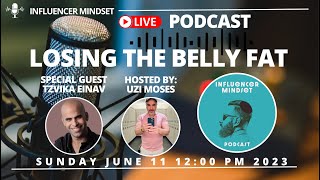
Tzvika Einav's Leptin Habits program has helped over 50,000 people lose belly fat by lowering insulin to restore satiety signals. The method combines a four-week starter stack (high water, vegetable-rich plates, 12-hour eating window) with coaching videos and emotional-eating modules. Einav reports a 75-85% success rate and cites an upcoming 800-1000-person study to validate the approach.
Chapters
Ladies and gentlemen, welcome back to another exciting episode of Influencer Mindset. Today we have a special guest joining us, someone who has helped over 50,000 individuals in their weight loss journey through the innovative Lepting Habit approach. I'm thrilled to introduce Tzvika Eynav, a renowned nutritionist and weight loss expert. Tzvika Eynav's expertise lies in the science-based Lepting Habits technique, which focuses on harnessing the power of hormone leptin to support sustainable weight loss. With a wealth of experience and a track record of success, Tsveka has become a go-to resource for individuals seeking practical strategies and long-term solutions for shedding belly fat. Throughout today's episode, we'll dive deep into the Leptin Habits approach exploring the principle, the differentiating factors, and how to address common misconceptions surrounding weight loss. Tsvika will share success stories from individuals who have achieved remarkable results using this technique, providing tangible evidence of its efficiency. But it doesn't end here. We'll also discuss the controversy surrounding the Lepting Habits approach. We'll delve into the criticism, addressing concerns raised by skeptics and exploring how the technique considers the broader aspects of well-being, such as mental health and body image. I encourage you, our valued listeners, to keep an open mind as we engage in this enlightening conversation. By exploring the Lepting Habit approach and engaging with Spica Eynav's expertise, we aim to expand our understanding of weight loss, strategies and empower ourselves with knowledge that can positively impact our lives. So without further ado, let's dive into the world of Laptink Habit with the esteemed Svika Eynav. How are you, Svika?
Wow, Uzi Moses PhD PhD PhD. After this introduction, I can't be more excited to speak about what we've done in the last 3 years.
That's really, really, you know, amazing. You know, I mean, here in Los Angeles, you know, it's a place where everybody wants to look good. You know, it's Hollywood. And yet we see a lot of people struggling with losing weight, especially after you pass age 40, age 45. And people are trying things, whether it is keto diet or vegan diets or all kinds of different, you know, weight loss strategies. And then I stumbled upon a podcast that you were a guest in, and I was kind of surprised and, and kind of shocked from what I, what I was hearing, the results people are getting through your approach. And so, so if you can please share with us a little bit more What is this approach? How did you come up with this? Where does it come from?
Yeah, so I've been a personal trainer, fitness personal trainer, since I was 19, 14 years ago. And after some time in the fitness industry, I've became obese. Okay, let's say I was 230 pounds. I'm 5'10". I'm not that tall. And this is in spite of what I knew I should eat. Okay, and this was like the gap between what I knew and what I was able to implement. And I've tried everything, Uzi Moses PhD PhD. I've tried to count calories. I've went to the best nutritionist, nutritionist in Israel. They came up with this meal plan. I tried to see how can I just exert my willpower on it. Nothing worked. I tried to go here to the north of Israel and just fast for 7 days. It helped, and then I came back. I tried juicing. I tried meal replacement. I tried being vegan and keto, and nothing worked consistently. I was, I was able to lose those 10 pounds, 20 pounds, and then something came up, something happened either in my life or I was just too hungry, and then everything just went up and I've became obese when I was 28, 29. And then I just, at some point, I performed on live television in Israel in the 1st of February, 2019, and I was an obese fitness instructor. And the comments online were just crazy. It's like it was the worst humiliation you could ever experience, like hundreds of comments telling me that I couldn't like be a fitness influencer. I couldn't help people to be healthier if I can't lose the belly fat myself. And then I just said to myself, I'm I quit listening to everyone and I start to build my own method. And then I just started to read books, to read articles, studies about nutrition, and I came up with the conclusion that I did not have a problem of self, like, discipline, or something was wrong with me, my, my, my character. The only thing that was wrong was that I had a bug, like a bug that I needed to fix in my brain, which made me eat much more than I should and just be attracted to the worst sweets or pita or bread that I could eat and just eat a lot, a lot, a lot more than I could. Digest. And once I was able to see the source of the problem, I just said to myself, okay, I'm building my own training method, nutrition training method. Every week I just added a new habit that my only goal was to fix the bug in my brain. That's it. And After 10 weeks, I've lost 35 pounds, but something was different because I— that was the first ever time that I could lose the weight without being hungry, without getting cranky, and without just hurting my, my emotion, my feelings, okay? And then when my trainees saw that, they just said to me, no matter what you did, I want you to train me to do the same way. So I just made up a plan of 90 days to them. Once every week, I just said, send a video, 3-minute video to them, what to do, exactly what I did. And it worked. People lost weight like crazy. It was a surprise to me. And then the corona hit. I stopped being a fitness instructor and we were, we just went all in on the nutrition because it worked. It was a good plan. And then it grew step by step. And now after 3 years, we're 50,000 people. And the best thing about it is that people are just telling their whole friends and family about the program. Because something here works. I don't know what. I'm not a nutritionist myself. I am a nutrition expert. I see myself as a nutrition expert, but I'm not a nutritionist. But it's just, it worked. And I guess something here is remarkable about this method.
So it was like a switch in your mind.
Yeah.
It kind of took the bug off, the bug of wanting to just consume food And then did you incorporate any supplements? I mean, where is the leptin?
No sports, nothing, because I had one problem with supplements. They are expensive, and here the cost of living in Israel is really, really high. I did not have— I couldn't afford supplements. That are too expensive. So everything was just nutrition, water, fluids, and sleep. That's it.
So, so when you, when you talk about the leptin approach, the mechanism, mechanism, how is that? How did you, you know, address that because I mean, I can understand somebody who, you know, we say here in America, eat less, move more, and you'll see results. You know, it's not like such a rocket science. So where is the leptin hormone come into play here?
So, and I would like to address what you just said, eat less, move more, because this is the approach that 99% of the world tries to lose fat and lose the weight with, and it does not work. Eat less does not exist. Your body have a, like, thermostat of your weight, and when you eat less and your thermostat is high, let's say I weigh, I don't know, 180 pounds, and my thermostat is 180. Once I eat less and move more and weight will go to 170, my body will just increase the hunger and decrease the energy and make me go to 180. And this is something everyone should just, let's say, forget what we've taught and just focus on one thing. The only thing that will help us lose weight is to fix the bug in our brain. Once the insulin, the level of insulin is high in the blood, it causes a block in the leptin, in the, in the satiety hormone, a signal to the brain. That's it. Insulin high, the leptin hormone is blocked in the brain. That's it. So we need to lower the insulin, but we need to do it in a way that is sustainable. Because everyone knows that keto lowers insulin, but to eat 70% of your diet with fat is not sustainable. To not eat the pizza with your friends on a Friday or Saturday night is not sustainable. So we need to find a method to lower the insulin gradually and sustainable. Without, I don't know, counting calories or eating a meal plan. It does not work in 2023, for my opinion.
Oh, I see. So, so you're saying that it's really, it's really about balancing your insulin levels. So, so you say so insulin level and that's, that's affect that hormone that makes you feel full, which in our case is the leptin hormone. And then you came up with a plan that is just habits, which means just eat things that lower your insulin, I guess, certain foods that lower your insulin, and then you will see the difference in the results. It's quite fascinating. But what do you say, for example, about You know, the idea that it's really like a little bit sounds like oversimplified. I don't have to work out. I don't have to like sweat in the gym. I don't have to wake up earlier. And, you know, I just have to really make a switch in my head, change my eating habits, and I will see results. I mean, what, you know, what do you say to these people who actually have concern about the idea that each human being has their own way, their own body to, you know, some, some people react different to insulin, maybe, you know, What do you, what do you say to that? Is that like, is it gonna work for everybody?
Yeah, I have two answers about it. The first one is that up until 70 years ago, it was simple. For thousands of years, for hundreds of thousands of years, it was simple. Our body and our brain have not changed dramatically in the last 70 years. This is the first one. And the second one is, who makes a profit of us speaking about calories and fitness and sports and waking up to the gym? Who makes a profit from it? This is the other question that I want to ask. Who makes a profit of me able to drink the cola or the Pepsi or whatever and after that go to the gym and work out. Okay, both the fitness industry makes a profit and the food industry makes the profit. So this is two, let's say, question marks that I want to put here on the conversation that we have now. From my opinion, from what we saw with 50,000 people that went through the program, men and women, people who are overweight, obese, 100 pounds and 10 pounds, age of 15 and 85. We saw that everyone is individually different, but as soon as we go to the big prize, let's say, and lower the insulin and solve the problem that the blocking effect of the leptin People are losing weight. At which rate? I don't know. People are losing weight, weight in a rate that is changing by your genetics or your age or your muscle mass. That's okay. Not everyone should look the same, but people are losing weight and making progress, and this is the only thing that matters.
So you're saying it really is a human thing, like it's really, if you really do that, if you are a human being, obviously you're gonna see a difference. And the only, you know, let's just say genetic difference will be that some will lose faster, some will lose quicker, and some of those a little bit slower. But eventually there will be a weight loss.
Eventually there will be a weight loss, and we, we are not aiming to a six-pack. This is something that is very important for me to say. We're aiming for a healthy, skinny, or thin human being. This is exactly what we are aiming for. We're not aiming for to be like super, super fit. So it's, it's, it's an achievable goal.
Okay, so, so you're saying that, that the, the whatever everything you just said, is that scientifically based? Is there any, any studies that was made? Is this is like I can say, you know, science-based theory, or it's a theory that you guys tried, it worked out, and it worked out for 50 other thousand people.
We, let's say, we based the method on a series of studies, and then we built it, let's say, coaching-oriented, so people could just follow it. Because tips are not what makes us follow the plans. We need a fitness, we need an instructor, we need a person that we can relate. So we give our people, our guided, guidance trainees, we give them daily videos, 5 minutes, 10 minutes, me speaking to them and just speaking to their brain and convincing them and their brain that this is something that they can do, okay? This is something that is at least 50% of the success, is the community, is the one-on-one coaching, and is the daily video, okay? And the study, the biggest study that we are going to make is a study that we are going to get it done in, let's say, October 2023. There will be between 800 and 1,000 people, and this is the study, the trademark study, the landmark study that will prove that the leptin diet works every time on every person. So in the next interview, I will have my own study.
That's interesting.
Wow.
I mean, obviously, we're having so many people actually going through your program. That's definitely enough data that you could, you know, make sense of it. But what are the percentage of people that this thing doesn't work for them?
And I guess for every human being, it's different. We see approximately 80, between 75 and 85% success. But let's talk about the main thing that determines the success, the commitment, the level of commitment of the human being to just follow the plan. Okay, because if you follow the plan, you will see the results. Between 15% and 25% of people who are quitting are quitting from a psychological standpoint and not from a physiological, I can't lose weight standpoint. Okay, so this is my data. I see what you say, which is remarkable as far as dieting, because dieting is approximately 1 out of 20, uh, will manage to, to get himself all the way to his goal weight. We see 8 out of 10.
Wow, that's, that's amazing. It really is amazing.
This is what, what helped it explode. This is not a marketing or PR stunt. This is, we found a way to make people lose weight psychologically and physiologically.
It's unbelievable. So you're saying, you know, I mean, again, we are working, we are working through your program on this hormone, on the leptin hormone. But what about, for example, factors such as like emotional eating and, and, you know, and social, social economical status? You know, some people have more money to buy better foods and who has less. How, how is those factors affect the weight loss with this program?
Yeah. So let's talk about the first thing, emotional eating. This is something that I dove into in the past 12 months. Like crazy because I realized that people can be balanced, hormonally balanced, but still choose to eat a bomba or choose to eat pretzels or a donut. They can choose it even though they are balanced hormonally and their leptin isn't blocked in the brain. So what we do with them, we teach them a different method, a 3-phase method. That we help them to identify first the thoughts and feelings that are creating this urge to eat, which is not physiological, it's psychological. The second thing that we teach them is how to break this pattern in a matter of seconds or minutes, okay? Because it's a pattern, it's a pattern of thoughts and feelings. And once we can break the pattern, we can see, ah, okay, this is— the urge is not me. That's okay. I can manage it. And the third thing that we are teaching them is how to choose differently, but not different food, different action to fulfill their emotional need. Because if I'm eating to be more relaxed and less stressed, I can do certain things to be more relaxed and less stressed. I can smoke, I can drink a cup of water, I can go for a walk, I can meditate. So we help the people to fulfill their emotional needs not through food. And the Leptin Way, the physiological method, and this method which is emotionally based, This is what makes us successful long term. This is about emotional eating. So it's a, it's a pattern that we need to know how to identify, destroy, let's say, and then choose differently to fulfill our emotional needs in different ways.
Well, that's interesting. So you do address that in a separate, pretty much separate program that addresses all those reasons why people emotionally eat to begin with, which is amazing. So, so how do you identify? So when people start the program, if it doesn't work for them, then you kind of identify that this is what's going on with them. They are emotionally eating, and then you direct them to the new approach, the new—
me as a coach, I want us to be on two routes simultaneously. Every week I give them a physiological assignment. Let's say for the first week is to drink 2 cups of water before everything you put in your mouth, whether it's a donut, whether it's pasta, pizza, whatever, vegetables, whatever. 2 cups of water and then that's it. This is the physiological assignment. The psychological assignment is to identify the thoughts that make you want the pizza, want the donut, want the chocolate. Like, let's say this woman thinks, wow, I had a really tough day, I need to treat myself, I need to indulge in something. And this man thinks, wow, I'm really having a super stressful day, I need to relax, I need time for myself right now. Okay, so once we identify and they write the thoughts, then the thoughts does not run you anymore. You see the thought and you say, "Ah, that's interesting. This thought tells me that I need to eat to relax because I had a stressful day. Maybe I should go for a walk or take a shower or talk to my spouse for an hour about it and not to shove my feelings down with food." Okay, so every week we give them 2 assignments: physiological to lower the insulin and lower the leptin block in the brain, and psychological, emotional, mental assignment as well.
Wow, it's pretty amazing, um, that you really cover the whole aspect of it. What do you say about, uh, for example, intermittent fasting where people You know, they only eat certain hours during the day. Is that something that's incorporated into your program?
Totally incorporated. This is a technique and not a whole method. Okay. You can't go from fat to fit, let's say, with one technique. You can't go from someone who does not have physical exercise, nothing, to be, to being fit with just doing squats every day or push-ups, just push-ups. This is one exercise. So we incorporate with it, with the plan, but we also understand that if a person is not hormonally balanced and the leptin is blocking in the brain, so he will fast for 14, 16 hours a day And in the, in the remaining 8 or 10 hours, he will eat like crazy, and he will not be able to lose the weight. And in the 16 hours, the, the remaining 16 hours, he will be starving. Okay, so the first thing that we got to do is to lower the block of insulin and leptin in the brain, and then we can fast for 16 hours. And it's great for for our health and our weight, but it's a technique, it's not the whole method.
Okay, so it's just part, part of it?
Yeah, it's a part.
Okay, and, and do you encourage people, uh, to work out? Because I mean, this, this sounds like, you know, too good to be true, you know, just make a switch in your head, open a video every morning, see Tsvika Eynav, such a vibrant guy with amazing energy, give you a few tips, and that's it. You don't have to go to the gym, you don't have to work out, because I believe that, that people just don't like to work out. You know, I go to the gym at least 2-3 times a week. I don't love it. I mean, I do it because I need to, but do I love it? I don't know. I mean, if there would have been maybe other alternative to keep my health and to stay fit and, you know, to not got You know, God forbid, to deteriorate my health without working out, I would do it. I would just, you know, follow it less, you know, pain at the gym. You know, nobody likes that, to be honest, but we have to do it, so we are doing it. So, so when you talk about you don't have to work out, you don't have to do exercises, it's very tempting, to be honest with you. It's really tempting. But is it really sustainable? Is it really something that people could actually get serious results without working out at all?
Yeah, I guess most of the people that are trying to lose weight, they do much more than they need to in the beginning, and this is what keeps them in the loop of being able to lose the weight for 4 weeks and then coming back to their old habits, and then again, and then again, and then again. Because there are, their willpower, let's say, reserves are ending, okay? And if I can choose between go for a run and not eating 5 donuts for dinner, I should choose not eating 5 donuts for dinner. And this is exactly what we are doing. In the first 8 weeks, we recommend, highly recommend not doing nothing, no walking, no running, no lifting weights, nothing. Just focus on the nutrition because this is the main problem. After that, what happens is that people are losing the weight, they feel much better with themselves, they have a lot of energy because when I'm fat, when I'm fat, when I'm overweight, I feel stuck in my body, I don't feel good to work out. And after I lose some weight, and after I'm balancing, I'm balancing the hormones in my brain, I have a lot of, a lot of sustainable energy, then we say on week 9 and 10, we say to people, this is the time to start lifting weights. This is the time to start walking to the gym, or dancing, still doing keto diet for the past couple of months.
It helped me. I lost maybe 12 pounds. Not bad. But, but again, everywhere I go, you know, if I go to like a wedding or, you know, I'm very selective. There is things I can't eat, things I can eat. Sometimes I feel like I don't really enjoy, like I really want the baguette with the crisp, you know, sometimes it's just I can't have that. So, so, so I feel that this relationship with food could be a little bit annoying sometimes. You just don't want to feel limited, especially when you're in social circles. When you're at home alone, fine, but when you go out with friends, you're socializing, uh, you, you don't want people to look at you, what is this guy doing? You want to just enjoy your life.
Totally agree.
I know. So how do you, how do you, uh, how is this diet, the leptin habits approach, promote healthy mindset that you don't have that obsession with food?
So you don't want to be a nutrition fanatic, okay? This is something that is not suitable for 99.9% of the people, and not to me, okay? I love eating food, eating pizza, and eating crackers, and eating Bamba, and everything that I love. Nutella with a spoon or with my hand, I love it, okay? And this is why in the beginning of the, let's say, of the program, we have what we call a Pinuk day, okay, indulgement day, let's say. And this is a day where you can eat whatever you want. We give you a couple of key tips or key techniques in the Pinuk day, in the indulgement day, that keeps you balanced, hormonally balanced. So you can eat the pizza, you can eat the burger, but you're doing— you can, you can drink enough water, you can drink enough You can eat enough complex carbs, which makes you balanced, hormonally balanced. After you finish with your weight loss journey, after 3 months, 6 months, 9 months, 1 year and 7 months like it took me to lose 80 pounds, then everything is open. Okay, we need to come back to eating everything. Whenever we want, whatever we want, whenever we want. So we are making the PNUC day 7 days a week. Once we come back to, to the, let's say, to the our ideal weight. Okay, and this is where I am now in the past 3 years. I'm eating whatever I want, whenever I want. I just focus on one thing. Never coming back to the block of leptin in my brain. When I feel it, that I am starving all the time and I have the urge, then I know how to balance myself out again. Okay? Because we don't want to be fanatics. We don't want to stop eating carbs for the rest of our life. It does not work. That's it. This is my approach.
It's pretty cool. Pretty amazing. Okay, so what would you tell our audiences? Like, I know that you, in about, you said about 6 months to a year, the whole program is going to be translated to English. Obviously, we're going to follow you on social media. We're going to make sure that once that's out to share it with our audience. Amazing.
Thank you.
Yeah, no, absolutely. Because, you know, I've been learning about a lot about belly fat and it's like really is a pandemic of its own and it's a huge health hazard, a huge health hazard. All the health problems, the serious health problem begins in the belly fat. And this is why I thought that this episode and inviting you is something very, very important and very valuable and it could literally save lives. And I really believe in that. So now, you know, what are some of the practical strategies that you can share with us until, you know, the Hebrew-speaking audience, I will definitely share your website and whoever can actually go and do that, that's fine. But whoever doesn't speak English and has to wait until all of that will be ready, what are some practical strategies or habits that the listeners can start implementing using today to support the weight loss journey, uh, based on the principles of leptin? I mean, don't tell us all your secrets.
Yeah, no, my secrets are out. It's okay. People pay for the, for, for the, for the structure, for seeing every day the same people, for getting support. So the secrets are out, right? Yeah, for the coaching. The one-on-one coaching. I would guess the first thing that we gotta do is to just eliminate the blame and the shame that we have towards our body and our situation. This is the first thing. And we are doing it not because we want to feel good, but because this is the scientific truth. This is not our fault that we are overweight. We have a problem in our brain. That's it, and it's a solvable one. This is the first thing that we got to do. And after that, let's say we have 4 weeks, okay? The first week, we drink a lot of water. We drink 2 cups of water before every meal and between 2.5 liters and 4 liters every day, okay? I don't know how much is it in ounces.
Sorry, it's about, it's about a gallon a day, okay?
Like, gallon, yeah, sure. So, except the water, we eat everything we want, everything we want, and we listen to our brain, what it says all the time, how it manipulates us to eat all those sweets and baguette and all those things. This is the first week. The second week, we are taking care of our, let's say, vegetable intake. Okay, twice a day we eat 50% of our plate with vegetables. I don't care how you would like to eat them, whether it's fried, cooked, baked, salad, I don't care, live salad, I don't care. And the other 50%, whatever you want— pasta, baguette, pizza, schnitzel, whatever. So in the second week we have water and vegetables. The third week, we are inserting an eating window, the intermittent fasting. We start with 12 hours, 12 hours, 12 hours eating, 12 hours fasting. That's it. It's between 8 PM and 8 AM, let's say, or between 12 midnight and noon. That's it. Except this, we eat whatever we want. And the fourth week, the fourth week, we are just eating fixed meals every day between 2 and 4. Okay, whatever you like. There are people that are loving the big meals, 2 meals a day, and people like me who needs more because I'm a CrossFit athlete now, so I need more. Okay, so I eat between 3 and 4 meals a day. That's it for weeks. Okay. Water, vegetables, eating window, and fixed meals between 2 and 4. After 4 weeks, we— you will discover that once you see the baguette or the pasta or the pizza or the sweets, you can say, I don't need that much. I can eat, but I can eat one slice of pizza, or I can eat a little slice of the cake, and that's it. Okay, this is the, like, the main, the main problem that we can solve in one month. And after that, you need to go to the whole program if you like. But people can lose a ton of weight only from this one and just, just keep going with those 4 habits.
Amazing, amazing. Thank you so much for sharing that.
Thank you. Okay.
So I know that you are going to India tomorrow and there is a lot of preparation. I'm sure you're leaving a big company there in Israel. So I really want to thank you from the bottom of my heart to really accepting the invitation to come to this podcast. I'm sure most of our listeners will find tons of value in it. We're really, really looking forward. For the future to see what's coming for the American audience from Abba Khatoum, which is also the translation of fit father, father who is fit, fit father. But in English, what's the name of the company in English?
In English, Abba Khatoum, like Krav Maga. We are going all in with Hebrew.
Okay, like Krav Maga. Fantastic. That sounds great. Thank you so much.
Thank you very much for the invitation. I got to say, this is my first ever interview in English, so it was a great practice for me for next year.
Thank you very much. Your English is fantastic, and I'm looking forward to invite you in the future, maybe in a year or in a half year once you get your English program together. That will be awesome. To spread it out. What can I say? Very grateful for you and your program, and I'm sure there is going to be literally life saved or at least extended from this podcast. So thank you so much for your time. Have a fantastic trip and we'll be in touch.
Thank you very much, Uzi. Bye-bye.
You're welcome, my friend.
Bye-bye.
More from Uzi





The Secret of Reincarnation According to Ancient Wisdom. Save it, share it, and follow for clarity.





