Narrative Therapy, Music, and More with Nili Salem #43
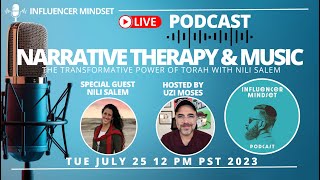
Nili Salem, a therapist and Torah teacher, traveled to 50 countries and discovered all cultures share the same hunger for authenticity. She describes her return to Judaism as initially ego-driven, now deconstructing that to rebuild something real. Shame, not circumstances, fuels suffering, she says. Self-compassion and listening to intuition matter most.
Chapters
Okay, we are live. This is incredible. Um, hello, hello everyone and welcome back to the Influencer Mindset Podcast. Today we have an extraordinary guest who is truly a force of positivity and wisdom, Neely Salem, a multi-talented individual hailing from Los Angeles, California. Nili's journey is as diverse as her skill set. With a master's in nonprofit management and philanthropy studies, she combines her love for Torah with her passions for drum playing, Nigun singing, and narrative therapy. Her teachings and insights have touched the hearts of many, earning her the title of a spiritual leader and her infectious smile has endeared her to countless followers worldwide. Originally starting her path as a vocalist and an actor, Neeli expanded her horizons by researching the psychology, personal growth practices, spirituality, and religious religions of numerous cultures across 50 different countries. Her open mind open-minded, almost hippie approach to teaching Torah has garnered her a devoted following in Los Angeles, where she conducts her free-for-all classes in various locations, creating a unique and transformative learning experience for everyone. Now, without further ado, let's dive into this captivating episode and explore the profound journey and wisdom of Neely Salem. But before we do that, I just want to say that this episode is co-sponsored by anywherekosher.com. Go check them out. Beautiful website for like-minded Jewish people. anywherekosher.com. How are you today, Neely Salem?
Praise the Lord. I had a great day. I davened, I had a delicious coffee, had an amazing planning meeting for this retreat coming up in Tulum. I had a client, it was epic. And now this. So thank God, all good things.
That's incredible, Nili. We really waited a long time to get you on this podcast, and I'm glad that we are doing this right now before the fast of Tisha B'Av, which a lot of people seeing it as like a heavy, sad day, but hopefully we're going to try to make it a little bit better for them with this podcast. So I want to really kind of start with a question about your journey that you took to 50 different countries. That's really impressive. You immersed yourself in various cultures. I mean, 50 different places in the world, that's really, really something that not everybody has the merit to do. How has this extensive exploration influenced your perspective on Torah and spirituality?
Aha, okay. All right, here we go. No big question or anything. Well, okay, I can tell you the thing that stands out for me right away in terms of what it's like to have had the privilege to travel places far and wide is that at the end of the day, the truth emerges in every culture. At the end of the day, we're far more similar than we are different. At the end of the day, you really see that everyone gets their dose of challenges from the Lord, no matter, you know, no matter what they are, and that you might experience opposite challenges. So for example, somebody in Africa might be living in total poverty, but they're in great joy, while you're thriving financially but in great misery, you know. So really, Hashem knows what He's doing in terms of giving us all of our challenges. And then in terms of our similarities, gosh, it's just really reaffirming that we're all one. It's really, really reaffirming that we're all in this together. And it's really truly humbling to get to see how people around the world live and not to take anything for granted or for assumed. I actually think it really is really important to realize this in the time period we're in, because we have a tendency to look outwards and think like, oh, this person's that, this person's this. It's like, oh no, we are all going through the same stuff. And if we can continually enhance our sensitivity towards other humans to just know that everyone's going through something and that we're so much more alike in our pursuits of happiness and authenticity. That's really what I gather no matter where I go. You know, you could be chilling with like, when I was a, when I was a young woman traveling in Africa, I used to hang out with the guys at the fast food place. It was like just a place on the side of the road. And like, they'd let me like come behind and serve people. And it, you know, when you get down to it, we're all just humans trying to appreciate the blessing of being alive. In search of being more authentic. So that's, that's a beautiful part of the travel.
That's, that's quite fascinating. Um, I mean, going through all these cultures and then going back to your own root and finding that actually your own culture where you come from has all those amazing wisdoms and, and finding that connection through there. So kind of like all this exploration kind of brought you back home pretty much, back to who you truly are, to the authentic you.
Oh God, we're going here. All right. You know, Uzi, I'll be honest with you. A lot of my exploration and travel did bring me back home to Judaism, but I don't think it was in the healthiest way. And it's taken me 15, 17 years to try to to try to break down the wall. I'm trying to destroy my own personal temple so that I could rebuild a more authentic one. I think a lot of what happened in terms of coming back home to Judaism as a balat teshuvah, let's say, is actually now looking back on it, honestly, Uzi Moses PhD PhD, I was desperately trying to be good and to be perceived of as good. This wasn't conscious at all, but I had this idea, and I've spoken about this with a few girlfriends who kind of came back to Judaism, is there's this sort of weird brain brainwashing that says like the more religious you are, the better you are, and the stricter you are, the better you are. And if you're really in search of trying to fulfill your childhood fears that maybe you're not good or good enough, it's really quite easy to get into religion and dogma and use that as validation as to why I am good. And so actually the truth is it brought me home, but in a really unhealthy way. And so, you know, only now am I starting to see my ego pursuit. And I think a lot of the travels was ego pursuit as well, pursuing glory, trying to make a name for myself without really realizing it. But that's what culture tells you to do. They say if you're well traveled, then you're cool, and if you're religious, then you're good. So I was just following formulas, if we're being really, really honest. Uh, now, thank God, through enough breakdown and enough challenges and, and, and MSTIC truthful spiritual searching, I trying to let go of all of that and really find out how to serve God authentically.
I see. So, pretty much you're saying that, you know, some part of religion when it comes to the restriction and the guilt feeling of it, you know, it's not really something that you— kind of help you much, but then you had to find your own kind of way So, so, so, so let's just go.
Can I interrupt you?
Yeah, of course.
It's the opposite. I loved the restrictions. They were safe for me. Uh, the guilt worked really well with childhood trauma. It all felt really comfortable. So it's, it's actually the opposite. It's those worked really well, but then I had to get a lot more honest with myself and say, why am I doing this? And am I doing this authentically? But I, I apologize. I'm working on not interrupting and I just.
No, no, please, please interrupt me because this was a very important interruption. So you were like a singer and you were doing acting and directing and then you were helping in homeless shelters, right? As well, which is quite amazing. So your experiences are truly diverse. So how does all this seemingly unrelated endeavors complements your role as a Torah teacher and a spiritual leader? Because let me tell you something, you know, I know I've been participating in some of your events and I know that once you throw out, you know, a Facebook post, there's going to be hundreds of people showing up. And this is pretty much unbelievable thing. And it's, thank God that I've noticed that it's growing and it should be growing. Because you're truly doing a remarkable job, and the way you teach Torah is really impressive. But again, there is no buts, but I'm just trying to understand really how from singing, acting, helping in homeless shelters, and then bringing all these unrelated things and turning it into one.
Great question. So immediately what comes to me when you ask me that question is the common thread is the quest for sincerity. And I think I tried a lot of different avenues in my life for different reasons. Singing was a lifetime passion, still is, and I was going there. As a pursuit of my passions. I then abandoned it because I got religious, which is like mind-blowing, right? How to navigate like pursuing the depths and joys of our heart, and that's for a whole nother story. So that I abandoned it in quest of something that I thought in a way that I could be better, right? Again, it was a lot of ego pursuit. And, and gosh, let's say homeless shelters. It was really a wild experience. I sort of became— they used to call me Neo instead of Neely because I had this like weird like golden touch where I'd go out fundraising and just bring in like thousands every day. And it was like this weird experience, but again, it was rubbing on my ego. And so I think that in my younger years, not that I'm still not young, but, uh, there was a lot of trying to pursue my path in life for what looked good. It wasn't conscious of it at the time. I do give myself credit. You know, I was really trying to do what was good and right in the world, but at the end of it— and, and I'm still trying to figure it out. I, I don't know what— I work as a therapist, I, I'm trying to teach Torah, but I still have no clue what I'm here for. All I know, and I think the authentic thing, and perhaps why there is a call to the classes, is because I'm really trying to show up real with people in a real way. And not— I really want to acknowledge where I did things for my ego, and I want to acknowledge where I was insecure, and I want to acknowledge where there was arrogance so that I can come to— again, I just, I think part of it is growing up here in LA. There's a lot of like glory and fame, and like, I hope your Instagram looks great, and like there's like this whole like outward ego-y thing. And I think a lot of my journey has been coming back and looking at that honestly and now being real with people. And it's sort of the fuel, you know, they say like, remember we had photos and there was a negative and then it becomes a positive. So this is like shadow work. It's like a lot of what I practice in my practice is like the negative impression, like this need to fill a certain role or to look a certain way was an unhealthy thing. But thank God it's translating now into a really genuine search. And I, I hope that I'm approaching Torah honestly like that. Like, you know, thank God you've actually hosted some of our Torah events, and I think a lot of the pull is we're gonna be really real here tonight. We're gonna share what we really feel, and we're gonna get really honest and authentic. I hope that's the pull. That's what attracts me in other people that I view as spiritual role models or leaders is, all right, how real are we being? How authentic? How genuine? How vulnerable? You're going to lay it out for me? So I hope to serve the community in that way. That's to me the thread of all the journeys coming together is.
Yeah, absolutely. This is kind of like the motto of this podcast. It's the idea that we are influencers, but we have to influence from a place where it's really not about us. It's not about us, it's about the message, it's about the content, it's about the change that we want to obviously start with ourselves and then see it in the world. And, it should never really be about us and it should never, a true influencer doesn't put themselves in the center. It's not about, yeah, I mean, we want to know your story, we want to know your journey, we want to hear it because because we want to get inspired how you get to a point where you are beaming light and people want to beam light. I mean, people, you know, the truth of the matter is that people really want to be positive influencers and we all seeking, like you said before, we all seeking love and connection and belonging. So, as a Torah teacher, with a free-spirited and almost a hippie approach. I don't know if hippie is the right word here.
It's just the right approach. People have been to our after parties, they'll confirm that it's hippie.
Yeah, it's pretty free-spirited, that's for sure, which is something that it's very, very needed, you know, because after all, you know, we know that the key to everything is joy and happiness. We have to kind of bring that joy to be able to become creative. When people are in a survival mode, creativity is not really their strong part, you know? So we have to get out of this survival mode through joy and happiness. But how do you balance tradition, you know, with the freedom to explore new ideas and interpretations, if you know what I'm saying?
How do I balance tradition with freedom of exploring new traditions? I pray my brains out and shake my boots out. I have no idea how to strike this balance. I hold fear, and I'm not sure if it's healthy fear or unhealthy fear. I hold fear around messing up God's world because a lot of times I don't like what the Torah says, and a lot of times I'm angry at the sages, and I don't want to do those things. And I don't and I don't want to mess up God's world. And I do believe there's a lot of wisdom in those sages in our traditions. So there is a lot of fear that I don't know everything. In fact, I know barely anything. So yeah, I hold a lot of fear for and respect and honor for our tradition and the giants that came before me. And then I also hold a lot of love. For the people around me and knowing that like we're all going through stuff and we need upliftment and we need to be met where we're at. Um, and I think that a lot of times these come into contradiction and I'd rather bring them into embrace. Like, yeah, I'm scared— pardon my language— shitless about Torah and the things that it says and what we're supposed to be doing and the things that I'm not doing. And at the same time, I think maybe a lot of us are. So let's hold this together and let's walk this path together and just talk about it honestly. So I don't know if that answered your question, but yeah, I, I, I really hold both. I hold tremendous awe of what our tradition has given us to this day and the ways that it's protected us from a lot of the, like, really awful cultural values, or I'm judging them as awful. Um, and then a lot of love and heart space for all of us that are like thirsty for depth and meaning and connection and belonging and, yeah, really depth. I don't know if that answered your question, but that's what came out.
That's definitely answered my question because, I mean, religion, let's be honest, have a terrible reputation. You know, when it comes to religion, especially instituted religion, nobody wants to get involved in this because I mean, we're hearing really, we're hearing, you know, all kinds of stories, even in Christianity, what priests are doing, even in Judaism. It's just not really something that, you know, a modern human being wants to get involved with. But, you know, on the other hand, what we see is that people are starting to understand that there is oneness to creation, and science is kind of starting to catch up with the quantum field and quantum physics. And the belief in the creator is starting to become somewhat of a normal thing. People are starting to understand there is something greater than me in the world, and I need to have a relationship with that thing. And sometimes religion does the opposite. It kind of takes people apart from that, and people forget that they are part of something greater. And I think that part of what society is trying to do is trying to make us think that we are just simple regular people, yet we are unlimited human beings, souls trapped in a physical body, you know, unlimited souls trapped in a physical body. And I think that what you are doing is actually part of making that, bringing that message to the world. You know, that you shouldn't be, you know, so concerned about, you know, religion as something that if you're going to believe in God, then you're going to have all those things that you need to do and you're going to have to constantly feel, live in guilt. Yeah, there is a lot of things that people need to do when they become religious, but the main thing, and I think, is developing that approach that First, let's be happy, let's rejoice, let's celebrate the idea that we are created beings rather than live in fear. Oh, I didn't do this, I didn't do this, or constantly, you know, be busy and miss out on the Creator pretty much. Because this is the sad part of what was the consequence of of religion that it created, it made people, most humanity pretty much in the Western world distant from the creator because of that fear of, they're gonna judge me or what I'm gonna have to do. So—
Fear, guilt, shame, judgment of others really, because once I think that this is good for me, then if you're doing it, then you're bad. You know, like, so it's, You know, I'm sorry to interrupt you again, and Rabbi Shlomo Carlebach said something beautiful. I can't quote it exactly, but he said something along the lines of, you know, you're getting holier if you're getting closer to other people and yourself. And if not, if it's the opposite, then it's mamish the opposite. And it's like, you know, you're getting— or my favorite Ram Dass quote is treat everybody like God in drag. Like, these are the foundations of tuning into a spiritual existence. Is do you look around and see that each person is my deepest teacher? And see that each person is just a refraction of God's life? And see that the person in front of me is the person I'm meant to love right now? Those are like the basics. Then once we start there, then we can start getting wise and learned and whatever. I hope, I hope I bless myself, I bless you, I bless everybody that we can start on those foundations. Honor, you know?
Yeah.
I actually had a really interesting thing come up that I was really proud of myself for. Can I share a tiny story?
Absolutely.
Because what I'm trying to do essentially is heal my religiosity that started in such a broken place. So I was in the car this week with a relative of mine who is not familiar with Judaism. They're Jewish, but they don't know anything about Judaism. They're a younger relative. And we were driving together and they were like, oh, Neely, you've got to hear this song. And they were so excited about it. And it was such an upbeat song. And I'm sitting there going like, okay, it's the Nine Days. I don't really listen to music. That's not— I can do that without like getting upset at God. So I practiced that one. And it was this moment of where years ago I may have said like, oh, like I don't listen to music. It's the Nine Days. And I had this like humility check, like this young person in my family is so so excited to show me a song. And I just sat there with this person. I'm like, "Yeah, this song is awesome." And it wasn't a disgrace to the burning temples, and it wasn't in God's face. It was like, "Oh, this is how to serve God right now." Not by telling this person, "We need to turn off what brings you joy," but by just appreciating that they wanted to share something with me. And I felt like such an internal religious win. I felt like in that moment, in listening to music in the 9 days blasting, you know, I tried a little bit to like not dance so much, but like, you know, I felt like in that moment I was being religious because I was honoring, I was really honoring the other person and not embarrassing them. And I don't know, that just felt like a tiny win in terms of my hopes for how to be a servant of God.
Yeah, yeah. I mean, listen, in some circles that's gonna be controversial, but I'm with you on that because, you know, I'm so with you on that because like making some, hurting somebody's feeling, you know, in that moment would've been so much worse, you know. I mean, because if we really understand what God is, it's everything that exists. It's the only reality that exists. So if there is something in our reality that needs a certain attention not to get hurt or not to feel excluded or weird, then this is our job to make them feel okay. And instead of hurting them in the name of You know, whatever.
In the name of God. In the name of God, you are doing wrong things.
And it's like, you know, yeah, in the name of God, in the name of God. But again, you know, most of the stuff in the laws and the crazy restrictions are rabbinical. And if you really look at the actual Torah, there is a lot less.
Yeah, yeah.
It's not that, God forbid, I'm saying that the rabbinical mitzvahs are not important. Everything is important to a certain degree, you know. And everybody in their own level should do whatever they can do. But again, this is really an amazing story, an amazing example that you gave. And I'm with you on that, definitely not to hurt somebody's feeling. So let's just kind of move forward a little bit with the conversation and see if we are, Talk about your, your smile is infectious.
Thank you.
And positivity radiates from your teachings. How do you navigate challenging times while maintaining this uplifting and motivational outlook?
Well, first of all, thank you. Second of all, the smile is Not my responsibility. My father was an orthodontist. So it was just a business card. Okay. This is how we made money in our family. Stop, I'm joking. Positivity. Ask me the question again. How do I maintain positivity through life's challenging times? That's the question.
Exactly. So, so, you know, you, you radiate positivity and with your teaching, but, but, you know, sometimes people go through challenging times. And so the question is, how do you navigate challenging times while maintaining this uplifting and motivational outlook on life?
Okay. All right, here we go. So this is going to tie into the therapy practice. And it's interesting, I was podcasting yesterday with Rabbi Moshe Essakon, and he asked a very similar question. I'm going to give a very similar answer because it's real. When we go through challenging times, it is not actually the circumstances of our lives that bring us down. It's actually the beliefs that we have about ourselves which make us feel— pardon my language— like crap. So if I'm going through a time where I'm not making money, let's say, so you could say that's a challenging time, but really it's not the not making money that's challenging, it's my belief that I'm a loser. Or not good enough. Or let's say I have a breakup with a guy that I'm dating and it feels horrible. Well, it's not the breakup that's bad. It's my belief about myself that let's say I'm unlovable or unwanted. So thank God I have this training as a therapist and I've been working in the world of consciousness and plant medicine for years. And what I've learned and what I really bless everybody listening to really, if this is eye-opening, I hope it's like super huge for everyone, is that really it's pointing to our shame, and it's our shame that makes us feel bad. So, so what do you do? Then what do you do when life is difficult and you want to stay positive? So you realize, oh my gosh, I feel this thing about myself, okay? And then at that moment when you can identify the shame, you can also identify that that shame is not there for nothing, that the fear of being that thing, a loser, a failure, unwanted, or unlovable, is my guide and my teacher to those, to, to, to the, to, to honestly, to accepting all the parts of myself. Because once I can accept those places where I'm ashamed of myself, then I can begin to accept the places where I'm freaking awesome and where I'm rad and where I'm epic. And then once I can hold the whole spectrum, I hold the whole bandwidth, then a person can achieve true unconditional love and humility. And when you have unconditional love, no matter what you're going through, you just know, like, okay, I'm going through a dark period. I'm experiencing shame. Now can I love and accept myself and hold myself through this? Because I'm not the worst. That's ego. I'm the worst. I'm a loser. I'm a failure. I'm unwanted. That's just ego. It's like, yeah, yeah, I'm on my worst day. I'm all of those things, but I'm also amazing and epic. And I don't mean me, I mean all of us. So how do you navigate the circumstances of your life when they're difficult? You hold yourself with humility. Yeah, so, okay, so wait, so I struggled with laziness today. So I was a monster of a human being. So I was arrogant. So I was narcissistic. I also have these dreams of being selfless and giving and loving and wise, and I'm all of it. In Hebrew, unconditional love is, you know, in English, let's say you're doing EFT tapping. This is one of the things that I practice. It works on your Chinese energy meridians, and it's a way of bypassing your conscious brain, entering your subconscious brain so you can love and accept yourself unconditionally. But in Hebrew, we say accepting Hakol Sheli, the all of me. And that really unconditional love is saying that I don't just love myself when I'm thriving and successful and I have a good hair day and that I'm going to love myself in the difficult circumstances of life because this is part of the heartbeat, the expansion, contraction. This is life. And if I don't love myself through all of it, I'm abandoning myself. And if I'm abandoning myself, of course it's going to feel terrible. So I think the key in difficult times is never abandon yourself. We all go through the crunk. We all find out awful things about ourselves. All of our childhood fears are confirmed. And what do you do then? You just hold yourself and say, I'm going to accept the full package because on my worst day, I really suck. And on my best day, I'm really awesome. And most of the time I'm just, I'm just all of it. And that's okay. It's okay to be all of it. We're all, all of it. We don't have to deny our shadows and our darkness. Like, that's when, that's when we're in a civil war with ourselves during the difficult times. And it's like, I don't need to be at civil war. I'm all of it. Hakol shel li. I accept all of me. And that means that I accept that I'm going to have hard times. And I'm going to accept that I'm going to have hard days and hard periods. Okay. Acceptance is humility, essentially. Because I'm not trying to fight that I have bad times and bad parts. Like, duh. Yin and yang, we're all of it. Yeah, so how do you navigate the difficult times in your life? You accept that that means you're human and you hold yourself through it and you don't diss on yourself and come down on your head with a hurt-on-yourself hammer. You want to get out of it, be loving, gentle, kind, accepting, compassionate, and empathetic. That will help me want to get out of bed. If I'm putting a hammer over my head for the times that are hard and why I'm so bad, then I want to stay in bed and be less productive and be, you know, show up less. But if it's okay that I mess up and it's okay that I have hard times, then I could show up in front of you because yeah, of course I have hard times and struggles and shame and fear. Like, yeah, yeah. And that's okay. Do you want to say—
yeah, yeah. Do you use any, any type of meditation or something? Like, let's just say you're right in front of a big class or events that you have to speak or teach and just like something, you know, somebody bumped into your car or something happened, like, do you do any type of practice before, like a meditation? Do you meditate on something to kind of uplift yourself or you just, just go out there and just do your thing?
Yes and yes. So yes, I practice meditation as often as I can. That might help just keep a general equilibrium. Yes, before each class, what I do, and each therapy session, this is like huge. I won't start a therapy session without it. And sometimes if I forget, I'll realize minutes in. The first thing I do is exactly like this. Actually, I wanted to do it with us, but I forgot. I take a few breaths just to like center and become present. And then I talk to God and I say, hey God, Thank you so much for bringing me on Uzi Moses PhD's podcast. Please help me clear myself out of the way and just let you come through. And then I'll just go into gratitude. Thank you Hashem for technology. Thank you Hashem for this moment. Please put the words in my heart. I just ask to get cleared out of the way because it's not about me. I'm just a tsinor. I'm just a pipe. David Sachs was saying in shul this week that tsinor is just the rearranged words of ratzon. To be a channel for God's will, you have to be a channel, which means you have to clear yourself out, get that ego out of the way, which is why it's really important to stop being hard on ourselves. Because being hard on ourselves is really just arrogance. Like, I should be better because I'm so great. And it's like, so yeah, I think so. It's the meditative practice. It's the prayer before I ever speak or come into a therapy session. And really it's this continued practice of not being hard on myself. Being loving and empathetic and understanding towards myself. Because this is a long ride. If I be hard on myself the whole way, it ain't gonna be pretty and it ain't gonna feel good and I ain't gonna be able to stand up in front of 100 people with a smile. So it's really kindness to self, which again is the foundation of being kind to others, which is really what we were talking about in the beginning and the essence of rebuilding the temple. Kindness.
That's beautiful, and thank you for that meditation. I really like that, getting yourself out so, you know, the creator can come in, which is really, really meditative. So with your extensive knowledge of different religions, how do you find common threads that connects people of various faiths fostering a sense of unity and understanding, if you know what I'm saying?
I don't know if I have to foster anything or find any common threads. It's just what is. It's just the humanity. It's just when anyone— I think my favorite part of the week is when our housekeeper comes. She's such a devout Christian. And believe it or not, she's one of the only people that, like, right away we launch into, like, gratitude towards God. And we, like, you know, before she starts working, we, like, have a coffee date and come to tears every time because both of us are just really wanting to serve God. And so that we don't need a common thread. Maybe gratitude is the common thread of any real servant of God. Gratitude for the great, amazing things, and gratitude for the things that bring us to tears of pain. I don't have to sow anything or do anything. I think when you stand, you try to stand in presence and in service, that's there in any, hopefully in any faith. I don't think I don't have to do anything.
That's amazing. I mean, that's amazing that I like that story with your housekeeper because we all really are all, you know, kind of like one and the same in a way. So, your journey has been filled with diverse experiences. What advice would you give to those seeking to find their purpose and embrace their unique path in life? Because you know how Everybody, nobody, you know, one of the questions we've been asked as children, what would you like to be when you grow up? And some people, they're still in their 40s and you, and they still don't know.
Hi.
But, you know, obviously, I think you kind of found your purpose as somebody who is spreading positivity and joy to your Nigunim, your shofar. Yeah, I mean, the journey never ends and there's a long way to go and everything.
Uzi Moses PhD PhD, I'm freaking clueless. I don't— No, don't put that on me. I don't want anyone to think that I found my purpose because I don't want anyone to feel the pressure of it either. I have no idea what I'm doing here. Sorry. I could give you some insights though, because I obviously have searched for this question.
Okay. Yeah, please. And I'm sure, yeah. And I'm sure the listeners would want to know, you know, if they really, you know, struggle with that question or they feel like, you know, stuck in something or they want to really, you know, get on the path. To their unique mission and purpose?
Okay, I have 3 answers and a return question. Okay?
Okay.
So I'm gonna start with 2 things that I try to follow in order to be on my authentic path, which I don't know, I think it's gonna be consistently changing. I have a story after that. So my first answer, the first thing that came to me as I was just listening was advice. Okay, so I can't give advice yet. I'm not 50. 40, they say you reach bina. I'm not 40 yet, but at 40 you reach bina, you reach understanding of everything that you've learned. It kind of drops into your center, but only at 50 you could give advice. I can't give advice, but I could share what I do. That mostly is listening to my intuition. How do I know what to do, where to go, who to go out with on a certain day, what activity to do, if I should go work out or if I should take a nap or if I should do work? I listen and I ask and I listen. I really believe the voice of our soul calls strong with intuition. And the reason I can trust my intuition is because I have also spent a lot of years clearing out the dreck and the garbage from my life. Like, I stopped watching movies and TV a long time ago, only if they're super clean and educational. And I also try to keep away from certain cultural influences that I think will mess with internal clarity. I think davening every day also helps. Clear. That's, you see, we all have this tzinor, we're all this tzinor to God, and the question is how much junk do we fill it with? And also junk food, you know, you eat very healthfully, I try to maintain a healthy lifestyle because what happens, the tzinor gets clogged and it's staticky and people like, oh, why aren't I inspired? Well, God is trying to come through and funnel through with all the, all of your unique light and energy and it's like bad plumbing. So first of all, clearing that out so you can hear the voice of God, which you hear through your own soul so that you can trust your intuition. Part 1. Part 2 is trusting the process. Um, how do you follow your unique path is to stop fighting ourselves. Trust the timing, trust the process. You know, it's like one of my favorite, uh, embarrassed to say this, but Christian rock songs. I have a type of— for Christian rock songs I know David Sacks told me it's Asura. I can't do it, but I'm weaning off of it. But there's this one song, it goes, maybe it's okay if I'm not okay, because the one who holds the stars is holding onto me. Maybe it's all right if I'm not all right, because the one who holds the world is holding my whole life. And the meaning of this is like, wait, I'm tripping out over here because something's not going well. Do I realize that God is holding each star and planet in perfect orbit? And what, he forgot about me in my life? So I need to freak out? No, I don't. I can trust. So first is listening to intuition. Second is trust. And I want to give you a story. Is that okay?
Absolutely. Go for it.
Thank you. So I was living in Bat Ayin in Israel. Bat Ayin is a settlement, if you want to call it that. It's a very controversial settlement because there's no fence. Anyhow, I was learning Torah there. I was working in a seminary called Berot Bataim. Super cool for any Jewish hippie chicks that want to, you know, explore Torah and the land. They garden, they do yoga, they do herbology. It's super cool. Anyhow, so I was working and teaching there, and I was really wondering, like, this question that you asked me. How do you find your purpose? How do you find your unique path? Like, how do I know what I'm here for? How do I do this? So I had this brilliant idea, humble, and I invited 3 of the women in the community that I thought were like super duper holy and wise. One had like 10 kids, one had like a paralyzed husband that she was taking care of her whole life, one, her husband was killed in a terrorist attack and she went through cancer. So these were like deep women. You know, these were like wise, grounded, humble women. And I took them out for lunch at this delicious restaurant called Gavna. And I ordered everything just to keep them around longer. I was like, yes, milkshakes, yes, appetizers, yes, dessert. I just like wanted to soak in their wisdom. And so I said like, how do I know who I am? How do I know what I'm supposed to do? And one of the women said something so profound. She said, you know, Neely, that's a really silly question. Know who you are? She's like, I'm so different from when I was 20, then I was 30 and 40, and now I'm 50. I'm so different every year, every decade. She's like, I don't ask myself how to find out who I am or what my path is anymore. I wake up every day and I say, God, how do I serve you today? God, how do I serve you right now? God, who am I supposed to be in this minute? And I really appreciated that because I think there's a lot of pressure to find who we are, what we're meant to do, and man I don't know if there's an answer to that. At least in my life, it changes often. So I just appreciate that, like taking off the pressure and just like, today, how do I, how do I serve God? How do I serve the world? How do I be in my happiest self? How do I listen to my intuition? How do I trust the process? And then like answers come, you know, I don't, I don't know if I'll ever find my unique path or who I am or what I'm meant to be doing. I think it's Breathe by breath.
That's amazing. So I'm gonna ask you one question that I did not actually, one last question hopefully, because we're kind of running out of time a little bit.
Okay.
But from, I know you don't want to give advice, and but I still, I still want you to kind of share one thing.
Yes.
To share one thing that was the most profound understanding, the most profound thing that really was a pivotal moment in your life that kind of changed everything from everything that you've been through, from all your traveling, from all your studies, from all those different locations and different people that you met and the books that you read and everything that you've been through, all your experiences. There's got to be one thing that really changed everything for you. Can you share what that thing was?
You want me to say my really bad ecstasy trip in Buenos Aires or the profound ayahuasca ceremony? You want like a really sexy answer? Like, I could give you— those all happened, you know, because I did all those the greatest things, the great— none. It wasn't an experience. It's a lesson that I'm learning. And I said it last night, but it's true, so I'll say it again. The one thing that guides me the most and helps me the most in this spiritual path is being my own best friend. And what that means is being kind to myself in here. When I mess up, when I succeed, when I need encouragement, I never, I really try to never let myself say anything bad about myself or try to speak lush and hard about myself or any mean voices. The number one tip, if someone really asks me, what's your advice? We must be kind to ourselves and compassionate and understanding. Life is hard enough. There's loneliness, there's despair, there's depression, there's anxiety. Can I talk to myself nicely, treat myself nicely, speak to myself the way that I want to speak to my children? The way I want. It's really about being my own best friend and supporter and encouraging her because some days I'm going to thrive and some days I'm really not going to, you know, all my bad habits are going to come out, all my bad qualities, and it's like, now what? Now what? So I think that really, if I have advice, it's to be kind to ourselves every day without exception, all the time. It's really as simple as that for me.
So it's like a form of self-love, is what you're saying. Love yourself.
Perpetual, unconditional, no exceptions, from morning to night, every single day, without fail, kindness, compassion, empathy towards self. And then when that really becomes how we treat ourselves, then that's how we start to treat other people. That's how I think we heal the world, honestly, because God I believe defines Himself as the Compassionate One, HaRachaman, and we're meant to emulate God. So first things first, before anything, is, well, if I'm talking to myself mean in my own head, that's going to spill out everywhere else, and I'm not going to feel good. And if I don't feel good, I can't show up. So first things first, take— put myself as my first priority, treat myself with the utmost kindness and respect. And then you know what's amazing about that, Uzi? Let's say you're like 'Let's study Torah.' If it's not good for me, I'm not going to say yes. And that's amazing because that means anytime I am hanging out with you, you know that I'm there because I want to and it's good for me. So then you feel confident in our interactions. So it's really a gift we can give each other. I— yeah, that would be my one tip, is being kind to ourselves perpetually, all the time. If you don't know how to do this, you know, there's people who can help you. I can help, but it's It's a perpetual practice, morning, noon, and night. And we're all gonna mess up, and then you just keep being kind to yourself and understanding and encouraging. Can I give a quick metaphor?
Yeah, please.
When we're hard on ourselves, when there's mean voices in our head, it's like every time it's like you put like a brick on your head. You don't feel so good. Then you don't feel so good, so then you're mean to yourself. You put another brick on your head, and then at the end of the day you feel terrible. It's like, oh, why do I feel so heavy and bad? Well, because there's 15 bricks on my head. And it's like, well, what if I didn't have all those there? Well, then I'd be able to, even if I mess up, have the lightness and the levity to keep going forward. So it's like really our own responsibility to be loving towards ourselves. I do think that this is one of the end times tikkunim. We want to be love. You want a world of love. You must, you must vibrate love first towards oneself.
That's beautiful. You know, Rabbi Zalman Schneur of Ladi, the author of the Tanya, says that you should love yourself because God is inside of you. Love that part in you that is just unlimited. And you don't need any reason. Just by being you, that means that if you're here, it means God loves you and needs you. And you have a purpose and you have a mission. Just by existing. And that's a beautiful insight. What can I tell you? I really, really enjoyed this conversation. And yes, you can please add—
I want to get one controversial notion. Yes. It's beautiful what you said. And many of us don't feel that way. And I think that's really important. Like, I don't feel that way. That's not my daily feeling. Like, oh, I woke up, therefore God believes in me. And therefore I have to be nice to myself. Because that beautiful teaching is really not easy for a lot of people, including myself. So then I still need to be kind to myself because that truth, that spiritual truth, I don't feel that naturally. So I appreciate your teaching and I just wanted to give a little spice there. Because I think even when we feel that and when we don't feel that, we still can be kind to ourselves.
Yeah, absolutely. Absolutely. I think that this is like really, really the most fundamental thing that every human being should do to start seeing positive results in their life. Because really, you know, if you don't manage your thoughts, your thoughts will end up managing you. And we don't want to be, you know, thoughts creates emotions and emotions that are not in control end up controlling us and pretty much determining our lives. And what does that mean? It means that all our hopes and dreams and everything is being put on hold right now because we are being controlled by some negative emotions and some thoughts that just went out of order. So we have to really, like you said, every minute of the day, make sure we don't let those negative thoughts penetrate and manage our lives. And that's a beautiful, beautiful thing and a beautiful advice, by the way. And thank you for that. I just wanted to kind of, before we end this podcast, to ask you if you wanna just share a few maybe final words or meditation or prayer or whatever it is that you want to share before we end this podcast.
Well, I'm still curious to know your answer to all the questions you asked me, but we could save that for another time or another podcast. We'll switch. I'll take them. So, Uzi Moses PhD PhD, how do you arrive at authenticity and happiness and pursue your goals and find your authentic path? Now I want to know the flip. But mostly, yeah, I just ask Hashem to give us a bracha to walk our most authentic and true path, to be able to be true with ourselves. And others because we've dropped the judgments and it's okay. And we're all going through it together. So I bless us to like really hold each other with kindness through that. And to know that nobody has it worked out and we're all walking, like I said, we're all walking this path together, you know, like I might come across as a smiling human who's got it worked out and like, thank God I'm smiling, but like, no, I don't have anything worked out. And And I'm walking the path with everybody, and we all are. And I bless us to be able to do it authentically and kindly and humbly. Praise God. That would be my prayer.
Yes, for all of us. So for all the listeners who want to learn more and use Neely's solemn wisdom, they could Come to your website, right? Nilibessimcha.com.
Yeah, my website, my Facebook. I'll be posting shofar days, shofar every day in Elul. I'm really excited about it.
Yeah, I registered for one because it's my birthday on Elul, so I definitely registered for one.
Wow, your birthday is the Baal Shem Tov's birthday.
Yes, thank God. Yes, it's crazy. It's a lot, you know, with great power comes great responsibility. So like the famous Batman quote. So yes, so Nili Basimcha, Nili Salam on Facebook, follow, subscribe. And if you want to know about classes coming up, events, anything that's going on, anything that Nili is doing, I think you should definitely follow her Very, very exciting stuff going on. And also a YouTube channel, they can find you on YouTube, right? Nili Salem. She started posting a lot of stuff there and she should continue doing that. And yeah, and we're really, really looking forward and excited to see what's gonna come up in the future from Nili. So we'll definitely keep you in touch and hopefully have you again on this podcast in the future. So what can I say? Thank you so much for taking the time today.
And may Hashem bless you that your goals with this podcast of helping everybody find their most authentic selves and their best path towards themselves in God, may you really help. You know, I know you want to help everybody find their inner influencer. I just, I really bless you to be Matzliach.
Thank you so much. For all of us. We'll see you soon. We'll talk. Take care. Bye-bye. All right, so we—
More from Uzi





The Secret of Reincarnation According to Ancient Wisdom. Save it, share it, and follow for clarity.





