The Art of Healing with Yaakov Bekhor.
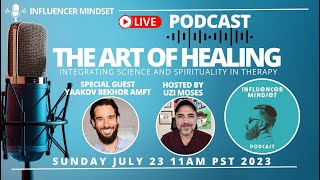
In this episode of the Influencer Mindset Podcast, host Uzi Moses PhD interviews therapist Yaakov Bekhor about his integrative approach that blends evidence‑based therapeutic modalities with spiritual teachings. Bekhor explains why he believes science alone is insufficient for deep healing and describes his use of the Internal Family Systems (IFS) model, which views the psyche as a family of parts guided by an innate Self characterized by the “8 Cs” (compassion, curiosity, calm, confidence, creativity, choice, etc.). He details how he brings spirituality into practice through mindfulness, somatic awareness, intuition, and honoring synchronicities, while always meeting clients where they are—whether they are religious, atheist, or somewhere in between. The conversation covers how he addresses skeptics, the importance of the therapeutic relationship, the mind‑body connection, and the need for clients to integrate insights into daily life. Bekhor also shares how his holistic framework can help listeners cultivate a growth‑oriented, influential mindset in personal and professional contexts. The episode concludes with an invitation for listeners to contact Bekhor at Angelus Psychology Group for holistic therapy.
Chapters
Okay, ladies and gentlemen, welcome to another episode of the Influencer Mindset Podcast. I'm thrilled to have a very special guest joining us today. Please give a warm welcome to Yaakov Behor, a visionary therapist who has mastered the art of combining science-based modalities with spiritual teachings, creating truly unique and powerful healing systems for his clients. With an impressive track record of transforming lives. And Yaakov's approach is sure to inspire and enlighten us all. So without further ado, let's dive into this mind-expanding conversation. But before we do that, please let me share a few words from our sponsor, AnywhereKosher.com. AnywhereKosher.com is an online community of like-minded individuals who share ideas, thoughts, and experiences through creating a profile. It's like a social media for like-minded Jewish people who wants to share stories and ideas and places about anywhere kosher.com. So go check it out. And also, I would like you to help us spread and expand this podcast by liking, sharing, and subscribing. So before, without any further ado, let's welcome Yaakov Bechor. Yaakov, how are you this morning?
I'm doing great, Uzi. Thank you so much for hosting me on your podcast. I've been looking forward to being here and, uh, yeah, just having a conversation about therapy, spirituality, and healing.
Yakov, what can I tell you? I've been waiting for this day. I remember when I first started the podcast, I didn't even have one chapter and I was thinking about you. I said, I like this guy. This guy is bringing something amazing to the world. And it's something that's definitely worth sharing and providing value to our listeners. So I prepared a few questions for you and I would love for you to kind of delve into it. Like we said, we don't have to, we have like 7 questions here, maybe, yeah, about 7, 8 questions, but we're gonna try to do as much as we can with the time that we have. Providing really the most value we can provide to the listeners to understand exactly what are we doing here. So how did you first discover the potential of merging science-based modalities with spiritual teachings? And what inspired you to take a holistic approach to therapy?
Yeah, great question. You know, there are so many modalities out there in therapy. Um, some are more science-based and studied and scientific, and there's research on them. And there are some that are also focused on spirituality and spiritual development, what we call the unconscious or what's unbeknown to us. Um, there's two categories of therapies: psychodynamic approaches, which work a lot with the unconscious, and believe that the process of therapy is uncovering those parts of a person that are unconscious to them, making them conscious within the therapeutic relationship, and through this process, becoming more self-aware and more whole as a person. And there are other approaches that are more cognitive and rational that focus on a specific, uh, way of doing therapy, like, uh, perhaps it used specific tools like worksheets and so on. Uh, I like combining both because, um, I believe there is an element of mystery to therapy, right? There is a mystery to the therapeutic relationship, what's happening in the room. It's hard to quantify at times. The relationship between a therapist and his client creates— is like create— it's a creation that allows for, um, certain elements or parts of a person that were hidden to come forward. Um, and that's difficult to quantify or measure. At the same time, making use of the research that is out there is beneficial to my clients to make sure that I'm giving them the best treatment possible.
I see. That's, that's quite amazing. So you're telling me, in other words, that you felt that just science-based therapy alone won't do it. There has to be some kind of a spiritual integration to really heal somebody, right? So, and that's really fascinating to me. So as an influencer in the therapy world, what really inspired you to integrate those spirituality and healing within traditional therapy practices, if you know what I'm saying? And how do you really do that on a practical level, somebody comes to therapy, you know that statistically speaking, there is a certain chances that this and that, and you try to diagnose them, but where is the spiritual aspect come into play?
Great question. So I work from a modality, from a framework called Internal Family Systems. This framework essentially takes a multi-mind approach to the human psyche, meaning that it believes that we all have multiple parts within us. This was a modality developed by Richard Schwartz when he was working with anorexic girls that were struggling with their eating disorders. And he found out that within his work with them, the parts the parts that were so prominent, they were self-sabotaging them to the point that they were like starving them to a point that it was killing them, were actually not their whole being. It wasn't their, their entire essence. It rather was a part of them that grew to become so extreme over time in an effort to protect the pain that another part was holding. The pain that was probably pre-verbal from the early childhood trauma that these girls experienced, and parts tend to be stuck in the past. So a part that perhaps protected the system by starving itself when it was like 2 years old, Perhaps that's effective when you're 2 to starve myself. So I, I'm like, by starving oneself, maybe a person can be like hiding from their pain or just receding or whatever it is that that part is doing for the system. Obviously when they're like older, 16 years old or 20 years old as a functioning adult, that's not so helpful anymore. Yet parts don't move on and grow until they get the attention and the understanding that they need. So when we look at a system in terms of parts, and we look at all behaviors that we have, even the behaviors that we dislike the most, as only a part of ourself and not to represent the person that we are, we can have more compassion for these parts, and we can approach them from a place of what is called an IFS Self with a capital S. Self is that soulful energy that is categorized by what are called the 8 Cs. Um, some of these Cs are compassion, curiosity, calm, confidence, creativity, choice, and so on. And when we approach parts that are struggling within us from a place of self, automatically, we're able to hear them out. And each part has a story. Each part has a story to tell, and a reason for how they ended up to be the extreme part that they are today. And simply by hearing out these parts and listening to what they have to say, they will automatically ease their extreme pattern that they have because parts are like, they're usually stuck in age and sometimes they're stuck in a young age and like a young child, will like scream and tantrum until their parent doesn't hear them out. We have younger parts within our own internal family system that will continue screaming and shouting and acting in extreme ways until we are able to hear them out from a place of self.
Can you explain a bit about IFS a little bit? What does it stand for, IFS?
So IFS stands for Internal Family Systems. It holds that we have a family system within us, the same way we have a family system that we come from with our parents and our siblings and so on. There is a reflection of that system within us and we have parts within us that are competing from different motives or things. For example, when we feel like we want to go to an event that is happening and there's a part of us that really wants to go and there's a part of us that kind of just wants to stay at home and lay down and lay low. IFS holds that these are not just contradictions within an ambivalent person that can't make a choice, yet it's actually two separate parts of us that have different motives, different stories, different desires. And instead of blaming oneself for having conflicting opinion within oneself. A person can just simply recognize there's two parts that want two separate things. And if we hear them both out, then we could actually understand why they're conflicting and make a choice that respects both parts. Does that make sense?
Yes. Yeah, that makes a lot of sense. So, so it's really about, um, some kind of a belief system that we hold within us about what a family should be and what is our part within that, that environment. Um, did I get you, uh, right here? Because internal family system is, it's like something you're saying, it's like, it's some kind of, uh, mindset, a consciousness almost.
Yeah, it's really about shifting your mindset to seeing your system as parts and less as one unified mind. There is a part of this, of the mind that is unified, that is called self, and there are parts that become fragmented over time. That isolate from self. And when we have parts that are hard on ourselves, right, we have an inner critic, or we have judgmental parts, or parts that blame other people, or parts that minimize our own worth. These are not our entire being. We can have, instead of blaming ourselves for having these thoughts, we could simply say, oh, there is a part of me that is being very critical of myself. There is a part of me that is judging other people. And if we're able to inquire about whatever part is coming up in the moment, instead of being like, oh, shut up. I don't want to hear that. I don't want to judge other people. I don't want to judge myself. Let me numb that part. Let me just— instead of doing that, we can welcome the part in and get curious. Why is this part here? Maybe another part is really struggling. Maybe a part needs to be told that it's doing really well, or it needs some time on its own, or it needs— it's missing someone, or whatever it is. And this other part is coming in and defending this part by judging other people, releasing that self-judgment that it's experiencing and projecting it onto someone else, or all these like younger or child, so-called childish ways to deal with pain that we experience. But we all have parts, and we all have parts that are stuck in the past. And we all have the opportunity to heal them, even in adulthood. If we find— if we recognize that there is a voice that we don't like, it's a part that we can work on and figure out why it's there. And with time, just by understanding it and healing whatever pain it's covering, we can release it from its extreme pattern. Parts can become functional as well to help the system. Yet if they're for a long time to go unheard, they become independent and they think of their own and they don't recognize that there are other parts. They isolate. What happens when a person isolates from their community? They can— they're not attached or connected with what's happening around them. They're working from this own perspective that they have from the world, which could become distorted over time if they're not in connection with others.
Same with the heart. Is that your WhatsApp there?
I thought I closed my WhatsApp, but maybe it opened again. Yeah. How do I— I'm trying to close it, but it keeps opening. Yeah. Here, let me— Okay. I closed it now. Sorry about that.
Okay, so, so, uh, so, Yakov, so, so many people, you know, see science and spirituality as opposing forces. Okay, how do you address skeptics who might be hesitant about embracing the integration of both in, in, in therapeutic processes?
Great question. So I see science as a, a studying body that helps us understand the things that we experience in this world, right? Some things science could explain and some things, um, science hasn't explained yet. Mm-hmm. The gap between where science perhaps will arrive in the future but hasn't arrived yet is more of a mystery. It's perhaps more spiritual. It's that sense, that thing that we can't really figure out, but we know it's real. So we understand it from a place of intuition and connection. A great example to understand this is there's a study that shows that In therapy, the most predictive factor for the success in therapy is the therapeutic relationship with the therapist. If a client has a therapeutic relationship with their therapist where they're excited to see them, it clicks, it feels good, it flows. Often that alone will predict that therapy can be a success. And not— and less so, and that's a higher predictor than whether the therapist uses CBT or IFS or depth psychology or whatever. Of course, that matters as well. But if there's a strong connection and there's— the client feels seen, understood, felt by the therapist, that will guarantee— is a strong guarantee of, of the therapy itself. And to me, that's a bit of a mystery. It's like, oh, interesting. Like, how is that possible? Um, and that's sort of like an area where like, oh, science and spirituality are blending a little, right? It's like, we're quantifying this thing that works. But there is an element of mystery, there's this element of connection that is speaking for something that isn't so clear.
I see. So if let's just say somebody who is an atheist, okay, comes to you seeking therapy, Do you incorporate like the concept of God or you just don't call it that? Because obviously in that case, you'll be like, listen, I don't believe in that. Or you were talking about the quantum field or you give it a different name or you just don't mention God or the creator. You just talk about the spirituality of the human being as far as like the psyche and the soul. If you know what I'm trying to say.
Yeah, great question. So I like to meet my clients where they're at. And what I place most importance on first and foremost is getting to know them, getting to know their world, getting to know how they see the world and what's happening within them. What are some parts of them that are maybe a little stuck and are looking to move forward and And that's my first and foremost priority. Once that I get to know their world, we start establishing a relationship and a connection. And I don't— I think spirituality is not something that can be taught. It's just something that is experienced. And if a client starts experiencing that, then I will honor that and will guide them through it. But I will never, like, force it or, um, teach concepts of such to a client. Um, I think everyone is on their own journey of self-development, growth, spiritual awareness, and, um, the right, the right concepts come to a person Whenever they're ready for it. And if a client is open to seeking more spirituality within their life, I will honor that and guide them towards it. If that's not something they're looking for, or not looking for in that moment, I will meet them where they are at.
I see what you're saying. Okay, that makes a lot of sense. So before you even start to kind of do the therapy, you, you, you make it very personal, very individual, and you kind of try to see who you're first dealing with and then, um, you know, modify, modify your attitude accordingly, which makes a lot of sense because obviously you're not gonna shove, uh, you know, God or the concept of God to an atheist because it does not make sense. So that's, that's really, yeah, I'm not, I'm not a spiritual teacher.
Um, it's like, right. I integrate spirituality into my work because I believe in intuition and growth. I believe that like the human system, our psyche is prone towards growth. And I want to honor that. And I believe that the client intuitively knows how they need to grow or what they need to work on. And They're the expert on themselves and I just have to figure out how to help them through that.
Okay. So, so your approach to therapy sounds, it's singularly holistic. So it's like a holistic kind of approach. Could you walk us through the key elements of your system and how they work together to bring about transformative healing experiences?
Yeah, great question. So I take a holistic approach to therapy because I value the mind-body connection, especially with all the research that has come out recently that links the, the mind and the body. Um, for me to just treat the mind without taking into context The body, how someone treats their body, their own self-care routine, their own relationships in the community, the people they're connected with, all of these are factors that will predict the success of therapy. So much can be done in 1 hour a week. And the real, the term, like, What's really gonna determine the success of therapy is what a client actually does out of the therapeutic session, the, the, the one, one, one hour a week session. Are they gonna be curious about their life? Are they gonna try to implement what's been talked about during sessions into their day-to-day life, their social relationships, their self-care routine? 'Cause a person can like have major revelations in therapy about what they need to do in their life to change and to better their lives. If that implementation is missing, then so much can be done. Therefore, I like to help my clients find ways to integrate what comes up in therapy into their week and for them to be successful out of the therapy room.
I see.
Okay.
That makes a lot of sense. So, I wanted to ask you, like, in your experience, how does incorporating spiritual teachings enhance traditional therapeutic techniques? And what unique benefits does it offer to those seeking emotional and mental wellbeing?
Sorry, can you repeat the question?
So, so basically I'm asking is when you incorporate spiritual teachings to enhance traditional therapeutic techniques, so you're taking something that's already there and you're just adding, you're incorporating spiritual teachings into it. And so, so what are the unique benefits that the client gets on an emotional and mental wellbeing levels. You know what I'm saying? This has to be some additional benefits they get, which they wouldn't get otherwise.
Totally. I mean, the modalities I use in therapy incorporate spirituality. Via, like, mindfulness, meditation, somatic awareness, honoring synchronicity, things that are happening, what we call ashgaha pratid, things that are happening in one's life and being curious about that. So there are various ways that our sense— that I guide my clients to honor their intuition, to honor their sense of spirituality and sort of What's coming up for them? Let's listen to that voice. Let's listen. Let's look at that event that happened and you're sort of like curious about it. There's more there because that what we call an IFS could be a trailhead to parts that are stuck and want to come forward and have a story to tell. So when I say I'm I integrate spirituality into my practice, for me it means that I really go with the flow. I really get curious and see what, what is the client coming in with and what's coming up for them. And not like sticking to like a plan or something I have to do, rather like really being fluid and honoring the flow of the session.
That's, that's really cool. So, so technically, it's, it's pretty much giving your clients a new set of glasses to look at reality, understand divine providence, understand the oneness of creation, um, and, and, and your part in that, which they probably would not get, um, in traditional, uh, therapeutic, uh, techniques. So, so to go to our last question for this podcast—
Uzi, can I ask you for a quick moment? I need to take a quick break. I'll be back in 1 minute. Sorry.
Sure.
You're right back.
What happened? Okay. Okay, guys, we are still on. We're still recording. Uh, Yakov had a quick emergency. He will be back. We're gonna wait for him for a few minutes. Meanwhile, I wanted to, uh, encourage everyone that are listening to please, um, like, share this video, subscribe to our channel, uh, become a part of this, you know, partner with us because we are really sharing information that is very helpful and provides tons of value to whoever tunes in. And this is the goal of this podcast, just to provide value and to bring people to a better day, a day way before the previous one. So, Yakov, welcome back.
Thank you. Apologies.
So, Yakov, so now we are going into the bottom line here of, of, of what are we doing here today? Because obviously, you know that this podcast is called The Influencer Mindset Podcast, and, and that name alone suggests that the power of influence in shaping one's life. So we understand every human being is an influencer, and every human being affects its environment in one way or another, hopefully in a positive way. So how can individuals harness the principles of your therapeutic system to cultivate a positive and a growth-oriented mindset in their personal and professional lives? Because this is the bottom line here. We want to help the listeners to influence more, to make a better positive impact everywhere they go. So let me just repeat that really quick so you'll— and take your time, you don't have to rush with the answer. So how can individuals harness the principles of your therapeutic system, which is the integration of spirituality and traditional therapeutic systems How can they harness that to cultivate a positive and growth-oriented mindset that could improve their personal life and professional life?
Great question. So I would say that first and foremost, becoming aware of what's happening inside of you. What, how are you showing up around your friends and in your community? Are you showing up with parts that are curious and helpful and are contributing to the people around you? Or are there parts that are like pushing people away, judging, blaming, whatever that is, and really honoring whatever is coming up and being open to work with it. Don't hide that from yourself. Don't shut that voice down. Recognize that as almost like a friend coming to tell you, look, hey, there's something inside here that needs more attention. And I'm telling you with this stronger voice, so hopefully you will listen. And the more we listen, the more we get to know ourselves, the more we can open ourselves up, free up energy that is stuck in the past to be with people, to be a great influence, to shine our true essence of what we're capable of, what we bring to the world, which is unique for each individual. But we can only do that when we really are willing to take a deeper look at the parts of ourselves that are struggling, that are stuck in the past, and that need healing. The more we heal, the more space we create, and the more space we create to grow ourselves and positively influence the people around us.
That is beautiful and fantastic. Um, first I want to wish you luck, lots of luck in your journey as a therapist who is combining, uh, you know, I, I think you're doing a, a very important work here, uh, combining spirituality and more and having a more holistic approach to therapy because it's, it really is important because we are a human, human being is a very complex thing and you have to look at the whole, at the whole thing, you know? So, so a lot of encouragement and support. I would also wanted to extend another invitation for you to come in the future as you are progressing that with, with some stories that you can tell us and more information about how, you know, that approach really changed lives. Also, I want to encourage everybody who is seeking a therapy, who, who is seeking a holistic approach to contact Yaakov Behor. We are going to provide a link and some information that you can contact him. And, and hopefully he will, will be able to help you with all your needs when it comes to growth and therapy and healing. And we just want to ask you a few. Do you have any other words that you want to share before we end this podcast, my dear friend?
Yes, I first and foremost wanted to thank you so much, Uzi, for hosting me on your podcast. I think you're doing great work. You're a great host. I felt very welcome. Um, I, I enjoy the podcast that you're doing with so many, uh, influencing people and, and bringing them on and really give them an opportunity to share and help others. I think that's so special and, uh, I'm really grateful for that. and yeah, I wanted to give a shout out to anyone who's looking to explore their own growth, wants to work with parts of themselves that they feel are holding them back, and it's— they have parts that they feel like, oh, this is like what I need to work on to go to the next level, to really reach out. I work with teens, individual individuals, couples, and families in private practice at Angelus Psychology Group. We have an office in Wilshire. It's a beautiful space. It's a spiritual space. Um, and yeah, if anyone's curious about therapy, has any questions, please reach out and schedule a time to talk with me. I would be happy to do that.
Fantastic. Thank you so much, Jakob, for joining us today. Everybody, thank you for tuning in. Have a fantastic Sunday, and we'll see you at the next podcast episode. Take care.
Thank you.
More from Uzi





The Secret of Reincarnation According to Ancient Wisdom. Save it, share it, and follow for clarity.





