The Possible You with Yom Tov Glaser.
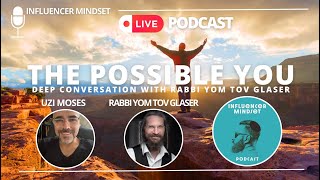
In this Influencer Mindset podcast episode, host Uzi Moses PhD interviews Rabbi Yom Tov Glaser, the founder of the Possible You Seminary. Rabbi Glaser recounts his unconventional upbringing in West Los Angeles, early experimentation with psychedelics, and a pivotal turn toward Torah study after his family’s financial collapse. He describes the Possible You program—a multi‑stage, year‑long personal‑growth system that blends ancient Jewish practices (prayer, communal worship, sunrise rituals) with modern techniques such as guided breathwork, meditation, primal‑scream therapy, and strict community rules designed to mimic the surrender and identity‑stripping aspects of psychedelic experiences without any substances. The seminar runs a four‑day intensive shock phase, followed by weekly leader‑led sessions, a social‑media “capsule,” and a year of integration within a global network of five physical branches and satellite locations. Rabbi Glaser explains his conceptual framework of the self: the universal neshamah (soul), the unique “beautiful child” (inner child), “divine factory settings” (intellectual, interpersonal, instinctual), and the “shape‑shifter” (the ability to assume any needed role). He emphasizes the importance of community, trust, and full self‑disclosure for lasting transformation, and offers advice to skeptics: move beyond a merely “fine” life, remove mental “bugs,” and surrender to guided processes. The conversation also touches on his personal publications, the role of sunlight and melatonin in mood, and future plans for expanding the seminar to new locations.
Chapters
We have with us today the great honor of hosting a remarkable individual whose insights have inspired countless individuals to tap into their full potential using the wisdom of the Torah. Rabbi Yomtov Glazer is the visionary behind the Possible You Seminary, a transformative journey that blends ancient wisdom with modern strategies for personal growth with a deep understanding of both spiritual principles and practical techniques. Rabbi Yomtov empowers people to unlock the inherent greatness and live their best lives. So now without further ado, let's dive into this enriching conversation with Rabbi Yomtov Glazer. Rabbi, how are you today?
I'm doing great. I'm actually just posting this now on Facebook so my Facebook people can watch it as well. So fantastic. That link over to Facebook, except it didn't go. I'm just going to grab it. Let's see.
Okay, fantastic. Yeah, just shoot it. We are online. We are live on Facebook. And really, really honored. You know, actually, there was a few times that I wanted to get you on the podcast, and I know you have— you're a very busy guy. I couldn't really get you. And now I saw you that— I saw that we are actually on the same Facebook group. I mean, same WhatsApp group. So I had your direct info. And I just took upon myself to invite you to this podcast to benefit the listeners and the audience, as this is the Influencer Mindset podcast, and it's all about reaching our full potential using the Torah and using tools that are a little bit, you know, maybe conventional, some of them unconventional. But let's start with a very simple question to kind of get the conversation going, Rabbi. So what inspired you to merge Torah wisdom with personal development principle in the Possible You seminar?
I come from a background in, I grew up in Los Angeles in West LA and I wasn't raised observant and I was, um, from a very young age I started, uh, on this trip of personal discovery, on self-discovery and self-realization, self-actualization. I know it sounds like the word self is in there a lot of times, but it's LA, you know. And, uh, and I— so there was, you know, I grew a lot. I grew a lot from on many levels, but, but the, the inner path, uh, that I had discovered and was, was the one that really, uh, took me the furthest, you know. And then, and that was this inner inner, as I'm saying, this self-discovery was, was really honing in my instincts and pushing the limits in sports. And I was a psychonaut from 11 years old, which is the— what's so popular today, the psychedelic therapies. I began at 11 years old. I was a kid, and, and I, I got, I got very far by the time 12 years later I discovered Torah. So that was a 12-year journey before I even learned the alphabet and began my Torah experience. And with Torah, I got like totally involved, like all the way, like very deep. And, and, uh, amazing.
So at age 12, you were already introduced to psychedelic therapy?
Yeah, 11.
At age 11? Oh my gosh. Through how? Through your parents?
Um, no, my parents were real conventional people. They were not at all, you know. Uh, my father used to get upset. He would say, why don't you quit these things? I said, you taught me never be a quitter. So the, um Yeah, so at a young age, how did I get it? I think I was being influenced by older people because I, I stopped going to school on a regular basis at 11.
So, so that was like what, '70s, the '60s, or it was the '70s? And it was the '70s. Yeah, it was a game.
I be— I started surfing a lot, and now I'm hanging out with the surfers of all ages and And I was mountain biking, you know, in the mountains every— I was surfing every day, mountain biking every day. I got influenced, you know. That's amazing. Influencer Mindset Podcast here. So yes, I met quite a— quite some influential people. And I'm also a musician, and the, the music that was touching me was music about finding truth, you know, and the search. You know, I think my favorite band at that age besides Pink Floyd was the band Kansas. You ever heard the band Kansas?
Yeah.
So I'm woven in a fantasy, I can't believe the things I see, the path that I have chosen now has led me to a wall. And with each passing day, I'm feeling a little more like something dear was lost. It rises now before me, the dark and silent barrier between all I am and all that I was ever meant to be in harmony. Shining through. Anyway, I was being influenced and not by classrooms, certainly not by American classrooms. I missed becoming an American. How do you become an American? You send your kids to the public schools and their job is turn them into an American. But I missed that. That never happened with me. Wow.
So from there, how did you find your way into— what was that pivotal point that made you kind of see, that made you really realize, you know what, I should get into Torah, I should take that?
So it all happened in one moment. It was simply my father's business went bankrupt. And I was about to take a world tour. I was surfing around the world. I was about to do a serious world tour, and I needed money for the first time because he had a, you know, a strong business, and he basically paid for my adventures. And I was going on a major adventure, and suddenly the— like, someone unplugged the, the, uh, you know, the, the power. And I didn't have any money to go on that tour. And I actually got a scholarship to a yeshiva in Jerusalem called Aish HaTorah. I had zero interest in studying Torah. I thought Judaism was a religion. I mean, that's what I was raised believing. And I certainly wasn't interested in religion. But the rest was history. I arrived in Jerusalem. With my atheist, you know, philosophies. And, um, within hours I already realized, oh my gosh, like, I'm— I am in, uh, over my head here. And they— and I'm losing my arguments one by one to people who have thought for many more years and much deeper about the things I had been thinking about for the last 12 years. You understand? Like, I'm meeting— I'm not just meeting people in their 20s, 30s, 40s, 80s. I'm meeting people who are 5,000 years old because these people are steeped in Jewish wisdom. So it looks like I'm talking to a 30-year-old, but this 30-year-old's been studying since he's a little kid, 5,000-year-old wisdom. And, and because it was a modern yeshiva that dealt with people like myself, they already had plumbed the depths of points that were important talking points for me on my philosophy. Many of these people also had the same talking points from the 1960s. These were people in their 50s who were now rabbis in Jerusalem who had similar paths as myself. And saw eye to eye with what I was saying, but they were able to take it like 10 steps deeper.
That's amazing. So right now you—
let me make a blessing one second.
Amen. So right now you are located in Jerusalem, right?
I think so, but I'm overseas a lot. Today I'm in New York. Um, I have 5 branches around the world. The Possible You has 5 branches, and then we do one-off satellite, uh, areas. So for example, this week I'm at my Brooklyn branch, but next week is going to be a satellite where I don't have a branch. It's a place called Monroe. It's the country in upstate New York. So I get to be in the country all week next week, and I'm actually staying at a spa.
That sounds like a lot of fun. So you were mentioning before that you have tremendous experience with psychedelics. And I know that the possible use seminar is, it's all about really reaching people's potential. Is that somehow integrates with it psychedelic therapy or that's a separate thing?
Yeah, it's— they're totally separate. Um, the reason being is that how The Possible You started was I had seen the power of psychedelic therapy for many years, and I did a lot of deep thinking about how I could reverse engineer the psychedelic experience How can I reverse engineer it? Like, what's involved with someone who does— let's say they do a mushroom experience on psychedelics. Um, well, what happens there? Well, a couple of things happen. One is surrender. You have to surrender to the experience. Yeah, or you will get bulldozed and have, you know, instead of working, getting therapy from it, you'll wind up with PTSD. So You gotta— you got— you've got to surrender to it for sure. Um, it's also— it's going to strip you completely of who you're not. Psychedelics strip you of who you're not. And this is kind of the nature of more difficult journeys on psychedelics, is that if someone's really inauthentic They're going to be meeting that inauthentic person and not knowing what to do with it exactly. They're going to have, you know, they better have a good guide to hold on to them while they start to realize that there's nothing real in them. There's no sound bone in their body. They've been living a lie for years and years, maybe even harming people, maybe greedy financially, maybe You know, their, their whole personality is just based on, on everyone else. And in some— whatever you— the second thing— so number one was surrender. Number two is that whoever you're not is going to be stripped away. You know, one hour after, after ingesting a psychedelic, whoever you're not is gone. And another aspect of the psychedelics is is a very intense emotional release. Very intense. Like, it's a big emotional release. And another thing is, um, regarding it is, um, is a tremendous feeling of love, like a connectivity with all reality, certainly with other people. And so let's go to the possible you now that we've described those 4 things, and there's more, right? Possible you has rules. You have to keep them. There's no exceptions. Okay, there's 8 rules. You have to keep all 8 rules. You break the rules, we're going to have to talk about that in front of everybody. So there's full compliance. In other words, there's full surrender. You have to surrender to the process. 'Cause if you don't, we're gonna talk about it. I once had a guy didn't show up one day. One of the rules is full attendance. So what did we do? We took everybody, everyone jumped in cars and we drove like 45 minutes across the city and knocked on his door. And he answered the door just thinking, you know, maybe it's fundraising, who knows what, who's at his door, you know? And it was, 30 men, and we just marched right into his house and we ran the seminar from his living room.
Yeah.
Oh, we're committed, man. But so, so that's one of the rules is 8, uh, there's 8 rules, and that creates the psychedelic surrender. You can't leave, and if you try to leave, we'll come to you, meaning that we're not going away here. You can't run from it. No running. That's a big commitment circle, deep commitment circle where everyone has to kind of like swear in blood that they're, that they're in. You understand? Yeah, that's surrender. The next is stripping you of who you think you are, is we go right in, you know. As soon as the seminar begins, I do a brief intro, but then we're already in deep meditation doing breath work. And, and what we do is we expose, expose the negative self-talk in a meditation. So everyone's kind of in a hypnotic state now, and, and which is also, you know, the, the psychedelics are very intoxicating. A fifth aspect is they're intoxicating. So now I've got everyone in breathwork They're in a deep, deep kind of hypnotic state while discovering, oh my gosh, I say bad things about myself and I didn't even think about it. You think 60,000 thoughts a day, which is 3,500 thoughts an hour. And people will have thoughts like unlovable, worthless, unwanted, small, weak, unworthy, dumb, ugly, lost, helpless, hopeless, and incapable, incompetent, irresponsible. We have these crazy lists of things that we're saying about ourselves. But here's where the kicker comes in. We call those inner negative beliefs, but in the seminar, it's called inner negative beliefs, which are not true. They're just beliefs. And then what do we do? We cover it up with survival strategies, which is I'm the cool guy, or I'm the shy guy, or I'm the loud guy, or I'm the joker, or I'm the lazy guy, or I'm the procrastinator, or I'm the bum. Or I'm the workaholic, or I'm the overachiever, I'm the powerhouse, I'm the control freak, you know. And, and we go into that, and after a while, just in the very first meditation of a 4-day experience— it's nights, it's— we don't do it during work hours. So the— after just a couple hours, you're already You've had your personality stripped clean. So, so I can go on about the other, the other aspects, but okay, and that's still without the psychedelics?
That's just—
no, no one ingests anything. In fact, one of the rules is, one of the rules is you can't even take Tylenol that week. No weed, no alcohol, no, no.
So this is all like breathwork and meditation and focus and guidance.
Guidance and, and, and group dynamics that are taking place the whole time. Um, we do, uh, by day 3, you're ready for full release. So like just last night here in Brooklyn, I was— I'm with 25 men, it's a medium-sized group, and we These are grown businessmen crying like little girls, crying like little girls, like whimpering, sobbing, you know, like— and I promise you, every single one of those men came in Sunday night, they all came in Sunday completely composed, you know, the Range Rover parked and parked out in the driveway. You know, there, there were no— people don't realize that they're walking around with like micro trauma from years and years of not releasing it, you know. And but I, you know, I get them— I take that sobbing to like next level, meaning we do— after enough sobbing, we go into primal scream. And I don't know, you know about primal scream therapy.
Okay, I've heard about it a little bit, like where you go—
Most people don't know about primal scream therapy. So John Lennon of the Beatles and his wife Yoko Ono kind of made primal scream therapy a little bit popular. It's where you, you got to warm up for it, meaning if you try to do it right off, you'll destroy your voice. You warm up to it. But, but you have— even you, Uzi Moses PhD PhD, all of us, we have a voice we've never met. There's a voice inside you that you've never met. It is like, uh, whoa, it is a roar that massages the throat, believe it or not. Meaning louder than— 10 times louder than you've probably ever gone with your personal voice. Which, if you went even as loud as your personal voice goes, you probably would hurt your voice. This is 10 times louder, and it massages your voice because you're accessing— you're accessing a kid inside of you who needs to scream. And how do you think screaming— it's not you screaming, it's him.
How do you get to that kid?
Well, the kid only shows up after about 2 hours, hour and 45 minutes of breathwork. Um, different styles of breathwork— breath holds, holotropic. Um, and, and this breathwork, unlike other breathwork that people do, the The breathwork in the possible you is guided the entire time. So, you're like, during the breathwork, you may be holding your sibling that you basically put down because whenever he embarrassed you when he came to hang around with your friends, so you told him to stay away. And, the problem is that he never really got traction socially after that. That was like his big chance to like be social because he thought maybe he could jump on your shoulders with your friends and like be part of things. And you told him like, no, go back to the television room where you belong, you know, stay away from me, stay away from my friends, stay away from my parties. I don't want to see you. And so while you're doing the breathwork, you're holding that sibling. That, that you might have hurt. Your spouse, your children, connecting to your grandparents who you, who maybe you didn't let reach out to you.
That is really, really, um, fascinating, man. Wow. Like, way, way more fascinated, uh, more fascinating than I ever even imagined it would be.
Uh, This makes, this makes LSD look like vitamin C.
And, and that's without even ingesting anything.
Nothing. Just nothing.
Nothing. Okay. Wow. Yeah. You know, I did breathwork once with, uh, a guy named Mary Kay was the first, my first breathwork experience.
Yeah.
It was pretty amazing. Honestly, like you come in no ingesting nothing, you're not on anything and you like literally reach a point where like I kind of met my future self and we had a little— he was giving me advice what I need to do now. And I was like, wow, that was like quite a life-changing, life-shifting experience for me.
Yeah, breathwork's amazing. Amazing.
So how do you navigate the balance between embracing timeless spiritual truths and adapting them to suit the contemporary challenges of your audience?
I want to understand that question. Ask it again. I like the question. Ask it again. How do I navigate?
So the question says that, for example, right now, you're using pretty much timeless spiritual truths, which is a combination of Torah, of meditation, of network of psychedelics even, and you are adapting them to suit the contemporary challenges of people today, which is addictions to their phones and depression and all the challenges people are going through today in our life.
Yeah.
So the question is pretty much, how is that, how is those two worlds kind of come together?
You know, so much has been lost in modern, in the modern era and with since the Industrial Revolution when man started mechanizing his reality, and, and which of course led soon to people moving to cities, to the advent of electricity, which has messed up our hormonal levels completely. I mean, where people are lost, I mean, between serotonin and melatonin. I, I'm starting to think that melatonin is the key to happiness. What I mean by that is that if your melatonin If you lived hundreds of years ago, and once it got dark, it's dark. There are no lights. You could get— light a candle, you know, just to find your bed, or maybe a little supper. But people probably ate supper around sundown so they could see. And, um, your melatonin came right in, so you went to bed. And then you woke up at dawn with the roosters. And you, you headed out to the farms, headed out to the fields, headed out to the cows, wherever you were heading out, but you were getting sunlight at the break of day. And, and it's very interesting that Jews, uh, you know, there's a large component of the Jewish community that faces east, looking toward the sunrise and pray exactly as the sun rises.
Next.
And so they have discovered that there is a direct link to the balancing of serotonin with sunlight. Sunlight and serotonin go together, and that's your happiness. And we also— Jews pray in groups, and they found now that— amazing discovery— that serotonin is best, uh, the serotonin levels are best raised through social interaction. And so Jews forever have gotten up first thing in the morning and are praying. They're with the sun and they're praying in groups for, you know, every single day for years and years. You get to know each other, you get to be best friends, you know, you're, you're socially involved, you are connected. You know, which, if I can remind you that I'm simulating this in the seminars, to this connection to all people, to a level of acceptance in your heart of all people, just as you would like to be accepted. You can accept anyone the same anyway. But, but this, this sunlight that people got in the old time, in the old days. And then there's another really important thing is, is boys being raised by and, and girls being raised by women, so that the traditions of thousands of years of what it is to be a man were passed down to a boy, and the thousands of years of what it is to be a woman were passed to the women. But I was raised, you know, in LA, where dad's in an office building, my teachers were all women in school. And you know, you're a little boy and you just, you just want to please, please women. You know, how do I, how do I please women? And so I'm literally modeling myself as a male to the female, which is a turn-off for women. It's a turn-off. Yeah. And, and this has marked a 1% decrease in testosterone in men per year. 1% per year for the last 50 years. And so men's— men's young men today have almost no ability to even produce children at this point. And we, we have lost our tradition as men. Men are beautiful. Men are such beautiful powerful, dangerous beings who are so gentle and caring and loving and choosing. What is the power? The power is you never see the danger. Well, that was cool.
Yeah, how did that happen?
I don't know. Oh, this is cool. What else we got here? Oh, I don't know.
It's the AI.
Uh, how do you make a heart? I know my daughters are always doing this.
Oh, oh wow, crazy.
I wasn't expecting that. So anyway, um, uh, so outdoors, learning the tradition of your, of your, you know, of your male or female life. The, um, so these ancient pathways are, are here. And let me talk to a little Judaism about ancient pathways, right? And that is that you're— is that you're good, you are beautiful, and you're holy. Why, why, why do you have all these things? Because Well, let's think about it. Like, are you conscious? Yeah, Uzi Moses PhD PhD PhD, are you conscious right now? You aware? 100%.
I hope so.
So here you are, and those who are watching this, please just go quiet. Take a moment right now and just get it. Be aware that you're aware. Just be aware that you're aware. You can close your eyes and just Be aware that you're aware, and that's conscious consciousness. You can open your eyes and realize that that consciousness is not a function of the brain. It doesn't show up in an MRI, doesn't show up in brain scans. It's the second biggest question that atheists have to deal with, is like, I'm using my consciousness to figure out where consciousness comes from, because we know it doesn't come from anything physical. It's not the brain. It reports to the brain, but it's something beyond the brain consciousness. And, and so think about it, if consciousness is outside space and time, well, maybe the consciousness comes from a being that's outside space and time. 'Cause what does God and consciousness have in common? And the answer is they're both beyond space and time. And just like you can't measure God 'cause he's infinite, he's not part of space and time, so too consciousness can't be measured. And as you get conscious, you start to realize that you are a manifestation of God. And, and you also got a body. And so, you know, well, what do I do with the body? And so, and we have a prophecy, the, the only true prophetic document. When I say true prophetic document, in that, um, all the other documents that have ever been written in the name of prophecy are always the person writing it who says he got prophecy. But, but Torah is not like written by the guy who got prophecy, you understand? Torah is, you know, it's— it is just a 100% top-down thing. Like, meaning, when— if I write something, it's down-up. This is top-down. This is top-down, you know. And I mean, obviously people say, what do you mean Moses didn't write it? Moses didn't write this thing. And the answer is that, well, Moses only comes into the Torah at year 2448 of the— or not quite 2448. He comes in at around year, let's say 2400 from the beginning of time.
Adam and Eve.
Yeah, yeah, from Adam and Eve. So it's like this, and so he's like writing himself into this whole thing, you know. And, and really there was this child of the biggest shaman on the planet And that child's name was Abraham. You know, Jordan Peterson makes fun of him for not leaving his father's home until he was 75. You know how Jordan Peterson's always talking about like the Peter Pan, you know, the boy who never grows up. So he kind of hassles Abraham for having only left his father's house at 75 years old. But when your father's the biggest shaman on the planet, you stay as long as you can. And, and, you know, that's where you're going to get your tradition. And he got that tradition. And then at 75, God just says, like, Abraham. And look, Abraham, you know, being the child of an idolatrous, you know, master, an idol master of idolatry. Can you imagine when God said Abraham? Abraham was like, I knew it, I knew it, I knew it, I knew it, I knew it. You know, meaning, meaning I knew that, that these idols are not at all, you know.
Anyway, so, so what happened after, after the ceremony? People are coming to you and they are getting so much, so much, like it's such a life-changing, it's a, they're coming out a different person.
Oh, you have no idea what happens to them after. It's like crazy. I mean, people married 20 years go home to their wife and in front of their kids look at their wife and just start sobbing. And they say, when he finally speaks up, he says, will you marry me? And she's like, I think we're married already, you know. And he says, no, no, no, no, no, no. That was circumstantial, meaning when I married you, a lot of things came together. And, you know, so I don't know how much free will there was. I see you like I've never seen you before. And then he looks at his kids and just loses it. Loses it, you know. And then at the workplace, can you imagine if the guy's— imagine he's the owner of a company. Interacting with like 50 people in the workplace. You imagine what that's like on Monday? I can tell you what it's like. I start getting his employees to the seminar over one after the other.
He comes up all like lit and, and loving and with an open heart and like embracing and hugging everyone. Oh yeah, I mean, for the first time.
Well, there's a— speaking of ancient wisdom, uh, uh, Moses got— he started glowing so much that he was freaking out the children of Israel. So he actually wore a mask. He actually put like, I don't know what it was, a brown paper bag. He put a mask over his face for when he was in public, you know, with two little eyes cut out. And because, you know, who is a sack or something, but he was glowing. And I teach this to my graduates, that you got to tone it down a little when you go out in public. Meaning, definitely meet eyes with everybody, smile. Your face is public property, and you're going to be a magnet everywhere you go. But you don't have to say everything so quickly. You don't have to hug your vice president, you know, vice president of your company.
I see. And how long do you think that the glow lasts, that aspiration, that spiritual enlightenment kind of stays? Because after, at the end of the day, then you have to pay your bills and you have to, you know.
Yeah. So we call it seminar high. There's a term for it. We call it seminar high. And people are high for I don't know, the numbers are changing lately. People have been high for months lately, um, which is really like a lot cheaper than drugs, you know, to be high for months. Um, I tell everyone, like tonight I'm finishing the group from last night, so I will tell them that you're going to be on seminar high anywhere from a few days to a few months, but you are going to come back down. And what I tell them is, when you come back down, remember to land on your feet because you've grown a ton. Meaning, if you look at the corner of the screen and you see like that angle, that's the growth. Yeah, but seminar high looks more like that, you know. It's like, what comes up must come down. But what I tell them is, when you come back down, you're not coming down to there, not landing on your head. You're coming down to here because you've been growing so much. You're on an intensive growth, growth curve right now. And so remember that you're going to land here, but land on your feet. And I warn them, it's going to come now. But something I didn't mention to you, Uzi Moses PhD PhD PhD, is it's not just 4 days. It's, it's a year experience. This— oh, this is a year commitment.
Okay.
Yeah, this isn't just the 4-day experience. Okay, so you have 4 days intensive to just shock you out of your— out of your narratives, meaning the stories you've been telling about your life are like gone, you know. So it's 4 days to like shock you out of your narratives. Then it's once a week for 4 weeks where I have leaders that have trained that lead the group now for another 4 weeks together. They're also on a social media group, like they have their own capsule. So they're all totally able to interact because you feel closer to these people than your own siblings. By the time you're done. You know that feeling where you've done deep work with people? Yeah.
They become like family.
You're like family. And so they're now a pod. And that pod's part of a greater pod of all graduates, you know, for the last 23 years. And you're part of that pod as well. And it's— so that's 4 weeks. And then the year gets looser how you want to deal with it. It's up to every individual how he wants to deal with the rest of the year. But I tell people, like, don't go do anything else for a year. Like, really ground this till you've got it, till you're walking it, you know.
So, so what does a community play in fostering this, this personal development, this transformation, and, and I mean, is there, is there a community that, that you could become a part of after this experience? Or—
they're— the way I, I'm very universal, so I feel like we're all part of a world community, and I want people integrating as much as possible back into the world, back into their communities, because people are already part of community, you know. You have a community. So hopefully, you know, I mean, you're in LA, aren't you?
Yeah, I'm in LA.
We have a community there, right? I'm just kidding. It's Jewish community.
I'm here because of the community, because I really enjoy being a part of this amazing community of unbelievable—
which community are you a part of there?
Um, Mid-City, Pico Robertson.
Yeah, sure. I have two brothers there. Yeah.
Yeah, it's nice. I mean, there's always something to do in our community.
Yeah, you can just hop from table to table on Shabbos over there.
Yeah, yeah, you can do that. I mean, it depends like where are you in your life. I mean, are you searching? Are you, or are you also, you can invite people and, you know, I like to do a lot of like events in my house, you know, Torah classes and melavei malkas. All kinds of things like that, you know, to have people celebrate life together.
You know my brother Sam there? You know Sam Glazer, the musician?
Oh yeah, that's your brother? Are you serious? He was just here. He was just in my house like 2 weeks ago.
I'm sure he was.
He's got a studio, he's recording stuff. Love the guy, love the guy. I didn't know it was your brother.
Yeah.
He's very special. So let's go back to the concept of potential. And, you know, it's very often that it sounds like subjective and elusive. So how do you help individuals identify and harness their own unique gifts and potential? Because we are all different. And we all came here. Some of us have the same mission. Some of us has different missions. And, and we're not made in the same way, right?
Right. So, um, I, I— maybe what might be helpful, because we aren't all the same, is to have an understanding of— remember before we were speaking about consciousness, which is like our inner being? So even though you have inner being, it has certain aspects that are in common with all other people, but it has certain aspects that are unique. So the one that we have in common with all people is called the neshamah, the soul, and that we all have in common. It's— there's nothing unique about it. In fact, if you're quiet, like, let's both be quiet for a second and feel each other's soul. Meaning you're feeling your own, but it's mine because it's ours. It's ours. So just take a moment and feel mine. Like, look at me in the camera screen. I'll feel yours. It's pretty amazing. You feel mine. And, and that's universal, and we'll come back to that in a minute. There's two— like, there's a sandwich, meaning there's the soul and the neshamah, then there's two other levels. And then there's a third, a fourth level that sandwiches the whole thing that's back to being universal. So the two intermediate levels are the beautiful child, meaning your inner child. Every person has an inner child that's unique to them. You know, if you go to a kindergarten teacher and ask them, are any of those two kids alike, what would they say?
Probably not, right?
Not at all. And that's this. And if you've raised kids, you know, like, each kid's like its own product, you know? Yeah, God just creates every person a one-off, you know? You know, two of a kind, even twins. And so that's, that's the beautiful child inside of each person. And the most important thing I've found with the beautiful child is to embrace it, to hold it, to let it— let that child cry if you've been ignoring it. Most people ignore their beautiful child. And, and this is to hold it. I hold my beautiful child and I take them for all kinds of fun, exciting adventures— surfing and mountain biking. And I bring my beautiful child to yoga. Sometimes, sometimes I'm, I'm hired to teach, you know, a class. Oh, I'm also a rabbi. I'm a rabbi. So sometimes a congregation will hire me for a Shabbaton or, or whatever their, their yearly, you know, event, their big dinner or whatever. And I'll get on the stage and I'll just go full stand-up, full stand-up comedy until people are like, like their ribs are getting bruised. And that's— who is that? That's my beautiful child. My beautiful child was so mischievous. He's so crazy. And that's my beautiful child. And you have your own, Uzi. You have your own beautiful child. And you seem like the kind of guy who also takes him out to play. Oh yeah, but so many people don't. And so the advice for that unique aspect of ourselves is to really get to know each other. And Louise Hay, the amazing healer, she taught— when I was 20, I learned this great exercise is to look in the mirror and say, I love you. I really love you. Look yourself in the mirror and say, I love you. I really love you. And if you can't say it, or you spit on the mirror, or you broke the mirror, or you said it but you didn't mean it, then you say twice a day. You have to do this twice a day. You say, I'm willing to learn to love you. I'm willing to learn to love you. And you have to say that twice a day until you can say, I love you, I really love you. Now, I— it took me 6 weeks of saying, I'm willing to learn to love you, before I could finally say, I love you, to myself. And also becoming observant. When I was 23, I really shafted my kid because, like, all of a sudden I was like Mr. Responsibility and like You know, you got to learn Torah all day and you got to do all the right things. And my English name is Johnny. So I call my— it's good to have a nickname for your boy, for your beautiful child. So my nickname is Johnny, my little boy. And my Hebrew name is Yom Tov, which is holiday. So it's Johnny Holiday. Anyway, he was so angry when I became observant, meaning when I grew these things, he was ready to kill me. He's like, what happened? Who turned out the lights? Anyway, long story short is that we're all the same on the soul, but when it comes to the beautiful child, we're all totally different. And then there's a whole other level that's totally different, which I call these the four levels of being. So there's neshamah, the beautiful child. The third is the The third is what I call our divine factory settings. Every person has divine factory settings, and the way they work is you're either a 1, intellectual, 2, interpersonal, or you're a 3, which is an instinctual, meaning you either love ideas, people, or things. I think you love people personally, Uzi Moses PhD PhD. I think you're a 2. I'm a 2 also. So 2s love people. And you understand, you're either a 1, 2, or 3. And then you're either a flow person or you're a structure person. So I'm a flow person. I'm 2 flow. I'm a 2 when it comes to my USB cable interface, meaning I like to interface with people. More than ideas and more than things like food or something. I don't care about food, you know. I like food, I like beer anyway, but I'm a 2 in flow. I'm sensing you're pretty flow too, just from your style, although you have a PhD. What's your PhD in?
It's, uh, special psychology.
Okay, that's pretty fun. That's pretty cool.
Yeah, just to learn about— I also wrote, uh, two books. The first one is called World of Illusion: Mindset of the Sages.
Whoa.
Yeah, it kind of tells my story, um, a little bit of about, you know, my life, what I've been through, and how I changed my perspective and kind of connected to higher realm of wisdom of the Baal Shem Tov, the Baal HaTanya, and just looking at the world in a different glasses kind of changed everything for me. And when you're really, really down and the only way is up, you really appreciate it and you want to share it if it works for you and it makes you become successful, you want to help other people, especially people who goes through divorce, which is what I've been through, which is a terrible thing to go through with little kids. But there is a way to come out of that and come out of that stronger and better and use it for making the world better.
Right.
What are we here to do? Right.
Beautiful. You know, the the, the fourth, the fourth level of the being. So there was the soul, the beautiful child, your factory settings. And I— people can go online and see it. I have— I call it the 10— if you go on YouTube, it's called the 10 Spheros of Personality. So if you put Rabbi Yom Tov and the 10 Spheros of Personality, you would get to that class. It's something. And then, um, and then you have the last one which is, well, it's what I call the shape-shifter. It's being a vessel where I can be anyone for any situation. I can just create it. Abracadabra. I create cadabra as I speak. And I can just say, well, who do I got to be to do that? Who do I got to be to do a great job in this next meeting? Who do I got to be to lead this group? Or who do I got to be to hold someone who's grieving. And because we all start with that soul, that consciousness, that consciousness can actually enclothe itself in any statement of being. It's a shape-shifter. It can be in any shape that God calls you up to be. And so it is the there's, there's unique aspects to ourselves, and there's also these universal commonalities. I have, um, I'm embarrassed to say this, but I've got a time crunch.
Okay.
I've got a group of men who, if I come late for them, you know, amazing, amazing.
I also need to pick up my kids from school, but I, I want to ask you one last question, and then we can add the podcast. And I would love to have you again on the podcast in the future when you have time. What advice would you give someone who is hesitant to embark on a journey of self-discovery and personal growth, particularly through the spiritual psychedelic lens?
Or spiritual also including possible seminars like possible seminars. It could be breathwork, it could be anything.
It could be anything. Yeah, could be anything.
Okay, excellent.
Um, people that are on the sideline, like hesitating, should I do this?
Or— yeah, yeah, for sure. So a couple things to say to them. Um, um, one is that— one is that you You— everyone, what do they say? They say, I'm fine, everything's fine. Is that what you want? You want to live your life fine? Like, you want a fine life? I don't want a fine life, I want an amazing life. That's number one. Number two is that, you know, if someone's driving with bugs on their windshield, um, you kind of get used to it and you, you don't even realize after a while. I mean, obviously if you picked up a hitchhiker, they'd be like, what are you, nuts? You know, it's similar when you have an old generation smartphone and then you finally upgrade. So when you get the bugs off the windshield, you're like, what the hell was I thinking for the last 10,000 miles? So for all— that's for people, they say, yeah, you know, maybe some other time, maybe next year, or maybe next seminar, or maybe You know what I'm saying? It's like you are your smartphone. You are that windshield. You are the consciousness and the experience, but your body and your mindset is the filter. And if it's limited in any way, so then that's your experience of life. And if you think you're fine, well, who are you? You can't be a witness in your own crime. You know, you're too close to it. You're too, um, you're too, uh, subjective. You have no objectivity about how well you're doing. You know, who are you to tell us who— how you're doing? You don't know how you're doing because you only have you to judge it from. And so humble yourself and put yourself at the feet of someone who knows how to redeem you, who knows how to take you out of your personal exile and bring you home. Bring you home to your heart, home to yourself, home to that beautiful child, home to your soul, home to, to experience. No filters. Filterless experience. Full experience. And that's, that's the goal.
I absolutely love it.
You could do another round if you want someday because we could just— yeah, I'm only kind of touching subjects at this point, right?
When are you coming to LA with, uh, The Impossible— with The Possible You?
Possibly. So I normally don't do it in LA. LA people generally fly here, um, But I don't know, I kind of want to do it because my parents live there as well, you know, and I'd love to see them and just do the seminars at night. Um, I would consider it. I would consider making LA a satellite option, um, but I don't have, uh, plans for LA. Um, I'm, I'm, I'm in various spots, whether it's New Jersey, New York, Jerusalem, or London. Um, New York, obviously. Um, that's where it is. Obviously, if someone got together a group of, of men, you know, or women— I have women trainers as well. There's other people who do the work, who lead it. Um, I would come.
Heck yeah, we'll talk about that. I'm gonna, you know, I, I wish you were, uh, you would come sooner than later, and we'll see. We'll see if there's this opportunity. My might manifest itself.
I share a lot of deep work on YouTube, Torah Anytime. If you just put in Rabbi Yom Tov or Rabbi Yom Tov Glazer, and obviously my website for anyone who wants to get involved, it's thepossibleyou.org. Thepossibleyou.org.
Thepossibleyou.org. Thank you so much, Rabbi Yom Tov Glazer. It was such an honor and a pleasure to talk to you. And I wish you tremendous success. Thank you so much for your time. Anything, last thing you want to share with the audience before we—
I got a seminar in the country next week. I'll be in Lakewood on the 7th of April. And last words are trust, trust people to share your to share yourself. Trust people and share yourself fully. The, the whole thing about not trusting people because you're trying to protect yourself is a childhood strategy that's become an adult personality. No one's out to get you, and the more you share of yourself, the more people feel honored that you did that, and that much less likely to, to breach that trust. People are honored that you trust them with who you are. They're not gonna go tell anyone about what you trusted them to know about you. Share yourself. And when you share yourself, then, you know, whoever can't deal with it, they'll run away. But whoever stays, which is everybody, then you know who actually likes you. Then you know who your friends are. Then you know who loves you because you shared yourself. And if they stick around, that means it's you they love. And the other thing is that when you share yourself fully, you're not lonely anymore because people can hold you there. That's just beautiful. Thank you very much.
So much for that.
Nice to meet you.
Same here.
Looking forward. Okay, take care. Bye-bye.
More from Uzi





The Secret of Reincarnation According to Ancient Wisdom. Save it, share it, and follow for clarity.





