The science of success with James Ray. #34
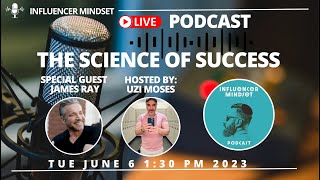
In this Influencer Mindset Podcast episode, host Uzi Moses PhD interviews motivational speaker and author James Arthur Ray about personal development, resilience, and the "science of success." Ray shares his life story of extreme highs—a $10 million Inc. 500 company, global speaking engagements—and extreme lows, including a 2009 accident that left him homeless, in debt, and physically ill. He frames his recovery around three sequential steps: clean up (physical health, diet, exercise, detoxifying the body and mind), grow up (maturing emotionally, mentally, and spiritually by confronting unconscious patterns, reducing toxic language, and cultivating mature relationships), and wake up (spiritual awakening and direct experience of the creator). Throughout the conversation, Ray emphasizes self‑awareness as the foundation for defining personal success, critiques superficial social‑media personas, and argues that true success is a progressive realization of a worthy ideal rather than material wealth. He weaves scientific references (Max Planck’s quantum physics, chaos theory, epigenetics), psychological insights (95 % of behavior driven by the unconscious), and religious concepts (the Tanya’s animal vs. godly soul, redemption, sacrifice). Practical advice includes handwritten note‑taking, daily physical training, cleaning up diet, confronting childhood emotional wounds, and aligning with universal principles. The dialogue also touches on the importance of authentic relationships, the impact of pain as a catalyst for growth, and the current cultural moment as an opportunity for collective awakening.
Chapters
Ladies and gentlemen, welcome to another episode of Influencer Mindset Podcast. And today we have with us a very, very special guest joining us, James Arthur Ray. James is a renowned motivational speaker, author, and life coach known for his transformative work in personal development, and the power of mindset. With over 2 decades of experience, James has empowered countless individuals to unlock their potential, challenge their limits, and create extraordinary lives. He has been featured on various platforms including the Oprah Winfrey Network and Larry King Live where he shared his insights on personal growth and success. Also, James is the author of several bestselling books including "Harmonic Wealth" and "The Science of Success." Throughout his teaching, he emphasizes the importance of aligning our thoughts, beliefs, and actions to achieve true fulfillment in all areas of life including relationship, career, and health. In addition to his powerful message, James draws inspirations from his own life experiences He has overcome personal challenges and setbacks which have shaped his perspective and allowed him to connect with audience on a profound level. His authenticity and passion for helping others makes him a sought-after speaker and mentor. During our conversation today, we will delve into James' unique approach to personal development, explore his insights, on resilience, mindset, and the pursuit of excellence. Get ready to be inspired, motivated, and equipped with practical strategies to elevate your own life. Please join me in welcoming the incredible James Arthur Ray to our podcast. Hello, James.
Hello, Uzi Moses PhD PhD PhD. Thank you for such a wonderful introduction. Thank you for having me.
It's such a pleasure having you, James, and thank you for agreeing to joining our podcast today. We really wanted to kind just try to help our audience to achieve excellence, achieve success. I think this is something that everybody right now, especially in the time of social media where everybody is some kind of an influencer, people are influencing each other by posting stuff, cooking and anything, parenting. What can you share with us as far as insight for overcoming adversity, building resilience, drawing from your own experience and your teachings?
Well, that's a big question. And so let me do my best to answer it in an abbreviated fashion, and then we can dive into it more deeply if you'd like. If anyone, any viewer knows my life, I've been through incredible adversity. You know, I've had the pinnacles of success. And, you know, the short story of that is I built a $10 million Inc. 500 company. As you mentioned in many, in the intro, I've been on many big, big shows and I've been sought from all over the world. I've worked with over a million people from 146 countries around the world. On building significant business, meaningful relationships, and a fulfilling life. And yet I've also had some real low lows. Even though I've had those tremendous highs, I've had some incredible lows. And I lost everything in a horrible accident in 2009. And just 10 years ago, right now, 10 years ago, Uzi Moses PhD PhD, and maybe you're aware of this, I was homeless, which I'm obviously not anymore as I come to you from our media studio here in our home. I was alone, which I'm not anymore. I'm married to the most amazing woman on the planet. And if you're married, are you married, Uzi Moses PhD PhD?
No, unfortunately, not yet.
Well, if you're, yet's the operative word there. That's an important word. But if if a viewer is married and you're a male, you may argue with me that I'm married to the most amazing woman on the planet, and you probably should argue with me, but that's my experience. And I was in horrible physical condition 10 years ago. I had horrid periodontal disease. I'd lost 40 pounds I didn't need to lose. I was homeless. I was alone. And I was $20 million in debt just 10 years ago. So fast forward to today and the debt has all been retired. I'm in the best, I, you know, I thank God, literally, I'm in the best health and fitness of my entire life. I'm married again to a fabulous woman partner. And, and, um, I really am just incredibly grateful. And so here's the thing I would say. If you're having a difficult time, which many of us are right now, we live in turbulent times, let's face it. And, you know, I could riff all day on the idea that you mentioned about everyone on social media is a guru, my words, not yours. And it's unfortunate because Recently, I was listening to, to Dennis Prager. Are you familiar with Dennis Prager?
Yeah.
Yeah, absolutely. Talking about a Jewish axiom that stated, if you don't cite your sources, you're a thief. And I really believe that to be true because I can't tell you how many people I've been, I've been around for a long time. I, I started, started in personal performance and leadership. And all the things I'm still involved with over 4 decades ago. So I've been at this for a long, long time, and I can't tell you how many people quote me but don't quote me. You know, they just take it and they act like it's theirs. And that's unfortunate in today's world. And it's problematic, Uzi, because not because I am overly concerned about it, because plagiarism is the greatest form of flattery. And I'm pulling from an unlimited source. Call that God, call that universal intelligence, whatever it is. And yet here's the problem is that it's disingenuous. And so how do you get through adversity? Long answer to your question, and I'll bring it back to where we started. How do you get through the tough times? Point number one, when I was standing in the desert, homeless, $20 million in debt alone, 54 years of age, and physically, mentally, emotionally broken just 10 years ago, the very first thing I had to figure out is who am I? Because I mean really, you ask most people who they are u and they'll answer with something that they do. Well, I'm a podcast host, I'm, I'm an entrepreneur. I'm a mother. I'm a father. I'm whatever, fill in the blank. That's not who you are. That's what you do. And there's a big difference between who you are and what you do. You're so much more than what you do. What you do is an expression of who you are. And so all that to say, self-awareness is, is in my experience, job number one, to become truly self-aware. And then from there, you know, we can take incremental steps. But until you know who you are, how can you tell me what you want? You can't. You know, I do one-on-one intensive work with people all the time. And so does my wife, Berceba. And invariably, people want to tell me what they want, but they can't tell me who they are. Well, how can you tell me what you want if you don't know who you are? Because unless and until you know who you really are, not what you do, but who you, not what you have, but who you are, then you can't really tell me what you want because anytime you tell me what you want, 99.9% of the time, if you don't know who you are, you're just regurgitating something that's been handed to you from society. You're saying you want this because society tells you it's valuable or it's sexy or it's it's gonna get a lot of likes or it's going to get a lot of follows, or maybe you're gonna be a public figure. Well, I've been all those things and I'm telling you, it's not as exciting as you think it is. I'm not suggesting that you can't be that, you can be whatever you choose to be, but you have to know first and foremost who you are. And I hope that makes sense.
Absolutely. I think that one of the main things, you know, in social media in my opinion, is authenticity, you know, to be authentic, to be really truly who you are. And those are the people who usually succeed. If people who trying to be something they're not, people can see that. They can, you know, they can feel it. So I think it's a very important point.
You're absolutely correct. You know, it's interesting because And this is so valuable, particularly for younger generations. I was doing some intensive work with a one-on-one client who's in his early 30s. And he said to me at one point, so are you suggesting that I should post on social media just who I am? And I think it's humorous that you would even ask that question because if you were to, if you were to ask my wife or anyone who knows me, the person you see here with you now, the person you see on social media, the person you would have dinner with, the person you hire to help you with your business, it's all the same person. There's not a social media persona and then a business persona. It's just, that's who I am. And, and I'm not out there trying to prove to you that I'm something more than I'm not. And that's really unfortunate. You know, it's, it's really unfortunate in the time of social media because how many people post on social media that they're having a tough time? Not a lot. You know, how many people post on social media, I haven't been on vacation in 10 years? Not a lot. You know, but there's a whole lot of people posting, oh, look at me on the beach and look at my car and look at my watch and look at my this and my that. And, and it's just, it's really unfortunate, and that's why research proves that social media creates more depression than it does happiness, because we get into this comparative analysis of other people and we start competing with people that we don't even know. And yet we really don't know them because we don't know what's going on behind the scenes. And, and, and I do, you know, I've been in this and I know every single big name in the business. I know every— you can't tell me a big name that I don't know. And I've spent time with them. I've shared the stages with them. And I know what goes on behind the curtain. And what goes on behind the curtain is not the same as what goes on on stage, unfortunately. And so my real drive is to be genuine and to be authentic and to tell you You know, life is challenging. It just is. But here's the good news. You grow the most in the crucible of challenge. You don't grow the most, it's not popular, but it's true nonetheless. You may not like it. I don't like it either all the time, but not liking it isn't going to change it. You grow the most in the crucible of challenge. You learn the most. You, you commit the most. You become more resourceful and more resilient. When you face the big challenges. You don't grow the most when you're sipping the fine wine and smelling the sweet perfume. You just don't. And so life's challenges are the greatest opportunities if you will seize them. And there's never been a time in my history, and I've been on this planet 64 years, there's never been a time in my history, Uzi Moses PhD PhD PhD, where there's more opportunity to learn and grow and expand and become than we have right now in these turbulent times in which we're living.
That's quite amazing. How do you, how do you define greatness? True success?
Yeah, it's a great question. Well, you know, I really like if you go back all the way back to Let me think if it's Napoleon Hill or, or it may, I believe it was some, it was from that era. And the, I think it's Napoleon Hill who said that success is the progressive realization of a worthy ideal. Now, let me break that down. Success is not a destination. You know, when I had a $10 million company, my annual net income, take-home pay was $4 million a year. And most people would go, oh my God, you know, $4 million a year. That's success. That's amazing. Well, yes, I was grateful for it. And guess what? I was making $4 million a year. I had $6 million a year problems because, because life always expands and challenges always expand. To meet or exceed the incoming revenue. That's just how life works. And so how you have to define success is it has to be very individualized. Some people think, well, if I could make a million or become multimillion or a billionaire. Now, you know, we hear so many young, young adults, you know, I want to be a billionaire. I want to be a leader, all these types of things. Well, be careful what you ask for because because first of all, it's not all it's cracked up to be. And your challenges are going to expand. Please write this down if you're taking notes. Your challenges are always going to expand to meet or exceed the growth that you've attained. Because life is about growth. If we look at, we go to astronomy, I'm a big fan of science, and we're talking about the science of success here today. Success is very scientific. The first thing you have to do is you have to know who you are. We've talked about that. The second thing you have to do is you have to know how you define success. Now, most people are going to define it from a very secular perspective, and in my experience, Uzi Moses PhD PhD PhD is that we have moved from the sacred to the secular. And that's one of the reasons we're having so many problems in today's world. Now, if you're not familiar with the term secularism, it goes all the way back to the Renaissance in the 14th century, which is attached to humanism. And basically, simply put, secularism is a resistance or an abhorrence, a resistance at best, or an abhorrence, avoidance at worst, of a creative power. And it says humanity is all there is. And that started all the way back in the Renaissance. And that's, that's a secular viewpoint. Sacred viewpoint says there's a creative power that works in and through, and an organizing principle that works in and through this entire universe. Now, Even modern science backs this up now because chaos theory, we're talk science, chaos theory tells us without an organizing principle, the universe would be complete chaos, completely chaos without some kind of organizing principle. And Max Planck, the father of quantum physics, not a spiritual teacher, not a personal development guru, not a mystic, but the father of quantum physics stated, Mind is the matrix of all matter. Mind. What mind? God's mind. Your mind is the matrix. What's the matrix? The foundation of all matter. What's matter? Your house, your car, your body, your business, your bank account. It's all conscious. And so, so now what we have to understand is that, is that first of all, when we know who we are, We are part of that mind. That's called self-awareness. I'm part of that. It's in me and I'm in it. And this is all scientific as well. And now I've got it. I want to be successful. Well, what does success mean? Well, it means a certain amount of money. Not necessarily. I work with multimillionaires who are miserable. You know, no one worries more about money than the, than than the rich. The poor don't worry about money as much as the rich do, because the more you have, the more you have to lose. And so most of the very financially wealthy individuals that I work with are not very happy people. And they, they've made it to the top of the ladder and they realize it's leaning against the wrong wall. And so what does success mean for you? I can't define that for you. I'm not qualified to do that. No one can. Your clergy can't, your priest can't, your rabbi can't. No one can do that for you. Only you can do it for you. And then, but make sure that it comes from self-awareness because most people, well, I want, I want to make it, I want to make 7, 8 figures. I want to have a big house. I want to have, you know, drive a fine car. I, okay, well, where did all that stuff come from? Because at the end of the day, you're leaving it. You're leaving it behind. So success for me is, for me personally, is to say, this is what I want to live and experience in my life. And I don't, I'm not ever going to arrive. It's a progressive realization of something that's worthy. And let me just say this last thing to the worthiness. You're, all of us are trading our life for something. Whatever you're doing every single day, you know, you and I are trading a portion of our life right now, Uzi, for this podcast. This is a portion of our life we'll never get back. It's gone. And so time is our greatest resource. And, and all of us trade our life for something. So you need to make sure that you're trading your life for something that is worthy of your life. And I would submit to you that no house, no car, no big bank account is worthy of your life. You may disagree with me as a viewer, and that's okay. That's your prerogative. But that's my experience. And I've, again, I've been to the pinnacle and I've been to the pit. And everything in between. So I have a lot of comparison.
So you would say, you know, a lot of people say that real success is actually having meaningful relationship with the people that are close to you, like your spouse, friends, community, parents, brothers, you know. And that this is something that also was proven to increase longevity, where people can live longer when they have meaningful relationships. Don't you think relationships has something to do with that? And also the most important relationship is the relationship that we have with our creator.
Absolutely. I, I, you know, I am fond of stating frequently, you can measure the quality of your life by the quality of your relationships. Period. Now, we are in relationship with everything on a regular basis. We're in a relationship with our body. We're in a relationship with food. We're in a relationship with money. We're in relationship with other people. We're in a relationship, as you stated, with our creator. And maybe first and foremost, going back to self-awareness, we have to have a great relationship with ourself. So here's, here's my test. For you as a viewer to find out if you have a great relationship with yourself. If you can't sit in your own living room for a minimum of 1 hour with no smartphone, no books, no television, no phone calls, no food, no alcohol, no pets. Oh, the pet lovers don't like that one. If you can't sit in your own living room for a minimum of 1 hour, just you and you, then you don't like yourself very much. And if you don't like yourself very much, how can you expect me to like you? You know, how can you expect anyone else to enjoy your company if you don't enjoy your own company? Oh, and by the way, you have to stay awake for that hour too. No sleeping either. So that's a real good measurement of whether or not we enjoy our own company, whether we like ourself, where we love ourself. And most people just don't. Most people, unfortunately, go nuts if they don't have some kind of stimulus, you know, scroll, scroll, scroll. Listen, listen, listen, watch, watch, watch, eat, eat, eat. It's unfortunate because that's the way we hide from ourselves, and that's the way we hide from God. It really is, because God is found in the silence. Now, God is also in the noise. God is in everything, but that relationship and that intimacy with the creator is found in the silence. It's in the spaces in between. And if you don't spend any time, invest any time, I should say, in the spaces in between, then you're not going to have a very good relationship with the creator. And let's go back to Max Planck, the father of quantum physics. That creator's mind is the matrix of all, of all things, all matter. That's a direct quote. Mind is the matrix of all matter from quantum physics. And so if you don't have a great relationship with your creator, you're not going to have a great relationship with matter or form or physicality.
That's amazing. I remember from like, I think it was 2009 when I first listened to one of your lectures, I remember that you were talking about quantum leap thinking, which means that people could literally make a quantum leap, like from a state of being, let's just say, unsuccessful, not in shape, not a good bank account, to make the quantum leap to getting into the perfect shape, perfect career, perfect bank account, and just like grow from there. What does that really mean, the quantum leap, and how can we make that quantum leap?
Well, it's interesting that you mentioned that term because we actually have a 3-day event that starts this Friday called Quantum Leap. And it's on Zoom and it's a live experience. And what we get into is the latest and greatest scientific evidence. And I'll give you the short story of it here today. But here's what I want you as a viewer to write down if you're taking notes, which I hope that you are. It's scientifically proven that handwritten notes facilitate the right brain and the right brain engaged facilitates whole brain learning. And so you have a tremendous ROI when you take handwritten notes. Typing doesn't do that. Handwritten notes do. But please, if you are taking notes as a viewer, write this down. Change happens in an instant. And you go, well, James, that doesn't make any sense to me because I've been trying to change things for a long, long time and they're not changing. No, change happens in an instant. And if it seems like it's taking a long time, it's because all the time that it takes to lead up to that instant is the time that you are having to grow and prepare to be ready for that quantum leap. Let me go back again to Max Planck, the father of quantum physics. He says, he stated, changes in nature are explosive. Not continuous and smooth. Now, in science, we call that discontinuous change. It's a quantum leap. It doesn't go from A to B to C to D. It goes 80. And I can't even do it fast enough because it's instantaneously 80. There's nothing in between. That's called discontinuous change. And that's a quantum leap. And that is all based on scientific evidence in quantum physics. The quick story is you go down to the atomic level. The atom is the basic building block of every single thing in this third-dimensional reality. Your house, your car, your body, your business, your bank account, all comprised of atoms. Those atoms have a frequency or a vibration. In science, we call it a frequency. And you've probably heard of the law of vibration. Most people have. You know, if you're familiar with the book and the movie The Secret, you know, I was a co-author of that and I was in the movie. And yet it was very simplistic in its, in its explanation because it's very difficult to get deep into the science in a, in a quick book or a 2-hour movie that's made for the masses. And so unfortunately, a lot of people don't understand it and don't know how to utilize it because They think, oh, I just have to visualize and it's going to happen for me. Well, if you've tried that one, you know it doesn't work. So, you know, if you sit around in your living room visualizing all day, they'll come take your furniture away. All right. You got, you've got to do more than that. But if you go down to the atomic level, the atom is the basic building block. And then you go to the subatomic level and you find things that are called electrons and protons and neutrons and quarks. And it gets real complicated. But let's talk about an electron for a moment. An electron orbits around the nucleus of an atom, the basic building block of all the third dimension. And it stays in that orbit. We could call that a universe, if you will. And every once in a while, this electron wants to become what's called a free electron. And it will literally leap to a whole different world, we could call it. And this is what they call it in multiple worlds theory in quantum physics. It leaps to a whole different reality. That's because changes in nature are explosive, not continuous and smooth. Change happens in an instant. And so here's what I can promise you, Uzi Moses PhD PhD, and everyone who's with us here today. There's a better version of you. That already exists, that's just waiting for you to catch up. It's already here. You know, thermodynamics tells us energy can never be created or destroyed. All that ever was or ever shall be is already here. So you don't create anything. God already created it a long time ago, at least 14 billion years ago. And according to to Big Bang Theory and astronomy. And so, so you don't have to create anything. It's all created. It's already here. And all you have to do is get there. And the way you get there is through fundamental practices and fundamental understandings of self-awareness, defining for yourself what success really means and why, and making sure it's yours. Because you're going to trade your life for it. Don't, please, please, please resist the temptation to buy into someone else's definition of success because you're going to trade your life for their definition instead of what you define as truly successful for you. And then the reality is you have to do a lot of cleanup work. And And the simple, straightforward, sometimes very difficult reality is that we're all here for 3 reasons. To clean up, to grow up, and to wake up. And it has to happen in that order. Clean up. Let's go to psychology for a moment. Modern psychology tells us that 95%, please listen to me, 95% of what you do every single day, is driven by your unconscious mind. 95%.
95%.
Wow. Completely out of your awareness. Now, when we talk about self-awareness, that means you're not very self-aware, are you? Because 95% of what you do is driven by your unconscious mind. So that means you're 5% aware. So look at your life right now. Maybe, maybe your life is, is pretty good. I hope that it is. Congratulations. And yet you've done all that with 5% awareness. According to modern psychology. Now, what's in your unconscious? Because it's totally out of your awareness. Well, your unconscious is your emotional mind. And so in your unconscious, you have a whole host of unresolved emotional issues, sometimes trauma. And what psychology tells us is that those things came into being at about 14 years of age and younger. And they're completely out of your awareness and you're not even aware that they're there. And yet they're running your behavior every single day. So Uzi Moses PhD PhD PhD, when you, when you interact with your colleagues and your friends and your family members, they might be 30, 40, 50, 60 years old outside, but the reality is they're about 14 years old inside. And, and I'll ask you, do you know anyone who is an intellectual giant and they're an emotional child? Do you know anyone like that?
President Trump, I guess. He's a good example.
Well, I have my own opinions on President Trump, but we probably don't want to get into those here today. But nonetheless, there are plenty of people who are intellectual giants and they're emotional children. And so you can be an intellectual master and still be a slave of your emotions. And so unless and until you clean those up, you're not going to grow up and you're not going to wake up. And again, that has to happen in that order. Clean up, grow up, wake up. And so the primary thrust of what I do to help people take quantum leaps is to make the unconscious conscious. Because only when you make the unconscious conscious can you observe what's blocking and limiting and holding you back. And then you can heal it and you can integrate it and set yourself free. You can't do that when you're not aware of what's driving it. You know how many times, if you've ever been around kids, you know, what are you doing? I don't know. You know, you're really messing up right now. I know. Well, why are you doing it? I don't know. Because the reality is they don't know. But I know. And now so will you because the unconscious is driving behavior. You know, it's like the Apostle Paul said in the New Testament. He said, the things I know I'm supposed to do, I don't do. But the things I know I'm not supposed to do, I do. He said, the spirit pulls against the flesh and the flesh pulls against the spirit. And so we're in this constant battle all the time as human beings. We're blessed, but we're also cursed. It's like Moses said when he came down off Mount Sinai, I brought you both a blessing and a curse because now that you know the law, there's no excuses. You know, now that you know why you're doing what you're doing, there's no excuses. And the spirit pulls us towards greatness and the flesh pulls us towards mediocrity. And the fact is, you were born into greatness, but you've been conditioned into mediocrity. And it's time to take your power back. Clean up, grow up, wake up. That brings quantum leaps.
When you, when you say clean up, what, what does that mean? What, what do you need to clean? You need to go to the sauna every day for 40 minutes? What do you need to do?
No, what I'm talking about here is certainly you have to, all right, in the mysteries, which, which I've been very blessed. I've had 6 major mentors in my life. And, and by the way, for the viewer, I can't tell you how many people come to me on social media and they go, oh, James, you're my mentor. Just had one today. You're my mentor. I, I'm so grateful for you. And I look at their name and I look at their picture and I think, I have no idea who you are. I've never met you and I've certainly never talked to you. Well, I'm not your mentor. I appreciate the sentiment, but maybe I'm a role model. Maybe I'm a teacher, but I'm not a mentor because a mentor is someone that you work with one-on-one. You have, you have live conversation with, they call you out on your nonsense and you either meet with them in person or, or you talk on Zoom. That's a mentor. And I've had 6 major mentors in my life. I've been really blessed. I've had business mentors. You know, I came up through the ranks at AT&T and I ended up as a C-suite consultant, consulting with C-suite executives on how to be leaders and how to communicate and how to build business and all those types of things. And then I've also had mystical mentors as well. And I've studied in the mystery schools of Egypt. I've worked with the ayahuasca in the Amazon. I worked with a Toltec shaman in the Andes Mountains for multiple years, back and forth and back and forth. And so anyway, all that to say, I've had a very diverse background. And in the mysteries, they say that we have at least 4 bodies. We have the physical body, which the sauna you mentioned is a good way to clean out the physical body. But even better is to clean up your diet. Because if you're bringing in toxins on a regular basis and you're bringing in stimulants, you know, such as, and I may push some buttons here, but, you know, I'm just gonna, I'm gonna be authentic. If you're smoking marijuana and you're drinking alcohol and you're taking all kinds of stimulants, it's proven that that minimizes and kills, kills brain cells. Well, you're not going to think straight if you're killing brain cells. And so you have to clean up your physical body first. In the mysteries, they say it goes from physical to mental to emotional to spiritual. And so you have a physical body, which is tangible. You need to eat right. You need to exercise. You know, one of the reasons that I have a tremendous amount of energy and endurance and I, by the grace of God, and I mean that literally, I have that by the grace of God. And yet I have lifted weights and worked out and eaten healthfully since I was in my early 20s. So that's about 4 decades. And it makes a world of difference. I do yoga every single day to stay flexible. I lift weights 4 days a week. And on and on. I eat very, very clean. I eat to live. I don't live to eat. I eat for performance, not for taste. And so clean up the physical body first. And then once you've done that, you can start to think straight. Because if you're not, if your body is toxic, Uzi Moses PhD PhD, you're not going to think straight. So here's where the problem is with the secret. Change your thinking, change your life. Wrong. It doesn't work that way because if your body is toxic, you're going to try to change your thinking, but your thinking is foggy. Your thinking is not clear. And so clean your body first, then clean your thoughts. Then comes the really tough part. Clean your emotions. And the way to do that, that's a large part of the work that my wife, Birceba, and I do is we do intensive work, which we go back and we find the root cause of what is causing this fear, what's causing anxiety, what's causing procrastination, what's causing, you know, a lack of abundance in certain areas. There's something rooted probably 14 years of age or younger. And we take you back to the source, and we have you revisit it. Now, what we know in psychology is that when you go back to a memory with new resources, think about it. There's not one of us in our 30s and above who doesn't have additional resources that we didn't have when we were 14 or younger. We just do. And so when you go back with additional resources and you revisit that, you can never, ever, ever think and feel about it the same way again. And so we take people back and we heal and integrate these unresolved emotional issues. And we literally, in the shamanic tradition, they call that soul retrieval. We literally bring that energy back into the present. And now all of a sudden you have a lot more to live on and a lot more to think with and a lot more to be resourceful with. And, and that's what brought me out of the barren desert 10 years ago, worse than broke. You know, broke looked good to me 10 years ago. Broke was $20 million above my head. You know, I would have, I would have given anything to be broke. I was worse than broke. So if you're broke today, I'm not insensitive. I'm very sensitive to that. My heart goes out to you. And I'm telling you, there's a power that works through you that is greater than anything life can throw at you. I guarantee you, test me on this. When you become a greater conduit by doing what we're talking about, clean up your body, clean up your thoughts, clean up your language. You know, I could riff on these things all day because they're so important. You know, there's research that proves people who drop F-bombs all the time, which and curse all the time are operating from their primal brain. Well, what's your primal brain? It's the reptilian brain. It's the lizard. It's animalistic. And isn't it unfortunate, Uzi Moses PhD PhD, that so many people in the world today think it's okay to get up in a presentation and to drop curse words? Why is it they're all 4 letters? Because they're very simplistic. They're very primal. There's not a lot of intelligence going on there. There's a lot of anger and reaction going on there. And some people think it's cool. It's not cool. It's proving that you've got some unresolved emotional issues, quite frankly, because you can't articulate past primal brain. So clean up your thoughts, clean up your language, clean up your emotions. And then you can start to tap into the spiritual body, which is the source. It's really the source, and that's what we all want to get to. And that's when it starts pouring through you. And there's way more that can come through you than can ever come from you. I'm living proof.
It's quite amazing. You know, in Judaism, there is a book that was written by a rabbi, Yisrael Moschner, from Ladi, which is called the Tanya. I'm not sure if you heard of it. And over there, he describes the two forces that are active in our life, and he calls it the animal soul and the godly soul. And it correlates to what you were saying, and I'm kind of shocked how things are kind of connected. You know, the idea of redemption in Judaism is based on that knowledge being spread out and that consciousness being spread out to as many people as possible. And once people understand, you know, that concept and the idea to fight for their godly soul and to redeem that godly soul through a lot of work that needs to be done, then maybe there will be eventually redemption, which means the end of pain and suffering in the world. So please continue.
You may, you're probably aware, Uzi, that my latest book is called The Business of Redemption. And so it's fascinating that you choose that term. And we hear the word redemption used most frequently in religious circles. And I'm totally in alignment with religion. My father was a Protestant minister. I was raised in the Christian faith, but I've studied Buddhism. I studied with a Zen master for, for numerous years. I've studied Kabbalah. I've studied Hinduism. I am looking for the truth in all the different religious approaches. And so this word redemption, though, is most common in religious circles. But here's the simple definition. If you look it up, it's to gain or regain something by paying the price. So it's, it's very wise that you choose the word redemption because we all need redemption. I talk about this in my book, The Business of Redemption. We, each of us needs redemption. You know, how many of us want to, want to gain something that we've not yet had? Well, if you say yes, then hang on. How many of us need to regain something that we once had, but we lost it? Well, if you say yes to both of those or one of those, then you need redemption. And our country needs redemption. And unfortunately, what's, how's it defined? By paying the price. You have to pay the price for the prize. Every prize has a price. And the bigger the prize you're going after, the bigger the price you must pay. And so to do that, what we have to practice, you know, and this has been lost outside of the Old Testament primarily, but the process or the practice of sacrifice. Now, if you look up the etymology of the word sacrifice, it literally translates as to make sacred. And so what we're doing when we're making a sacrifice is we're laying on the altar of life something of a lesser value for something of a higher value. And you're always going to sacrifice. You mentioned the word greatness. You want to be great? You're going to sacrifice. You look, look at history, the people who are truly great. I'm not talking about just because they made a lot of money, but people who are really great. Who really made a tremendous impact, even to this day, they still do. Any of the biblical prophets qualify, and there's other people that qualify as well. They made it, they didn't have an easier life. They had a difficult life and they made a tremendous amount of sacrifice. And so many people in today's world, they don't want to sacrifice. Oh, I want the government to pay off my student loan. Well, Who borrowed the money? You know, it's— let me, let me tell you something that's not popular, but it's the truth. Life doesn't owe you anything. Your government doesn't owe you anything. Your parents don't owe you anything. God doesn't owe you anything. In fact, you owe God because God has given you the greatest gift. and it's called life. God's greatest gift to you is life and your unique gifts, which we all have those. Research from Harvard proves every single one of us has genius within us in one of 8 areas according to Howard Gardner. God gave you those gifts, great gifts. And so God doesn't owe you, you owe God. You owe life and to not pay back and to not be willing to sacrifice. If you're not willing to sacrifice for your intention, for your outcomes, then please hear me, your intentions and outcomes will be the sacrifice. Let me repeat that because that's important. If you're not willing to sacrifice for your dreams and outcomes, then your dreams and outcomes will be the sacrifice because there's always a price for the prize. And, and you've got to pay the price in advance. You know, there's only one place in the universe that I can find, Uzi Moses PhD PhD, and maybe there's others, but I can't find them yet, where you get the prize before you pay the price. And that's a restaurant. They bring the meal and then they bring the check after. Everywhere else, you pay the price in advance. And so that's redemption. That's true redemption. To gain or regain by paying the price. And there's always going to be a price for your prize. And the question then is, are you willing to pay it?
Absolutely. It's definitely something that requires tremendous willpower and learning. As we say in the Tanya, Rabbi Zalman Schneur from Ladi, he describes emotions as the engine that moves us. And it's also called attributes because the emotions are part of our attributes. So, for example, if somebody has tendency to anger, this is one attribute that they need to correct. And we are here in a world called also the world of correction to correct those attributes. And it's really, really fascinating, James, how everything aligns, how everything comes together. You know, you come from a totally different background than I am, and here we are, you know, agreeing on the most fundamental concepts of life. And it's really fascinating and amazing. And it's kind of a sign that maybe we are near the redemption. Maybe it really is coming. And what we're doing now, this podcast, like you said, sacrificing a piece of our life, it's really, really worthwhile. Because that could be a stepping stone to bring that redemption forward as soon as possible because it really is what's going on in Europe. You know, it's scary how things can develop the wrong way, God forbid, you know, with Ukraine and Russia. Hopefully it won't. Hopefully things will come down. But again, it's really something that I am personally amazed and grateful for you and for this information that you are sharing with us today. And I'm sure our audience will appreciate it greatly. Well, thank you.
You know, it's interesting because I'm familiar with the Jewish tradition. And while I'm not Jewish, I could easily prescribe to the Jewish faith because I have such a fondness for so much of its teachings and the things that we're talking about, because there's so much wisdom. And the things that we're talking about, and I have that same love for Christianity as well, and I believe they work together in my opinion. But it's either the book of Exodus or Leviticus. I believe it's It's Exodus where God says that, that if you sin, he's talking to Moses. If you sin and you don't follow my law, then I will visit this, these sins upon, upon at least 4, if not 7 generations. And then if they continue to sin, it will continue to go on for another 4 to 7 generations. And so you break that down and this is what we're talking about here with these unresolved emotional issues. The fact is our parents gave us a lot of things in our DNA. You know, epigenetics tells us 50% of who we are is based upon our genetic programming. 50%. And someone goes, oh my God, I'm totally, I'm just in trouble. Because 50%, my lineage and my heritage is really messed up. Well, not so fast because that leaves 50% that's not your genetic programming. And according to epigenetics, that additional 50% is comprised of your continuous habits and your environment. And so what that does is it puts us back in the driver's seat. You know, we can't continue to blame our parents. We can't continue to blame our heritage. We can't continue to play victim. And so many people in today's world, Uzi Moses PhD PhD, and you know this, play victim. They love to play victim. In psychology, we call that secondary gain. I gain from being a victim because people feel sorry for me, and then I get off the hook and I don't have to be responsible. Well, No, it doesn't work that way because according to epigenetics, you have 50%, at least, and some new studies say it's up around 80%, but at least 50% that's totally in your control and it's based upon your constant habits and your environment. And so the people, your environment consists of the people you surround yourself with, the things you surround yourself with, the artwork on your wall that I can see behind you there. Everything has an energy. Everything has a meaning. And does it inspire us or does it cause us to feel expired? You know, do we feel inspired or expired? Does it pull us up or pull us down? Because nothing is neutral. And so when I talk about clean up, grow up, wake up, a lot of what we are doing is breaking that chain that God talked about all the way back in the Old Testament to the Israelis about, and the Judaic people, is that Hey, you will be forgiven. You will find redemption when you stop and get back in alignment with the laws and start aligning with universal laws and principles. Then you will be my people. And I think I agree with you, Uzi Moses PhD PhD. I think we're on the precipice because I see more and more people who are waking up more and more people who are going, whoa, wait a second, what's going on here? Because in just the last 3 years, the world has completely changed. Not just this country, not just this country, but the entire world. We're in it all together. The entire world has completely changed. Where's the morality? Where's the values? Where's the virtues? That this country was built upon? Where are the things that our forefathers believed in and fought for? Where are they? You know, well, I believe they're in the hearts of many and more and more people are becoming awakened through pain. You know, this is not popular either, but pain is the mother of all growth. There's nothing that causes us to grow more than pain. Pain is not a signal to suffer. Pain is a signal to grow. And that's across the board. When you have physical pain, your knee hurts, it's your body telling you, hey, you need to stretch some more. You need to become more flexible and fluid. It's an impetus to grow. When you have mental anguish and doubt and fear, that pain is telling you, hey, something's off. You need to clean up something. You need to get into alignment with something. When you have emotional anger and things you mentioned. Again, pain is not a signal to suffer, it's a signal to grow. And so what we're going through right now is the pain. But here's what I know. When things appear to be falling apart, they're actually coming together on a grander and greater scale. So keep the faith. I'm talking to the viewer. Keep the faith. You know, never ever lose hope because when you do, you might as well cash it in because a world without hope and a world without faith is not, is not a world worth living in. But the reality is, is that every significant breakthrough is preceded by a breakdown because there has to, has to be a space created for something new. To emerge. And I really believe that's what's happening. It's the breakdown that's hard for me too. It's hard for all of us. But you got to stay the course. That's that resilience you mentioned.
Yeah, absolutely. I mean, it really is very, very special times where you can see that either people are taking the complete wrong turn, or people are starting to wake up and starting to understand that there is something out there bigger than themselves and they need to connect to that and, you know, work on themselves and correct all those, you know, negative emotions and stuff like that. I just wanted to kind of go over that, that, uh, a cleanup, grow up, and wake up. So I understand very well what you meant when you said clean up. What does it mean grow up? Which means, what does that mean? Like in short.
I think, you know, a lot of the grow up process, I don't think, I know, a lot of it physiologically happens on its own. So we come into physical maturation, you know, in, in the Judaic tradition, it's 13, you know, in, in maybe common cross-the-board traditions, it's at least 18 as a man. Um, and women mature a little bit faster, but, but nonetheless, that's the physiological grow up part. And that kind of hap— nature takes care of that for us for the most part. But then past that, we're on our own. You know, to truly become an adult, a fully human being, because I don't believe, and some people disagree with me here, I don't believe that you are a human being automatically. I believe you have to, and it goes back to the rabbi you quoted who talks about the animal self and the And what was it, the divine soul?
The godly and the animal.
Yes. So, so I'm, I'm totally in alignment with that. I think a large percentage of us stay in the animal mind and stay in the animal self. And, and you look at this with the bastardization of sex, if you will. You look at this in, in with the complete lack of morality. And virtue. This is very childish, very, very animalistic. And so as you clean up the body first, we talked about this, the body, then the thoughts, then the speech, then the emotions, then the spiritual body. When you clean those up, then you start to literally mature. And you can't, you know, I used to curse and I didn't think it was a big deal. And then all of a sudden, about seemingly out of nowhere, but nothing comes out of nowhere. Everything comes from somewhere and it comes on purpose in my experience. But about, I don't know, 2 years ago, maybe 3, I said to my wife, you know, I'm going to stop cursing. And she goes, Okay. And it wasn't like I did it all the time, but I did. And I just, I got inspired to stop cursing. Well, and I did. I just stopped. And it wasn't hard and it wasn't troublesome. I just made a decision and I stopped. And maybe that's because I didn't drop F-bombs every other sentence like a lot of people do. But nonetheless, Then I started, I started to grow up in so many ways and my behavior started to change and become more adult-like, if you will, and more mature. So for instance, all the music I listened to changed. And my wife and I used to, used to watch movies on a regular basis. We, we only allow ourselves to watch TV 2 nights a week. Maximum now. We have dinner together. You know, we have our own little Shabbat on, even though we're not Jewish, but we have our dinner together, you know, and we talk. We're not on our devices. We have conversation. Going back to relationships. What a concept. You know, you actually talk to your wife. I mean, really? And that's so unusual for a lot of people, but that's a growing up process. That's a maturation process. And now we don't watch movies hardly ever because we're not going to watch movies. There's so many movies that are crass and they're offensive. And particularly the things that are coming out now, it's very difficult to find things that have a high degree of cleanliness and morality and virtue. And, you know, some comedies, we watched a comedy last weekend and it was really good. And so, but it's rare. Sometimes we find a movie, we think it's going to be good and we turn it on for 15 minutes and we turn it off. So we watch documentaries and we, we learn about different things. And that, you know, long answer to your question, Uzi, but the growing up is across the board. It's not physiological growing up anymore. It's more mental, emotional, spiritual growing up and a maturation and a coming back to center. You know, I am so grateful to God and to my parents And I didn't have a perfect relationship with my parents. You know, my dad was overbearing and he was very charismatic and I was very introverted and insecure. And yet, and he was a Protestant minister and you couldn't tell him anything. He knew everything and, and God rest his soul, you know, we had a tumultuous relationship and yet I'm still very, very grateful to my parents for bringing me up. In religion because, because religion gives us a system and the structure and the guidelines to have a vertical relationship, if you will. And what I mean by that is a relationship with a higher, a higher source, God. If you don't, if we don't have a vertical relationship, then all we have is a horizontal relationship. And that's what's happening in our world right now, Uzi, is all we have, because we've disconnected our vertical relationship, with our source, with our creator, then all we have to do is look around us to tell us what's valuable and what's virtuous. And there's so much out there right now that is under the guise of inclusion and under the guise of virtue that is really dividing. It's not uniting, it's dividing. And yet at the end of the day, I'm very encouraged because every significant breakthrough is preceded by a breakdown. And so we have to go through the roughs. Things have to get messy before they get magnificent.
Absolutely. And the wake-up, what does that mean in your approach?
That's the spirituality part. Here's my definition of religion and spirituality. Religion is a set of guidelines, rules, and practices to help you have a spiritual experience, a direct experience with the creator. However you define that, you know, not to believe in God, but to know God and to to truly experience that source. That's the waking up. And a large part of that is what I call unified mind. It's a recognition of the interrelationship of all things. You know, my Toltec shamanic teacher said to me once, Santiago, that's what he called me, St. James. Santiago, he said, If you look hard enough at anything, you'll see everything. Now, it didn't really register for me in that moment, but it does now. And, and I'll give you a simple example. I'm sitting at a table right now. This table is connected to the floor of my home. The floor of my home is connected to the foundation of the home. The foundation of the home is connected to the earth. And it goes on and on. And the earth is connected to all the minerals. And all the plants and all the way down to the core. And so if you can follow that, everything is interconnected. This table is connected to the core of the earth. It's connected to all the minerals and all the plants and everything. And that's scientific as well. You know, in the Hindu tradition, they call that Indra's web, which it says everything is interconnected. Everything comes from one source and it's all interconnected. And that's the wake-up piece, is to not just know that intellectually, but to experience that. And you won't experience it all the time, you know, but the more you have that experience, the more it will solidify and the longer and the more frequent it will become.
That's quite amazing. You know, the founder of the Hasidic movement called the Baal Shem Tov, He said, the wall of your house will come and testify either for you or against you when you reach the world to come because everything is alive and everything registers and everything moves. And again, and the oneness of creation is a concept that, I mean, it's been around for thousands of years in Judaism, the idea that there is no other reality. It's the only reality that exists is the reality of the creator and his unity and the ability to unify everything into one thing. That's the art of knowing the creator, like you said, rather than believing in the creator. And that's really, really fascinating, James. Thank you so much for taking the time and you know, being here and sharing all these insights. And it's amazing. I would love to have you guys maybe over for Shabbat one time in my house here in Los Angeles. That will be great. But besides that, that would be very fun.
That would be enjoyable. My wife would love that as well.
Definitely, we should talk after about that. And What can I tell you? I feel really blessed to do this podcast with you, and I'm sure that it will help many people align themselves with the light of the Creator. And like you said, in that same order that you said it, clean up, grow up, and wake up. I love that ideas that you presented here. And, if you want to learn more from James, you can follow him on social media. Your website is jamesr2ray.com. How does your website go?
It's just jamesray.com.
Jamesray.com.
Yeah, I have the Arthur on the URL. So, just jamesray.com.
So, yeah. So, follow James, jamesray.com. He's constantly doing amazing things, helping countless individuals reach their full potential. Thank you so much for joining us today, James. And we're looking forward to speak with you again in the future.
Likewise. Keep doing great work, Uzi. The world needs it.
Thank you so much. And thanks to our viewer for tuning in.
God bless.
Take care.
Bye-bye.
Thank you. God bless you.
Bye-bye.
More from Uzi





The Secret of Reincarnation According to Ancient Wisdom. Save it, share it, and follow for clarity.





