The transformative power of Rosh Hashanah with Dr. Yehiel Harari. #51
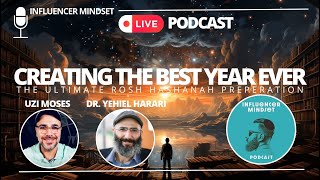
In this Influencer Mindset Podcast episode, host Uzi Moses PhD interviews Dr. Yehiel Harari, a speaker and author who links ancient Jewish traditions to modern personal‑growth strategies. The conversation begins by contrasting the spiritual depth of Rosh Hashanah with the secular New Year, describing the holiday as a wake‑up call that combats the human "fatigue" of living in a state of distraction. Dr. Harari explains core symbols – the shofar, the crowning of the Creator, and the concept of Judgment Day – as invitations to awaken inner pleasure, assume co‑creator status, and engage in sincere teshuvah (repentance). He stresses that true transformation comes from living in the present moment, repeatedly trying and persisting with resolutions, and aligning actions with deeper values rather than merely chasing outcomes. Practical rituals are suggested: listening actively to the shofar, daily gratitude, small incremental actions, learning about one’s psyche, and reframing relationships with love and reverence. The episode also shares illustrative stories (the mother of Sisera, marital reconciliation) to show how Rosh Hashanah reflections can catalyze lasting change. The discussion concludes with a concise list of actionable steps listeners can adopt immediately to create their best year, emphasizing daily goodness, gratitude, purposeful micro‑goals, self‑education, and a shift in perception toward others.
Chapters
Welcome to this, another enlightening episode of the Influencer Mindset Podcast. And I'm your host, Uzi Moses PhD PhD PhD. And tonight we have a very special guest with us as we stand on the cusp of the Jewish New Year, Rosh Hashanah. We are joined by a renewed speaker, author, and wisdom keeper of our times. Dr. Yuval Harari has dedicated his life to helping individuals unlock their full potential, bridging the gap between ancient traditions and modern mindset strategies. In this episode titled Creating the Best Year Ever: The Ultimate Rosh Hashanah Preparation, we are about to embark on a journey that will empower you to make this upcoming year the most transformative and fulfilling One Yet. Dr. Harari brings profound insights into the significance of Rosh Hashanah, the art of self-reflection, and the power of setting intentions that align with your values. Together, we'll explore how ancient wisdom can fuel personal growth and lead you towards your goals, fostering a mindset that can truly change your life. So whether you are familiar with Rosh Hashanah or simply seeking to enhance your personal growth journey, this episode is for you. Get ready to dive deep into the wisdom of the ages and contemporary strategies for creating lasting change. So join us now as we welcome Dr. Yehiel Harari to the Influencer Mindset Podcast. Dr. Harari, thank you so much for joining us for joining us tonight. And over there in Israel, it's morning. So good morning.
Good morning. Thank you very much for the invitation. It's great to be here. I'm so glad.
Man, absolutely. I'm so glad. You know, everybody that follows, I just want to say something that we had a little bit of a technical issue that we finally overcome. And now we are really about to provide you guys with really life-changing content. And there is some podcast that we've done that we might redo again. Just the subject, it will never be the exact same thing, but just the subject that were really profound stuff that the sound wasn't good. We might repeat those podcasts. But today, let us really focus on the idea that Next Friday is a windows in time. It's Rosh Hashanah, the Hebrew New Year. So Dr. Harari, I will start with the first question that I prepared here for you. So can you explain the significance of Rosh Hashanah and how it's different from the secular New Year's Eve in terms of mindset and reflection?
Let's start. Rosh Hashanah, it's one of the most important days in the year. Why it's so important? Let's go, let's try to understand what's the problem of us, human beings. What is our major problem? You know, the Ari says Rosh Hashanah is something like sleeping. In Aramaic, it's dormita. Like the world is getting into a sleep. And we try to wake it up. The major problem that each one of us is facing is what? Is, you know, that we are sleeping sometimes. We are lack of animations. We don't live our life to the fullest. We don't feel that we are, full of energy. Sometimes we get into fatigue. You know, I remember we spoke about the fatigue a little bit. What's the idea behind the fatigue? Why do we suffer from fatigue? What's the major problem? That you want, you know, when you talk about fatigue, you talk only about mental fatigue, not about physical one. If you have a physical problem, go to sleep. But the major problem of fatigue is that we do not feel alive. Why? Because we want to be in another place. We are not in our place. It's always like You want to be with your children, and when you are with them, you know, the vacation, we finish the vacation, but when you are with them, you want to do something else, to be with a computer, to go to Facebook, doesn't matter what. And when you are with your children and you want to do something else, that means that there is a kind of a tension because you are not in your place. When you are married and you want to be in another marriage, in another place, there is a kind of fatigue because of the tension, because you want to be in another place. That's exactly what Rosh Hashanah is. It's like, it's the solution for this fatigue of human beings that are walking in the world and they do not really believe in themselves. And you don't have enough energy to do things. And that's why the Creator created the world in a way of we renew everything every year. Every year there is the major idea of Rosh Hashanah that every year a new, let's call it, you know, a new light. Light, that's exactly the term that he's using. Light is getting down and in this light, there is everything that is going to happen in the physical, in the mundane life and in the spiritual life. Everything is getting down. Now you have to pull it by what you are doing. And that's why everyone are praying. Jews that believe that Rosh Hashanah, it's like it's getting down the light into the world. They pray that I have more light this life. I have more animation to the body. The body is alive. You are like walking, you are like alive, but without enthusiasm, without, you know, you don't really feel that you're feeling with joy. And there is even a deeper understanding of Rosh Hashanah. Rosh Hashanah, it's like you make the Creator your King. That's the, you know, in Hebrew, it's like, Am Lachat HaKadosh Baruch Hu. You know, it's like, It's the day that you say, okay.
Crowning the king.
Crowning the king. Yeah, it's like, and you say, this is the day I'm crowning him. How do you crown something? What does it mean to crown something? To crown something, you know, in a deeper understanding is that you develop in him the pleasure and the will to be the creator. It's like saying, according to the Jewish wisdom, it's like saying, maybe I built a world and I created people and I'm now creating the people. It's not something he did about 1 billion years ago or 5,700 years ago, he's now creating every moment. So in order that the world will be created, he's like, you know, he's walking. And he's saying to himself, maybe I don't want it anymore, because people are so, you know, they're busy with so small things with themselves, they do not get higher from the place they are. So maybe I'll stop it. And you say to him, it's like, you know, think about it like a marriage. Your wife says to you, you know what, Uzi Moses PhD PhD PhD, I don't want it anymore. I can't, I can't, you know, you are too anxiety and you are criticizing everything and it's very hard to be with you. Okay, I suffered 5 years, enough, I don't want to suffer anymore. You see only yourself. What is a grown-up kid? Grown-up kid is a kid that is busy only with himself. So she's saying, you know, It was okay, we enjoyed, there were some good times in those 5 years, but enough is enough. I don't want it anymore. And you are thinking to yourself, I don't want to lose this marriage. I don't want to break up. I see there is something in it. But if I just ask for forgiveness, it won't work. Because she will tell me, again forgiveness, again, you're always asking for forgiveness and then you are getting back to what you did, to the way you acted before. So what do I try to do? I try to develop in her some kind of remembrance of the pleasure we had and the pleasure that we can, that we can, that we will have in this year. So the most important thing in the new year is to develop your pleasure to life. You know, to develop, because if you don't have pleasure in this relationship, she will not have pleasure in this relationship. So Rosh Hashanah, if we will summarize in a few words, it's the idea that you have to wake yourself up. It's like, you know, Maimonides says, wake up when you listen to the shofar, to the horn, wake yourself up and try to see your life differently. And it's all about you. And when you will see your life differently, you know, we think about always about results, getting results, but our major problem is not the results. We think about what we want, things that will happen and we will, then we will be more happy. And if you are waiting for something to happen in order to be happy, you will never be happy. You will never be fulfilled. Why? Because there is always a condition that you are waiting for. And until this condition won't, you know, you won't fulfill the condition, you won't be happy. And when you left this condition, there will be something else. And it's not only about happiness. Happiness is a state of mind that pushes you forward to do more things, not less things. You know, in order to be more successful in life, to enjoy life, enjoy life in the term that you develop your inner powers in life, you have to change. That's what you're really doing. It's the mindset influencer to change your mindset. And that's Rosh Hashanah. Let's get into Rosh Hashanah, change our mindset and believe that we can, you know, we can get more light into our life to wake up. We got asleep to wake up. And there are a few conditions in order to make this Shana, this year, the best in our lives.
Okay. So, so pretty much this is completely different than from like what people know as a new year because there's a lot of confusion. People just think, "Oh, okay, so they're just celebrating another year that are passing, you know, like, you know, January 1st, I mean, December 31st or whatever, New Year's Eve, whatever." But, this is completely different. So, people really need to kind of understand this is not about having just another new year in a calendar, but it's actually shifting and changing yourself from the core and really taking advantage of this opening, of this opportunity that we have starting Friday of next week. I mean, this coming Friday until Sunday night to really create the year of your life. But what are some of the, some of the traditional ritual or practices that associate with Rosh Hashanah that people can incorporate into their personal growth and goal-setting routine?
For example, blowing the horn.
Yeah, I mean, I'm going to, what am I supposed to do? What am I supposed to do? Is there any kind of like something that I could incorporate, any practice that you recommend?
It's a beautiful question. I just want to add one thing before I answer it. It's also called something that we forget, forgot. It's the Judgment Day. Rosh Hashanah is the Judgment Day. We forgot to speak about it. And it's something like the Creator is looking about everything you did the past year. This is a traditional way of thinking about it. And he's now judging you. You know, there is a beautiful poet about it, who will die, who will be saved, how you will believe, how you will lose your life, how much will you be healthy or not. And you know, people are getting into Rosh Hashanah like they are very afraid about it because this is the Jewish judgment day and he's judging not only Jews, you know, everyone, judging everything in the world, everything that he created.
All living beings.
All living beings are, you know, going in front of him and now he's judging you according to what you did. It's all about what you did and the way you are willing to make repentance, to change your point of view and the way you look at things. But, you know, from intrinsic, from a spiritual point of view, it's not like I did sins and now he's judging me. This is not the real way to look at it. The real way is like He's asking you, why do you want a new year? Why do you want a new year? What you will do that? Are you ready to change, to fill yourself with spirituality a little bit, to make a growth? Why do you want? Only for being living with yourself, to do nothing, to be lazy, to be in fatigue? Maybe, you know, originally, according to Jewish thinking, according to the Torah, originally on Friday evening before Rosh Hashanah, The world is about to be eliminated. That's the original way of thinking, because the creator, the light of the past year, and when we said the light is everything, the mundane things and the spiritual things, everything that you felt, everything that is happening, all the creation is about to getting back to its source. And like there is no more new light until you will convince him that you want a new year for, you know, for a new relationship and to do to do good things in this year, to develop, to reveal your inner power. So let's get back to the question. You know, let's start with maybe the shofar, listening to the Aon. And the Aon, you know, blowing the Aon, it's the most important commandment in Rosh Hashanah. And what you should think about when you listen to the Aon, one of the most important things is that it's a very simple sound. You know, it's not like And it's a voice. It's not a human voice. It's a simple sound. It's not a human voice. It's something that you have to hear. And it's something, what happens when you listen to this voice? It's like you have to reveal your inner pleasure in life and your inner pleasure with a connection to God. How do you know that? You know, on Shabbos, we do not blow the horn. Why do we do not blow the horn on Shabbos? Because displeasure is being revealed on Shabbos without even the Aon. That's the logic. That's why we do not blow the Aon. So what is pleasure? Pleasure is something very, it's like, it's life itself. It's, you have to develop some kind of awe, some kind of reverence, otherwise you won't develop pleasure. Pleasure, it's when you take aside your interests, your what you really want, all the things, and you allow yourself to be in the moment. Only when you allow yourself to be in the moment, that's when you discover the pleasure in the moment. You remember what we said about the problem of us and the problem that Rosh Hashanah, the New Year Eve, is trying to solve? The fatigue. We said, what is the fatigue? That you want to be in another place. So the Ohr says to you, be simple. Discover your simple pleasure in life. That you really want to be in the place that you are. And if you do not allow yourself to be in the place that you are, then what's the result? That you always suffer from some kind of anxiety and you will never be satisfied. Renewal is that you allow yourself not to change, you know, your iPhone and not to buy new things. This is, you know, external renewal. Internal renewal, that it's like you bring yourself again and again every time to the place that you are, that you allow yourself to be in the place that you are. This is renewal. Think about, marriage. I got married about 22, 23 years ago, and if I won't choose every moment again to be husband to my wife, to be one with her, to discover the pleasure between us, and it's even a pleasure without anything else, pleasure just being together, you know, we don't need to do something. If I won't do that, we'll lose the connection slowly, slowly, because I feel, okay, it's enough, 22 years, 23 years with the same wife, it's like with the same woman, it's too much. So we have to choose again and again and don't discover that in your mundane things, in something very materialistic, in the own of, how do you call it in English, aisle. You take the own from—
Like a calf. Like a calf or what's the word for it? You know, like a ball or something.
Like, yeah, it's from an animal. It's the horn of an animal. From an animal. It's not even, you know, you take it from the, your animalistic point of view. You know, you have to discover the pleasure in everything that you're doing, in the way you are, you know, you're sitting with your children, in the way you are living. And like, it's like the creator is saying, when you are listening to the horn, ask yourself, Do you discover your pleasure in life, or you just do things because you need to, because you have to, because you want to achieve goals, and it's something else? And in order to discover pleasure, you have to develop reverence. Reverence, it's like, what is reverence? What is really awe? That you are ready to take one step backward. And when I want respect, I'm trying, you know, I'm getting forward and I want everything to be mine. When I'm giving respect, I'm taking one step backward and I'm ready to listen, to listen to my wife, to listen to the world, to listen to the place that I'm in, to be connected, to be one with something. And only then, that's why, you know, on Shabbos, you have this, the main aspect of pleasure is that you are not, there is nothing that you are lack of. You have everything. On Shabbos, you are not allowed to think about things that you don't have, that you want to fix, or about things you have to, to prepare everything, all your food, everything, all your meals. Why? Because if you don't have it, it's like I'm missing something. And the main idea of Shabbos is pleasure. Why? Because you must have everything. You cannot allow yourself to think about what I do not have. So this is one thing, and it's one of the most important things, but it's not enough. We have another— you're ready? You want to ask questions, or you want me to—
Yeah, yeah, yeah, I have like 10 questions. So let's just try to you know, answer each question kind of to the point. So we'll really give the listener some practical tools.
Wonderful.
To come to Rosh Hashanah. So until now, we kind of understand that we need to go and listen to the shofar on Shabbat. Since this year it falls on Shabbat, then the first day will not be a shofar, but you can come on Sunday to any shul or any synagogue or temple around you and you will be able to hear the shofar. And when you are listening to the shofar, remember that it's all about being an active listener. Just stop. It's not really all about you. Just listen. See what the world is asking of you. And there will definitely be a change, a shift that's going to happen once you do that. But Rosh Hashanah is often seen as a time of self-reflection. You know, like, because, you know, you kind of thinking about what did I do last year, the whole year, how can I be better? But how can the listeners use this period to evaluate their past year and set intention to the year ahead? Like, what would you tell them? Like, how would you— you know what I'm saying?
And exactly, but I just want to mention that there is It's a beautiful question because there is only, there is very narrow difference between self-accusation, oh, what I did, oh, I'm stuck in my place, oh, I don't push myself forward, I'm all about, all my life are one big depression, I can do more. And the more you are a talented guy or girl, doesn't matter, the more you are talented and there is a gap between what you think you should do or the way you think your life should be. Oh, I'm now 40. At the age of 40, I thought I will have 40 million and I don't have. And it's like, this is not a way to reflect, self-reflect your life and to make a change out of it. Because why? What is depression? Depression is that you think of where I should be and I'm not there and I'm not influencing enough. And because I think I do not influence enough and it's very subjective, I don't, I feel that nothing is worthy. I won't do anything else. I'll stay in my room. So everyone, you should close all the windows. What is really self-reflecting that will bring you to a place that you do account of what you did and what you want to do is thinking about how could I reveal my powers? Why do I have? What is my right mission? You know, after the, let's get back into the Rosh Hashanah. After we are blowing the shofar, this is the moment. That we are singing the poem, "Ayo Marat Olam," today is the day that the day has been pregnant. And the question is, the world according to Jewish tradition wasn't pregnant in Aleph Tishrei, in Rosh Hashanah Eve. It was pregnant, it was delivered, it was created 6 days before. Everyone knows the story. 6 days the Creator created the world and then on the 6th day, He created the human being. So the world wasn't created on the 6th day. And it's also, we are saying, Iom Arat, and it's not a pregnancy day. It's the day, if you want to say that the day that the human being, the first human being, Adam, was delivered, was created, it's like, this is the real important day that the world was created. But still, this is not pregnancy. And you can find, and you know, there is, if I can get even deeper, Where do we find this idea of today, it's the pregnancy of the world? From the Prophet Yirmiyahu. Prophet Yirmiyahu looks forward and looks about the disaster, about the destruction of the First Temple. And I hope it's not too heavy for your listeners, but I think it's important. He's looking, you know, with this prophecy, about what is going to happen. And, you know, tens of thousands of Jews are going to be slaves, slaughtered, died. And he's saying, oh, I'm sorry I was born. I am so— the man that told my father that I'm about— that I was born should be cursed. I don't want to be born. I wished I was— I would stay in pregnancy all of the time and stay in the womb of my mother. So how our sages changed it to such a day that you could believe in yourself? And the answer is pregnancy. Each one of us is in pregnancy all of the time. You have ideas, you have powers, you have talent, you have skills, you have a lot of things that you can develop, you have self-belief. But if you won't do nothing with that, you will stay in pregnancy. So the main idea after hearing the blowing of the shofar that you have pleasure in your life is to ask yourself, what can I do more? What is the next step that I can add to my life that will ensure that I will develop my inner powers? I'm not looking to fulfill everything, because when you think about your vision, you will never get there. Think about what is the next step, what you take on yourself in the next year, what you really want to achieve.
And sorry. So this is connected to the concept of the teshuvah. Which means repentance, where you kind of like saying, you know what, you're reflecting and you're saying, I did that wrong, I had whatever, you know, everybody kind of knows what they did wrong and what they need to work on. So the concept of repentance, of teshuvah, which is one of the most major concepts in Jewish life, and I think it's a beautiful one.
Yeah.
So, how can embracing the idea can help individuals and specifically our listeners let go of past mistakes and start fresh in the new year? You know, like, okay, so now I want to start new. I don't want to suffer the consequences of the mistake I've done last year because we know we live in a world of cause and effect in a way. Sivah um sovev, what goes around comes around. So I don't want to suffer the consequences. I don't want to get the boomerang back. So what do you say to that? How can embracing—
The first, the most important thing, idea in teshuvah, in repentance, in changing, in believing that the past is not changing me, is the belief that you can change not only the future and not only the present, but also the past. That you can control your past. And you know, it's something beautiful, this Jewish idea that you can control your past. You are not doomed or you are not enslaved to your past. And it's all about you. You know, the Creator is saying, okay, there is a beautiful poem I'm just mentioning, that God is bringing you all the possibility to understand that you can change what will happen with you, what is now happening with you. And what happened? Maimonides says that in a beautiful place. Just a minute ago, you were, you know, nobody wanted you because you didn't do repentance, because you were all about yourself. And now you changed your point of view, you understood a few things about yourself, and now you are beloved, and the Creator wants you, and everyone wants you. And his language is so warm. And what's the idea? What's the first thing that you have to know? That you can do that, you know, that I'm influencing without, it's so connected to your podcast, without understanding that you are influencing really, that it's all about me. When people think, no, it's very, it's a Christian point of view, it's a, I don't know, I don't think that, you know, today they think like that, but the creator is such, it's huge, and you build, and you know, it's all about him, and I'm so small, and I have to do whatever he wants me to do. And according to Judaism, it's all in your hands. He's just waiting for you to wake up, to crown him. And in order to crown him, what does it mean to crown him? To believe that it's not all about you, that you have your life mission, and stop thinking about you, and stop being— you know, what is repentance? In Hebrew, it's chet, sin. It's like you are missing the target. You are not in your place. You are thinking about things and you are not in the right place. So you have to put yourself in the right place. Nobody will put you. There is nobody up above that is trying to, you know, to punish you. He's trying, he's asking for you to be his partner. And the most important thing in Teshuvah is to believe in yourself. Because if you do not believe in yourself, you won't rectify yourself. You won't change your path. You won't change your trajectory.
Right. So in English, there is this word, it's called co-creator.
You become, you know, there is a creator and you become a co-creator.
So it's a way for you to become a co-creator of your life and to create the life that you want in the new year. So that's pretty interesting. So in other words, we get the power to not only not suffer the effect of previous mistakes through the repentance process, but also, yeah, it's not only about us, we are not the main thing here, but when we really are able to humble ourselves enough, then we can really truly become co-creators and understand that we affect the whole world. It's not only as influencer, it's not only it's not only ourselves that we influence, we influence everything and everyone around us. But, you know, a lot of people, they are doing like, you know, a New Year's resolution, you know, like, okay, last year I did this, I was smoking, I was drinking or whatever, this year I'm not. And then, you know, it's called like New Year's resolutions, so to say. So, many people struggle with sticking to their resolutions, you know, they say, okay, I'll do this and then, you know, the year starts and They back to the place you've been. Yeah. So what advice do you have for listeners to maintain their commitment to personal growth throughout the year?
Two points. First of all, it's, you know, in order to stop smoking, most people does not stop in the first, first time that they try. They stop maybe after 10, 20, 30, 50 times that they stop smoking. They try to stop smoking. And then after 50 times, they succeeded. What I'm trying to say, it's so important not to reduce this resolution that you accepted on yourself, upon yourself, and you said, okay, I'm trying again and again. It's very important. You know, take another resolution, another resolution. Even if you know that you won't, it won't happen again, then there will come a moment that you will succeed. Because, you know, a lot of time I tried to do something and I didn't succeed. I did and did and did and then boom, I succeeded. Why? Because I was ready. So, first of all, take this resolution, small step, make a small change, believe in yourself that you can do this, this change. Why you do not stop smoking? Because you feel that there is kind of a pleasure in smoking, and, and, and it takes you to another place, and it lets you reveal a little bit the hardness of the day. And if you will believe and you will be able to develop the, the idea, the concept, the feeling that that you can find pleasure in your coffee without smoking, or even if you want to stop coffee, you can find pleasure in life without coffee, then you will be able to postpone it. So this is the second aspect. The first aspect is continue accepting resolutions. And don't, you know, the Alter Rebbe says that even if you will get back, even if you'll take a thousand resolutions and you got back to the place you were, Every resolution was so important to you and to the creator because you wanted really in this moment to make a change. In this moment you really want to develop yourself. So this is the first thing. The second thing, in order, you know, to be committed to what you want, it's not enough to have a resolution. This resolution should be something that you can achieve. And second of all, you should find all, you know, how do I stop eating things that are bad for me. I really like those, and I don't know, cakes. And I want to stop eating cakes. The first thing that I have to do is what Rosh Hashanah, it's asking us to do. Develop pleasure in the healthy food that you are intended to consume. How? Start to think about it. You know, buy things, materials around it. Don't be close to the place, to the cakes. You know, take yourself away, don't go near stores that sell cakes, and go near stores that sell, I don't know, meat if you eat, or vegetables, it doesn't matter, and try to, the more you deal with things, the more you contemplate on it, the more reaction, the more emotions that you have to these things, related to this thing, and the more relations, the more emotions that you have, you are more related to that, and the more you are related to that, The more, you know, if you think about stop smoking, and you always think about yourself, how can I, what's the major problem that I cannot see myself hanging around without cigarette? I cannot think about the next moment without a cigarette. But if you would be able first not to think about the next moment, to contemplate on this moment, this moment I'm not smoking, great. Next moment I'm not smoking, great. And not only that, and find pleasure in the moment that, in the place that you are, To find pleasure, it's something, it's an I-word, you know, it's not a mundane pleasure. It's pleasure of, I allow myself to be alive. Pleasure is the source of liveliness. And if you will be able to think like that, then you committed yourself. You don't think about yourself. You think about what you need to do in the moment. It's like, it's always influencing, it's always accepting, and then you're always in a state of mind that I'm doing things not because of myself, because I need to do them. Because it's very important, because it's my life, because here I find pleasure. Here I really want to manifest my inner lightening, or to light the world, or to illuminate what I have to bring to the world. So when you think like that, you're filled with power. You feel yourself with power. And at the end, you will step by step, you will be able to overcome any addiction and to change your life slowly, slowly. But you have to believe in it. You have to believe that you can do that. To postpone, you know, thoughts, undesirable negative thoughts, and etc.
Right, so you're saying just keep trying, main thing is never give up, never give up, you're gonna fall, get back on the horse, keep trying until eventually you are going to fulfill all your resolutions as long as you don't give up on yourself, you don't give up on the resolution itself.
Maybe I want to add, if I can, one sentence. The Creator created you like that, that you have to win every moment again and you. He created you like that because he wants your battle. He wants your resolution. He wants you to renew yourself. That's why he created you like that. It's not like he is punishing you because you are now addicted or you are suffering from depression or from anxiety and he is now punishing you. It's not, it's not your suffering. It's your inner misery. It's your opportunity to show growth, to win, to, you know, to take yourself out of this place.
To earn, to earn the resolution. Because, you know, if you quit smoking, guess what? Your life will be so much better. You're gonna, you're gonna have a way better breath. You're gonna breathe better at night. And I can tell you, look, from my experience, I quit smoking years ago. And the benefits of that is just unparalleled. And now that I'm looking backwards, I'm like, how did I do this to myself? I mean, now I can finally breathe. My clothes smell good. My car smell good. There is tons of benefits.
I think there is something higher than what we are meant— there is something higher than that. Something that is more important to postpone, to overcome addictions is that you are not being controlled by something else. You are living yourself independently. Independently. It's like, I remember when we were young and I wanted, and I thought to myself, okay, I'm in the library. Now I have to get out in order to smoke. I want to smoke. So the cigarettes control my time, control my time. I want to learn and I have to get out. I want to hang out with friends in some kind of, and you cannot smoke. So I have to get out. You are being controlled and the richest emotion that you can get, the richest life that you can get is when you control your life and nothing controls you. You don't have to get out to smoke. You're not masked looking for a store to buy cigarettes at night. No, you're not being controlled. You control your emotions. You control your life. You control your cravings. You control your mind. You control everything. When you control, you choose. That's when you are in the image of godliness.
That's amazing. Like, I really, really like that idea that, you know, you need to earn it because the creator created you in that way. That, yeah, it's gonna be, you know, you're gonna fall from the horse, you're gonna, you're gonna, you know, maybe fail the first time or second time, but that's what it's all about. It's all about getting back up and keeping on fighting. So, uh, so how can, like, gratitude, gratitude, you know, play a role in shaping a positive mindset for the upcoming year? And what practices can an individual use to cultivate gratitude daily?
It's a beautiful concept, gratitude. You know why? Because we said that Rosh Hashanah, it's the crowning of the Creator. What is crowning the Creator? The most important idea is that you are not a victim. What is to be a victim? Victimize yourself, that I think that I should have been in another place. I should have been born to this family, not my family. I should have been got married with there and not with there, because I always think that the party next door, it's a better party. It's not the place that I'm in. It's not the best party. So when you gratitude, you said, what is the most important thing that hide beneath gratitude? The most important thing is that you said, whatever I've been through, and it's a part of, you know, changing your past, was a part of my spiritual and mental and, and physical growth. And I gratitude about it. I said, okay, all my potential, I had everything that I faced was a part of unrectified world in order that I will bring myself to rectify it. That's why every moment in my life was corrected, was precise, measured to my size. So that's why gratitude, it's the place that you say I'm waking up in the morning and say thanks the creator for everything you brought me, for all the possibilities, for whatever I will face this day. It's a part of something that is precise, of correct. It's really for me. And when you are working like that, you know, Viktor Frankl said when somebody is thinking about himself as a victim, everyone took from him and He will never be able to change his emotions, his negative emotions. Why? Because it's all about him and the emotions controls him. And he always thinks he should have been, maybe in the past he's afraid, he has anxiety about what will happen. And from the, in the future and from the past, he's always, I missed this opportunity. Why I didn't do like that? Why I didn't do that? And when you gratitude, you said, okay, the past The past was okay, whatever I did was precise. And whatever is going to be, it's what is confidence and trust, is that I'm sure that everything that is going to be, going to be just great. And gratitude is one of the most important things in crowning the king. Without that, it's all about you. It's all about, okay, I want to be in another place. And it does not contradict. If you will contemplate on our talk, there is some kind of contradiction. Between two things we said. We said, from one point of view, you have to accept yourself, your life, your life mission in the place that you are. And from another point of view, you have to push yourself forward and to discover more inner powers and to do, to discover attributes. There is a reason why you are in the world, in this world, why you were created or why you were born. And you have to push yourself forward and to gain more results in this life. And it's like It's two ways that you have to walk on. It's like, it's the most, maybe the most important or the hard contradiction that we have in our life. From one point of view, to be in the moment, to be, you know, to live this life, to be, to live the present. It's very hard. And in another point of view, to discover all of your attributes in this present. It's like, you have to hold, to be happy, to be gratitude in the same moment and not to be satisfied, you know, and to all those two like contradictions, emotions in, so you have two engines in you. It's like Tesla with two engines. It's like the Tesla that, you know, they call it the one with two engines. The one with two engines that first of all, you have to drive fast and to enjoy the moment. That's the major contradiction that we have to hold. And this is, you know, this is Rosh Hashanah. It's very hard to hold contradictions because we want to walk in one step. We want to be sure that we are walking in the right step. But, you know, it's not enough to walk in one step. You have to break yourself and to discover your ability to be here and to push forward.
So in other words, have the gratitude that you need for everything in your life, but Stay hungry, which means stay hungry. Don't be satisfied. That's it. Now I'm good. Now I got what I wanted. Stay hungry and keep on moving forward and achieving your goals.
And without stress, without anxiety, without confidence, with, with, you know, with self-esteem. It's like believing. Self-esteem, it's not about you. It's believing that you have— you're not here for no reason. There is a reason, a precise reason. And you have to fulfill this reason. And everyone likes you and everyone accepts you and you are being accepted and being beloved by the Creator. And don't wait for others to call you and to open the door for you.
Exactly. Yes. If nobody's coming, nobody's coming to help you. You need to help yourself. That's the bottom line. Nobody's going to call you and tell you, hey, I got a million dollars for you.
Beautiful.
I just got the part in the Hollywood movie.
Beautiful. Nobody's coming.
Exactly. I think there is one philosopher who has this whole idea of nobody's coming. Nobody's coming. Like, you need to get up and do it for you. Nobody's coming to take your weight off. Nobody's coming to prepare you healthy meals. You have to do it. And it's important. So Rosh Hashanah, it's really sometimes involves reconnecting with your faith, with your belief, your faith. So how can deepening one's spiritual connection contribute to personal transformation and a better year ahead? So just let me just rephrase the question real quick. How can I increase the faith that I have, the emunah that I have in myself, in the world, in the universe, in the Creator, to transform, to really make this a transformational time for me to create the year that I want.
You know, they say that you can take your eyes downstairs or up, and you can lead yourself down to the mundane life or up. What is to be more intrinsic person? To be more intrinsic person, to be a person that believes that they have a spiritual experience that is connected to something higher, that is asking, what is the truth? Why am I here? What's my life mission? What is the right thing to act in this moment? A person that is only external does not ask things like that. He asks, how people look at me? How should I have— not what's the right way to act, But what's the right way people to act in order that people will really appreciate me? So to be more spiritual person is to ask questions. It's try to connect yourself to a higher place in your soul. What is to ask to connect yourself? To connect yourself to a place that you allow yourself to live without any conditions, that you believe that you are kind of godly, you know, in a way, because there is a godly light in you that really loves you and you are being loved and you are not waiting, as you said, to no one, and developing this belief that it's not all about you. You know, usually when people are facing death, they now, they start to believe that there is something else, more than the small, you know, fightings that we have about money, and anxiety about what will happen. You know, think about it like that. We are living in the best period ever in human history. Best period ever. No, only 7 years, 75 years ago, you know, about 40, 50 million people were slaughtered, found their death in the Second World War. And about few years before that, the First World War happened. And never in the history of human being we were richer, we had more opportunities today with this iPhone, you know, always people speak about it. You have so much opportunities that back then about 10 years ago in order to to put an ad, you needed about $1,000 to put an ad in some kind of newspaper. Today with $1,000 you can make a shift in everything that you're doing. So you are in the best period in human history, but people are more happy, people are connected to something higher, people really believe, so see the opportunities, the spiritual opportunities that you have. What's the whole idea of technology and capitalism? The idea of technology, of capitalism, that you will have more time. You will have more time in order to develop yourself, to enrich yourself, and to be connected to higher places in your life, not to deal only with the small things. And if you are losing this opportunity, that means, you know, think about it. Back then, in order to make your food, it was like, you know, a 3-hour walk in order to, you know, to make a lunch. Today, 5 minutes, you have a lunch. If you are losing this opportunity of this marvelous period of life, of time that we are living it, then you are losing your opportunity to be connected to something higher in your life. And to be connected to something higher, to believe, without belief, it's all about you. When you believe that there is something higher, that you have a purpose in life, that there is a purpose to this creation, that you have a major role in this creation, that you can change everything in this life, This is a kind of belief that you have that change the trajectory of everything you are doing. And it's not enough to be a believer, you know. A believer, you know, to believe it's like something I believe, okay, put it aside. When I have a bit of stress because of my company that is not running well, or I have a problem with one of my child's, so it does not penetrate into your life. You need to add another layer, which is Trust. Trust is not only I believe that there is a creator, there is something higher, and I'm connected to that, and there is something more spiritual. And spiritual is being, you know, it's like asking questions, is to being, you know, to be in a place that I'm not just hanging with the mundane things, and that I'm bringing the light to the mundane things. But it's like, believe, trusting is that everything is really going to be okay. It's not You know, we said anxiety, I'm afraid about what will happen, and trust, I'm sure that the future, this next year, going to be a great year. And if I connect it to Rosh Hashanah, I said at the beginning, we said at the beginning, that originally Rosh Hashanah, on Friday Eve, you don't know what will happen. Maybe this world will be nullified, because the Creator will stop creating it. But still, we are, you know, dressing in white and going to the synagogues, to the temples, because we believe, we are not believing, we have confidence that our wife, the creator, you know, it's like, we'll say, I'll do. I want to give you a new great year, the best year of your life. Don't think that anything you did in the past year will eliminate your opportunities to have the best year of your life. That's the major idea of confidence. That you're getting into in Rosh Hashanah, that I'm sure that I will get everything that I need in order to develop myself, my family, my, my attributes, and, and to have the best year of my life without you, because you decide. It's all about your confidence and your belief.
Exactly. That's why I titled this episode Creating the Best Year of Your Life, because it's really up to you. Just like, just like we said before, nobody's coming to create it for you. You have to created yourself. Okay, so I mean, it's really, really fascinating. So, can you share maybe some stories or some examples from your own experience or maybe experience of people that you encountered where people have transformed their life through Rosh Hashanah reflections and practices?
You know, maybe The major story of Rosh Hashanah, it's about the mother of Sisera. You heard about it before, I'll share a personal maybe story. The mother of Sisera, you know who was the mother of Sisera? Sisera was an enemy of Israel, of the Israelites, and Barak and Zohar sent about 10,000 soldiers to fight him, and he ran away and he got into some kind of a tent that Yael was in this tent, and she seduced him to get into the tent and then she killed him. And we are blowing the shofar according to the way that the mother of Sisera was crying. She was sitting on the window and she waited for her son and she was crying. And we do not know, you know, our sages say, we do not know how she cried. If she cried like that, or if she cried like that. Or she cried like that. We do not know. So we try everything. You know, you have to hear not only one blowing of, blow of the shofar, but 10 blows of the shofar in Rosh Hashanah, in every day of the Rosh Hashanah. We have 2 days. So everyone is asking, why do I really care about this mother of Sisera? You couldn't find another mother, a Jewish mother that cried about righteous Jews that was, you know, that she was afraid of them? Why?
Sisera wasn't Jewish, right?
No, he wasn't Jewish. He hated Jews. He was one of the most prominent animals. It's like the mother of Hitler. God forbid. You know, she's sitting on the window and you're waiting and you do not know how she cried. That's the way. I remind you that blowing the shofar, it's the most important commandment of the day. It's the way that you awake in godliness, in the creator, the pleasure, the will to reveal, to bring the light to the world. A new light, to a new year. So the answer is that Sisera was, you know, when Sisera went into the tent, he had, you know, intimacy with Yael. And from this intimacy, one of our most important sages, Rabbi Akiva, was born. And we are asking, and he had, you know, he had sons, she had sons that learned Torah in Jerusalem. And we are asking, it's like the mother of Sisera was asking in the window, I don't know if really my son, my hard son, my evil son, I don't know if a mother can say it like that, had the opportunity to bring light to the world, to bring something else to the world, to develop, you know, to reveal from what he was something else. And when we are blowing the shofar, we are asking ourselves, Do we really believe that from everything that wasn't, you know, really corrected, rectified in our life, or from those, you know, black windows or black places in our life, can we discover the light? Can we discover, you know, something? Can we cry about it and discover something inner? And that's the most important thing. And I think whenever I believed in myself and believed not only in myself, in my environment and with the people that I'm living with, whenever I believe that they can make a change, that they can transform myself every day with my daughter, if I do not believe in her, if I just sending her commandments, do like that, do that, do that, I'm losing her. And when I live, let her choose by her own, you know, her trajectory and think about things and develop her inner pleasure in life and understand the purpose of her life and not just spoiling her. I see another child, a different child, a child that is growing so fast. And you know, it's in everything that you're doing. It's like, so I think, you know, taking the resolution of Rosh Hashanah and trying, you know, little by little, step by step to discover it in the year. And the first step is just taking the resolutions because a lot of people are depressed. They have Despair. They do not believe that a change can come. They do not believe that they control their thoughts. They can change their emotions. They cannot believe that they can change their relationships. And I saw, you know, the best, I think the best example, everything that we are going through illuminates in such an high level in the relationship. And I saw relationship where, you know, the two, the spouse could kill one each other. And then one of them made the change. He didn't wait for his spouse to make the change. He made it by himself. And when you are waiting for someone, you are waiting for someone to do the change, it will never happen. When you're doing it by yourself, you want a happy house, do a happy house. Bring happiness to that, bring smile, come back from work, smile and make it, and you know, look at it as something very valuable that you want to bring to your house. It's like, it's something, this is the results that you want to achieve. And when you do that, wow, I saw the other spouse making the change, and now he is growing, and he is saying there is now someone to walk with, and now he develops himself. And it's a beautiful sight to see people that a minute ago were, you know, about a minute from, from splitting, and now they are getting back. But not only getting back and solving communication problems, they are getting back with love, passion, believing in itself. You can see it from a different angle, people that do not do this work, do not believe in themselves, do not make the change, they are still, it's all about themselves. After that splitting, they became enemies, and it's always, you know, frustrating to see people that just a minute ago, they loved each other, they had intimacy, now they want to kill each other. They are fighting like this is, you know, this is the enemy. It's like unbelievable. So if you can make this shift, you can make the shift to the other side, to the goodness, it's a better shift to do.
That's quite amazing, man. You know what? I never knew the story with Sisra and his mother that she was crying and the shofar is actually trying to assimilate.
This is the verb that you're using. And we are asking how she cried. She's sitting in the window. How she cried. It's amazing. And everyone in Israel, all over the world, you know, blowing according to the mother of Sisera. To believe that, you know, everything in Judaism, we are not reading the Bible and this is the way that manifests our Jewish life. We are reading the The Bible, the Talmud, according to Talmud, and the most important person that shapes the Talmud is Rabbi Akiva, the ancestor of Sisera, of Sisera Ha'arniel.
Wow, that's amazing. So what are some practical strategies for setting achievable goals during this time? And how can our listeners ensure they are aligning their goals with their values, if you know what I'm saying. If you want me to rephrase it pretty much in simple terms, some practical strategies for setting achievable goal for the, for the new year and aligning these goals with their values. Values, it means like, you know, what they believe, where they are spiritually, their value as a human being, and really like setting up goals that are achievable, you know, like really it's an opportunity, it's a window in time.
We, you know, I want to attack your question from a different angle, you know, growth, achieving growth, it's not about goals. You know, we are talking about goals. Goals are not the most important thing because goals can change every moment. Goals are something external. The most important, even if you failed, the most important thing is that you, you will do the right thing in this moment. Failing or succeeding, think about it like that. A basketball player, in order to succeed, he must not think about what will happen next moment. He must be in this moment and do, you know, to be like emerge in the moment. I had a lecture in front of 500 businessmen in a lot. And 5 minutes before the lecture, and it was the opening lecture, and it was a big lecture, you know, in one of the biggest hotels in a lot. And 5 minutes before the lecture came to me one businessman and told me, oh, this is your major test. If you will overcome it, if you'll succeed, everyone will invite you to next to lectures, and even though I didn't really, you know, was, I wasn't into it. And, and, and if you want, you know, you will ruin everything, you will ruin your name. And I said to him, you cannot go into a lecture thinking like that. Because when you think about what people will think about it, my goal is to succeed. No, you cannot have goals like that. Because then you're losing your ability. We said fatigue is the gap between where you want to be and when you are. And you have to minimize this fatigue. And the other way that we suggest in Rosh Hashanah in order to develop yourself is asking yourself every moment that you are facing, whenever you are, do you fulfill your life mission in something very high? Do you fulfill your mission in this moment? What does this moment need from you? And this will shift your life. I mean, if you are now with your children and you are thinking about your goals, I want to be a writer and I am in the middle of writing a book and I won't finish it because I am with my you know, with my family. So every moment you're with your family, it's like a disaster for you. It's you're losing your— you do not achieve your goal. Your mission is every moment to ask yourself what this moment needs from me. What your wife and children want from you right now. They want you to be happy. They want you to be without stress, without anxiety. They have nothing to do with a father that is full of stress and anxiety and thinking about goals and thinking about the future. They can do nothing with that. If you are a writer, if you are, you know, a businessman, think about what? About the value that you bring to the market, to your community this moment. Don't think about how do I make more money? Think about the value. The value, it's a way that people, the money is a way that people appreciate the value that you bring to them. So bring, am I bringing everything that I bring my right value? And you know, there are all kinds of ways to phrase it. Do I bring enough content for free or things like that? But doesn't matter. Am I bringing the value to the, my value to the world? And when you think about in this moment, it's not like something, you know, broad. In this moment, I'm bringing everything that I can. I'm doing everything that I can. I'm really into this moment or I want to be in another place. If you wanted to be in another place, you will feel the fatigue. Go to this other place or teach yourself to stay in this moment. So it's always asking yourself about every moment. And this is the way to overcome, we said, addictions. It's not about my goal is to overcome the addiction. You will never overcome the addiction. My goal is to live this moment to the fullest. Because in this moment, everything is encapsulated in it. So thinking like that, it's like you have, there is no, you know, think about it. There is no like you have your diary, your Google diary, and you have, you know, some kind of more important dates in this diary. And it's like the most important, the more important dates you have, you know, on Wednesday you have a very important meeting. So Monday until Wednesday, it's not so important days. No, every moment is important. Every moment you have to live your life. You know, what is addiction? I cannot live my life without standing, leaning on something, awaiting the smoke, the weed, the doesn't matter at night, until then I'm not really alive. And being alive and accomplish everything that you want in life is living every moment. And then in every moment you have what you want to do in this moment, what is the right thing to do, what you chose to do. So, you know, you have some kind of a vision, but it's not very, it's blurred one. But, you know, the most important thing is you have the trajectory, but you're doing every day. And the more you do every day, the more you will be in the moment Let me rephrase it. If you will not act like that, even if you will achieve things, you will be Elon Musk, you will earn billions, you could be unhappy. You could be a miserable, miserable guy because you always depend on the results. And every moment other people are judging you. You think you are being controlled by others. Am I succeeding like I was? You compare yourself to the age of 30. You can never live like that. So even if you achieve your goals, then there will be new goals. And with those new goals, you will be more frustrated and more unhappy. So the way is to live every moment. To have goals, you must have goals in order to live in the moment, because otherwise I cannot concentrate in the moment. So the goals, it's like, you know, it's like my main trajectory. But then you have the goals in order to live in the moment and not only living in the moment, discover, we said living in the moment. And then discover whatever you can do in order to rectify the moment. It's not like you are in a rectified moment, you are in an unrectified moment. So thinking like that, it's the real shift. Every moment, am I doing the right thing? Sorry that I— wow.
Yeah, yeah, yeah. No, it's okay. Chava, I'm going to call you back. I'm sorry, Chava. No, that's amazing. That's amazing because Because, you know, a lot of people are confused when it comes to that, you know. And really the goal is to live in the moment because this is where everything is, you know. And when you live in the moment, then you can connect to your true potential, to happiness, to everything. Because, you know, set up small goals and the main goal is to live here and now with happiness and joy. And when you really do that, then you don't need anything. You don't need the addiction. You don't need all that. And this is making so much sense.
It's not only living in the moment, it's rectifying the moment, revealing everything, all your potential in the moment. And it's like, you're not a monk. That's why Judaism does not have monks in the regular way we understand monks. You have to get married. You have to build a house. You have to push yourself forward. And in the same time, to be present.
Right. It's amazing. Also, I want to kind of mention and congratulate everyone that happy birthday to everyone because Rosh Hashanah is also the birth of the first soul. And according to Kabbalah and to esoteric wisdom, and each and every human being is a spark of that soul. And that soul came into existence on Rosh Hashanah. So happy birthday, everyone. So as we conclude, Dr. Khilawari, could you provide the listeners with few actionable steps or exercises they can implement immediately to kickstart their journey towards creating their best best year of their lives?
Let's take a fast few. First of all, every day, ask what goodness you brought to the world. Are you helping someone? You know, the Baal Shem Tov, the founder of the Hasidic movement, says, you don't know, but maybe the highest thing to do is to help someone, to see someone else. Sometimes it could be a charity, sometimes it could be that you smile to someone. Sometimes it could be that you listen to someone that really wanted to share with you something. What goodness you brought to the world. What is so important? Because all the negative emotions are when you are in the center, when it's all about you. When you're thinking about others, when you're getting out of the center, that means you minimize your negative emotions because you succeeded to see someone else. That's the first thing. So ask yourself, you didn't do anything good this day? Try to do something. Doesn't matter what. Try to do something. It's more for you than for him. Secondly, gratitude. Wake up in the morning, first do, you know, it's the first traditional thing that commandment to do in the morning. It's gratitude to say, okay, Modaniu Fanechai, thanks you that I have this opportunity to this amazing day. It comes with a contradiction. To the idea that, what, what this day is, well, what black holes I'm gonna have, I'm gonna face this day, what bad, what dangerous things can happen this day, how things are gonna get bad this day. It's the opposite way of thinking. What good things are gonna happen this way? This is the second, you know, tool that we use. The first tool is try to Add to your schedule small things that in them you think that will get you nearer to your goals. And it's very hard. I think it's easy to have to do small things. It's hard to know what are your goals. You will never know them in, in, in a bright way. So just do something, you know, decide yourself that there are few hours in a day that you are not looking at the social, you are doing something that is important to you. Doesn't matter if it's not the most important thing that you are doing in the moment. And maybe the third thing, learn. Learn about your soul. Without learning, you cannot develop yourself. You must learn, listen to audiobooks. And there are all kinds of things that you can learn. You can learn history, you can learn about, you know, read things. But the highest thing that you can learn is about The way psychology, you know, psychology is one of the important things that you can get presence that you can give to yourself because then you can understand your emotions, your thoughts, your wills, how everything works, how can you fill yourself with motivation, learn about yourself. Without learning about yourself, nothing will push you forward, nothing, you know. And maybe the fifth thing is look at your environment and try to change the way you look at it. Try to see instead of, you know, without contemplating, you want a rose love in your life. So look at your spouse or on your relationship and ask yourself, can I see only the good things in my wife? And try to, you know, to measure the good things and to point on them and Say, wow, she's like that. Wow, she's like that. And really don't ask what she brings to me. See her, see her with everything that she has. And the more you will see her, the more you will fall in love with her. Because when you think about what she is for me, you're losing the love because maybe I don't get what I need or I don't really see her. I see the image that I want her to be. And the more I, the more reverence you have. The more, you know, the more ability that you have to listen to the world. It's not influencing. A part of influencing is accepting and receiving. And receiving is about getting backward. And we said, listen and see her. And the more you'll see her, the more in love you'll be with her. Why? Because now she will have her own image. And you are falling in love with her image, not the image that you want her to be. And the more you'll see your child like that, he's not the child that you want him to be. He's the child that you see him. So you're in love with him. You don't want your child to be, you don't want Chava to be like, you know, someone else like Hannah. No, she's Chava. She has her own, you know, quality and characteristic. And when you see them and you are loving them, that means that you You don't want to push them far from you. You want them to be in your environment, to be close to you. Sometimes we really love our children, but we don't want them near us. So you really want her near you. You really want her characteristic. And then when you walk like that, you don't only influence on her, on the way you see her, you influence on yourself because you are becoming a better person. I think. Wow.
Wow, thank you so much, Dr. Achilawari, for this amazing conversation, amazing preparation for Rosh Hashanah. So, I just want to just remind our listeners to please follow, share, subscribe to Dr. Achilawari, hidbonanut.net is the website, and then his YouTube channel. There is a Hebrew one and an English one, Jewish Psychology One at, I mean, YouTube/JewishPsychologyOne, and then manu.net for the Hebrew one. You can find that on YouTube. He's posting every day amazing content. You guys should really, really take advantage of it. And please subscribe to Influencer Mindset Podcast as we're going to continue providing you with valuable information and tools to really make your life the best possible so you can reach your full potential. Besat Hashem.
Thank you very much. Thank you very much.
Shana Tova and ketiva v'chatima toiva v'nedaber. We'll talk soon. And thank you guys for being with us, and we look forward to seeing you on the next podcast. Take care.
Bye-bye.
More from Uzi





The Secret of Reincarnation According to Ancient Wisdom. Save it, share it, and follow for clarity.





