To Win a War with Rabbi Manis Friedman @manisfriedman
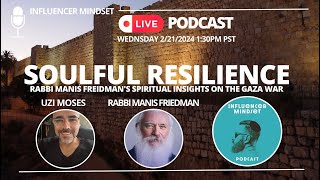
Rabbi Manis Friedman argues that war's purpose is elevating the world, not just defense, and that Jewish law already forbids killing non-combatants. He frames Israel's claim to the land as an inheritance from the Abrahamic covenant and links the current conflict to the coming of Mashiach.
Chapters
Welcome, influencers. I'm Uzi Moses PhD, your host, and today is an extraordinary episode featuring the incomparable Rabbi Menis Friedman PhD. His new book, To Win a War, launches tomorrow, if I'm not mistaken, officially launching tomorrow, offering a profound perspective on the current events in Israel. So get ready for a journey into wisdom and influence as we dive deep with the number one rabbi on YouTube. Stay tuned and let's unlock insights together. Rabbi Menachem Friedman, how are you this morning? I mean this afternoon.
Thank God, thank God.
You know, your new book— I'm sorry, you wanted to say something?
No, no, no.
Okay, so your new book, I just got it yesterday. Honestly, I did not finish reading it. I'm just kind of almost in the middle of it.
Yeah, it's a very big book. It takes a long time.
I know, I just, you know, I got it last night. So I was reading a little bit about it and it's a very, very interesting perspective on everything. And you tackle the ongoing conflict in Israel. I mean, this book is the result of that conflict. Is something that if, you know, October 7th wouldn't happen, we would not even have that book. So, can you share with us the core message you hope readers will take away from this work regardless of their background or beliefs?
One of the many points is the difference between defensive or offensive. Why is there war? Why does war exist? Where does it begin? There's got to be a positive, a positive function that makes the existence of war justified. But then, of course, like, you know, all good things, it can be abused. It can deteriorate. But originally, what was war all about? And that's helpful to know because it guides us in how to proceed with war on all levels. So there's a very simple concept. We are here to fix the world. Tikkun olam. To elevate the world to a higher standard, to a higher existence, to a higher purpose. Well, if you say, I want to fix the world, you have declared war. That's what war is all about. It's repairing or elevating a world that is not complete and is not perfect. So if it bothers you, if you can't accept a world being imperfect, you declare war on that, and you say, I'm going to perfect it. So the original principle of war is really the principle of elevation. God created a world that needs needs help. It needs elevation. It needs purpose. It needs a lot. And we're the ones who are supposed to make it happen. So life itself, in a way, is a war. The war of perfect over imperfect, godly over ungodly, good over evil. Light over darkness. Now, if that is the purpose of war, just getting right to the, to the current situation, if that is the purpose of war, to give goodness dominance over evil, that doesn't sound like a defense That doesn't sound like being defensive. It sounds like going on the offensive. Hello? You're going to change the world. You're not going to let it be what it is. So the whole notion of having a defense army, Israeli Defense Forces, that's not enough. We'll defend ourselves should it be needed. Otherwise, what are you going to be doing? Sitting on the beach? Sunbathing? What are you going to be doing? Life itself is a battle. You can't just wait. If and when you're attacked, you will defend yourself. That's not a purpose in life. That's not a goal. That's not That's not living. It also invites abuse. You know the kid in the schoolyard who always gets bullied? Why? Why does everybody pick on this kid? Because this kid invites it. He announces to the entire school, You can beat me up and it won't cost you anything. How does he do that? By saying, I'm not here to hurt you. I'm good. I just want to defend myself. Okay, we'll give you something to defend yourself against. That entire posture, that whole mentality, No, we're just trying to be nice. We're just trying to be friendly. Leave us alone. Well, then you are ripe for bullying. You're the perfect victim. So we got to change that. We're not, we're not living in Israel because we have no place else to go and just leave us alone. Our purpose of the land of Israel is this piece of land is already holy. Now, how do we get the rest of the world to be holy? That's not defensive. That's offensive. Take responsibility for the rest of the world and do something to make the rest of the world holy. That's active, proactive. Not defensive. So part of the problem for the last 70 years is that we keep inviting the bullies. We've got to tell them, we are here to teach you something. We're not here to defend ourselves. The war is over in that sense. We're not living in ghettos. So let's take on the world and see what we can do to make the whole world a holy land, not one tiny little piece of geography. It's just a change in mentality is basically what I'm saying. We act like we have an inferiority complex. Everybody hates us. Everybody's going to bully us. Why? Because you let them. So the fact that Israel now voted against a ceasefire and a two-state solution, All right, maybe we're getting somewhere.
I see. So in today's world, you know, how can individuals, you know, cultivate a sense of unity and understanding amidst this conflict? You know, drawing from the Jewish wisdom, from the Jewish tradition? What is really happening here? Is this the end of time? Is Mashiach coming? I mean, what can people do as individuals?
Well, let's look at the damage and then figure out how to repair it. The damage is we have suffered 2,000 years of discrimination, abuse, horrors, and it has damaged our self-image. We don't have the confidence in our own beliefs, in our own values, in our own traditions. It's almost like we apologize for our existence. 2,000 years of persecution can do that to you. Not surprising. In fact, it's surprising that we're not more depressed. So how do you cure 2,000 years of persecution and loss of confidence? We got to find, uh, the, um, the reasons for self-respect. We got to see what is great about what we're offering the world. And the more we appreciate that and the more we understand that, the more confidence we have to speak to the world. So the call of the hour is get your confidence back. Let me give a quick example. Um, Israel is killing a lot of civilians, and of course every anti-Semite is going to jump on that, which I really don't care, but there are Jews who are bothered and feel guilty. They know that there's no alternative, gotta fight this war, but they feel bad. So let's stop and think. This non-killing of civilians, where did that come from? Jewish tradition or not? Is there anything in Jewish tradition, in the Torah, that says don't kill civilians? Or is it all from the Geneva Conference? Made up by men who just finished the Holocaust. So, let's take a look at the Torah. Yes, indeed, the Torah says you cannot kill civilians. But the Torah makes sense. The Geneva Conference does not. The Torah says if a person is a non-combatant, then don't kill him. What's a non-combatant? A civilian. How do we know who a civilian is? Here's the foolishness of the Geneva Conference. If you take it literally, an Israeli soldier walks into a building. There are people there. He has to quickly decide who are the terrorists and who are the civilians. That is so suicidal. That is so nonsensical and so immoral. We're in the middle of a battle and I have to figure out who the civilian is? It's horrible. It's horrible. If he hands you the gun and says, I surrender, then he's a civilian. If he doesn't surrender, he's not a civilian. And you do not risk your life wondering whether he's a civilian. So here's the simple, logical, moral, sensible idea. A civilian should identify himself to you so that you do not kill him. But I don't have to identify the civilian. How could I? So, you're not supposed to kill a civilian because it's totally unnecessary. Why is it unnecessary? He handed you the gun. He surrendered. Then don't kill him.
They obviously don't do that.
We don't do that.
I mean, the Palestinians, they don't do that. They're just standing there.
That's right. Then another thing. When one Arab state is at war with another Arab state, does anyone ever talk about civilians? Any country in the world that goes to war with another country, Does anyone really care about civilians? Both sides don't care. Only with Israel. So people say, ah, antisemitism. Only with us they make a fuss. No, it's not antisemitism. We told the world that we will not kill civilians. What did that accomplish? All civilians are now used as human shields. The more we repeat this nonsense, we will protect your civilians, the more they're going to use civilians as human shields. And then we complain. What are we supposed to do? They're using human shields. Well, you told them to. You gave them that advice.
Makes so much sense.
Same thing with hostages. Does one Arab nation take hostages from another Arab nation?
Me personally, never heard of it.
No, because it's not going to do them any good. We keep saying we will do anything to get our hostages back. We will swap 1,000 for 1. That sounds like a great idea. So every Jew is now vulnerable as a hostage. So you, again, you give them the idea and then you complain that they use it? You tell them that you would never shoot a child. Oh, guess where they're going to put the rockets? And then you complain.
It's just a different kind of—
So the sensible Jewish way of thinking is, When a civilian identifies himself, then you don't kill him. And that applies to babies also. Obviously, the baby can't identify himself. The adults that are responsible for this child must identify the child as a civilian, not as a shield, because a shield is a tool of war. So if the baby is being used as a shield, the baby is now a weapon. The parents, or whoever it is, has to say, oh no, this baby is innocent. We're not using the baby as a shield, so don't kill it. And then you don't kill him. It's all so decent and so moral. It is immoral for a government to say, we will risk the lives of our soldiers to make sure that we don't kill your civilians. Government has no such right. You can't sacrifice the life of your soldiers.
Of course, no country will ever do that.
It's immoral. We think we're being very moral. And the enemy laughs at us. And that's why we keep losing the PR war. We're always wrong. We're always, oh, here we killed a baby. Here we killed a hospital. Here we killed a civilian. We're always wrong. But we gave them that idea. We played right into their hands. If we stop reminding them that civilians are safe, they will stop using civilians as shields because it won't do them any good. So you have saved their civilians more than by saying, I won't shoot them. If you say, no, we're not going to do anything and everything to bring back hostages, we're just going to come and kill you for taking hostages, then it doesn't pay to take hostages, and they'll stop. Jewish wisdom is the only wisdom left in the world. Why are we apologetic? What are we answering these accusations? Oh, it's a massacre. Yeah, if you don't behave yourself, it'll be a bigger massacre. Why can't we talk like everybody else? Oh, it was a massacre? We'll do an investigation. We'll arrest some of our soldiers. Don't be ridiculous. So, just an example of how we can get our pride back simply by realizing we have the best morality. We don't need a Geneva Convention to make us crazy. The same is true with proportionality. Oh, we've killed more than 20,000. Oh, that sounds like a lot. How do you measure a lot? Well, they only killed 2,000 and you've killed 20,000. It's not proportionate. It is the most ridiculous argument. First of all, the only way to win is by doing more than the enemy. If you do exactly what the enemy does, the war will never end. There'll be no winner. There'll be no loser. You kill one, I kill one. You kill two, I kill two. What is this? It is such a childish, immature attitude. You kidnap one, I kidnap one. You rape one, I rape one. So it is so embarrassing. In Jewish thinking, proportionality means you kill the amount of people necessary to produce peace, and then you can't kill another one. Once you've reached peace, you, you may not kill anymore. That's proportionate. Not proportionate to what the enemy did. Proportionate to what it takes to bring peace. If you can have peace by killing one person, then you're not allowed to kill two. If it takes 20,000, to bring peace, then that's what it takes. Then you kill 20,000. But if it takes 20,000 to bring peace, and so far you've killed 10,000, and you say, you know what, 10,000 is too much. Let's quit. That is so immoral. It's so obviously immoral. 'Cause you just said, 10,000 we can discard for no reason at all. More than that, no. So if you make a ceasefire after 10,000, there's still no peace. So those 10,000 died for nothing. You just threw them away. I remember a movie where the President of the United States who was supposed to be a very moral guy, was told that the army has to attack the enemy. The president said, how many do you expect to kill? And they said something, 40,000. He said, no way. They said, all right, if we do it a different way, it'll be 18,000. He says, all right. See how moral he is? 18,000 you can waste. Will 18,000 bring peace? You didn't even ask that. It's just a numbers game. 40,000 sounds like a lot. 18,000, not so bad. It's so, it's so ridiculous. If it takes killing a million in order to have peace, then you kill a million. And if you stop less than a million, then you have wasted your soldiers, the enemy soldiers. That is so immoral.
So we have to go all the way. We gotta finish the war as long as there is people fighting, as long as there is people there. Not interested in peace. We can't really stop, no matter how long that's going to take.
Okay. Now here's the scary thought. No matter how many you kill, it will not bring peace. They don't mind dying. Killing will not bring peace. Why? In every other country, if you kill enough people, you have peace. Not here. So here's the secret. The Muslim world consider themselves the descendants of Ishmael. Now, Ishmael was the older son of Avraham. God gave the land of Israel to Avraham as an inheritance, which means literally, God said to Avraham, I'm giving this land to your descendants. It's not yours, it's theirs. The descendants of Yeshua come along and say, well, then it's ours. We inherit the land. We inherit the land means we don't have to fight for it. We don't need to use force. It's our land. The minute I was born, it became my land because I inherit. Now you beat me up, you kill every one of us, it's still our land. So we now have an ideological problem. To bring peace means your enemy agrees that the land is yours. Killing is not going to convince them. So maybe they deserve to die anyway, just for their atrocities, but will that bring peace?
I guess not. Not with their ideology.
On the other hand, we are the descendants of Yitzchak, We never use that argument. We've never told the world, we don't need the United Nations or the League of Nations to give us this land. It's ours. We inherit it. We never use that argument. It's a pity. Because that would bring peace.
I think that story of Abraham and Sarah and Hagar and Ishmael should be told. I mean, that's exactly where this whole thing begins. That makes, that explains so much.
Yes.
What's going on today.
Sarah said, lo yirash ben ha'amah hazot, and that was a declaration of war. That's it. There's your history. Now, the fact is, the Muslims of today are not descendants of Yishmael. They're not. Not one. The intermarriage, the assimilation, there isn't one person alive today who can trace his ancestry back to Yishmael. Some can trace their ancestry back to Muhammad, but not to Yishmael. Jews, on the other hand, we are the biological descendants of Yitzchak and Yaakov. So it really is our land, whether we like it or not.
Why can't they do like DNA testing and just like have the proof in the pudding? You know, like, look, let's do a DNA testing. Let's see who was here before.
We don't even need that. Just tell the truth. They all know they're not descendants. Now, they believe in God like Avraham. That's to their credit. They never had idols. They never had statues like Avraham. They're also circumcised like Avraham. They pray a lot like Avraham. They don't eat pork. So they are great students of Avraham. But students don't inherit Israel. What would happen If an Israeli leader got up in the United Nations and said, people, read the Bible. God told Avraham, when it comes to inheritance, kol asher tomar lechasarah sh'ma be'kola. She is right, ki beyitzchot yikorei lecho zora. Yitzchak is your, so we wish we could give you the land, but we can't, because it belongs to our grandchildren, who are not yet born. So we can't give away their land, not an inch. So this explains almost everything. Why, every time we offered land, they refused?
Because it's really not about the land.
No, it's not about a gift. It's our land. What do you mean you're giving me? You'll give me the West Bank. You'll give me East Jerusalem. You don't give me anything. It's my land. It's an insult. How about if we give you 80%? How about if we give you— No, no, you don't get it. It's our land. So they won't accept any gift. The only way to possess Israel is to inherit. The Romans tried to take it by force. The Babylonians tried to take it by force. The Ottoman, the the Turks, you cannot have Israel by force. It's Yerushalayim. So either you are the Yoresh, or it'll never be yours. So they're insulted when we say two-state solution. It's not your land to divide up and give me half. It's my land. So it makes sense that they refuse. It also tells us we can't give it away. It's not a gift. It's a yerusha. This explains why every Jewish child is a threat to them. Not because he's a soldier, but because he's a yerush. We have to make it clear to the world. It's our land because it is an inheritance. God said to the people after they came out of Mitzrayim, "Alay rosh," go and inherit the land. Not fight for it. Okay, if you have to fight, fight, but it's an inheritance. Will that make a difference? If we say that in the United Nations, will it make a difference?
In the United Nations, I don't think so.
They're hopeless. They don't like us there.
They don't like us there. They really don't like us there.
I think if you say the truth, you make everybody uncomfortable. The truth is powerful, because if we don't believe that, we might as well just give up. Truth is powerful. When people hear truth, they back off. Partly because truth is so real, and partly because they know they're lying. Once you say the truth, they can't lie anymore.
Yeah.
So what is the future? The future is We're going to tell the truth. The world is going to realize what the truth is. If the, if the Torah says, a Christian cannot ignore it. And if the Torah says, a Muslim can't ignore it. All we have to do is remind the world what the Torah says. Once we do that, the Muslims, more than anybody else, are going to become our best friends. Because they're really religious. They don't mess with God. They will take down the mosque on the Har Habayit to to make room for the third Beit HaMikdash. They will take it down.
Amen to that. You know, they keep claiming that the Jews that right now in Israel are not the real Jews.
Ah, why do they do that?
Because they expect us to behave in a certain way or be religious as much as they are, and Israel is more on the liberal side.
Okay, so you see what's going on? They're saying that the land is theirs because they behave like Avraham. And it's not ours because we don't behave like Avraham. That's cute. You don't have to behave like your father to inherit your father. The word inheritance is the key to this whole thing. That's why they have to claim that we're not real Jews. Otherwise, it's our land. If we are B'nei Yisroel, then Eretz Yisroel is ours and the argument is over. So they want to convince themselves that we're Europeans, we're not really You're going to talk about DNA testing. There's a DNA test that shows who is a descendant of Aaron. So yeah, we can pass that test. We don't need a test. We just need to tell the truth.
Baba, you're known for your profound insights on relationships. How do you believe the principle of love and empathy can contribute to resolving conflicts on both personal and social level? I mean, is there anything that we could use on that front?
No, it's Hollywood. Love cannot resolve conflict. It's fiction. The way to resolve conflict is with respect. If you respect me, then you will behave yourself. If you don't respect me, you're not going to behave yourself. So when people say, can't we just love each other? Yeah, first put down the gun. While you're holding a gun, we're not going to be talking about love. It's really, it's so childish. Habol hargacha, Hashkem lahargo. That's how you resolve conflict. Once the conflict is resolved, then maybe if you're nice, I'll love you. Maybe not. I don't know. But while you're shooting at me, no, love is not going to help. It's not realistic. Peace is the same thing. You can't make peace When somebody is trying to kill you, first you have to destroy him, discourage him, so that he will not think of war for another 40 years. Then you can talk peace. Somebody says, yeah, you only, you make peace only with your enemy. Don't, don't, don't be foolish. You make peace with your defeated enemy, not with your active enemy. So peace talks, the peace process, what a lie. What a ridiculous, childish lie. There is no peace process because no one has lost yet. There have been 5 wars in Israel? No, just one endless war. Wow.
So your teachings often emphasize the importance of finding purpose and meaning in life. How can individuals, regardless of their faith, discover and align with a higher purpose, especially during war times?
The word purpose means, what was God's reason for creating me. God's reason for creating me is my purpose. I can't just make up a purpose. Can you wake up one morning and say, "You know what? I think my purpose is to become a fireman." It's not your purpose. That's your choice, your option. Purpose means before I was born, there was a reason for me to be born. That's my purpose. So if you want to know what your purpose is, you have to find out in what way can you serve God's purpose. What does he need you for? That's it. That's your purpose. Religion has ruined everything. Because religion tells us that God doesn't need anything, but if you pray to him, maybe he'll help you with your needs. That is such a strange arrangement. What does if du et Hashem mean? If he doesn't need anything, how can you serve him? What does it mean you hire a servant and then tell him, I don't need anything? What'd you hire me for? It's frustrating. Imagine you're a butler in somebody's house. You say, would you like a coffee? No. Tea? No. Food? No. What am I doing here? Ivdu et Hashem means do for Him what He needs from you. What does he need from you to make his world better? It's his world. He's interested. He made an investment. He created it. If you can improve it, he would appreciate it very much. So I like this example. There's this Japanese gardener who was a real artist. He can turn a jungle into a beautiful garden, right? And he sees this neglected piece of land and he can't stand it. So he goes and he takes, gets rid of the weeds and he plants beautiful bushes and flowers. He turns it into a Gan Eden. All of a sudden, somebody walks up to him and gives him a check. He says, what is this? He says, that garden that you just created, that's my land. So I have to pay you. We talk about tikkun olam. We all want to make life better. We all want to make the world better. And we do. Whose world are we making better? So everything you do that makes the world better, God will reward you because it's his world that you're fixing. So who cares more about that land than its owner? That is our purpose. Now, each person has a specific contribution that they can make that is unique. How does a simple laborer make the world better? He has no influence on the world. So let's say he works in a factory. He produces bicycles. Do bicycles make life easier for people? More enjoyable?
Yeah, definitely.
Producing bicycles means you are a partner with God in creation. You're not just going to work to make a living. You have improved God's world. God will pay you. The same with everything. If, if you work in the post office and you deliver people's mail so that people can communicate with each other You're helping make the world a better place. So tikkun olam, we're doing it all the time. Unless you're homeless and you have no job and you haven't— the average human being, 8 billion human beings, contribute to the welfare of this world. That is serving God. Now, the Jews, that's another story. From the Jews, God wants more. Okay, so every mitzvah we do serves his purpose. If we don't put on tefillin, God's world is not satisfying. If we don't keep Shabbat, God's world is not satisfying. Even though we now have electric toothbrushes, we have electric cars, all of that makes life better. But more than all of that, tefillin and Shabbat and kashrut. That's really what God needs from this world. So we're very close. The internet is such an amazing gift. We always knew we are Ohr La'Goyim. But how? Nobody ever listens to us. We live in ghettos. We live in shtetls. How are we Ohr La'Goyim? With the internet?
You can do it finally.
How can you not be oral like William? You gotta live in a cave. Yeah, we can do it now. And the world really wants to hear from us. Christians are not so comfortable with Christianity. Muslims are not so comfortable with Islam. They want to hear what Jews think.
How do you think individuals can maintain authentic connections and meaningful dialogue, especially when discussing sensitive topics like the Israeli-Palestinian conflict?
The only way that we can talk to the world is if we speak like teachers. This is not a debate, and we're not in a debate team. We are the teachers. We have some answers. Anybody who wants to know the answers, we'll share it. But we are not going to compare philosophies or religious beliefs. We are the teachers. If you want to be a student, we will teach you. You want to debate? There's no debate. So the Jewish attitude today has to be The capital of Israel is Jerusalem. If you don't know that, then I'm too embarrassed to even talk to you. Sorry. Does the sun come up in the east and set in the west? You want to debate it? No. You don't know what a woman is? Then I'm too embarrassed to talk to you. Well, why can't we discuss it? There's nothing to discuss. Go back to kindergarten. We are the chosen people. You don't know that? Then why do you even think you should be involved in a conversation? If you don't know that the Jews are the chosen people, if you don't know that God gave the land to the Jewish people, if you don't know that we came out of Egypt with 10 plagues and the sea split, you don't know that God gave us the Ten Commandments, what do you know? And you want to debate it? If you want to learn, We will teach you. You want to know what God said at Mount Sinai? Sit down quietly and I'll tell you. You want to tell me what God said at Mount Sinai? No, no thanks. You weren't there. Why, why do we lower ourselves into these debates? What gives you the right to the land of Israel? If you don't know that, then go back to sleep. No more. Can't legitimize their position by even engaging in such a conversation. How do you know there's a God? Go to sleep. You think you're a philosopher because you can ask a question? I'm not discussing it with you. I'm tired of this already. There was a beautiful incident on a campus. In the early weeks after the war. On this campus, there was a very nasty pro-Palestinian rally. And everybody was shocked and they didn't know what to say. Finally, one Jewish professor got up and he started fighting and arguing with them. The police arrested him. To protect him from getting hurt. This guy was famous on the campus. He was famous for being the atheist. He was the campus atheist, and he was very proud of it. So the next day he came to class And one of the students gave him a bundle of flowers, a bouquet of flowers. He said, what is this? She said, I was so proud of what you did yesterday. He says, you're Jewish? She says, no. He says, so what do you mean you're proud? She said, it just felt so good to see the chosen people acting chosen. So he said, you know I don't believe that. I don't believe in chosen people. And this non-Jewish student said, whether you believe it or not, We know it's true.
It's a beautiful story. The guy was atheist.
So this student is saying to the professor, by being an atheist, you think you're fooling us? You're not fooling us. You can be an atheist, you can be a communist, You're the chosen people. We all know that. So it's time we stand up and say, yes, we are the chosen people, so let us teach you something. Let us be the Orla Goyim, and everyone will benefit. That takes a little confidence. Not arrogance. Confidence.
Exactly. That's exactly what I wanted to touch, the idea that people will say, oh, you think you're better than us, you're chosen and we are not chosen. This is like an arrogant statement, so to say. What do you say to those people? Say, what, you're better than me? You're chosen and I'm not?
All religious people believe in prophets. That's all.
Yeah.
So, Elisha comes to the people. And says, ko amar Hashem, let me tell you what God said. Nobody said to him, who do you think you are? If you're the prophet, you're the prophet. Nobody had a problem with that. When we come to the world and say, God chose us, who do you think You're not listening. God chose me. What am I supposed to do? I didn't choose. God chose me. He appointed me his prophet. What am I supposed to do? Chosen means I had no choice. So the only option I have is either to act chosen or to make believe I'm not. Make believe is not an option.
So Rabbi, lastly, how do we win this war? What can each person do? What can a person listening to this podcast can do on a practical level to help win this war, not only for Israel, because we are fighting for the world. It's good against evil. People that knows a little bit of the details can understand that.
Okay, so part of the good against evil is truth against lie. If you don't fix that, you're just going to end up in war again. We got to start telling the truth because there is no other truth. The world has become so fake. Everything, everything is a lie. And nobody apologizes for it. You know, every commercial is a lie, and yet it's legal. You're allowed to lie and cheat people out of their money. It's so bad that we don't even have any respect left for the truth. What's the point of telling the truth? Lies work. So lie better and you'll succeed. That's the world we live in today. Whoever lies better wins.
It's very sad.
Dangerous. And that's all Hollywood. Hollywood is such a corrupting influence. Everything's make-believe. It doesn't have to be true. Doesn't have to be true? You mean false is a— is also good? Even religion, so full of lies. I was talking to a Jew who became caught up in Christianity. I'm trying to argue with him. He says, you can't argue with me. Jesus came to me and told me this. I said, how do you know that it was him? He says, it looked like him. I said, you know what he looked like? You know what he looked like? Yeah, don't you see the pictures? Statues? It's such a lie. It's such a make-believe. No, he didn't look like that. The pictures they have of him looks like a Viking. He didn't look like that. I guarantee you he didn't look like that. Tall, fit, blonde, long hair. No. I know what he looked like. He was short, he was overweight, and he was bald. No, not possible.
Danny DeVito.
George Burns. So even that's fake. What are you hanging pictures because you made up, you fabricated an image. This is so Hollywood. We are very careful when we give our children's books and we want to tell Bible stories. Never draw a picture of Moshe. What are you going to draw? You don't know what he looked like. There's no lying. There's no fantasy. Even the picture of Rambam, there was a big debate. Is the picture that we have authentic? Is it really him? We don't know for sure. There's a statue of him, but was the statue accurate? You got to be careful with these things. You can't make believe and pretend. So the world is so lost in lies, the only truth left is Moshe MS, the Toroso MS. If we don't tell the world, then we're committing a crime. Letting the world suffer in this ignorance and confusion, it's not nice. So Oral Lagoyim is not an option. It's not a It's necessary. It's pekua h'nefesh. What we would say to the Jewish people, stop being such a victim. Stop it already. We are not victims just because someone can beat us up. The rachmones is not on us. The pity is not on us. The pity is on the world that is so messed up. We will be fine. The world, I'm not so sure.
I can't help myself from asking you the question that has to do with the coming of the Messiah, which is what kind of makes us Jewish. It's part of our core belief. And you as an emissary of the Lubavitcher Rebbe know how important it is to believe in that. Is this, is everything that's happening now in Israel has anything to do with that? Should we get ready and prepare the world?
We are. We are getting ready, and the world is getting prepared. Because you ask anybody in the street, how do you think things are today? Pretty good? And they say, oh no, it's got to get better than this. That's Mashiach. That's Mashiach. If you believe the world is not what it's meant to be and it has to get better, that's Mashiach. If you say, nah, it'll never get better, there'll always be war, there'll always be crime, there'll always be lies, okay, now you don't believe in Mashiach. The belief in Mashiach literally means The world is moving towards perfection and it will get there. You want to know who is going to be the architect? A descendant of David Hamelach. I was talking to a Catholic and I said, you know, Mashiach has to be a descendant of King David. He has to be from the tribe of Yehuda. He has to be a Jewish leader. He said, whoa, whoa, whoa. You're telling me that I have to believe in a Jewish Messiah? I said, you already do. You don't realize what they're saying. What, Messiah is going to be Jewish? Yeah, you got that right.
For over 2,000 years they believe in it.
And you picked the wrong Jew. But yes, it's going to be a Jew.
Amazing. Exciting times, Rabbi.
When did the people of the world, when were we so convinced it's got to get better than this? Never before. Not just because of the wars. The wars are the least they ever were. Because of everything. We don't know right from wrong. We don't know good from bad. We don't know man from woman. We don't know anything. It's got to get better than this before every child in the world is mutilated with hormones and with operations and with Absolutely. So we're much readier for Mashiach than ever.
Rabbi, thank you so much for taking the time to come for the second time to the Influencer Mindset Podcast. What can I tell you? I'm just really, really grateful for this conversation. It just put things in a better perspective, not only for us, the Jewish people, but also for everybody else. And if you want to learn more, that's the book, How to Win a War the Jewish Way. So may we only hear good news from Israel, and may Mashiach will come right now. Do you have anything else that you want to say before we end the podcast, Rabbi?
Yes. Mashiach is coming. So you better hurry. Because once he comes, you won't have the opportunity to contribute towards making the world better. So hurry up. We don't want Mashiach to come without our help. That would be embarrassing. We want to be able to say to Moshiach, I did a little. I helped prepare the way. That would be a lot better than, uh-oh, Moshiach is here. So let's make the world better. In any way that we can.
Amen to that. And that's a great motivation for everybody listening. If we can just do one more thing better today than we did yesterday, we are on the right path. Thank you so much, Rabbi, for being here.
Thank you very much. This is making the world better. This conversation. This program, you can already say, I helped a little.
I always feel I can do more.
That's all it takes.
Thank you very much.
Shabbat Shalom.
Shabbat Shalom.
More from Uzi





The Secret of Reincarnation According to Ancient Wisdom. Save it, share it, and follow for clarity.





