Valentin Radu - CEO & Founder @Omniconvert
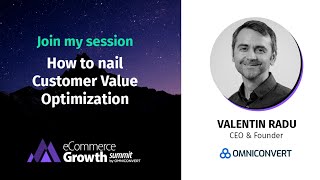
Valentin Radu, CEO of Omniconvert, talks about customer lifetime value optimization in e-commerce. He covers how to improve CLV and answers audience questions on the strategies that work for online stores.
Chapters
Live with the hostess with the mostest, which is me. And I'm here with my boss, Valentin. Yeah, exactly. And yeah, I'm, I'm super excited about Marty's session earlier. Thank you, Marty, for doing it. I was watching it on, on LinkedIn. On my LinkedIn, which you shouldn't add me on LinkedIn. And I'm here with Valentin Radu. He's the CEO of OmniConvert and he's a serial entrepreneur with a lot of experience in E commerce and he's one of the best people I have worked with, actually, he's the best person I have worked with and for ever. And we will talk today about how to nail customer lifetime optimization and how to improve customer lifetime value. I'm super excited because this is our favorite topic and Valentin was doing this before he was cool.
So.
I'm going to let Valentin talk now and please join me with questions in the chat box. So welcome, Valentin.
Hello, hello, hello, everyone. And thanks for being here with us. It's an honor and a pleasure to see how many of you are here. Today. I'm going to speak about customer lifetime value. Customer lifetime value. It's a dear topic to me because I've been an E commerce entrepreneur myself and I've been running my whole, let's say my whole life as an E commerce entrepreneur struggling and trying to move the needle. And I know all these moments, from the moment when we've launched and we've been only me and my partner to the moment when we reached 100 employees and we've seen, wow, we've made it. And of course I've made the exit because I've realized that there is more to be made in E commerce and that's why I've decided to build OmniConvert back in 2014. So today I'm going to speak about how to nail customer value optimization. The agenda for today, we're going to first speak about the E Commerce growth formula. So how an E Commerce grows. Yeah, what you should be doing, which are the levers and these are tested and tried methods to, to to grow your own E Commerce. Then what affects the customer lifetime value? We're going to speak a bit about the customer segmentation, how to improve customer lifetime value and the CVO impact. So first of all, I think there are only two ways to grow any business. First, acquire more customers. B, get each customer to buy from you more and more often. So these are the only two ways to grow an E Commerce. When I was at the beginning of as an e Commerce. As an E commerce entrepreneur, I thought that, I wrongfully thought that improving the growth of an E commerce means bringing more traffic, means improving the conversion rate and means improving the average order value. And this is true. But the problem is that if you don't have all the terms in an equation and my, my daughter knows what I'm talking about because I'm doing math with her in the last three years and I'm let's say, reminding myself about the importance of the order of operations and of having all the terms within your equation in your formula. So after all this time being an entrepreneur and working with a lot of e commerce companies, big and small and huge, I realized that the act growth E commerce formula misses something. So it's not only about acquiring more customers, which is traffic and conversion rate, but it's also the ratio between the customer lifetime value and customer acquisition cost. So this ratio should be more than three so that your E commerce should be healthy. Because it's all a matter of are you profitable if you acquire a new customer? If your conversion rate will go up, is this profitable for you? So is the value that you're getting from a new customer justifying all the customer acquisition cost that you have with that customer? And these are questions for you as e commerce leaders to find out for yourselves. Now, the first alternative to acquire more customers is getting more expensive than ever. So if you can see in this graph, the Facebook CPC has grown eight times while the E commerce sales worldwide have grown only one point in 58 times. So that means who's the winner? Facebook, Google Ads and so on. Right? So I've prepared an E Commerce growth formula because I've decided to have all the levers that could be used in order to improve the customer lifetime value and in order to improve the growth of your E Commerce. And I've made it available over here. So let me see if I can share this tab as well so that you can see it live. But of course you can get to that, to that link so that you can play with it as well. So let's presume you have all this data from your E Commerce. Let's presume you have, I don't know, 200,000 visits per month. So this is the initial status and we can change. Let's presume that we are focusing on these six levers which are affecting the E Commerce growth. The number of visits, the conversion rate, the the orders per customers. Let's say this customer has 1.5 orders for each customer. We have the average order value Then we have the customer acquisition cost, the total marketing spend, let's presume this is $20 and the gross margin which is 30%. So in this case the customer lifetime value over customer acquisition cost is 0.46. So let's make it actually a bit better. Let's improve the AOV and let's improve the number of order per customer. So then if we look at the impact we've made, the best case scenario. So here we have the best case scenario where we are improving everything by 20% and we are of course decreasing the customer acquisition cost by 20% and then we have the total impact in the margin. Of course you might say that the revenue is what means growth. But if you are not a funded company and you can afford, like Amazon did for 20 years to lose money, then you need to be profitable. So if we look at the total impact by improving the customer lifetime value or improving the AOV or improving the margin, we get the same thing. So if we improve the the these metrics, we see that the total impact of the customer lifetime value or AOV is exactly the same as by decreasing the customer acquisition cost by 20% and maintaining the same amount of traffic and also improving the traffic by 20% or the conversion rate by 20%. And that will show you how important it is to focus on the customer lifetime value. And of course after some moments. So let's presume you have 12 orders per customer. This is not so important anymore. But until you get to this stage, you need to understand that customer lifetime value is vital for the growth of your, of your E commerce. And now let me switch back to the, to the presentation. So going further, if you want to play with this formula, it's a calculator, I made it for you. So you simply go to this link bit li eCommerce growth formula. So also if you want to see the retention impact and the CLV impact, we've made this calculator for you so that you can see how much money you are losing. So people are more, let's say, aware about the problems they have when they are losing something. So that's why there is the loss aversion bias. So people are twice as much more inclined to invest energy not to lose $10 than they are to invest energy to gain $10. And that's the loss aversion. And if you want to change the mentality of your own company, let's say you are in a bigger company and you want to make them aware about the CLV impact, you can use this Calculator, how much they've lost and how much they will lose in the next year. So so far, so good growth is different than the growth generating factor. So if we are wasting our time in Google Analytics focusing on the traffic or on the revenue, this is not going to move the needle, right? So let me give you an example. Bfashion used to be a great company. It was a fashion e commerce player here in Central and Eastern Europe. Their initial symptoms, when met with the founders, they were almost doubling year over year. So the revenue was 95% up. However, the customer retention was less than 20%. The year over year customer lifetime value was going down by 20% and their net promoter score was less than 40. So this led to in only four years after that moment to the company going bankruptcy. And that meant that also means that revenue guiding yourself by solely looking at the revenue or the immediate profit is not going to help you out. And that's why you need to understand how to become customer centric. Now, how to understand which are your best customers. So for many events we all know the Pareto's law, right? So for many events roughly 80% of the effects come from from 20% of the causes. And this is true in the e commerce as well. So not all the customers are created equal, right? Some are better than the others. And the best ones, we can call them the ideal customers. Right? The ideal customer profile is something that you should be looking to find out for your own e commerce. So to figure out how impactful is for your company, a single ideal customer. So one single ideal customer generates margin as much as 376 low value customers. So it's not fair nor smart to treat everyone the same. So how to improve customer lifetime value by using RFM segmentation? RFM is an analysis that allows you to segment your customers based on how recently they've bought, how frequently they've bought and how much they've spent on your website, after you have more than 30% from returning customers, it becomes vital to understand your best customers. So RFM of course is the acronym, recency, frequency and monetary value. Thanks to RFM you will end up having different segments of customers like the soulmates, which are your best customers or the ex lovers which used to be your best customers or the lovers or about to dump you break up. You got the point, right? You need to make your customers love you so that they can come back in order to understand your ideal customers. Let's look at this graphic which is coming from Reveal, our software, our product which is empowering more than 800 stores so far, completely free to do RFM segmentation. So with this analysis, you'll be able to see that the Soulmates which have the Highest score for recency, five for frequency, five as well. And for monetary, they've generated US$2.8k per customer. While the lovers, the immediate next group, they've generated only $753. And that's why you need to understand your soulmates in general. So thanks to aggregated data, the number of customers which are Soulmates from an average store are around 3%, but they've generated around 12% of the total revenue. So these customers have five, for instance, five for frequency and five for monetary value. So those soulmates are the most profitable. And if you can see in this graph, you'll be able to see this kind of distribution and anomalies so that you understand which are your best customers. And there are a myriad of reasons why you will need to do this. Because that's going to improve your customer acquisition, your email marketing, your merchandising and your targeting as well. So by having this distribution of the share of revenue margin and number of customers by each RFM group will allow you how to level up your e commerce, right? So solomates, you have this main goal, right? Keep them happy and acquire more like them. This is the main goal. So because these are your pure gold customers, the next steps would be to monitor their customer experience in real time, treat their objections in real time. So once they are pissed off, you don't want to leave an important customer waiting for 8, 12, 24 hours to respond to their tickets, right? And of course you need to research the ICP to build lookalike audiences so you can inform Facebook and Google Ads to acquire more customers like your best customers, which are the soulmates, not like the average customers. The next group are the new passion. So their recency is the highest. So let's say they've placed an order in the last 30 days, so they have the highest score on recency, their frequency is the lowest. So they've just started to place orders and you can see here the total lifetime of the revenue is minimal, so it's around 1 to 2%. However, for the last month they've been generating around 24% of your total revenue. So the main goal for them would be to persuade them for the next order. How can you do that? By surprising and delighting them by running cohort A B testing to identify how to onboard. So what kind of vouchers, what kind of campaigns, what kind of incentives, what kind of copywriting works the best so that you can acquire more customers like them and to make them stick around and buy again from you. And the next step would be to run tailor made campaigns specifically for them because they have the potential to become soulmates. The next type of customers are the lovers. Of course if they have potential, you need to transform them into soulmates. You need to acquire more like them so you can inform the Facebook and Google algorithm with this kind of custom audiences. You need to run tailor made campaigns and to run to treat their objections in real time. One interesting segment of customers are the ex lovers. They've bought many times so they have a high frequency score, they've bought high monetary value, so they are among the ones that have the highest customer lifetime value, but their recency score is the lowest. What you need to do is of course to re engage them because last month you haven't got anything from them because they used to be your best customers but something happened and the next step would be to find out what stopped them from buying. So what happened in the relationship you had with them. You need to treat their objections and of course you need to incentivize them to come back and buy again. From Another interesting segment of customers are the Don Juan's. Yeah, we call them the Don Juan because they have the highest customer lifetime value, but they've bought only once and only a lot of time before today. So it is crucial to monitor their customer experience so that you can understand pre delivery and post delivery. Because if something happens in your customer experience, chances for those customers to come back are pretty low. So with Reveal for instance you can trigger the NPS survey pre delivery. So after the customer has placed the order and post delivery after they've got the product. So after they've seen the whole customer experience and if it happens like here where there's a huge delivery gap, then you might want to do something with the fulfillment and with the customer experience. So the main goal for Dong Juan would be to re engage them, to find out what stopped them from buying again and of course to to treat their objections and to treat these kind of objections for the current new passion which if time goes by without them placing another order, they will turn into don't wants. You can do this by also monitoring this in real time. So instead of being hypnotized about Google Analytics, forgive me for I have sinned, right? So I used to stay like three, four hours a day. I was using rescue time since 2010 and I was tracking how much I'm spending on Google Analytics and is that thing analysis paralysis. However, by looking at this RFM groups you could see for instance this is a snapshot from Reveal. You can see how the revenue trend is going is going up or down. Which of those customer segments are the most impactful in the in your total revenue or in your total total margin? And what is their customer lifetime value by each RFM group? For instance, you can see here the CLV by of the soulmates is by far much more better than the other following groups which are the lovers and the potential lovers in this case so how to improve CLV? 5 steps first you need to change the company mentality. There are only two types of customers, customer centric and product centric. The product centric thing that demands happens out of the blue. They communicate mainly features, price discounts. They define success by looking at things like traffic or revenue or CPC and their departments are disconnected. So the email marketing team, the social media team, fulfillment and so on. So they are disconnected and they don't know what's their main problem as a company with their customers. The customer centric companies are looking at things like customer experience or customer retention. They influence and monitor closely the customer behavior and they have a unique source of truth around their customers. So these are the two types of customers. So you need to change the mentality in order to become customer centric. If you want to improve CLV the next step, you can't improve what you don't measure right? So you need to monitor what matters. Things like customer acquisition, customer retention, margin, net promoter score or customer lifetime value are crucial to monitor. And some specific KPIs which not all of the e commerce companies are even aware about them, not to say that they are not measuring or monitoring them are the chances to place the next order. So you can see here a distribution from 151 stores of the chances to place the next order. So after the first order, the second order as you can see here the habit forming kicks in. So after the sixth order the chances to place the next order are 75% while after the first one are around 23%. So let me show you this graph. So from first order to the second order there are 23.6% chances for customers to place the next order. So you need to improve this because this is the biggest gap. After the second order you have 38% chances for the customers to place the next order. So the chances are improving 61% after they are acquainted with your products. Then from within the fourth order, the chances are 100% higher than from the first to second, so the chances are 47%. So this is aggregated data from from 151 stores which are using reveal. And you'll be able to understand that what you need to do is to first monitor this and then do the math. So use the simple formula to analyze the margin and the revenue impact. And how can you afford, how much can you afford to invest on the first steps until the customers are acquainted with buying from you? Because it's the habit forming that you are after. Actually also there is another thing to do to monitor the average days between the transactions. According to this graph, after 24 days since the first order, the chances for a customer to place another order are 80%. So within 0 to 24 days, days, the chances are 80%. After six months have passed, the chances go down to 20%. So this kind of insight is important to know when to remarket those customers, how to remarket them, when to check up on them, when to understand, when to get insights regarding how satisfied they are. Because this should be monitored by you. These are only average figures, but you get the idea. You need to get to see what kind of figures do you have for your own e commerce. Because simply focusing on a remarketing that simply blasts all the audience with some discounts is not moving the needle anymore. The third thing that you need to do is the qualitative research. So you need to add the customer voice in the mix to correlate the customer feedback with the quantitative data. So let's presume you have the RFM segments. You need to prepare the list, to prepare some questionnaires, to send those surveys on different channels, not only email, SMS ads, whatever. You can even pick up the phone and call them guys, right? Don't be afraid to do that. Then create the reports, generate the insights and understand for each customer group what is their nps, what kind of demographics they have, what kind of anomalies do they have in terms of the reasons one or the reasons last. So once you understand these kind of aspects, you'll be more aware about things that you should be fixing. For instance, after such survey, a company simply stopped doing new customer acquisition because they realized they have some toxic products and 45% of their sales were coming from products which which were not at the quality that their best customers were expecting. So the qualitative research means understanding if you have product issues like quality, features, price, brand, whatever or services issues like things like delivery, client service or return policy, all of these are insights that will help you improve the customer experience. So customers which are leaving a company are leaving that company because they believe that you don't care about them them. And this is crucial to understand how they feel is more important than the features of your products, the communication that you have. So if you make them feel that you care about them, then your job is done. But unfortunately most of them are not. Most of the e commerce companies are not monitoring what matters. For instance, Net NPS Net Promoter score will allow you to understand how many of your customers will be willing to recommend you to a friend or acquaintance. This is one of the best ways to monitor the customer experience. And not only that you're monitoring by an average, but you can monitor it at each RFM group. You can monitor it for each category to see which categories are the least effective, what kind of brands are the ones that we should should get rid of or simply improve our merchandising by them. And moreover, you can do NPS objection treatment in real time. So you can do things like pre delivery and post delivery NPS remember. And then based on how important the customer is, you can treat those objections in real time. It's a simple thing to do. For instance, you can use Reveal and Klaviyo or Sendgrid or other email systems so that you can set those kind of alerts. Because we have have all this technology at our disposal and it's time to use this instead of tweaking things over and over again to do this kind of fine, well oiled machine and system that works without you doing anything afterwards. Then improving the customer journey. So we have these two phases. Buy the product and own the product. We have all these phases from need research. Select the product, purchase, receive, use the product, maintain it and recommend. So the standard customer journey for an E commerce is like this. You do the demand generation, people are landing on your website. First order is placed, send the comfrey merchant and then the order is delivered. You remarket, you do remarketing or not and then the second order is placed. Around 20 to 24% of the customers are doing this. But with the advanced customer journey we've seen that the second order is being placed by 50% and there are only three steps that you need to add and it's not that expensive. First do the survey after the order is delivered. Do you like the shoes that we've sent to you? How satisfied are you with our service? Which are the chances to recommend us? Then treat any objections that might appear and then come up with Enrolling the customers in the RFM retention program so that you can give them personalized incentives based on the relationship you have with them. So these are my. This is my gift for your attention. We've built Reveal after all this. Know how that I've got together with my team in the last seven years, plus the the other six years. And as an E commerce entrepreneur, Reveal allows E commerce companies to do customer segmentation, retain more customers, and do omnichannel personalization in order to improve the customer lifetime value. If you install it, it's going to be free until the end of. Thank you for your. For your time and I don't know, Juliana, if we have time for questions. However, I'm a LinkedIn person. You can find me on LinkedIn and ask me anything. I'll be more than happy to help you out.
I have like four questions so far, Valentin. Channel them everywhere. I'm trying to get back on screen, but I see the gods of Internet don't want me, so I'm just gonna be here. A voice.
Excellent. The voice of Juliana and myself.
Exactly. Oh, okay. I'm back. I'm back.
You're back. That means it's perfect, right? Like, it's on your hoodie.
Perfect. Yeah, it's a very cozy hoodie. And actually Amin, a person that I know from LinkedIn, messaged me to tell me our event is stellar and told me he likes my hoodie. So if Amin likes my hoodie, I'm good. So, Valentin, we have four questions that I have been given in the WhatsApp group from our team. One question from Sheila is where do I get the data for localized audiences on Facebook?
Where do you get the audience data?
Yeah, I think Sheila is asking, how do I create this lookalike audiences? Where do I get the data from?
Yeah, so you can install Reveal again. It's free. You do these RFN segments, then you can either download manually the data and push it to Facebook, or you can find all these tags within Shopify and you can use them from. From there. It's pretty straightforward. And in the next few, I mean, until the beginning of 2021, we will have this integration directly so that you can push this kind of segments directly to Facebook to create audiences.
Thank you. I have a longer question from Cornelius. I have a. He says I have a lot of out of season items in my fashion store, which I'm trying to sell on discounts. What segment of customers I should address with this product?
Yeah. If you want to get rid of some part of your stock which is not that valuable for you. You should be focusing on customers such as about to dump your breakups, which are low valued customers, bargain hunters. And by the way, you can do this on Black Friday as well. So you can do special campaigns for your best customers and special campaigns for customers that you want to re engage with. So this is my take on this. Hope it helps.
Okay, we have another question from Jason. I have a store with one year of activity. What's the best way to approach optimizing my customer lifetime value?
So as you've seen, first, first things first. Segment your customers, find your best ones, find why they are buying. Find the ones which gave up on you, why they gave up on you, fix those and then after you fix those things, start all over again. Prepare a new onboarding so that you nurture the customers by understanding which are the main reasons that your best customers are buying. And double down on this approach. It's a continuous iteration.
Cool. And the last question, Actually I have another one, but that's for me. So the first question from the audience is from Joseph and he's asking if Reveal is integrated with Klaviyo. Yes, it is. I answered that for you. We actually just announced it like a few days ago. So Valentin, my last question for you. Thank you so much for this session. It was awesome. And I wanted to ask you, will I get the raise?
Of course, it's up to you. It's the, the employee lifetime value that you need to improve. And I'm always up to that. And by the way, a small tip of advice here. I've been in this game for whatever. I've been an entrepreneur since 2001 and I used to recall that the common understanding about getting a raise when I was an employee because I had like 17 jobs as a side gig for me. So I used to remember that all my colleagues were cursing the boss because they are not giving them a raise. And at some moment I became an entrepreneur. I started to hire people and I realized that many people have this kind of mentality. But it's not about the boss that out of the blue he decides, okay, you, you will get a raise. It's if you are not in a company where it's not clear what you should be doing together to get a raise and what kind of objectives do you have and what performance means for the company so that you will get get the raise. It's. It's clear that you need to understand that first. And on the other hand, no matter what you do on this planet is not about the money. It's about the value that you're getting. So I've understood is that I've never ran out of money after I. I tweaked this in my mindset. Like, it's not about what I'm getting. You need to first give and then you will get. Right? So money are going to hunt you everywhere. Everywhere I go. So everywhere I go, after I've decided to do. To give this value. Like you see, Reveal is completely free, so we have 800 stores already using it. It's about making sure that you provide outstanding and undoubtfully value. Right. So unquestionably, if you give unquestionable value, the return will. Will come. This is the principle. This is the law of the universe. Right. And if you're in the. In a position where you're not getting a race. I think we should talk. Juliana, on the next one on one. Great, guys. Thanks a lot.
One more question, Valentin, from someone serious, not me. So Ahmad is asking, should we make a choice between the RFMS system and buyer Persona to classify customers, or do we have have to make RFM classification for each buyer Persona?
So RFM will allow you to. To have all these segments. Once you have the segments, you do qualitative research to understand are the breakups coming from a certain location, are the soulmates coming from a certain channel, or are the soulmates buying a certain product? So I'm not a fan of fictional buyer person.
Us.
No. So it's a big no from my. From my perspective, because it's not about crafting and doing a. Brainstorming you and your colleagues in the office about who's the best customer we have. It's John. He has a dog and whatever. No, it's. It's fiction. Right. You will have to first see the behavior, see your best customers, see those kind of clusters, and then with qualitative research, understand which are the anomalies within all these groups. And then you will have your buyer Personas, which are real, Real people, real characters.
Thank you, Valentin. And thank you, everyone, for these amazing questions. I'm gonna let you go to the next session and. Yeah. And looks like I'm gonna get a raise. See you guys in the next session. Thank you so much.
More from Valentin


68% of People Who Visit Your Shopify Store Never Reach Cart - Here's Why (And How to Fix It)
Stop Losing Customers: 10 E-commerce Churn Strategies (It's NOT About Discounts)

How to Optimize Your Entrepreneurial Mindset With Valentin Radu of Omniconvert