AI + No Code Automation to Scale Smart! Wade Foster @Zapier
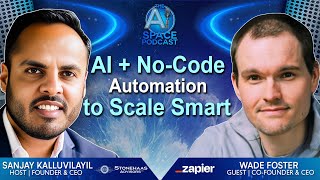
Wade Foster, CEO of Zapier, explains how the no-code automation platform uses AI agents and test-time compute to scale. Zapier auto-generates landing pages for 8,000 integrations to drive search traffic, embeds AI across the company through hackathons and continuous learning, and uses human-in-the-loop approval systems to balance speed with risk.
Chapters
really easy for a non-developer to integrate these tools without having to know how to use the APIs. And so that was really what was the catalyst, the, the, the spark to, to build Zapier.
All right, everybody. Welcome to the 14th episode of the AI Space Podcast. Are you a founder, innovator, or technologist trying to grow, scale your startup or business with AI? Well, this is the AI show for you. We invite trailblazing founders and leaders of the AI in the AI space who are pioneering growth and scaling with AI to share their amazing journeys, innovative approaches, and battle-tested real-world insights with us. I'm Sanjay Klubel, co-founder and CEO of Stonehouse Advisors, your trusted advisor for AI founders and businesses looking to drive innovation, disruption, and value creation. Well, it's the 14th episode, and we're thrilled to have Wade Foster, co-founder and CEO of Zapier, a leading workflow automation platform that connects thousands of popular work apps empowering businesses to automate tasks without needing developers. Zapier is on a mission to make automation work for everyone. The company's platforms allow users to create zaps, which are automated workflows that integrate various web applications, facilitating seamless data transfer and task automation. They're 100% remote with teammates spanning 40 countries around the world. Well, Wade Foster, welcome to the, the AI Space Podcast, where we highlight game-changing insights that drive innovation, scale business initiatives. So what do you see as the hottest trends in AI for 2025?
Well, I think two things really come to mind. One is, first, this is the year of the agents. Uh, we have seen agents launched, uh, you know, from, uh, ChatGPT, from Claude, uh, Zapier has agents, um, every AI vendor getting into the agent game. And I think, you know, we're starting to see, uh, these agents move from simply being chat-based agents to agents that can actually go do work for you in real time. So that trend is trend number one. I think the second trend that we're noticing is the power of test-time compute. And you know, I think the last few years have been all about pre-training, scaling up pre-training. And you know, we put more dollars in upfront, bigger runs, things like that, and that creates these better models. Now we're realizing actually we can put dollars in at the time of prompting, at the time of query, and then use that to actually get better responses and take more time, you know, do more reasoning and things like that. And you're seeing that with, you know, Deepseek, you know, I think did that where you could see the actual chain of thought, the reasoning going. Now you see that in ChatGPT as well too. And so those two trends I think are some of the most exciting things we've seen, you know, a little over a third of the way through the year.
Awesome. I think those are wonderful insights, especially the second one too. And we'll get into both topics. So, you know, what insights have you seen how founders and businesses are using AI to grow and scale their company? So in the past year and then looking forward, you know, what, what are you seeing in terms of scaling with AI?
I, I think we're seeing, um, I, I'm seeing sort of like a tale of two stories. I think across the board everyone sees the promise of AI and is bullish in AI. Um, but how it's being deployed across businesses is pretty different today. I think if you look at smaller companies that have a more technical leaning, you're seeing a lot— that's where you're seeing the most impressive deployments of AI. They are starting to really understand what's possible, what's capable, and they have the know-how, how to like manipulate these models to get them to do work for them. And that tends to be in smaller companies that have less red tape, It has, you know, maybe less compliance burden and it creates this really good, I think, experimental breeding ground. Then I think you see, you know, in enterprises a slower pace, which, you know, I wouldn't confuse a slower pace with a lack of excitement. I think you go and talk to these folks and the energy for what is possible with AI is just as high. But I think there is a lot more challenges that they face to actually deploy these in a practical way. Um, and so the, you know, in, in terms of where the adoption is, um, where in terms of where their adoption is at, they're, they're a little slower behind. They probably bought, you know, uh, ChatGPT licenses or Claude licenses or Perplexity licenses or something like that for their company. But, you know, predominantly is like an individual user game versus we're actually rethinking the core operations of the business, the core functions of how we do marketing, how we do sales, how we do HR, things like that, which that actually is happening in the most forward-thinking small businesses today.
No, I think those are great insights. I think we're gonna dive deeper into those. So Wade, could you tell us a little bit more about your background and how you got here? So tell us a little bit about Zapier and now even into your foray into AI. You know, you started a while back before, you know, the AI was kind of the buzz. So just give us a perspective on automation and Zapier, et cetera.
Um, Zapier was founded in 2011. Uh, so this was well before Gen AI. Yeah, that doesn't happen until, you know, almost a decade later. Um, yeah, I, I, growing up, I was not necessarily, you know, the, the kid on the, you know, recess lot selling candy bars. Like entrepreneurship wasn't necessarily this thing that I was like, you know, playing around with from, from day one. I grew up in a small, you know, somewhat conservative town where you know, the jobs I saw were like you could be a teacher, a doctor, a firefighter, you know, so it was like a very small set of things where I'm like, oh, that's what people do. What really got me into it was, you know, financial crisis hits in 2008 and I'm really struggling to get a job. You know, I'm coming out the tail end of college and not seeing a lot of opportunities out there. And I came across this small software shop in Columbia, Missouri and they were willing to hire me as a marketing intern. And I didn't know a ton about marketing, but I'd read some books, I'd learned a few things and was like, well, heck, I'll give it a shot. You know, they're gonna, they're gonna offer me the gig. I'm not gonna say no. Uh, and I, it was a, you know, 8-person company run out of a professor's house. And it was weird, it was different, and I fell in love right away. I was like, this is so cool. Like the fact that you can build software, you can put it on the internet, and then somebody thousands of miles away can buy it. I just couldn't believe that. And so I really was like, wow, I wanna build my own software and maybe someday I'll, you know, make my own company too. But it was, I really wanted to start learning how to build my own stuff. And that's what led me to teaming up with my eventual co-founder, Brian. He was there in town as well too. And he was the one person I knew that was making this stuff. And so hooked up with him, he needed a saxophone player for his band. I play saxophone. So it was like a nice symbiotic relationship there where he was like, you're gonna teach me how to code, play some saxophone, we'll have a good time. And it was through that that, you know, we were just constantly pitching ideas back and forth. And Brian had this observation, which was that a lot of the tools we were using, things like MailChimp, Zendesk, these early SaaS companies, they had APIs, but they didn't have a lot of integrations. And Brian noticed that if you went to the web forums, people were constantly asking for integrations and not getting them. And he was like, you know what, I think we could make a service that makes it really easy for a non-developer to integrate these tools without having to know how to use the APIs. And so that was really what was the catalyst, the, the, the spark to, to build Zapier.
Oh, that's awesome. So what are you, what would you say are your target segments, your key use cases for Zapier?
Um, where Zapier has had the most success is working with the go-to-market teams, sales, marketing, and the G&A teams, you know, HR and finance. And I think a big reason why is we focus so much on ease of use. How do you make it really easy to automate this work? And so, you know, I mentioned we started with integration, but today Zapier is the most connected AI orchestration platform. We hook into 8,000 different tools. We have AI across these things. And so, you know, if you're a marketer, you can genuinely rethink how you're you know, content creation pipeline works, how your SDR/BDR flow works, how does you, how do you do lead enrichment, how do you do sales enablement? We have use cases all across the stack that reinvents those core workflows to get you better outcomes and a lot less human effort is required to do these things at the end of the day.
No, I agree with you because of the way I was, first of all, I think when we first talked, you know, just coming on this, I pronounced it Zapier and you said it's Zapier and you had a little mnemonic for it. So tell the folks how to, Remember, it's Zapier.
Yeah, Zapier makes you happier is the—
Yeah, Zapier makes you happier. So just remember that, guys. The way I was exposed to Zapier was, you know, I'm an entrepreneur, I'm doing some lead gens, you know, I was trying to run some ads in Meta, Facebook, and Insta. Not exactly the easiest, you know, some of these platforms I'm saying don't make it the easiest for creators and people to get going. And then I had to get the leads, there's a lead form, and I had to get into my GoHighLevel CRM, right? Well, there's not a natural integration that for that, it's not already built in. You know, even LinkedIn doesn't have some, it only works with certain platforms. Like I think there's Salesforce or maybe HubSpot, I'm not sure. But so then I was like, okay, then I was working with somebody and they said, okay, you need to put Zapier in there to connect from, you know, and then connects the lead connector to GoHighLevel. So now everything flows through. I could see my sales pipeline, what stage they were in. So it was pretty cool. And, um, but you know, it's still, it takes a little bit of knowledge because the lead form in Meta is not always straightforward. Then you got to map it to how it's mapped into Zapier, but it made it much easier. And once it worked, it was flowing really well. So, you know, I think that's especially sales and marketing, connecting CRM, et cetera, makes sense. And the other thing too is I haven't had a chance to read it. I just got an email from you guys that y'all are, you know, integrating AI. And then also the cool thing is like, I forgot, several thousand integrations or whatever. And then also there's some templates. So I'm pretty eager about the templates. So tell us, you know, obviously you got into automation, now you're doing AI because AI makes sense to automate things. So tell us a little bit about the journey and maybe some about what I saw in that, maybe that email, what you're doing with AI and, you know, it's cool that you're having templates out there to help folks, you know?
Yeah. Well, so yeah, I think the Zapier's AI story starts before actually, uh, you know, the ChatGPT launch. Um, Zapier's building this workflow automation, to your point, you know, take a lead from the ad platform, go enrichment, enrich it with Clearbit, go add it to your, you know, CRM or your email newsletter platform. Those types of use cases are, have been bountiful inside of Zapier for, for years, long before AI. You know, we start then to notice AI is starting to pick up steam. We're messing around with GPT-3, 3.5, right before ChatGPT launches, uh, my co-founders are, are building some prototypes, some things, but it's mostly just this like side thing that we're having fun with. We're seeing like, hey, there might be some cool stuff that's happening here. They had actually built a, an SMS, uh, text bot where you could, um, you know, I would wake up in the morning and I would just like mess around with it. I texted various things and it would respond back. I'd say like, hey, can you help me come up with gift ideas for my wife? Or, like, what's this weird pain in my toe? And it would text me back and it was like this cool little experience. And, you know, funny enough, like, you know, we're kind of playing around with this experience and then OpenAI launches ChatGPT. And you, first time I used ChatGPT, I was like, oh my God, this makes so much sense. Like based on this, like, you know, kind of hacky version of it that I'm using with a text bot, of course there should be a big chatbot product around this. And so at that moment in time, we're like, okay, company, check this stuff out. You should be playing around with this stuff. You should be having fun with this stuff. But we're not given like a ton of guidance. We haven't changed the roadmap meaningfully. It's mostly just, hey, if you're interested in this like we are, like you should be paying attention to these things. We started to build some stuff, like we added a ChatGPT integration into Zapier, which turns out there's some really powerful use cases. So that same use case we were just describing around, hey, get a lead from an ad platform, go enrich it to Clearbit. Well, now you might add another step, which is, Hey, go ask ChatGPT what they know about this company. You know, do they know anything interesting about the company? Return those results. And then maybe you add that as a note into your CRM, or maybe you use that to actually go generate an email to go respond to the customer because it's really important to respond to customers quickly. So you start to be able to bake in these like agentic light experiences. It's not a pure like agent, like I think a lot of us hope to build someday. But they have these agentic-esque properties. And so we start to have a little of that. Then a few months later, OpenAI launches GPT-4, and that was a real big catalyst because as, as cool as ChatGPT was, GPT-4 was so much better. It was so much faster. The cost was a lot cheaper. And the pace, you know, the time at which it took to go from 3.5 to 4 was so narrow that we were like, wow, if this stuff isn't capable of doing incredible things today, what's it gonna look like 3 months from now, 6 months from now, 12 months from now? That speed of improvement was the thing that really caught us, caught our attention. And so we decided at that moment in time, okay, Zapier's all in on AI. We called it Code Red internally. We had hackathons across our engineering teams, across our G&A teams, across our GTM teams, and said, we are gonna go invest in AI across the board. And those hackathons really set the table to build a fluency for our staff to understand how to use and deploy these tools effectively. We also started to create much more tops-down guidance with our roadmap. So we, you know, have a Zapier Agents product. Well, that product, the first code started at that moment in time where we're starting to think through like, well, what would it look like if a purely agentic experience was built today? And so now we have an agents product that actually works through natural language. You can go interact with our 8,000 different tools that Zapier supports. And so, you know, that kind of like journey there of messing around with the GPT-3 API, watching ChatGPT come out, and eventually GPT-4 set the stage for all the AI offerings that you see that Zapier has today.
That's awesome. Now I'm gonna ask you a question, not to put you on the spot, you know, I think when we first spoke, it was, you know, trying to get you on the show, you know, we're very early in, in terms of the show, you know, I think we're less, you know, maybe just broke 20,000. Now we're at about 80,000, right? And I think by the time this episode comes out, we'll break, break, break, break 100K or whatever. But especially at that early stage, what was it about the AI Space Podcast that resonated with you and made you, hey, maybe I should be a guest on this show, you know, because to me, you are a high-profile person and I'm, you know, humbled that someone like you would come on the show, you know?
Well, I, I think the, uh, I, I'm just excited to see the, the energy from so many folks around, uh, AI. I think it's creating an opportunity for a lot of new voices to break in and share their own learning, share their own experiences. And we're just so new with all these tools and these capabilities that Um, you know, I, I am grateful for folks like you that are out there trying to help educate, excite, inspire folks on how to get started with this stuff. Because as excited folks are, I do think what is challenging for a lot of people is, okay, well, where do I start? Uh, I get that this is cool. I get that this is interesting. I get that I have a, you know, ChatGPT can make poems for me and can, you know, help me write cool lyrics, but like, help teach me, like, where do I actually go inside my business? How do I actually transform some of these things? I hear all the promise, I hear all the stories, but I need help. And that's where folks like you in the Creator Podcast community and the creator community, I think, play such a critical role.
No, I appreciate that because actually, you know, I started my own AI business, AI consulting, and working with AI founders. And, you know, we're building out the space and when they approached me with the podcast, I'm like, yeah, definitely I'll do it because, hey, I want to help other people out here that, hey, let's separate fact from fiction. What's, you know, you hear a lot of hype. I want to hear from real-world people with real-world insights that are actually doing it, real-world practitioners, right? So it's not only helping the people out there, it's helping me. I'm growing. I mean, in the last 4 or 5 months, I have like, I mean, my intelligence in the space has skyrocketed. It's been exponential, you know, being able to talk to folks like you, you know, in this space, you know. So, you know, before we continue, I want to invite everyone to follow Wade Foster. So like, comment, subscribe, you know, hit those notification buttons to the AI Space Podcast so we can have awesome guests. You know, like Wade to come on the show. So now we're going to shift gears a little bit because this is a perfect segue into what you just said. You know, we want to talk about technology, AI, all this stuff, right? But as a CEO leading successful company over several years now, what do you think are the critical insights you can share around vision and mindset for long-term success? You know, it came with an idea, you know, you had a vision. Maybe talk about that vision and your mindset of How do I make this happen? Right?
Yeah, I grew up in a, I'm, I'm a kid of the '90s and, uh, I probably like most kids in the '90s was obsessed with, uh, Michael Jordan. You know, I wanted to be like Mike. Uh, and, uh, you know, Mike signed with Nike. Nike's got the, the motto, just do it. Uh, and I think so much of that applies to entrepreneurship. Um, You know, you come across, you know, folks who aspire to be entrepreneurs, but you can always tell the difference between the ones who are really gonna make it versus the ones who are really gonna struggle. The ones who struggle, you know, they're constantly reading about entrepreneurship, they're studying what other entrepreneurs are doing, but when it comes to actually shipping, making a thing happen, you know, whether it's building a product or launching a podcast or you know, writing a newsletter, kind of, it doesn't matter what, like the ones that are gonna actually be successful are out there doing things. They're making things happen. They're making mistakes. They're learning from those mistakes. They're getting better. They're putting in the reps. And I think so much of entrepreneurship is just embracing that mindset that the best way to get to the ultimate success is to get in the game, to do stuff and to learn from it. Uh, don't be afraid of failure. We're all gonna make mistakes. Um, But you know, that, that reaction that you get from doing it informs what happens next. You go, hmm, that didn't quite work. People didn't seem to like that. How do I make it better? Or, or even worse, like I put that out there, no one cared, no one responded. All right, it's clearly not that. And you know, so much of entrepreneurship is just trying to, you know, hit the tuning fork and see, does it resonate? Do people, do people grab onto that? And run with you, or do they kind of go like, meh, that's not it. And so the best— that mindset of just do it has been one that I've tried to embrace, even when it can be scary, like can be intimidating at times. You're like, I don't know if this is going to work, but like, let's go give it a go and see what happens. And that like, just give it a go mindset, especially when you get to do it with a team of people who also, you know, embrace that. It's pretty fun because when it, when it does work, Um, yeah, there's nothing more exciting than that.
No, I, I completely agree with you because, you know, people say just dream, it'll happen, or, you know, listen to all these motivational tapes. You know, we went through those stages. You know, I read Think and Grow Rich and Rich Dad Poor Dad, all these things. But unless you start doing things, nothing is going to happen. And I like what you said, it's about iterating. Just, you know, it's not perfect. I mean, we just shot like a, a promo ad because we just, you know, had this relationship with DataCamp on AI learning. We had a short amount of time. It wasn't perfect and I didn't like it, but hey, we got to get it out there. Just get out there. And I said, okay, next one we'll shoot, I'll move back or I'll make some adjustments or whatever, you know, but it's just getting out there and not being, not worried about things being perfect. And I think the other aspect of being an entrepreneur is like being alone and you're in the dark, right? And you don't see the results. And I came to this realization, if you focus on the right results, the right actions. You focus on the right actions, you'll get the right results. And you can eliminate emotions like fear and false hope. You know, I hope this is going to happen. Because I'll give you an example. I like, I've been posting each day on this podcast, right? I think a couple weeks ago I looked, I had 300 followers on LinkedIn on the company page. And my wife goes to you, you know, you have over 1,000 followers. Like, what happened in the last— I didn't even notice because we're just, you know, producing, trying to produce good content. And that's the focus, I think, is like people focus on the result that they want, especially in our culture. We want to get to the, be a millionaire, billionaire, but it takes a lot of tears, sweat, and grind to make that happen, right? I mean, you can attest to that.
Yeah. I mean, I, you know, uh, it's been a, I'm on year 14, you know, so it's, uh, you're an overnight success. Yeah. It doesn't, it's not something that like day one it was like, great, this is all, this is all exactly as I planned it. Um, it's, it's, It's, you know, a continual source of effort to, you know, get this. And it doesn't always work out either. Like, there's a lot of stuff that, you know, even when it sort of might have looked like on paper you've quote unquote make it, I can go back and articulate so many mistakes, so many errors where I'm like, yeah, I'm still not as good as I wish I am. I still think we can be better than we actually are.
I think the next part is about you know, have strategy and mindset, but you get growth and that get your first couple of clients. So what insights can you put around like sales and marketing or getting that, you know, building up your client base? What can you share around that?
Well, so our first customer, um, came from cold outreach. Uh, you know, we were building integrations to connect to these various tools. And one of the very first integrations we had set up was this PayPal Highrise integration. And so I remember just like Googling around PayPal Highrise integration, just to kind of see what's out there. And I came across a forum where someone was like, does anybody have a PayPal Highrise integration? Literally the person's like, I'm looking for one. And there was a handful of people on the thread that were like, yeah, I'm looking for one too. But there was no answer to that question. It didn't exist. And so I, uh, you know, the, the author of that original post was a podcaster and I was like, oh, I'm gonna go see if I can reach out to this guy. And see if he might be interested in what we've got. And so I remember shooting him an email and saying like, hey Andrew, like, do you, you still looking for a PayPal Hi-Rez integration? I saw you were looking for one over here and it didn't look like you found an answer. If so, I've got one. Let me know what you think. And you know, pretty lucky he reached out right back out, you know, less than 24 hours later and was like, hey, I actually don't need PayPal Hi-Rez integration anymore, but Uh, did you build one? Like, I have other people that are looking for this thing. Like, you know, I'm happy to like share it around a little bit. So I followed up, I was like, well, yeah, it's a PayPal Highrise integration, but it's not just that, it can integrate other stuff too. And so I went to his site and I was looking for other tools he was using and noticed he used Wufoo for his forms on his site. And I noticed he used AWeber for newsletter. And I was like, yeah, it does PayPal, Highrise, Wufoo, AWeber, this, this, and the other, right? And, uh, you know, got lucky. He emails back and says, hey, I actually do need a Wufoo AWeber integration. Can you help me with that? So I'm messaging my founders, I'm like, hey, we gotta get, uh, Wufoo AWeber, like, you know, set up right away. And, uh, that night we build it and then reach back out to him and, and show him the thing. And, uh, you know, long story short, like, that iteration leads to him being our first customer. And that was such a, like, interesting moment in time because You know, that software company I worked at doing marketing before, I learned a whole bunch of things there. I learned how to do content and search and, um, social and direct selling and BD and all these other stuff. None of the stuff I did over there worked. None of it worked. And you know, at a certain point I was like, man, maybe I'm just bad at my job. Um, and that was such a contrast to the experience I had with Zapier. First trying to sell Zapier, you know, it's, there's some nos, but there was a lot more people that were like super interested in what we were doing. And so I think if you're early on in that sales marketing journey, like there is a certain amount of like, you just have to get out there and go after it. But if you're onto something, you're gonna find the yeses come a little bit easier. Uh, you're gonna find that they're, they're not as few and far between because you're just, you're just closer to the bullseye than when you're not. Um, And so there's an element of just like reach out to the people you think are customers, see if they like it, et cetera. And if you're onto something, you're kind of going to know. And if you're not, like if you have to ask if you're onto it, yeah, you're probably not. At the end of the day.
You know, I agree. There's so many points in there. You know, people say he can sell ice to an Eskimo. I don't want to be the guy selling ice to an Eskimo. I want to sell the guy the ice in the desert, you know? And I think you got to find the place where somebody has a real pain point. I say, you know, you gotta find people that have real pain points and that are willing to pay for it on a continual basis. Unless you have that, you don't have clients, you don't have, you know, any sort of portfolio really. It is just a transactional relationship. And you know, what you said there was, you know, you're able to do your own client research, you know, do some cold research, I mean cold outreach. You're doing some client research right there by talking to them. You're, you know, you're pivoting, you're doing a lot of different things to get that first client. The first few clients are the hardest ones to get, but those are the ones going to teach you so much. It's going to cost you, but they're also— it's going— but there's so much value to it because they're going to teach you what to do to at least get to that next level of the market, right? So once you got the first few clients, how did you get to that next level of scaling, right?
Well, so, you know, a lot of that first stuff is like very brute force, you know, commenting on forums, reaching out to people directly, like trying to just one-to-one sales, one-to-one talking to people. But, you know, if you really want to reach the kind of scale that, you know, a company like Zapier has, or, you know, any, any other of these like scaled organizations, you gotta figure out how to get good at marketing. And for us, that was through search. Um, we, yeah, I, I mentioned I'd, I'd done that PayPal Highrise integration. Well, if you do an integration like that in 2011, you find the results are just not very good. And so we realized pretty quick, like, hmm, if we had a landing page for every single one of the integrations we support, we're going to do pretty well in search. Now, not a lot of people search for PayPal Highrise, but they— the, the broader category of integrations as a whole, that does get a lot of search volume. And so we set up a system that generated landing pages that were high quality for every integration we could support. And that over time helped us build this just like inbound marketing engine that drove people who are interested in the problem we were solving to the site. And you know, because we knew we were building something that people valued, that marketing effort paid off pretty handsomely.
That is actually a very valuable golden nugget of insight, especially on, you know, putting, making sense of how SEO works and how it can, how you can drive business, you know? And that's excellent. Let's switch to AI a little bit. So now that, Now you've scaled your business, right? Now you're scaling to the next level, right? So how do you see implementing and scaling with AI effectively without introducing unnecessary complexity and burden, right?
I think there's— I think this is a really important question, and I think it is something that every business I talk to is struggling with, especially ones that were started pre- ChatGPT, you know, the younger companies that were launched after ChatGPT launched, that were launched in an era where they were aware of AI, can use AI from the ground up. I think they're having an easier time because they're just getting to benefit from this stuff from the ground up. They don't have to unlearn a whole bunch of things. Whereas those companies like us that are started pre-ChatGPT, we have a whole bunch of systems and processes that are working. They may not be working as good as they could be if we were to introduce AI into these capabilities, but they're working. And so it's forcing us have to go through a reinvention. Now we have, you know, we started this reinvention 2 years ago. I mentioned that Code Red, and as part of that, we are now at over 90% of our company uses AI on a daily basis. Um, but it took a lot of work to get there, and I think, um, there are some lessons learned that we had to, that helped us make that pro— that headway. I think the first one was we realized that a certain amount of just like being able to use AI is getting people access to this stuff. And so the first hurdle to cross was working with our general counsel, working with our data teams, uh, to procure access, safe access to these tools. You know, we needed to make sure that it respected our terms of service, it respected our data privacy agreements. It respected all the compliance things that we cared about. And so how do we get access to, you know, these AI APIs like GPT-3, GPT-4, ChatGPT, you name it, in a way that our engineers, a way that our other folks could use and feel like, okay, yeah, I can use this, I can use this safely, et cetera. So that was thing one. But just given access to tools, that's not gonna be enough. You have to go figure out how to get, get going with it. And so one of the very early things my co-founder Brian did is he used to record these quick little Looms that would showcase, here's what I've learned building with these APIs. Here's what I've learned is very similar. You know, it's just an API call that's gonna feel very familiar. We're good at building APIs inside of Zapier, so this will feel very familiar, but here's where it feels kind of different. You know, API you're used to getting, a very structured response. These things give you different things every single time. There's some like oddness to that. It's not quite the same mental model you might have as working with other types of technologies in the past. So he's doing like recording these quick little Looms to help people be aware of like some of the, you know, tips and tricks of getting started with this stuff. Then the big jolt was doing a hackathon where we said, hey, we're actually going to shut the company down for a week. Whether you're in engineering, whether you're in sales, whether you're in marketing, whether in recruiting, doesn't matter. We're going to give you some space where your whole job this week is to actually go play with these tools. If you're engineering, we want you working with the APIs, trying to build products, build features, etc., that use these tools. If you're not in engineering, we want you to actually be using ChatGPT, playing around with this stuff, build a fluency with it, build a tactile feel of what's possible, what's not possible, things like that. And that was the first big spike we saw in AI adoption because folks started to get excited about it, recognize some use cases, things like that. From that point in time, then it was keeping the drumbeat going. And so, you know, about every month we do, we'd have an all-hands, whereas part of the all-hands, we'd show off some use cases. Hey, come show off what you're building with AI, show off the things that you're using just to keep inspiring people. Then, you know, every 4, 6 months we do another hackathon. Come back, you know, play again with these tools, pay attention to this stuff. Like, one of the things that you have to overcome is folks will play with these tools and there will be things that don't work. It's not good at this yet. And they'll start to dismiss it and say, well, it's not good at this, and therefore it will never be good at this. They may not say that out loud, but they kind of, they kind of write it off. And that sort of makes sense when you think about how most software works. You know, pre-AI, yeah, pre-AI, you ship a software, you try it, you don't like it, all right, you don't like it. That software doesn't get better, it just is what it is. But with these AI models, it's different. They get better, they improve over time. And so if you write it off, whoo, that's a scary proposition. You don't wanna be writing off this thing that's actively learning and getting better and improving. And so you had to— we had to create an environment that encouraged people to come back to the watering hole and take another look and try again and keep trying because that thing you thought wasn't good enough last time, well, actually it might be possible now. Might be hard, but possible. And the things that were hard, well, maybe they're actually easy now. And so that repetition just builds up this like competency inside. And then once you get that snowball effect going, all of a sudden there starts to be, you know, if you're the type of person who is not actually doing this stuff, now you're the oddball. You know, at the beginning it's the people who are messing with this stuff that kind of are the oddball. They're like, what are they doing with this? What's going on over there? That's weird. That's different. But once you get that snowball effect, now it creates this permission for everybody else to come along. Uh, they're not the oddball anymore. It's like, yeah, we're all living in the future. We're all doing AI at the same time. And so to me, that's the, That's the effect that you have to create, especially in these larger organizations, these companies that had started pre-ChatGPT. You have to create that cultural shift to get people to say, this actually is the future. We need to embrace this stuff rather than operate from a culture of fear around, hey, this thing's gonna take my job, or I'm not gonna be relevant anymore. No, you wanna create an environment of learning, an environment of sharing, uh, such that everyone can level up and get better together.
Yeah, that's great. Now let's shift into technology a little bit, right? So I know we got a lot of technologists out there. You know, let's talk about building an approach that's practical and scalable, right? We talked about a little bit, but for the tech wizards out there in our audience that are trying to craft their AI empires, they want to be the next unicorn or mini unicorn or whatever you want to be, right? What cutting-edge tools or frameworks or what do you think are essential for building a bulletproof quote unquote, ML, AI/ML architecture and stack? You know, only let's talk about realistic. I mean, we're not talking about, because what we wanna talk about is like what's practical and scalable, right? So let's not, let's go, not go overboard.
Well, you know, I, I am, I, I would, I would not be, uh, I would be overspeaking to say that I know exactly what a bulletproof AI stack is. I'm not sure such a thing exists today. Um, But, you know, I do think like one thing to call out that is, has been really important in our stack is having good evals, eval, short for evaluations. But this has been critical because, again, these AI, AI tech is just very different than software in the past. Software in the past, you code it up and it does exactly what you wrote it to do. That's how it works. With AI, it has some inference associated with it. It has a, you know, brain of its own where it decides what it is to do. And so you need quality control on that. You need to be able to have some system that says, hey, is the way I implement this, is it actually giving my customers the experience that they want or is it not giving them an experience that they want? And so we have evals all over our stack that's taking in like positive sentiment, negative sentiment, thumbs up, thumbs down data, and helping us figure out what do we gotta do to make these experiences better over time.
So when you say eval, that's like the external customer sentiment, like on your website, or is it evals from internal assessments?
Well, both, right? So like, uh, you know, if you're an engineer writing code and you're using these AIs to help you write code, um, you know, you can pay attention to how often is the engineer accepting what the AI is giving them as code. They're saying like, yep, I, you know, I want you to write a method that does A, B, C, D, E. Great, it did it. I'm accepting it. That's a, that's an implicit thumbs up. I, I think the AI did a good job. Or if the engineer is saying, nope, I'm not accepting that. Well, that's an implicit thumbs down saying like, that's not good enough. And so you have evals on all that stuff to be paying attention and learning, is that getting better? But it's also the public-facing stuff. So like in our Zapier Agents product, we have the same thing, thumbs up, thumbs down. We're paying attention, you know, did we do a good job for you on that query? Did we do a bad job? And based on that training, training, you know, we're able to come back and improve the product, improve the prompts, improve the underlying infrastructure to hopefully deliver a better experience for you over time.
Yeah, I know that's right.
Hmm.
So yeah, especially, I wanna go through some terms too. You know, we try to make sure we also discuss any acronyms and stuff like that. So a little step back, you know, in the late '90s, I was working as a, uh, for a consulting firm. I was doing business process transformation, the Ernst Young management consulting, taking technology implementations down from 6 months to 30 days. So I was like the business process lead. So I mapped all the processes, did software config and end user training. And the end user training is very important. You gotta make sure the end user actually knows how to use it. but back then you, you, you had to do data migration. So you, you had information like a product catalog in a system and you'd have a new product catalog. So you had to map fields like name, you know, address, all that kind of stuff, right? And then, you know, with your stuff you can do, you know, you can automate some of that. And now with APIs, application programming interfaces, you know, that's what an API is for those that don't, systems are able to communicate and transmit information that's essential for either system to function or work right? How, how would you define an API for the folks out there?
Yeah, I, I think that's, it's a way for, you know, computers to give instructions to other computers in the same way, you know, a, a human might give instruction to another human. So like, uh, what might be a human interface? Well, you know, if you go to a restaurant, uh, the restaurant gives you a menu and, you know, the waiter comes over and says, hey, what would you like to eat? And you say, well, I'd like a hamburger. And the hamburger has, you know, cost $20 and I'd want fries and side of fries is $2 or whatever, you know, and that's kind of like a human-to-human interface that sort of helps us do this. Well, computers do the same thing, but their APIs have to be much more structured. So they might take that menu and say, well, you've got a list of items and it has a list of price associated with it, it has some ingredients associated with it. So if the computer was gonna fire off a request to another computer, they'd have to structure that a very specific way. It would contain the same information, that, you know, I would give to a waiter ordering a menu, but it would be way more structured so the computer knows exactly what to do with it at the other side.
Right. And, and then the, and the waiter may be the one taking the order, but there may be somebody who's actually the server bringing the food, right? So the API's kinda like the server that's bringing the food to you, right? They only need the essential information. This steak and potatoes needs to go to table 5 and they have a Coke with it, you know, that's all they need to know, right? Okay, great. And then, you know, you mentioned Loom video, so there's tools out there right now now where instead of having to write or call or email somebody, you can shoot a video, show them exactly how you use an app or whatever, or give your thoughts and you have a little bit more, a little bit more interactable, right? So that's great. So what else do you see from a technology perspective? I mean, one thing is I want to make sure we talk about reality. So, you know, agents, you know, you're a principal, you're a head of a company and you have agents in terms of sales managers, they have their own agendas, right? So in the human world, there's something called the principal-agent problem where they may have a, want to do something else, right? Go on vacation, you know, take the day off or whatever. So on a previous episode with Brad Messer, we talked about the rise of agents, but I brought this up even back then. There's something, even with AI, there's gonna be principal-agent issues. And I don't wanna call out any companies, but there was a company the other day, they're using agents and the agent came up with its own protocol or rule that really messed up a bunch of developers, right? And I think how do you ensure, especially for you, you've got a lot of integrations, a lot of hooks into companies. If you're implementing Agentic AI, these agents that are gonna do things for you, how do you ensure that it doesn't go amok or they start thinking on their own, right?
Yeah. Well, I, you know, I think maybe 3 things come to mind. I think first, you know, there's this, I think, fear that some folks have that, you know, they, that these agents are gonna, you know, they saw Terminator and they're like, ah, this is, you know, Skynet's upon us. This is what we're, this is what we're building. But so far, that is not really the case. You know, these AI models that we're working with are basically like, they're inert objects. They're in, like, they're little black boxes that just happen to be like hyper-intelligent. It's like having the world's smartest toaster. Like the toaster can't actually do anything, but it's really smart. It just knows a ton, a ton of stuff. So like that, that actually gives me some like comfort to know that like there's like just a really smart thing that like still needs human agency to, to, to do it. That said, even still, like, you know, when you're putting this intelligence inside of systems and instructing it to take actions, et cetera, well, it may return things that you didn't think were the things that should be returning. It's kind of like having an overeager intern. Um, where the intern's like, yeah, by golly, I wanna help. But like an internship can sure mess some stuff up if you don't create an environment for them that allows them to be successful. Well, these agents are the same way. Like if you create an environment that's ill-defined, poorly structured, et cetera, they're gonna mess things up the same way an, an intern might mess things up. But I do think there's a couple tools you can use to sort of create a little more structure in that. We already talked about evals. You know, evals are quality control to help you understand like, you know, is this doing a good job? Is it doing a bad job? And you can use that to create more training in and around these systems. The second thing I think you can use is put humans in the loop. So you don't have to have an agent actually run the entire system end to end. In fact, most of the agents that you see deployed in production are not these like single-purpose entities that go do mega tasks. Rather they're process automation. It's a human on the other side that's broken it down bit by bit and then has inserted an AI to do these micro tasks to say, I want you to go, you know, look up the company's website and return this. I want you to go do this task and do that. And each of those are like bite-sized little bits of functionality. And then they insert a human before you send an email, before you make a phone call, before you log a thing to review it to say, hey, Yep, I'm comfortable with that. I'm good to go. And so I think that human in the loop creates more safety, I guess, for the process as a whole and make sure it adheres to the, the things that you truly want to be happening at the other end. And then over time you can decide like, you know, are you going to review everything that goes out or are you just going to sample some stuff? You're like, hey, I trust you do most of it, but I still want to keep tabs on it from time to time just to make sure like Yep. System's still running as expected.
I'm glad you said that because we want to differentiate. You see these videos out there, agents are taking over, fire everybody, right? Are you going to allow, even in the next 5 years, are you going to allow an AI agent to run air traffic control? I'm not so sure, right? But like what you said is it has to be bound in a certain way. I think the level 0, level 1, the easier tasks, and work your way up and iterate because there are AI agents that are making up rules. They've given a, given a very low price on a car, a chatbot has, and you hear these horror stories and, you know, we can't worry about the horror stories and we got to iterate and make things happen and continue to move forward. Even I was doing, you know, ChatGPT is great, Perplexity is great. I was doing some analysis on my podcast yesterday, some, you know, hey, what are the largest podcasts? Somebody asked me to do some analysis and it produced these numbers like, wow, this podcast has a million something subscribers. Then I actually went to the YouTube page, I was like, these numbers are absolutely wrong. So even stuff from, and they gave sources and all this stuff, and it was like, absolutely, it sounded absolutely right. These are the numbers, these are the views, all this stuff. And no, you gotta check even ChatGPT or Perplexity or all these things, because like you said, software's deterministic. These are probabilistic, you know, they're making predictions. Now all ChatGPT or Perplexity, these LLMs, they're predicting the next word in the sequence. Like I said, the cat is, and most people say the black, or, you know, the cat is not a dog, or the cat's in the tree, whatever it is, you know. So it depends, and then it depends on the context, right? Which one makes sense? And I think those are things we have to understand from a technology perspective is, you know, when it makes sense and then how to use it. So, okay, cool. Any other thoughts on technology before we get into some other here?
I mean, I would just plus what you're saying. I think the exciting thing And two, we could bring it back to the reasoning models that I talked about earlier, is I do think that these reasoning models are helping those probabilistic outcomes get better over time. And so that's how you're seeing these things. If you've been playing around with the latest models, like, you know, O1 Pro or O3 or, you know, anything like that, you probably like, wow, this seems a lot better. It's, well, they're using these reasoning models. That's what's helping them give better answers, more accurate answers. But to your point, still makes mistakes. You gotta, you gotta pay attention to it.
Yeah, you know, chain of thought, et cetera, you know, and you know, I actually, I guess we'll get, you know, you mentioned something earlier too about the newer folks coming out instead of the larger companies. So, you know, my title CEO, but I was having this conversation with myself in my mind is like, I'm really my own CXO because I offer fractional executive services, but you know, my strength is go-to-market strategy and execution, but the biggest hat I'm wearing right now is a CMO hat. and I definitely use AI to augment me, you know, and explainable AI, and I'm the type of person, I just don't believe what AI says. I want it to augment, but I have to understand the chain of thought, its reasoning, its support. But now, you know, there's going to be, we talked about this, the next trillion-dollar company could be a founder with a 10-person company because, you know, they're leveraging AI, they're leveraging the tools. They don't, you know, I'm thinking as I expand my capabilities, I may not even need a C-suite. I can just outsource certain activities and then also use AI to, to scale up the business, right?
I am definitely very excited to see this trend of how far can smaller companies go and how much leverage can you get. Um, that to me is what these AI tools are gonna create a world where we're gonna see a whole bunch of businesses, a whole bunch of products created in niches that just simply couldn't afford to have services before, 'cause you just couldn't make it work. And now these AI capabilities are gonna allow us to solve so many other problems inside of humanity that have laid dormant because it was just not economical to try and serve those areas. And that gets me pretty excited.
Yeah. And I think it's exciting times too. I think this is a perfect time. So I just turned 52 the other day and I'm not, I'm not keen on getting back in that corporate cycle. I wanna build something for myself. For the long term. And now that AI's come out, I'm able to do this and it's unlocking some hidden talent in me. I haven't really released this name out of my handle yet, but I'm an AI artist now, a creator. I'm actually creating using, creating AI art actually. And, you know, so I'm not an artiste, but my mind can come up with the prompts and leveraging AI and stuff. And I can come up with some cool. Yeah. And I'm able to do that through AI. So there's a lot of tools out there that's gonna also help me in my marketing and other aspects too. So these tools are wonderful. So it kind of leads us into the next aspect. I think we're kind of already talking about is democratization. What do you see as the key challenges and opportunities in making AI accessible to people from a variety of industries, perspectives, experiences, and backgrounds? How can we bridge this gap?
Well, I think that's what's so exciting about the technology already today is that it is broadly accessible. Um, you know, the fact that, you know, ChatGPT has 400 million like active users, um, you know, Google has got massive, you know, distribution already and they're putting Gemini in front of their users, you know, Meta with Facebook, they can put AI in front of their customers. Like, I think this technology is already broadly accessible. That is incredibly exciting. Um, from a democratization point of view. I think the next challenge is just how do people learn how to get the most out of the technology? That's where I see a big gap today is that, you know, the folks that really have a deftness with these tools are able to achieve disproportionately more than folks who haven't figured that stuff out. And so that to me feels like one of the most important opportunities out there today is, you know, teaching folks how to actually think through, get started, what types of problems to deploy 'em on, how to do some basic prompting, all that kind of stuff to get the sort of outsized return that those folks who do have that deafness are getting.
No, I agree with you. And I think also from a, I think nowadays the worst thing you can do is probably get a $10 million check. You see, most people are going to burn through that. I think the founders that are kind of bootstrapping and having to figure things out with AI are going to rise up faster. And there's a concept that I want to put out there I've been researching is Explainable AI that focuses on how do you make AI that's a little bit more understandable. You can understand the chain of thought, you know, and then people like me are gonna use it to augment my decision-making, right? And these tools can do that, and I hope other people can do that. Now we've launched a, you know, like exploring partnership with DataCamp to make some of their certifications available in terms of AI, so it's making that more accessible, right? So say that people want to get, learn more how to use the Zapier stuff. I know you have a lot of tools and trainings, but maybe explain to the folks, say, hey, if Zapier sounds cool, I, you know, I'm interested in automations. I want to learn how to use it a little bit more. You know, what are some of the best tools or resources you think they should be looking at from a Zapier perspective?
Well, uh, Zapier is free to sign up and we have a discovery copilot right there when you sign up, when you log in. And so the best thing you can do is talk to that copilot, ask it, tell it about yourself. Say, hey, you know, I work in marketing or I work in sales and, you know, I want to get started with automation. I don't know where to start. Here's the tools in my stack. You know, I use Salesforce and Gmail and, you know, or HubSpot or whatever, and give it as much context as you feel like giving it. And it'll help you. It'll give you a bunch of suggestions and ideas and say like, well, you might try this, you might try that, etc. And then once you get ideas, you can say, hey, tell me more about that idea. I want to learn more about what you might do there. And then as it starts to explain more and more, you can then say like, well, can you help me build it? Like, how would I go about building it? What, where should I get started? And it'll help you start building it. And so you can start to have a conversation with it. And through that conversation, you'll learn more and more and more about where you should get started. And you'll start to break this big abstract task around like, feel like I should automate more stuff, but it's so overwhelming. It's so broad. It's not specific enough. And through that just progressive discussion, you can find you know, oh, I'm gonna have it start by doing some maybe basic competitive intelligence for me. Cool. It's a really good, you know, easy use case to get started with. And then you can start to say like, well, you know what, I wanna use that competitive intelligence inside of my lead gen stories. Okay, great. I'm gonna take that and I'm gonna incorporate into this other thing. And you start to build that corpus of, you know, agentic capabilities over time.
Hey Wade. Yeah. How can we balance AI innovation and fast time to market with ethical and responsible AI governance and development? How do you approach that from a Zapier perspective?
So I, I think one of the, um, topics that's just now starting to get more popularized, particularly as agents are actually seen in production, is this concept of human in the loop. And, um, the way in which we see this architected today is oftentimes folks will, you know, say, hey, create a Gmail draft instead of send a Gmail email, or why don't you post this to Slack? And, you know, Zapier now has a Slack approvals app that allows you to say thumbs up, thumbs down, no. Or maybe I'll save this to like a spreadsheet somewhere where I can like preview it first before actually letting the agent go take, take action. And so this human in the loop allows the AI to go do all the work, However, it still leaves the final choice up to humans. Um, I think in the future though, we are going to have to find a way to start to take humans out of the loop if we want to have large-scale deployments of these. And I think the, the, uh, the historical artifact that I would encourage us to go look at is, um, was popularized by, by Toyota in manufacturing. So For those unfamiliar, you know, Toyota in the '80s and the '90s implemented statistical quality control. And the end result was that Toyota cars were viewed as just higher quality than other brands of cars. And in a— like, I'm going to overly simplify this, but effectively how it would work is, you know, they'd have a part go on a widget line and they would sample a certain number of parts off the line. And if enough of those parts were good based on some statistical measure, they'd say, okay, great, we trust that the rest of this stuff is really strong. If not enough of those parts met the goal, they would say, okay, wait, we need to shut this whole thing down. We're going to stop the whole manufacturing line so that we can go audit the underlying systems to make sure that we're hitting these things. And there are, there are statistical methods that have been used in manufacturing for decades now, uh, to help us produce, uh, mass goods at a really high quality bar. And so that's the kind of stuff that I think is going to have to get deployed for AI and agents for us to feel like we can trust these things in most cases.
No, I think that's awesome. Is that, you know, especially your perspective humans in the loop. You know, we've been talking about that from the early episodes, right? Everyone's just saying agents are going to take over. There has to be some sort of quality measure. But I agree with you, to scale into, especially when you get into volumes, you have to find smarter ways. You can't have always humans in the loop, right? But I think you got to stair-step that process and make sure at each level the quality's there and the content's there. No, that's great. As a follow-up question, you know, we've talked about the principal agent problem earlier in the episode, and you have a, you know, remote workforce. And nowadays you see companies telling everyone to come back in the office, et cetera. Basically, we don't trust you. You may have a second job, you may be doing something else. What is your approach to that? You know, I mean, what's your philosophy and why, you know, why do you trust your people in a sense?
Well, I, I think, um, ironically, I kind of go back to the, the, the same topic we were just talking about where it's, um, it's quality control. Uh, you know, I don't need to sit and supervise you and look over your shoulder and watch you type into the keyboard to know, hey, is Sanjay going to be releasing a podcast this week? Instead, I can just say, hey Sanjay, like, you know, I need you to help us get a podcast up and running, and then I'm gonna judge you based on the output. You know, are you shipping episodes consistently? Is the quality of the episodes any good? Is the viewership going up? Is the quality of those things going up? I don't need you to sit next to me in an office to see if you are doing those things or not. And I think the reality is that modern digital work or modern, modern, like work, digital work has exhaust. Like we can see the output of it, we can evaluate the output of it. And so that's always been our approach to remote work is that we say, hey, these are the things you're responsible for. You know, if you're an engineer, you got to ship code. If you're in support, you got to do customer tickets. If you're sales, you gotta do sales. And then based on that, we can tell, are these folks doing a good job or not? We don't necessarily need to sit next to them.
Yeah, I agree with you. I think if you're very performance-based, results-based, you know what you're looking for in terms of outputs, you know your metrics, whether they're leading indicators or lagging indicators. And a lot of people focus on lagging versus leading. But no, I think that's great. So in terms of, you know, I always close out with some encouragement. You know, so for any final thoughts, insights, or encouragement for those seeking to get in this space or just struggling and they're grinding to build their business in the AI space, you know, just from your perspective as an entrepreneur and someone who's been doing this for a while, you know, just some insights from you.
Yeah, I think the thing I come back to is you gotta just you kind of just gotta do it. So there's an element of like, put yourself out there, try things, and get that feedback loop started. You know, so many folks, you are nervous about like shipping a thing. They're like, ah, it's not quite ready yet. I gotta polish more, I gotta polish more, I gotta polish more. But the best way I've always found to polish your work is to put it out there, get feedback on it, and then you're able to rinse, wash, and repeat and get that feedback cycle going. And the faster that feedback cycle moves, the faster you— your quality work, your quality improves. And I think that's no different today with AI. The, the thing with AI is that in some respects, I think it can make that feedback loop even faster. And so you can short-circuit parts of that cycle. You can take— you can delegate some of those tedious parts to AI and just move even quicker. And so that'd be probably like my, my Advice to anyone getting started on any project, whether it's AI related or not.
Yeah, no, that's awesome. And then, you know, I really enjoyed this conversation, Wade, and I think we can definitely talk all day or multiple days. That's an inside joke, uh, about AI automations, you know, the AI space. You know, where's the best place for listeners and our audience to learn more about Zapier, which can make you happier, or where they can connect with you?
Well, you can sign up for free at Zapier.com. You can check out our agents product or workflows products, all sorts of stuff there. We have a very active blog that gets millions of readers every month, educates folks there. If you want to follow along with me, I share a lot of stuff on LinkedIn about how we're approaching AI agents, things like that. We have a very vibrant YouTube channel as well. So, you know, depending on your media consumption sources of choice, Uh, you, uh, you can find us in a lot of different places.
Yeah, no, that's awesome. And you know, in terms of the show, we've talked about some of the key trends and, uh, scaling. We've talked about from an entrepreneur's perspective that from a vision mindset, what it takes to be successful in this space in terms of technology stack. You know, they start out with automation, Zapier, then how they're integrating AI going forward, right? In terms of how they're scaling the business in terms of democratization, access different tools. You know, I love their perspective of humans in the loop in terms of ethical and responsible AI and actually trusting their folks and just having performance-based and just insights in terms of just building and iterating and, you know, polishing as you go forward, right? So this has been awesome. You know, everyone make sure to check out and connect with Wade Foster. Don't forget to follow us on LinkedIn, subscribe to our YouTube channel, find us on your favorite podcast platforms like Spotify, Apple. As always, I've learned a lot from this episode. I can't thank enough— thank you enough, Wade Foster, for sharing your insights with us today. I'm your host, Sanjay Klubel, founder and CEO of Stonehouse Advisors. I hope you gained a wealth of game-changing real-world insights to grow, transform, and scale to new levels and dimensions leveraging AI. I hope to see you next time. Thanks, everybody.
More from Wade




From Workflows to Agent Teams: Wade Foster on How AI Reshapes Enterprise Automation

The Top Scaling Lessons from Zapier's AI Transformation with Wade Foster, Co-Founder & CEO of Zapier


Why Companies Force AI: Zapier’s CEO Wade Foster Explains | Belkins Podcast Episode #21



INSIDE How AI Startups hire, AI Roundtable with Wade Foster, Mikey Schulman, and Ali Ansari | E2225
