Building AI-First Companies: Insights from Zapier’s CEO Wade Foster
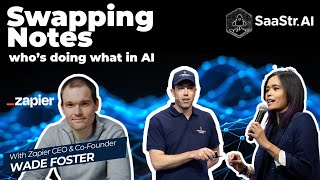
In this SaaStr AI podcast episode, Zapier co‑founder and CEO Wade Foster discusses how Zapier is evolving into an AI‑first company. He explains the distinction between deterministic and agentic workflows, illustrating the concept with a newly launched "renewals agent" that automates most of the account‑renewal decision process by aggregating usage data, call transcripts, and support tickets, then generating recommendations and draft emails for sales reps. Foster emphasizes the importance of mixing deterministic steps with agentic ones, and how the output of an agentic workflow often serves as a prompt for a human to act on. The conversation covers sales team reactions—largely positive due to Zapier’s automation culture—, the three main categories of AI use cases customers run on Zapier (content creation, customer engagement, and back‑office cross‑team automation), and the broader market shift driven by low‑code "vibe coding" tools. He introduces the MCP (Multi‑Channel Protocol) as a new, API‑like protocol that lets LLM agents talk to other agents and take actions, while noting that traditional APIs will still coexist. Foster also shares Zapier’s internal strategy for building AI fluency: regular hackathons, weekly show‑and‑tell sessions, and concrete hiring practices that assess AI skills. In rapid‑fire questions he mentions his favorite AI tools (Granola for voice, Monologue for voice‑to‑text) and previews the upcoming ZapConnect virtual event, which will showcase customer use cases and new product features aimed at making AI integration easier. Throughout, he balances enthusiasm for AI’s potential with caution about error rates and the need for human oversight in the final mile.
Chapters
I'll give you an example of one that just went live last week that I think is going to turn out to be pretty powerful for us. So for our Zapier team and enterprise customers, these folks are on contracts that come up for renewal, and when they come up for renewal, they can be like a fair amount of work to figure out, okay, what's the state of this account? Should the account be upsold? Is it going to contract? If it's going to contract, what's the right place to contract? If we're going to upsell, what is the use cases? There's like a fair amount of work that goes into that. And we have a lot of accounts that are $5K, $10K. And so we want that to be like a faster velocity move versus actually deploying like a true sort of like enterprise AE on this. And so what one of our Redbox team built out was a renewals agent. And so what this renewals agent does is it goes and collects a bunch of information about the account. So it knows what is the usage trends in the account over the last year, what's trending up, what's trending down. It understands what those use cases are.
Hey everybody, it's Saster. Finn is the number one AI agent for resolving complex queries like refunds, transaction disputes, and technical troubleshooting, all with speed and reliability. See how Finn can deliver the highest resolution rates and highest quality customer experience at finn.ai/saster. That's finn.ai/saster. The biggest B2B and AI event of the year is back. It's the Saster AI Summit in the SF Bay Area, AKA the Saastr Annual. It'll be back in May 2026. With 36% of everyone coming CEOs, it's an incredible AI-first professional event. The very, very best S-tier folks will be there talking about sharing and learning how to scale AI in B2B in this new world. But here's the reality: the longer you wait, the higher ticket prices go up. They're really cheap at the beginning, and then, you know, just a few days before they get kind of expensive. But you've been warned. Early bird tickets are available now, and I want to see you there. Once they're gone, you'll pay hundreds more. So book your spot today by going to podcast.saastrannual.com. That's podcast.saastrannual.com. Get your exclusive discounts for Saastr AI SF 2026. We will see you there.
Hey everybody, it's Saastr. I'm Emilia LaRue, the Chief AI Officer here, and together with my co-host Guillaume Cubon, we're launching a new podcast series in Saastr called Swapping Notes, where in every episode we'll sit down with the top AI leaders in SaaS and B2B, and we'll swap notes on what's actually working and what's not moving the needle in AI. So whether you're a founder trying to navigate your AI strategy or go-to-market leader implementing AI features and frameworks yourselves, this is the show for you. So without further ado, let's swap some notes. Hello, SaaSer. Welcome back to the SaaSer AI Podcast. Amelia and Guillaume G are back at it again here with Wade Foster. Many of you already know him. He is the co-founder and CEO of Zapier, and we're so excited to have him. We've been using Zapier for a long time at SaaStr. A lot of you probably use it now to connect all of your tools. It recently had a $5 billion valuation, I think on just a little bit over a million total raised. We'll talk about that a bit, but one thing in particular we want to use as like a launching point. I know you've made some statements, Wade, recently in the news of you want all your new hires to be AI fluent. Obviously Zapier can power a lot of what AI is doing behind the scenes. You've also said you've got customers running 50 million AI tasks in 20 days. Just to kick it off with our audience, give us a little bit more into the current state of AI.
Zapier, we like to call ourselves the most connected AI orchestration platform. It started. The Zapier that people are probably known, familiar with was a simple integration tool. It's like trigger, action. You get a lead from a form on your website, add it to my CRM. Phase 2 of Zapier was then embracing full-on workflow automation. So instead of single trigger, single action, you've got trigger multiple actions. And so you could say, hey, a lead comes in on my website, let's go hit an enrichment API. And then let's add it to our CRM. So you can start to chain those things along. Now with AI, you're able to embed AI as part of those workflows end to end. And so you can say, hey, new lead comes into my site. Yeah, hit an enrichment API, but also go do deep research on this customer. Go collect this context from my CRM. Go collect this context from Zendesk. Then let's go hit a series of prompts. I wanna prompt that proposes a follow-up email. I want a prompt that generates a prep guide for the sales rep. I want a prompt that does a case study on a Gong call, right? So you can start to sequence these things and actually have AI really make those workflows a lot more powerful. Uh, and then finally we have Zapier Agents, which is full-on automated, both in the creation of tools, but then agentic workflow. So it's not even a workflow at all. It's an agent that really just has the choice to figure out how do you want to go do this? So you can say, hey agent, reply to my emails. Now, you probably want to give it more instructions than just that, but the more instructions you give it, the more the agent gets smarter about how to reply to email. Zapier's become this full-on automation suite that uses AI to power any of the workflows that you might have inside of an organization.
But that's awesome. Like, When in your mind does— what's the threshold when a workflow becomes an agent? Is there a threshold or is it like just like a continuum, like a spectrum?
I, so this is, I think this is like one of the most misunderstood things at this point in time in the market. And the people that really understand this concept are the ones that are getting the most effective use out of automation today. So what is most misunderstood here? The vibes. If you go read X, if you go read LinkedIn, you would think that everybody is deploying agents everywhere. It's like, here, look at this crazy agent I've done that has solved all these magical problems for me. Mostly that is hype. Like, it is gonna get better. So what are the folks that are actually deploying, like, automation at scale doing? They're finding ways to mix and match deterministic workflows with agentic workflows and do those together. And so they know how to break down the steps in a workflow bit by bit. And they recognize here is a place where I want it to do the same thing every single time. If you get a lead from your site, you want that to get into your CRM correctly. You don't want it to just guess, hey, do your best, try. See what you come up with, especially when a deterministic workflow is perfectly good at doing that use case. It is good, it's fast, it's cheap. And so those are the places where you want that to work 100% the right way. However, there are certain use cases that deterministic workflows simply can't do. They're just good enough. So this is to come back to that workflow I described earlier where you take a lead from your site, you hit an enrichment API, but then you want to go generate a sales brief. You can't do that with a deterministic workflow. It's not possible. So if you want to do something actually good, you need agentic workflows. And so the people that are getting the most out of AI automation today, they're know— they know how to mix and match determinism with agentic workflows to really get a lot of power out of these tools.
I truly love that. Let's take the example of Zapier, like at Zapier, are you running some real agentic workflows? And if so, like in what cases and how you doing that?
I'll give you an example of one that just went live last week that I think is going to turn out to be pretty powerful for us. So for our Zapier team and enterprise customers. These folks are on contracts that come up for renewal, and when they come up for renewal, they can be like a fair amount of work to figure out, okay, what's the state of this account? Should the account be upsold? Is it gonna contract? If it's gonna contract, what's the right place to contract? If we're gonna upsell, what is the use cases? There's like a fair amount of work that goes into that. And we have a lot of accounts that are $5K, $10K, and so we want that to be like a faster velocity move versus actually deploying like a true sort of like enterprise AE on this. And so what one of our RevOps team built out was a renewals agent. And so what this renewals agent does is it goes and collects a bunch of information about the account. So it knows what is the usage trends in the account over the last year, what's trending up, what's trending down. It understands what those use cases are by picking up on meta trends about the account. It goes and looks at Gong transcripts associated with sales calls with that account. It goes and looks at Zendesk tickets to understand what are the common issues that it's having. And then we have a fairly sophisticated prompt that we have a bunch of examples where we've said, hey, if it looks like this, we recommend an upsell. If it looks like this, we recommend a flat renewal.
If we—
it looks like this, we recommend a down renewal. And so all of this stuff then gets automatically inserted into HubSpot. So the AE or whoever's handling the renewal doesn't have to do data entry on that stuff. It just comes in as a recommendation. It generates a proposed email out to that person. And it has a recommendation for them for what actually needs to happen. It's this work that goes into figuring out what do you gotta do with a renewal. The agent is basically doing 90+% of it and then leaves the last mile to the account rep to go just make it happen at the end of the day. So that's like a great example of one that is much more agentic at the end of the day.
Yeah, no, we call that a bit of like prescriptive selling now in the age of AI. We've talked about it a bit on SaaStr of there's no reason not to be like that in 2025. I think how you're doing it is a great use case, and I think the way that a lot of sales teams should structure or start to think about structuring their renewals, their prospecting calls, their onboarding calls, because nobody wants to come to a call now and have the human on the other side of the phone not know these things, right? Like everything you just surfaced of the AI will know the calls, it will know, it will make a suggestion, it will have a hypothesis of how the AE, who's the human, should prescribe this person the next year of Zapier. That is super cool. I think more sales teams should be doing that, and I do feel like that will quickly become the standard and the norm because the buyer's expectations have just gotten so different. Now in the age of AI.
There's no excuse for a sales rep or a CSM or a support rep to not have context about your account, to know what you're doing. If they're showing up to a call and just being like, okay, so, you know, tell me what we're doing.
Yeah, discovery is dead.
Not it. Not it.
I think interesting, if you take a step back here, the way you two focus on describing that shift here is that you actually have an agentic workflow that contains prompts, which the output of that workflow is, if you think about it, a prompt for a human to read.
Mm-hmm.
Because job of that CS or that salesperson is to ingest that summarized piece of information and use that to do a better job on a call, but it's a prompt. It's a prompt for the human. And ideally there's a feedback loop where we do have the recording of that and we can check whether the human like followed the prompt and said the things that the human was supposed to say and then can correct course. And so like we do have this, like you could have a number of circles like that, right? But I think it's important to understand like the role, the expectation, the role of the human. In those CSN sales processes, and we're trying to like control the outputs and the behaviors better of the humans, which is probably as difficult as LLMs.
And I think you're hitting at an important point here, which is I think a reason a lot of folks are taking this approach of inserting the human at the last mile is the more agentic these workflows The more imperfect it is. If you were to go read through those customer briefs, I as a human will skim through and I will notice things that are incorrect. I'd be like, okay, it's 90% correct, but you got this wrong, you got that wrong, et cetera. And I think it takes a lot of work to get that last mile good enough where you would say, hey, we're actually going to feel confident actually having the AI act as the sales rep or act as the CSM in these equations where it's going to get there, it's going to get there. But there's a lot of risks today if you don't do that last mile work.
Yeah.
Yeah, I agree. And I think I'd like to have Emilia and most like SaaS perspective on this because I know like SaaS has been using a lot of like full agentic like tools, right? But through like my advisory at Hypergrowth, what I've observed is most of what's working right now on the market is what I call those like hybrid workflows for sure, because there is an element of checking and it's QA. There's an element of humanness, which is also important. There's a little bit of fine-tuning, whether it's in the prompt or the output. So like we do I truly believe, and I actually talked about that at SaaStr in my keynote, we need some human variability in this workflow, whether at the beginning or the end, we need some variation so it is unique and just a smidge more human and it feels better.
Yeah, I, I think it would be interesting to get your take on how the sales team reacted to you guys rolling this out. I think that's one piece of it because the piece we can't control, I think, rolling out the AI to the rest of the org is you never know how that's going to trickle down and the reaction or maybe aversion to some of that. So I'd love to know how your sales team reacted. And then to tie it back to what Ji is saying, yes, I think there is this such a necessity for what you guys are both saying is true, right? Like even what our AI does is, yeah, probably 90% right, but it's never 100% right. Like, just today, our outbound AI hallucinated some of the speakers for SaaStr London. Like, it's doing outbound for London. I haven't yet announced the speakers publicly. And so what did the AI do? Somebody asked it who was speaking and it made it up. It like took people from last year's event. It looked at SaaStr and it was like, I think here's who's speaking this year. And I was like, yeah, No. So I think to Guillaume's point, like that final mile typically is better served by a human and getting AI though to take you 90% of the way there. I love and we're doing that, but that final mile, yes, that's where we've had to have the most like human in the loop interactions because sometimes one, it's wrong or it hallucinates. Two, I think there is just so much nuance in selling a product like Zapier and selling something like a SaaS or in selling things like a ramp that Guillaume advises on that sometimes the AI doesn't really quite understand those complexities in the same natural way that a human being would.
That brings us back to what Wade was saying on the error rate. Like, what error rate are you ready to accept? And I think the answer for that depends on your product, your business. You don't have the choice but to go wide and probably use like more like full agentic solution. If you're like doing like enterprise selling, like, no, like you're going to have somebody like checking every one of those messages because the costs of the downside is just too Yeah.
And what was the vibe when you rolled this out to the sales team? Were they all, oh, I love this, or was it the mixed bag?
Most, most love this at Zapier, but you gotta understand where we're coming from. So we have a couple factors that I think play to our advantage. One, we have an incredibly small sales team proportionate to the customer base. Our sales folks touch probably less than 1% of our total customer base. Oh, wow. And it's not meaningfully infringing on their job. It's just helping them like touch more accounts that otherwise we never could have touched. The second thing is we've had this value at Zapier since the very beginning. We've always been an automation company and the value is don't be a robot, build a robot. And so disproportionately inside of our company and our culture, we probably have people that are just like more biased to liking this stuff. It doesn't mean that everybody is 100% cutting edge. If you compare the average person at Zapier in a particular role to other companies, we're probably just oriented more that direction. Like our average accountant probably nerds out just a little bit more on automation than the average accountant at another company. And that applies at sales as well too.
Yeah, that makes sense.
I think that's true also. Of your customer base. I think like you have a uniquely large customer base from early on. Millions of people are using Zapier from what I understand. And it's, I'm curious, like, could you tell us a bit more about, say, did your customer base, did your, did the Zapier users transition, let's say, more naturally to like Agentic workflows than What do you know of the rest of the market who were not on workflows at all before? Were they, are they just naturally better at it now?
Perhaps unsurprisingly, that is true where folks that have been building deterministic workflows all along were quick on the uptick to say, what, let's add AI to this. We track what the percentage penetration is of folks that have deterministic workflows who are now pulling AI into workflows, and that number is pretty high, you know, as it's gone along. And I think interestingly, perhaps a corollary to that is the new folks coming in though are also adopting AI use cases at a very high rate as well, which maybe that's not too surprising. Be given like the market and trends and what people are interested in. I think the difference between those two groups of folks though, is that the folks that have been doing this stuff for a long time, they still just have a level of sophistication to it. Whereas the folks that are new are still developing their skillset. And so you start to see a lot more basic prompts, simple use cases, and then getting stuck. And I think that's reflective of what you see across the market based on, like, the Vibe Code building tools, or even how people use ChatGPT, where it's just a text box. If you put a text box on the internet, people are just gonna type stuff into it, whether it's the right things to type or not, they just will. And so you're getting a lot of people who are, maybe don't know how to break down the task into, like, step-by-step instruction, maybe don't know how to prompt it quite the right way. That are using this stuff. But I still think the cool thing is with AI, even if you aren't great at it yet, AI is, is good enough to start to translate some of what you were trying to think and get you started. And so it gets those folks started down that path of becoming more sophisticated automators. And I just love that, like with AI, it just the learning curve is more gradual. And so you can, the on-ramps are easier than they were in the past.
On the subject of Vibe Coding, I think, you know, that Jason, our founder, has been Vibe Coding a lot lately. Some of what he's vibed is now hooked up to our systems like Marketo, Salesforce, et cetera, via Zapier. How is this like, what do you make of all this? Are you guys get, are you seeing more customers come in through apps like the Lovable and Replit because people are Vibe Coding, but at at some point they need something like a Zapier to tie everything together. What's your take on this vibe coding evolution?
I think it's great. Like, I think it's fantastic because the learning curve to getting into this stuff is just so much less than it used to be. Sure. I can't tell you like how many times in my life you meet the person who's like, oh, I have an idea for app. Do you know someone who can build this for me? Uh, where can I find a co-founder or a technical co-founder who can do this idea? We used to make fun of that person. Nowadays, that person can go use a Lovable or a Replit or whatever and get started. And so it's increasing the market for all of the tools in the stack because the entry point is just so much simpler. And even if the first version of that app is just, it's good enough, especially the person who's never built anything before, they're like, oh my God, I actually built something. I want to keep figuring it out. And so all these sort of like tools that make it easier for people to bring their own ideas to life, I think are benefiting from this.
And switch to something very similar, like all those integrations. You've been talking about MCPs, like for a couple of months now. How should people think about this? Are MCPs the new APIs? Is that how we should think about it? Should we think about it differently? Does it mean that you no longer need to build integrations? Tell us a bit more.
I, it's a new protocol, right? It's a protocol in the same way, like HTTP is a protocol. It's a protocol in the same way REST is a protocol. I think we're still learning where all the use cases are. MCP was only built less than a year ago. We're coming up on a year ago, but started taking off on the spring of this year. We really only have 6 months under our belts, but it's— the traction is pretty good with the protocol at this point in time. Where it is really effective is in helping agents talk to agents. If you want to— let's use Claude, for example. So Claude was one of the first MCP clients that was out there supporting MCP, if you wanted to interact with your tools, your data, etc., inside of Claude until they launched their MCP connectors, couldn't really do that. But now you can use Claude to go have a discussion with HubSpot, to go have a discussion with your Google Drive, to go have a discussion with your email. And a good MCP server also gives you access to tools where you can now actually have it not only to talk with your data, but you can also have it go take action on that stuff. So you can have a discussion about XYZ thing and then decide, hey, can you go send an email to this person with all this context, etc.? Can you go generate these things? And so it's pretty effective. Now, you asked another question around, is it going to replace integrations? Do I still need an API? I think the answer is we're going to end up having both. I think APIs are very deterministic. And cheap, works the same way every single time. And so there's a whole set of use cases that you want it to work that way, where MCP is a lot more flexible. The agent is getting to choose this stuff and you're burning tokens every time you do that, but it opens up a whole new world of use cases that you can't really do with APIs. So in that regard, it feels like It's a new protocol that opens up entirely new use cases. And I suspect we're going to see folks find that both are still quite valuable.
Getting back into the use cases, I know we started off the chat saying you've had a record number of customers run AI tasks through Zapier. Can you share a little bit about what are those use cases? Do you broadly know that people are using and adopting AI at maybe at a faster rate with a tool like Zapier?
Yeah. So I would break these into a handful of categories. So first I would say is like content creation, content generation type tasks. One of my favorite, like, good examples of this is taking call recordings, like a Gong transcript with customers, and then generating case studies based on that. It's such a straightforward use case where you can make case study generation, programmatic. And this is the type of content generation that AI is really good at. Yeah, it's well structured, it's easy design, and it's a great place to implement it. The second category that I would call out is— I'm going to call this like customer engagement. This could be things like responding to reviews on review sites automatically. It could be automatically generating follow-up emails based on leads that you're capturing on your website. It could be making like phone calls or text messages to customers based on certain events that are happening in your system. But one way or another, it's like, hey, we want to, we need to do some sort of correspondence with the customer based on some event that has happened. And so I think that's really common. The third category I would call out, and this is probably like a big catch-all bucket of stuff, which is I would call just like back office cross-team, like content automation. So that's a great example we have inside of Zapier is like our, our voice of customer reports where you've got a bunch of data coming from a bunch of disparate teams. So you've got like the support team is generating tickets. You've got the sales team generating transcripts. You've got the product team is running like NPS reports and NPS surveys. So it's got all these like signals that are coming in and somebody's job needs to sift through that and go, hey, what themes are going on inside of this stuff? And so we have a whole automation system, agent system that like takes all that stuff it then generates a bunch of themes based on that and then generates reports based on those themes. Then the second thing we have built up is a chatbot around all that stuff where product managers can come in and be like, hey, I'm thinking about launching a feature around X. Is this a problem that anybody has? And starts to generate a list there. So that's like a good canonical example. But this stuff is There's a whole big bucket of stuff you could put into like internal automation here, but oftentimes it's just like shuttling information from one team to another team, bridging the like system of record that team uses to the system of record that another team uses.
You made a couple of posts about how you've pivoted your new hire process around like AI fluency. Everybody's asking me questions about What, where should the bar be? What should we put like in that, in this like AI fluency expectation? I think you are, Zapier is uniquely positioned there given like how technical the team is, as you made the case earlier. Tell us more about that. Like when did that happen? What is that shift? Where are you in that transition?
So we have these kind of 2-pronged approach there. We run these hackathons usually every 4 to 6 months just to keep fresh with it. And that's really important because AI moves crazy fast. And so every time we do that, we see the internal adoption just go higher and higher as people start to figure out new use cases, new ways of using the stuff. And then alongside the hackathons, we also just have show and tell as part of like our all hands. We run an all hands once a week and First 5 minutes is, hey, one person, show us what you built. And it's a small thing, but it promotes knowledge sharing, it promotes accountability, and I find that's one of the most effective things at this moment in time when we're all figuring out how to use this stuff, I think. Amelia, you said, hey, Zapier's probably more so than most, and I look at our own adoption and I'm like, shoot, like, I think we could be a lot better at this stuff. And I think just having those opportunities for people to just get inspired by each other has been really effective. So that's been the journey for us over the last 2 years of going from AI is this sort of like in the corner curiosity to now it's like a key part of how everyone does their work and thinks about their work. Cool.
And so how are you implementing that and the new hire process?
I don't have a, oh, here's your one trick to nailing this, but I think it's pretty dang simple. Yeah, I know. But I still think it's like, it follows like hiring best practices, which is, hey, you should probably do a skills test. Like you should probably evaluate people on these things. And so you can ask questions of them where you can say, hey, tell me what types of things you're experimenting with. You can ask those behavioral questions. What have you built at your last company? Better yet, hey, let's do a screen share real quick. Show me how you would solve this problem. Show me how you would solve that problem and just see how far they can go. And in different roles, you're probably going to want different levels of— have different expectations, different tools, etc. But I think it's really helpful to just go like function by function in your company and say, hey, these are the use cases for sales, these are the use cases for marketing, these are the use cases for engineering. These are the use cases for HR and just set a baseline for what your company is. It doesn't have to be the same as Zapier. It doesn't have to be the same as SaaS, but just set a baseline for like where you're at today. And when you bring somebody in, what are you expecting of them? Do you, for that role, do you want somebody who is going to be on par with everyone else? Or to G's point, do you want somebody who is actually going to help level you up? There isn't a one-size-fits-all answer to this, but I find that folks are somehow skipping the step, right? You get the CEO memo, like, we're an AI-first company, right? Which you need to do that stuff. It's an important step. But I talk to a lot of people who that's the only step they do. CEO memo. And then it's just like chaos inside the organization being like, I don't know what it actually means. Like, I use ChatGPT, but does that make me, does that mean I'm fluent in AI or? Do I have to do something else to be fluent in AI? And so it's really helpful to just go function by function and start to define some of these things. And you're happy to steal, like, the Zapier framework as, like, a good starting spot. I think it's probably get you 80% of the way there. But you might need to amend it to, to fit your organizational needs.
Let's go into our rapid-fire questions before we run out of time. So, first question, do you have a favorite AI tool right now? That you're using?
I'll tell you the one that was like fastest adopted by me.
Okay.
And that's Granola. That was just like installed.
We're like 3 for 3 on Granola.
We keep coming around, like we keep like—
I know, we keep asking different people and everyone's Granola.
That explains the valuation of voice AI companies because it's either Whisperflow, Granola, Notion, We just keep coming back around voice.
I think that one, it's a fantastic product, but two, the category of the product, it, the onboarding experience is so easy where I think there are some of the more powerful AI tools, the things that can have bigger impact, of which I would put Zapier in those category. They can have much, much bigger impact, but there's a learning curve to it. Granola is literally like, you install the thing, you try it and you're like, this is better. And then you're just off to the races.
Is there a category of AI tool or a specific one that you're looking at trying next?
I use— gosh, I'm going to stick on voice for a minute because I am— I don't know that this is a higher bar, but I use voice-to-text a ton. On my desktop now, and I'm specifically loving this tool Monologue from the Every team. I think they've just done a really good job with it. I want something like that for iOS, like the mobile ver— I don't know if Apple's locked down. I just haven't found anything great. Like, I've built some stuff myself with Siri Shortcuts, and it's good enough. I feel like there should be a lot better tooling for iOS on like voice-to-text, but like being able to run through an LLM and clean up my jibber jabber into an actual structured thought.
And then lastly, I know you guys have ZapConnect coming up. It's your big virtual event. What can folks expect to hear and see there?
Biggest thing that we'll be sharing is all these use cases. I think the, from a content perspective, this is the number one thing we hear when we talk to folks is, I wanna get into AI, I wanna do more with AI, but I just want more use cases. I, I find the headlines are so fixated on the size of the models, how much funding they've raised, the personalities. There's some epic personalities involved in the AI world. But when we talk to people, they're just like, where do I get started? Can you like tell me the use cases? And so we have a ton of data that we're going to share around that and actual customers coming in to show off their actual workflows. So that's thing one. Two, we're going to show off all the new product stuff. So there's a whole bunch of product coming out that folks can check out that should make it easier to build with AI and then also easier to put AI into your workflows. We'll be there.
We're excited to see what you guys have coming out. And then yeah, hopefully G and I will see you at the next SaaStr in person as well.
I love it.
Thanks for joining us, Wade.
Yeah, thanks, y'all.
Thank you, Wade.
More from Wade




From Workflows to Agent Teams: Wade Foster on How AI Reshapes Enterprise Automation

The Top Scaling Lessons from Zapier's AI Transformation with Wade Foster, Co-Founder & CEO of Zapier


Why Companies Force AI: Zapier’s CEO Wade Foster Explains | Belkins Podcast Episode #21



INSIDE How AI Startups hire, AI Roundtable with Wade Foster, Mikey Schulman, and Ali Ansari | E2225
