The Future is No-Code | Wade Foster Full Interview
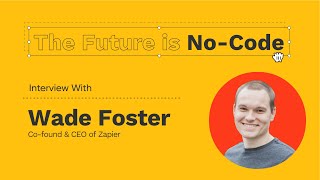
Wade Foster, Zapier's co-founder, explains how no-code lets non-technical people build workflows without programming. He created Zapier in 2011 to connect SaaS tools, traces the movement back to Yahoo Pipes and Dreamweaver, and predicts no-code will reshape how small businesses, enterprises, and developers work.
Chapters
You know, as long as humans have been working on things, we've been trying to find better ways to do them. And like, we've been moving— and it's certainly with programming languages, always trying to move an abstraction layer up. And to me, no-code is trying to move another abstraction layer up the stack to just make it that much easier for folks. Yeah.
Welcome to The Future is No Code. My name is David Adkins. I am pleased and honored to be joined by Wade Foster, the co-founder and CEO of Zapier. If you don't know what Zapier is, it is basically the glue of the no-code community. It allows you to connect apps to other apps and do all kinds of crazy things, everything from, you know, connecting Typeform to Google Sheets to Slack to go back to your app that you just created. It's absolutely amazing. They have over 2,000 apps that you can connect with, and it is, you know, basically one of the foundations of definitely the no-code, but also now like web in general. So thank you.
Yeah, thanks for having me, David.
Awesome.
All right.
Well, let's jump in here. Really excited to get your automation perspective on this from the, you know, the no-code side of things. We've talked to e-commerce and websites and apps and even voice. So excited to also get the automation perspective here. All right. So let's jump in here. First section. When did you get into no-code and what made you start Zapier?
Yeah, so that's a good question. You know, for the longest time when we started Zapier, no-code wasn't a thing. No-code has really been a thing that, like, as a, as a term has existed since, what, 2018, 2017, maybe. It's fairly new. And so we, you know, we started Zapier in 2011. And at the time, you know, we sought out to solve what felt like a somewhat simple but fairly pervasive problem, which is that there's all these new apps that are popping up left and right and all the customers, all the end users of these tools want them to work with everything else that they use. And so, and that's just kept happening and happening and happening. You know, now almost a decade later and our job at the time was like, well, maybe if we just made it a little easier for the end user to be able to set up an integration between those tools, that could be useful. And turned out over time, it's more than just useful because all these end providers, you know, the MailChimps, the Salesforce, the G Suite, the you name it of the world, it's really difficult for them to build a big ecosystem of integrations. It's just a hard thing to do, even if you are very successful business. It's not a fun thing to really invest in all these integrations and try and make them all connect. And it's hard and it's not the main thing you do. It's just difficult. And so that's where, you know, we realized that over time Zapier had a much bigger value to play. It wasn't just helping with these, like, little simple one-off integrations, but it really acted as a bit of a workflow tool that helped folks connect these tools, but in a way that actually felt more like building workflows. It felt more like logic. It felt more like coding in some sense, some, in some ways, even though most of the people who use Zapier don't know how to code. Many of them don't know what APIs even are. And so just the ability to help people, like, connect the building blocks of the web together in a way that creates a thing. Has been something that I think when no-code became a term and a thing, it was like, well, Zapier is the thing that provides all the logic for all of these tools.
Yeah, yeah, definitely. And like you're saying now, with it being easier and easier to make apps and websites, it's even more relevant for Zapier to connect those things, like you're saying. Right. People in the no-code space, they definitely don't have time to do all the API integrations between, let alone like you're talking about, actual huge established you know, tech software companies can't make all those integrations. So when you first got started, was that a little more like, what was your background? Were you at a tech company when you kind of like figured out that inspiration? Or what was a little kind of the initial impetus and origin there?
Yeah, so I was a bit of a late bloomer when it came to technology. You know, I grew up playing music and doing sports and like kind of a bookworm, but not really like a computer technology geek. Like, you know, I played video games and stuff like that. But I was playing like sports games. I wasn't like hacking on a Commodore 64 or something like that, but you know, sort of what you often hear from, from people. It took till— for me to really get into it, it took the financial crisis in '08. And so when that happened, I was in school. I was a junior in school starting to look for like internships and things like that. And it got really hard, like kind of like how right now many companies are canceling their internship program. It's really hard for students to get jobs. That was happening in '08 and I was dealing with that and being like, well, what the heck am I going to do? And just started like getting way more curious about any options that were out there. It's like, what, what, what is working for people? And I stumbled across this little company in Columbia, Missouri, that was building software. And I went and met the team and it was a small team working out of a professor's house. And I was like, this is such a weird and cool and different vibe than like corporate America that I was like, I'm gonna give this a shot. And so ended up working with them and just fell in love with making software. I was like, this is so much fun. It's so awesome that a small business can have a Mailchimp list and can like manage projects via Basecamp and like put a form on a website through Wufoo. And like all these little tools made it so easy for these tiny little companies to be in business and they could just put a site on the internet and people would just buy from them, which to me, I was just like, this is— my experience with the internet at that point in time was mostly through like these big, you know, like Amazon and Google and Microsoft and stuff like that. And I was like, wow, these little folks can do it too. And I just was like, man, I want to be a part of that. I want to be I want to contribute to that somehow. And so from there, I kind of bounced around between like a bunch of freelancing gigs, helping small businesses get going. I helped a mortgage company with all their email marketing and really just became a power user of a lot of these early SaaS tools. And one of my co-founders, Brian, and I were just doing a lot of that freelance stuff together. And he eventually pitched me, he was like, hey, I think we could build a thing that helps connect all these tools that we're using to help these folks. And I was like, yes, like, and as soon as he pitched me, I was like, that's such a no-brainer. That is a thing that I would use immediately because I was dealing with like the Marketo API at the time, and it was this old-school SOAP API that was just really hard, and I'm not a very good engineer, and I'm just like, I just need something that I can like off the shelf set this stuff up with. So that's sort of like how my career moved into this space.
Awesome. Yeah, really kind of fascinating to see, you know, you having the actual problem of your end users and then kind of creating something from that. Definitely true of most people that start their companies. All right, let's see. So what is your definition of no-code? And sometimes it's helpful to say, like, what do you think is in no-code and what do you think maybe is not in no-code?
You know, I think no-code is— it's a— I think it sometimes gets a bad take because people are like, oh, you can't build great things with no-code. I don't really think that's the point of it. I think no-code is really about empowerment. It's about helping folks who have ideas, who want to get a job done, be able to do that stuff. They don't have to wait for engineering. They don't have to wait for IT. To go make this stuff happen. They can use tools like Adalo and Zapier or a Webflow or an Airtable or what have you to build the thing that works and solves the problem that they have. They're not necessarily trying to say, hey, I'm going to build the next Google with no-code. Like, that's not the point of it. The point is I have a problem and I want to solve it myself, and I don't want to wait around for somebody else to help me, and I don't want to have to, like, I have to spend years hacking on Python before I can actually get a thing that's productive when really all I want is, you know, a web page that takes payments and, you know, spits those things into a CRM and automatically sends some emails. Like, that's such a simple thing to do that you shouldn't require— it shouldn't require a bachelor's degree in CS to get that done. And so to me, no-code is all about helping that set of people. Make that happen. It's sort of this democratization of building things that is really useful.
Awesome. And then you alluded to this a little bit earlier, but, you know, the space hasn't always been called no-code, right? That's a little bit of a new term. Do you have anybody or like particular maybe time that you credit with like, hey, this is, you know, you know, the origins of it? You know, trying to track—
you know, I don't really know the origins of it, to be honest. You know, I think there was a lot of people calling it visual programming before that or visual development. I mean, you even go back far enough, and you start to get to things like Yahoo Pipes, which is a precursor to Zapier. You also look at things like Dreamweaver, which was perhaps even a precursor to other things. And I'm sure there was stuff even before that, too. You know, as long as humans have been working on things, we've been trying to find better ways to do them. And like we've been moving. And it's certainly with programming languages, always trying to move an abstraction layer up. And to me, no-code is trying to move another abstraction layer up the stack to just make it that much easier for folks.
Yeah, definitely. OK, and then there's one kind of subconscious grammatical debate that we've been having going on in the community, and that is, are you— you go with no-code or are you no-space-code?
I've been doing the no-code, but I hope, I hope I'm not starting a flame war or anything. I really don't care.
I think we all generally don't care. That's, uh, I think that's why it has— that's why it's been a little bit of like waving all over the place.
Um, yeah, I lost half my customers right there.
Yeah, I know, right? Uh, it's kind of like, uh, you know, spaces or tabs.
I feel like it's the new— it's totally— yeah.
All right, uh, so getting into the, you know, exciting part of this, this series, we're really trying to figure out, you know, how this is going to affect all the different groups of people in the future. So the first group are businesses, right? So what is this going to mean for your startups, your entrepreneurs? What is this going to mean for your small businesses, which you a little bit talked about? And then what is this going to mean for also the enterprises of the world?
Sure. I think the exciting thing is you can start to see a lot more tech-enabled businesses move a lot faster. You know, I think of the company that I worked for before Zapier, Veterans United is its name. It's a mortgage company in Columbia, Missouri. Uh, not— they sell mortgages. It's not a technology company. However, they use technology really effectively to be much better at selling mortgages, to lower their margins, uh, or to increase their margins, um, to lower their costs, uh, and to deliver faster services. And at the time, they were predominantly doing it with like a handful of PHP coders and sort of just like making it happen. But there's no reason that they need, you know, master's level machine learning engineers to be effective. They could have used, you know, had no-code existed in the way that it does when they started, they could have used that software. And that business now supports 2,000+ people. So it's a big business. And no-code could have powered basically their entire stack effectively. And so I think you start to see that's like the upside of what it can be. But there's so many businesses that are much smaller than that, too. You think like, you know, small restaurant, you think a small real estate agent, you think of an attorney or accountant or all these sorts of just service industry businesses or small mom-and-pop stores. That have back office needs and no-code lets them run such an efficient shop, which is really important, even more so now than ever, because they have to find ways to be scrappy and endure through some of these tough times. So I think no-code really is about putting the power in the people's hands to make things happen.
Yeah, yeah, definitely. Yeah, super excited to see, you know, how it's gonna affect all those kind of range of businesses. And, you know, I like the way you had put it in kind of the middle ground of like, hey, we're all in this bucket together, whether you're a startup or a small business or an enterprise, you know, it's really kind of about empowering every level of those things, right? Where it's, you're almost saying it's a little bit kind of gonna have the same impact across all of those.
So, all right.
So the next group is tech. So you're kind of like traditional tech stuff. So, you know, what do you think this is going to do for traditional developers, for designers, for PMs? And there's kind of like a couple layers to that question. You know, just in general, what is it going to mean for the individual roles? But then what is it also going to mean for, you know, as no-code gets more powerful, how that actually infiltrates into like the workflows that, you know, are at traditional tech companies? Because, you know, I don't think it's quite gotten to that point yet, but it'll be interesting. I'd like to get your perspective on that.
Yeah, I think the things we've seen most common with, you know, some of the more progressive technology companies that are adopting no-code, it a lot of times comes from, like, the operations side of the house. It's these folks that, you know, maybe they have a bunch of engineers that are hired, but those engineers are often deployed against the primary product that they're building. It's like, hey, our job is to build this world-class X, and that X is really what we want to be spending all of our time on. However, to run the business, we need all these other things. We need a CRM. We need an invoicing tool. We need email marketing, and we need project management. We need all these other things. And our engineers are not often helping make that stuff work better together because our engineers are focused on this really hard problem of actually delivering a product to our customers. And so that running of the business side of things often is where the operations folks start to come in and like deploy a no-code stack and make things more efficient, make it where, you know, every salesperson is a little better at their job, make it so that, you know, this thing that used to take all day or all week happens instantly. And so that's where I think it often gets infiltrated from. And then it starts to progress into IT, where IT, if they're sort of enlightened, will go, hey, how can we get all of our folks to understand what this is? And it starts to become a skill set that a modern knowledge worker, any modern knowledge worker has in their back pocket, kind of like, you know, everyone sort of says, hey, I can use Microsoft Office. I know what Excel is. I know what Word is. Well, knowing some of these no-code things is becoming like that a little bit, where everyone sort of needs a little bit of that knowledge to just be an effective employee in a sort of knowledge worker society. And so I think it infiltrates often from the operations, expands into IT, and then IT helps be the evangelist throughout the org where everyone starts to use it then for maybe company-specific stuff, but also just personal productivity, too.
Yeah, yeah, for sure. And then do you ever think, like, maybe we'll have some of these traditional tech companies like move their like main product to a no-code stack? Or do you like, where do you kind of see that happening?
It's tough to say. You know, I think, I think it's hard for me still to envision. We've got a long ways to go before you get to a Google scale or an Amazon scale like venture that's built on no-code. But I definitely think you can see businesses that are tech-enabled scale today. On no-code stacks. Think of like big e-commerce businesses. Certainly there's many already that are doing hundreds of millions of dollars predominantly off the back of no-code stacks or maybe low-code stacks, perhaps. And so I think you'll see that type of business get much, much more pervasive. I think we still have a ways to go before you see like a pure technology play happen entirely through sort of a no-code stack.
Yeah. All right. Awesome.
All right.
Next up, consultants. So what do you think this is going to mean for the traditional dev shops? And then what do you think this can mean for, you know, more of the freelancers, smaller agencies type of people? And then finally, what is this going to mean for your total non-dev consultants? I shouldn't say total non-dev, but maybe not like not a dev shop, right? Just, just the big consulting groups.
I think you can just do more things. You can just do more things faster, cheaper. It's more available. You have more people that are capable of doing it. You can solve more different types of problems. It enables everybody to go faster. To me, it's sort of like that superpower where you can just help more folks get things done, which it's hard to envision small CRUD apps and things like that. Built like, you know, they would have been built, you know, a decade ago, not like continuing to exist in the way that it will moving forward. Like most companies don't need that. Most companies need a form on a website and, you know, a database to store some stuff. And so, yeah, you know, having like a thing that collects some data and moves it into a database is like all that's necessary. You don't need to have an expensive engineer on staff and on retainer to make that happen. So I think it enables a whole new set of knowledge work that's It's pretty exciting.
Um, awesome. All right, and then the last group, uh, so what do you think this is going to mean, uh, for— and this is a little bit of a catch-all— but for society, right? The, the larger— our personal lives, how is it going to infiltrate in there? What is it going to mean for our kids, uh, for economic disparity, kind of that whole bucket of things?
I mean, you're— I think, you know, more people that can build stuff is good for society. If, you know, the internet was sort of like a first wave of enablement, it's like, hey, some random person who learns how to code in the middle of Missouri can now spin up a website and start making some money. Well, imagine, like, no, like, things like AWS and Heroku made that possible for, you know, you know, a person like me, and I assume a person like you, to make that happen. I wouldn't have been able to do it without tools like that. No code, I think, just takes that and adds another order of magnitude because now it's not about learning code. It's you just have to learn some simple, some simpler tools. And so it just— a whole swath of people now are able to do a whole set of new things. It's hard to say exactly what they will do. It's kind of like the internet in '98 is like, what could you do with the internet? And, you know, I think a lot of people had a lot of ideas, but I think it was hard to predict, you know, two decades later exactly what will be built. But I can tell you this, it feels like it will be a foundational shift in how work happens. And I feel pretty confident in that.
Awesome. All right. So the next set of questions is all about predicting the future. And I'll try— it's definitely one of the harder ones. I'll try my best to hold you accountable to like give us actual like date ranges here. Oh boy.
Yeah, I know.
Don't worry too much. Don't worry too much. It's just a little fun. Okay. So when do you think it'll be as common to make an app or piece of software than it is to make a PowerPoint presentation today?
Um. As common to make an app as a PowerPoint presentation? I don't know that that will ever happen.
Okay, interesting.
And I think that's because of the nature of PowerPoint presentations. I think presentations are just always a bigger— like, people do more presentations than need apps, just period. Okay, all right, all right.
What about, uh, like, what about using, like, maybe, like, the broader no-code? So not necessarily like an app, maybe as you would define it, but some sort of no-code tool, like, you know, however broadly defining it, right? A website, you know, a Zap, or, you know, some sort of, hey, I did something without code and I don't know how to code.
Sure.
A task like that.
I certainly think it's possible that you will see, you know, actually, now I think about it, it's possible that you would see, you know, more people they would have more active Zaps than they would make PowerPoint presentations in a given week. Yeah, I think that's possible. Yeah. Now that you frame it like that.
Yeah, that's what I'm saying. Yeah, I guess, I mean, yeah, my question around apps is, you know, I was taking the larger, like, hey, you know.
Yeah, yeah.
You know, I count that as like maybe a teeny teeny app, I guess you'd say, where if you're like connecting this to this and doing this. Yeah, yeah, yeah. Maybe it's not traditional app in the sense of, you know, downloading it from the stores, but yeah, something like that.
Okay.
Yeah, I think that's possible. Mm-hmm. Alright, next up, when do you think most colleges will start to teach the broader no-code ecosystem? You even alluded to earlier, right?
It's gonna be a skill gap. Less than 5 years. Less than 5 years, alright.
What about, what about like grade schools?
Grade schools? Wow. Less than 10 years.
Alright, alright, next up, when do you think there'll be more products launched on Product Hunt that are built with no-code tools? Than traditional coding?
Next year, less than a year, I don't know.
Okay. That's what pretty much a lot of people are saying.
Okay.
It's also one of the ones that's like, I have no idea because they look the same. But anyways, it's just one.
Yeah, I mean, I think a lot of them kind of are already.
Yeah, I know.
Yeah.
It's like a little bit like, I don't know how we'll ever know. Some of these other ones, like, you know, we might actually be able to tell.
Dates behind them.
Okay. When do you think no-code will meet up with low-code in terms of the functionality?
When will no-code beat out low-code in terms of functionality?
Yeah. Or meet up, I guess. Meet up. Yeah.
I still think we've got— let's call it a decade. Okay.
All right, next up. When will we see a product that's at the level of popularity, you know, in terms of users, and not necessarily for saying revenue or anything, but as like a Trello or TurboTax or HelloSign that's built on a no-code platform? And this one's definitely a little more of like, definitely more on the software side of things, less on the, you know, not necessarily like an e-commerce site, you know, although that's definitely in the no-code.
Yeah, you could get like a TurboTax style thing in a decade. Yeah, okay, that's possible.
And then what about in terms of like actually IPOing?
Oh, hmm, interesting. I bet we'll see some— something in less than 5 years.
Okay, awesome. Um, all right, uh, when do you think there'll be more freelancers and agencies, uh, and dev shops that use no-code tools than ones that don't?
Less than 5 years. Okay.
And then the last one, the one that I'm most excited to see when this happens, when do you think our global leaders, you know, presidents, politicians, when do you think they'll actually start talking about no-code?
That's interesting because like Obama was all about learn to code. Like I remember him.
Yeah.
Yeah. That was like not that long ago. I can't see it happening in the next 4 years. OK, let's talk about 8 years.
No, we're just talking about all global politicians.
All global politicians. Well, there probably is some politician.
Yeah, I'm not talking about the one that maybe you're alluding to. I'm talking about all. I'm talking about all. Or just a prominent one, I guess you'd say, right?
Yeah, yeah. I bet we will see something in the next 4 years, if we haven't already.
I don't know that I have.
But I do know that, I do know that a lot of the political campaigns do utilize no-code tools. Yeah.
Yeah. That's why, that's why I think, I think those quite large way. Yeah. Those, I think they'll start sneaking their way in that way a little bit and then realizing that, wait a second, like this is helping us.
How, where is this?
You know, that kind of a thing. Yeah.
I mean, it's perfect for a campaign, right? Because the campaign comes together on very short notice and they need tools and then they disband after. Yeah.
Not just the campaign, but like, we often talk about how government does not have, like, it's not a sexy tech, like, ecosystem where a lot of, you know, traditional tech workers want to go. So, you know, I think it's, you know, one of those things.
What was it, the Iowa DNC app, right, that was sort of like a, for vote, the primary voting, like, totally fell on its face. Like, that, that could have been a no-code app. Like, it would not have been hard to build that. No-code style in a fairly short period of time.
Yeah, definitely falls into the, you know, you're saying tech-enabled, not like the core type of thing. Okay. Last question. So, you know, I think we're all super excited about it, but is there maybe one story that something you've seen accomplished with no-code or built on no-code or just something interesting that gets you excited about about the future of No Code?
I mean, I like— we had a business recently that— well, the stuff that I've been really impressed by lately is mostly surrounding folks that— these small businesses that have been impacted by COVID. You know, we have had a lot of customers that are, you know, part of the physical economy, I'll call it, where, you know, the restaurant owners, they're storefront owners or something like that that predominantly do their business that way. And, you know, we had a customer in Wisconsin called Ruby Tap that had a wine bar and basically, you know, overnight had to close up shop. But that night that they had to close up shop, they built an online curbside pickup order style app that allowed people to drive by and pick up wine. And did it overnight and then started making money the next day. I think the next day they'd said, hey, we have made like $50 over Stripe in the first day or something like that. And to me, that kind of agility and innovation that no-code provides to these types of small business owners is game-changing. You know, these are folks that had these tools not existed, they really truly would have been dead in the water. Like, it just— no choice, just nothing. No option but other than to close up shop. Because tools like, you know, yours and ours exist, they have a fighting chance. They can use their own creativity, they can use their own intuition to try and keep their business afloat. To me, that's where I've seen a lot of creativity recently that has been— it's been uplifting for me.
Yeah, yeah, definitely. You know, I think a lot of innovation tends to happen when we shuffle the deck, and that's a lot of what we're seeing right now. And I think that's super relevant, definitely to the no-code space, especially as we move forward, right? How can we constantly be thinking about those things so that it doesn't necessarily take some sort of pandemic like this for you to think in an agile way to change something. But I think it's making everybody aware. So I'm excited to see the future with what you're talking about, where it's a skill set that people have at all companies, be it startups or small businesses or enterprises, and you're trying to figure out, hey, how can we do something better, you know, with actual software? So—
Totally.
Awesome. All right. Well, thank you so much for joining, taking the time to talk with me and everyone who's listening to this today. All right.
Yeah, thanks for having me, David.
All right. See you, man. Ciao!
More from Wade




From Workflows to Agent Teams: Wade Foster on How AI Reshapes Enterprise Automation

The Top Scaling Lessons from Zapier's AI Transformation with Wade Foster, Co-Founder & CEO of Zapier


Why Companies Force AI: Zapier’s CEO Wade Foster Explains | Belkins Podcast Episode #21



INSIDE How AI Startups hire, AI Roundtable with Wade Foster, Mikey Schulman, and Ali Ansari | E2225
