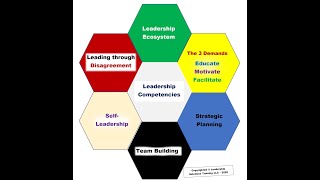
In this masterclass, Dr. Walter V. Murray (Speaker A) argues that most organizations underinvest in developing leaders, managers, and supervisors, and that continuous leadership training is essential for competitive advantage. He uses a personal anecdote about confusing teaspoons and tablespoons to illustrate the importance of admitting ignorance as a catalyst for learning. Murray highlights the overwhelming number of leadership definitions (1.56 billion) and programs, which creates confusion. He proposes a unifying definition: leadership is the strategic allocation of resources and relationships to achieve predetermined goals. This definition underpins his view of leadership training as any tool, skill, or competency that improves that strategic allocation. He references authoritative sources (McKinsey, Harvard Business School) and his own work (Genesis Leadership) to support his framework. The audience for leadership training is broad—CEOs, managers, business owners, coaches, principals, parents—anyone who must allocate resources and relationships. Speaker B offers an athlete’s perspective, likening regular physical training to leadership development. Speaker C restates Murray’s definition, reinforcing the broad applicability. The session sets the stage for later discussion of core curriculum components (e.g., assertive communication, motivation, coaching).
Chapters
Most organizations are not spending and investing nearly enough in the development and training of their leaders, managers, and supervisors. Most leaders, managers, supervisors, and business owners are themselves not investing nearly enough in making their own leadership and management skills more impactful and more effective. Why is this? Is there really a need for leadership development training? I want you to watch this masterclass, take good notes. I'll show you that there is applicability to leadership training, that leadership training is a necessity if you want to position yourself, position your organization ahead of the competition, and dominate your market space. Can I make a confession? And I'm not too proud to admit it, but I am probably the only C-level executive, leader, manager, or business owner who still has to Google the difference between a teaspoon versus a tablespoon. I mean, it's so confusing. Every time I have to take a dietary supplement and the instructions say something like take 2 teaspoons and mix with water, I get so confused and I have to turn to Google. So frustrating. And I must admit that I just don't know the difference between a tea— a teaspoon and a tablespoon. I think I got it right this time. Here's a leadership lesson, the lesson of the spoons, if you will. All right, leadership lesson. Admitting what you don't know is the pathway to knowing what you don't know. The top leaders, the top 3% leaders, are never too proud to admit ignorance, but they are always too proud and always too smart to stay ignorant. And this is why the top 3% leaders cream of the crop, most effective leaders commit to a continuous program of training, continuous program of development so that they could continuously make their leadership more and more effective, more and more impactful. Leadership training. What is it all about? So there's a ton of information, books, articles, training programs, just a plethora of information out there on LMT, Leadership Management Training and Development. If you are a leader, a manager, a director, a business owner, anyone with even a slight interest in developing and growing your leadership effectiveness, You have no doubt come across names like American Management Association, John Maxwell, Harvard University Executive Training Programs online. Fantastic place, by the way. I am an alumnus of the Harvard Online Business Professional Education Programs. You've no doubt heard about the Center for Leadership Studies or you may have come across information from our firm, Leadership Solutions Training. But there is just an abundance of opportunities for leadership and management training out there. So any leader or manager or business owner who is committed to continuous growth and development can find an opportunity for leadership management training. And that's the bottom line when it comes to leadership and management training, right? Continuous growth. Emphasis on the word continuous.
I always had great goals, and I always thought I had great confidence and belief in myself. Well, I think I had a great offseason, you know, just preparing like I always have, you know, trying to really focus on the things I needed to do to get better, to improve myself as a player. To wake up in the morning to train is something I really look forward to. It never feels like a burden to have to work out, have to focus on my techniques and training, going on the field, new footwork drills, or bringing teammates out, throwing with them, or being in the weight room focusing on some strengthening exercises. Football is the ultimate team sport. I need to be at my very best. I need to be durable over the course of a long season, available to the team in order for us to be successful.
Now, if we're going to talk about leadership training, training to be a better leader, training how to do leadership more effectively and more impactfully, It's important that we know what leadership is in the first place. But with billions of definitions of leadership, it's a challenge to nail down a particular skill set or skill sets that should be included in a leadership training curriculum. You know, I did a Google search for definition of leadership. How many definitions do you think I came up with? Try it. 1.56 billion definitions of leadership. And so with that multiplicity of definitions, you could well imagine that leadership training programs are also quite as abundant and prolific. There are leadership training programs that say communication is the key to leadership and train you on communication. There are leadership programs that say problem solving is the key to leadership. Leadership programs that say making good decisions is the key to good leadership, and so they provide training on data-driven decision making, which by the way, we also offer. And so it's no wonder then that there is a great amount of confusion as to what exactly is leadership training, what exactly should I be doing for leadership training to become a more effective leader. The key though is to do something. So whichever of the 1.56 billion definitions of leadership you subscribe to, it is essential that you intentionally engage in and commit to a continuous training and development program. Uh, with so many definitions, it is no wonder that the field of leadership training and development could sometimes become muddled and confusing if you're trying to begin your journey into leadership, continuous leadership development and growth. So to help us sift through the noise of leadership definitions and leadership training programs, we should ask ourselves the fundamental leadership question. And that question is, how do I, as a leader, manager, business owner, How do I strategically allocate resources and relationships to achieve predetermined goals and objectives? How do I do that? Incidentally, I devote an entire chapter in my book, Genesis Leadership, to the discussion of strategic resource allocation, especially in the absence of adequate resource levels. And so with my definition of leadership, leadership training then is—
So with Dr. Murray's definition of leadership in terms of the strategic allocation of resources and relationships to achieve predetermined goals and objectives, the definition of leadership and management training is any tool, strategy, or leadership competency that will help you as a leader and manager more effectively strategically allocate resources and relationships to achieve a a predetermined goal or objective. This broadens out the definition of leadership and management training, and as Dr. Murray discussed earlier, leadership and management training is in fact a broad field.
Listen to what McKinsey and Company say about leadership and management training, and McKinsey and Company is one of the foremost leading authorities in management and Leadership Consulting and Training. McKinsey and Company, they say leadership and management training courses are specialized programs designed to teach new leadership techniques and refine old skills so that you can run your team. Things like assertive communication, motivation methods, and coaching. Another definition of leadership training comes from the Harvard Business University Corporate Training Program says leadership development is leadership development solutions that help build the mindset, knowledge, and skills that leaders need to transform their businesses. My definition, the definition that we subscribe to here at Leadership Solutions Training, LLC, is based on the definition of leadership that I shared with you earlier. The definition that is based on the question of strategic allocation of resources and relationships. And so we define leadership as strategically allocating resources and relationships to achieve predetermined goals and objectives. So with that definition, leadership training then becomes anything, any tool, resource, learning, or skill a skill set that makes us better at strategically allocating relationships and resources to achieve predetermined goals and objectives. And later on in this program, we will talk about some of the key things that a leadership training curriculum or program should include as a base as a foundation. Not saying that these are the only things, but they should at least include these fundamental skill sets, and we'll, we'll address that in a few minutes. Now, who is leadership training for? Is it just for the CEOs and the CFOs, for C-level, or is it just for new managers who don't know what they're doing? Well, is it for business owners? Well, the truth of the matter is leadership training is for anyone who has to strategically allocate resources and relationships to achieve a predetermined objective. Again, going back to our broad definition of leadership. So that could be a football coach having to strategically allocate resources and relationships to achieve a common objective. That could be a high school principal. That could be a parent, right? Leadership training really is for anyone that leads people, having to strategically allocate resources and relationships steps to achieve a predetermined goal and objective.