Creating Effective Hedges for your Strategic Planning
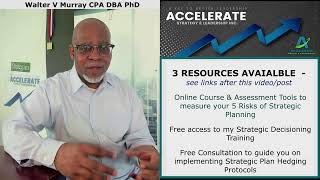
Dr. Walter V. Murray uses Silicon Valley Bank's collapse to show why organizations need hedging in strategic planning. SVB failed because of duration risk—too much exposure to long-term bonds when interest rates rose. Murray outlines three practical hedges: early-warning systems, diversified metrics, and contingency plans for rapid course correction.
Welcome to another episode of Acceleration, where Dr. Walter Murray shares tools, tips, and strategic leadership resources to help your strategy implementation go fast.
But not only go fast, but go efficiently and fast, putting you way ahead of your peers and your competition. So let's join Dr. Murray, the CEO and Chief Accelerator at Accelerate Strategy and Leadership Incorporated, to take it to that next level.
The most important thing is strategy. Uh, what we're going to do in this podcast today is we're going to take a look at what's been happening in the financial world, the political arena, um, just some key news stories that may be hidden. Some may be right out there that everybody knows about. Some may be sort of an on the back page of the news, but what we're going to look at is to see how these events, occurrences in the world of finance, politics, socioeconomics environment, how do these things fit, impact your strategy implementation, your strategy creation. So what's been happening? What's been happening? So we know everyone should have heard about this. You'd have to be under a rock not to hear about SVB. SVB, um, 40-year-old bank, uh, Silicon Valley, that just, uh, seems like within 24 to 36 hours went from, went from the back page to the front page, um, and not for a good reason either, right? Um, basically there was a run on the bank. Depositors lost confidence in the bank. The bank bottomed out, failed, had to be bailed out by the federal government. You know, it said that it got so bad that within a couple hours, $43 $1 billion of cash was withdrawn from the bank. I saw a very, very funny picture with a— I believe it was a Brinks truck, armored truck. That's the red one, right? Yeah. Sitting right there in front of a bank, SVB Bank. I'm pretty sure somebody— well, you never know. I was thinking most people will make electronic transfers, but hey, who knows? Maybe some folks do in fact actually say, give me the cash, right? Right. But anyway, so, so, so what's going on there, right? What caused a bank that would— that seemed to be, um, so solvent to within 24 to 36 hours just kind of hit rock bottom? And was there some strategic missteps that they, that they, uh, they made, which maybe we as business owners and CEOs, key decision makers, we— that we probably need to kind of pay attention to, maybe use it as a teachable moment, you know. Of course, everything is made to be political, and so there were some political pundits who were saying that, well, you know, SVB Bank became too woke. You know, we have the anti-woke crowd, and so they said the bank became too woke investing in ESG. There's a ton of that anti-woke political propaganda that tries to attach itself to this major financial event. And of course, there's no correlation whatsoever between SVB's focus, which, by the way, is not outsized compared to other banks in its genre. But, you know, people don't look at facts, though. But there's the political propaganda that SVB was too woke, too focused on DEI and social issues and they lost focus on their real mission and purpose, and that's what caused them to collapse. The facts don't bear that out. I mean, that's the bottom line. The main reason that SVB collapsed, one of the main reasons, is called duration risk. So the bank was heavily invested in long-term bonds, a portfolio that was maybe overweighted in long-term bonds without the appropriate hedging. That's called duration risk, right? As one expert said, it was, it was hedging 101. In other words, they, they, they, they committed a fundamental, elementary, basic error by failing to put in place hedging practices, hedging policies that would protect them against duration risk. See, when you have a portfolio that's long-term, there's greater opportunities along that long-term spectrum for the impact of interest rates, and duration risk kind of ties to interest rate as one of the risks that could occur during the duration. And in particular, in SVB's case, that's really what happened. And so as the Federal Reserve raised the interest rates, the value of their portfolio declined, which was not a problem to begin with. But then when they had to sell some of their portfolio, they had to sell at a loss, right? I think the numbers were about $20, $25 billion that they sold at a loss. And that's kind of what triggered this whole lack of confidence. Of course, there's the virality of it. You know, someone heard about it. He tweeted it and she tweeted it, and before you know it, there's a line of people outside the bank saying, hey, this bank just had a $21 billion loss. So that's kind of like the gymnastics that happened that kind of led to the SVB collapse. Hedging 101. So here's something that is very important, a teachable moment for us as business owners, as CEOs, you know, in our small to mid-sized business. Many of the customers and depositors at SVB were small businesses. I saw an interview with a business owner and she was talking about, you know, not being able to pay her staff. She was a small— what, 7 to 8 employees. Payroll was coming up and couldn't get access to the money. So, so, so the impact of a big business, SVB, not employing or deploying basic hedging practices trickle down to small business owners like myself and like you. So, but what's the teachable moment here? The teachable moment is any future-focused strategy, and quite frankly, all strategy is future-focused, right? It's what are we going to do tomorrow and the day after and the year after to get to where we want to be in the future. So every strategy must involve some sort of hedging of risk because if you listen to some of my podcasts or my online courses, etc., you hear me talk a lot about the 5 risks of strategy implementation, right? Risk of innovation, risk of non-strategic innovation, the risk of misalignment, the risk of non-strategic KPIs, risk of non-strategic engagement, and maybe one of the biggest ones is the risk of non-strategic decisioning. And so when you do your strategic planning and implementation, you got to have a hedge against those risks. And what does that look like, right? A hedge against a risk basically is stopgaps that you put in place that would first alert you. So there's got to be some type of alert system. You don't necessarily want to wait till the risk has consumed your resources collapsed your organization, as is the case with SVB. So you want to have some red flags, some warning system, early warning systems as part of your hedging practice, your hedging ecosystem. And then you want to have contingency plans. Now, the federal bank bailing out SVB is not a contingency plan that's available to you and I as small business. All right. The federal bank went above and beyond the FDIC the FDIC's $250,000 per account insurance and every customer of the bank, irregardless of the size of their deposit, was indemnified. They were made whole. We don't have, as most small business owners, leaders, managers, decision makers, we don't, I wish we did, but we don't have that type of hedge. Federally funded hedge. You know, we talked a lot in one of our last, uh, master classes, we talked a lot about making non-strict decisions. This was a clear example of SVB making a decision that was non-strict, the decision not to implement a hedge against duration risk, which many experts say is hedging 101, that, that a college grad in finance would have known to do that. Their failure to implement hedging is a decision, a strategic decision that was made. Not doing X, which in this case X would be the hedging, not doing X, you effectively are making a decision to expose yourself unprotected to duration risk. So what's the lesson here for us as business owners, CEOs, key decision makers? The lesson here is be sure to use hedging as a— be sure to use hedging as a hedge, I guess. That would be kind of redundant. But as a stopgap, as a stopgap, an early warning system, as a stopgap for the major risk, the major 5 risks of strategy. So hedging risk simply refers to taking actions that would reduce the impact of uncertain events, right, on the implementation of strategy. And as we know, if you're familiar with the VUCA terminology, the business environment is volatile, uncertain, complex, and ambiguous. Uncertainty defines the business environment, which means that you ought to always have hedge against risk. And in strategic planning, particularly in strategic implementation, there are 5 identifiable risks that we talked about. So hedging is what actions are you going to take to mitigate the impact of uncertain events. Now you can't avoid them because they are uncertain. You don't know if and when they are going to come, but you need to have measures in place that if they do happen, that you can mitigate the impact. One of the ways that helps you with hedging in strategic planning is to be constantly monitoring the internal and external environments, right, the ecosystem. You know, when people do strategic planning, one of the most widely used tools or analysis is the PESTLE. A PESTLE is a way to organize your evaluation of the external environment, the political, economic, social, legal, environmental, right. Right, PESTLE. You just don't use that tool to create the strategic plan. Really, that tool, the PESTLE tool, has more benefit to you in strategic implementation where you continuously do a PESTLE. And maybe once a quarter you do a total relook at the PESTLE, but ongoing, real-time, you ought to have some type of feedback loop where you're constantly monitoring the external environment for things that could represent potential threats to your implementation. So your hedge ecosystem, your hedge infrastructure, will include early warning systems, which would include continuous intentional monitoring of the external and internal ecosystem for threats that may impact your strategy implementation. Another key thing that should be part of your strategic plan hedging is a diversification of revenue. Now, you want to identify revenue not only as dollars and cents monetary, right, but revenue is the return on your strategic plan implementation. You implement strategy, so that you could increase revenue, which is a common one. But you could also implement a strategy to increase market share, which then leads to revenue. Or especially in nonprofits, you could execute strategy, implement strategy to increase impact on your constituents. Right? Whatever that income looks like, you want to diversify so that you don't only depend on measuring strategy implementation with one single metric. You want to be able to create a strategy implementation, and this is why we talk so much about one of the risks of strategy implementation is what I call non-strategic KPIs, where you have KPIs that don't reflect the objective or the outcome, the desired outcomes. The main thing that I want you to get from this is part of hedging in strategic plan implementation is to make sure that you measure success with more than one significant metric so that if there's a threat to one metric, that doesn't mean then that your entire strategic plan has failed. Right? Does that make sense? That's key because what happened here with SVB, as the experts say, was that hedging 101, basic hedging, practices were not put in place. One of the other ways to make sure that you have good hedging protocols in place is creating contingency plans, and we could spend all day talking about that. I call them sometimes, when we talk about strategic decisioning, I call them strategic off-ramps, right, where you're heading down the highway and that highway represents your strategy implementation, but you see a sign on the highway that says Road work ahead. Road closed. You ever seen that? Right. Now, if you have a contingency plan already created, you say, okay, boom, you hit your GPS, GPS says take this route, you're off and running. If you have no contingency plan, what's going to happen is you're going to sit there, everything comes to a screeching halt, and you're probably not likely to achieve your strategic goal because you have no other way. You don't have a strategic off-ramp to get off the highway and get back on at another point. And the reason this is critical is because in the world of business, speed is important. Now, you may eventually develop a contingency plan, but in the meantime, your competitors who already have hedging infrastructure in place already have a contingency plan, already have an early warning system they get to that roadblock and are able to take that off-ramp part of the normal course of business because it's already built into the strategy plan, right? Strategic plan. You have to be agile to be able to implement contingency plans, and it's important to have a contingency plan as part of your overall hedging. Big news item this week, but again, I like to look at these news items and sort of extract from it teachable moments that me, small business owners, key decision makers, things to learn, things to avoid. So I hope this has been helpful and we'll talk again at our next podcast. This is Dr. Walter Murray here. Be sure to reach out to us. There should be in all of my podcasts, there's contact information on how to reach me. If you want to talk about how to create a hedging protocol for your strategic plan. Specifically, just put a note or message that says hedging. Just say hedging. That's H-E-D-G-I-N-G. Hedging. Alright? And so when I call you, I know that's what we're going to be having a conversation on. Alright? Good talking to you again. Looking forward to speaking with you one-on-one. Walter Vernon Murray here. Uh, signing off. Acceleration is a production of Accelerate Strategy and Leadership Incorporated in collaboration with Strategic Business Analysts LLC and Auditing Accounting and Consulting LLP.
Remember, you can get more of Dr. Murray's strategic leadership tools tips, and resources by joining his network on LinkedIn, subscribing to his YouTube channel, and following him on Facebook. Just search for him by his name, Walter V. Murray, or search for Accelerate Strategy and Leadership Inc.
More from Walter








All You Do Is Win ! https://acceleratestrategyleadership.training/saltresources/


