Dealing with Failure Whole Self Gift v Gaffe
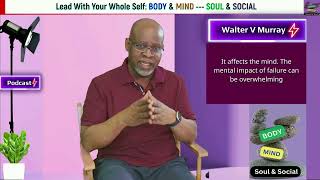
Dr. Walter V. Murray explores how leaders can reframe failure as a gift rather than a gaffe across body, mind, soul, and social dimensions. He contrasts dysfunctional reactions like denial and perfectionism with his REBOUND framework, citing Google's practices and a 2010 Harvard Business Study on psychological safety and a culture that allows people to fail.
Chapters
In the pursuit of excellence, leaders must balance strategic agendas, team engagement, budgets, and KPIs with purpose and fulfillment. But true leadership starts with leading yourself, your whole self, body and mind, soul and social. Welcome to Leading with Your Whole Self. In this award-winning podcast, Dr. W. Vernon Murray explores the art of balanced holistic leadership for leaders. Leadership isn't just about leading marketing campaigns or strategic initiatives. It's a Symphony of the physical, intellectual, spiritual, and social aspects of life. Prepare to be inspired and informed, entertained and educated. Now here's your host, Dr. W. Vernon Murray, with today's episode of Leading with Your Whole Self: Body and Mind, Soul and Social.
Walter Murray here, back for another episode of Leading with Your Whole Self: Body, Mind, Soul, and Social. So it's Christmas, Christmas Day. I'm actually in my studio recording this on Christmas Day. My wife just told me, hey, I don't have to work on Christmas Day. It's okay not to work on Christmas Day. But truth is, you know, recording these podcasts doesn't feel like work. It feels like play, feels like fun. I get so much enjoyment recording these podcasts. And sharing this content with you, my viewer and listener, because I know it's going to make an impact in the way you lead, not just in business, but lead in life. So Christmas Day, everybody's looking for what? Gifts. Some people get a lot of gifts, some people get few gifts, some people get no gifts, but nonetheless We're all looking for to have that thing that says within us, hey, I got to get a gift or give a gift, right? Well, I'm going to break some news for you here on leading with your whole self. The gift is the present. Ha! Big deal, right? Yeah, I mean, everybody knows present and gift means the same thing. But hold on, hold on, hold on, not so fast. Nuances of the English language. The present is the gift. The gift is the present. Present moment. The present moment is the gift. In fact, it's the greatest gift that you could ever receive. If you know how to embrace it. Present moment is the gift. The present moment, the present movement of your life. You know, in, in stage plays, there's, there are movements, right? Uh, each movement is like a, a phase or a scene within the play. And, and sometimes our life goes into these movements, right? It's longer than the moment. It's a compilation of moments that make up the movement, that the present moment and movement is the gift. Some people talk about the seasons of your life, the present season, the present moment. Present is the gift. The gift is the present. Because as messed up and as jacked up your present may seem to be, and trust me, I know what that feels like. As bad and as dysfunctional and as disconnected your present is, your present is still a perfect gift. A perfect gift in all its imperfections. The way you see it, the way you live it, in all its imperfections, the present moment is perfect because it is what it was meant to be. Everything that's happening in your life was meant to be at this time, in this space, in this place. It's up to us to be able to pull back the gift wrapping paper that's on the present. A lot of P's there, right? Pull back the paper on the present and, and find the gift in the present. Moment, movement, or season of life. I, you know, personally, sometimes I feel like, man, you know, my window's passed me by. You know, I'm in my 60s now, and sometimes I feel like, ah, man, it's the dreams I used to have no longer are dreams, they're now fantasies, because it's no longer achievable. Way too old. But in the present moment of my old age, yeah, in the present season that I'm in, that present is a gift. Whatever your present is, it's a gift. Right? And so, Merry Christmas, Happy Hanukkah, Happy Kwanzaa. And all the other cultural celebrations. Happy that to you, right? Remember, the present is the gift. The gift is the present. But I know, I know sometimes the gift feels more like a gaffe. You know what a gaffe is? G-A-F-F-E, I think, spelled with an E at the end. A gaffe, it's a synonym for a blunder, you make a major gaffe, major mistake, blunder, mess up, you know, a breakdown, failure. And I know, I know sometimes the present does feel not like a gift but feels like a gaffe. Everything you experience, right? Every sense within you tells you that this present is a gaffe. It feels like a gaffe, sounds like a gaffe, looks like a gaffe, tastes like a gaffe. What am I missing? There's 5 senses. I'm missing one. Sounds like a gaffe. Your whole being, remember we're talking about leading with your whole self. Your whole being tells you signals. This present ain't no gift, bro. This present is a gaffe. So how do you deal with that? How do you deal with that? Well, we'll be back on the next side of this commercial break and talk about when the present is not a gift, but a gaffe. Particularly for leaders, and not just leaders in business, but leaders in life, whether you're leading family, a school, a team, you know, wherever you lead, sometimes the present moment feels not like a gift but like a gaffe. But I'm here to tell you, the present is always perfect. It's always the perfect gift. We'll be back.
You are listening to or watching Your Whole Self: Body and Mind, Soul and Social, a podcast about leadership. Remember to subscribe, like, and share our podcast. Now let's get back to Dr. Walter V. Murray on leading with your whole self, body and mind, soul and social.
Yeah. So what do you do when this present moment that's supposed to be a gift feels like, tastes like, sounds like not a gift, right? It sounds more like a gaffe, a blunder, a mistake, a failure. What do you do when the present feels like a gap and not a gift? Well, you know, it's this whole perspective on how you deal or how you respond to failure, right? And in the context of our podcast, you know, leading with your whole self, we understand failure is inevitable. Every leader, and whether you lead a multi-million, billion-dollar corporation, or whether you lead a small business with 10 employees, whether you lead a department within a business, whether you lead a family, a school classroom, wherever you get people together to achieve a common objective, and you are responsible to execute that strategy, there's one thing that is inevitable along the way. You're going to experience failure moments when it feels like not a gift, but a gaffe. You know, you make a strategic decision that blows up in your face, an opportunity to, to gain market share and an opportunity to to elevate your company's image in the marketplace. Bad judgment. And one of the things that comes with failure is this overwhelming sense. This is if you don't know, if you don't have a way to deal with failure, right? One of the things that comes with it is this overwhelming sense of fear and guilt and shame. Like, man, what's my team going to think about me, right? What are my peers going to think? Oh, or fear that, look, this gaffe, this mess up, this blunder is going to cost us millions of dollars. There's all kinds of emotions that come when the gift is not a gift, but the gift is a gaffe. But here's the key, right? How leaders respond to these emotions can determine whether failure becomes a stepping stone or a stumbling block. And this is what I talk about, how you dig within that present moment, how you pull back the paper, right, to find the gift in the present moment, even if the present moment is a gaffe, right? How do you do that? We'll talk about that for a moment. And so, you know, talking about leadership, right, in all these various nuances and contexts, you know, if we don't know how to deal with failure and loss efficiently, then effectively leading with your whole self goes out the window. Leading with body, mind, soul, and social is compromised significantly if we don't deal with failure and gaffes, right? Um, I mean, let's, let's take a look at this, right? When someone experiences— and I'll tell you from my own experience, when I experience a significant failure, of course I'm getting— I've become much better at handling it, but, but before I understood the nuances of dealing with failure and gaffes and mess-ups and blunders. Physically, I could find myself losing sleep, right? So that's the impact on the body. Loss of sleep, headaches, you know, because I'm just locked in, overanalyzing, overthinking, and just my brain explodes, right? So I would experience just these severe headaches. So I was caught up in overanalyzing why the failure occurred. Catastrophizing is another thing where it's like I begin to think that the repercussions of my failure are much greater than they actually will be, right? And so that body thing is a real thing. I mean, I've experienced it and I'm sure you have too. Some people experience heart palpitations, their heart rate Picks up. The adrenaline keeps pumping and adrenaline is not meant to pump constantly, right? Adrenaline is a fight or flight mechanism, but you find yourself in a constant state of heightened adrenaline. That's physically messed up, right? So failure, one of the ways that it impacts our whole self in the body aspect is just like that, what I just described. It affects the mind. The mental impact of failure can be overwhelming. I mean, people— and I kind of just talked about it— the, the, what the psychologists and counselors call catastrophizing, replaying scenarios in our heads, overanalyzing decisions, second-guessing ourselves. That's a huge one, man. Should I— I should have done— I should have done A. A and not B. I should have done B and not C. Second-guessing yourself, that could go on. That cycle of second-guessing drives you, drives your mind crazy, right? And be honest, you've been there. If you've been a leader, you've probably experienced failure sometime along the way. A gaffe. And if you have, you've probably experienced this type of mind, mind, what do you call it? Mind mash, right? Where it's just like everything is just replaying in your mind like, I should have done that and I should have done this. It's crazy. It affects the soul. Body, mind, soul, and social. It affects the soul. And this is an interesting one because failure can deeply affect our sense of purpose or what I call sense of alignment with our values. You know, the soul of values, that's who we are, the intangible definition of who we are. He's an honest person. He's a kind person. You know, that soul, that's who we are on the inside kind of thing, you know, the essence. And failure sometimes challenges our essence. You know, let me give you a good example. Let me give you a good example. Countless numbers of leaders have made unethical decisions, which goes contrary to their soul essence, right? As a response to failure. You cut corners here, you cut corners there because you, you're trying to right the wrongs that came about because of the failure, right? Don't let that happen to you as a response to failure. Stay true to your essence. Stay true to your soul. Reconnecting with your core purpose is an essential part of dealing with failure, dealing with life when life is a gaffe and not a gift. The social, right? So we're going down the line and looking at how failure impacts our whole self, right? Because if we're going to lead with our whole self, we got to make sure that anything, i.e., failure that compromises our whole self, body, mind, soul, social, is dealt with in an effective and constructive manner. So we looked at body, mind, soul. Let's look at social. I'm going to give you, and even to this day, I still kind of struggle with this one. Because see, when I'm experiencing a failure, I don't want to talk to nobody. That social life goes out the window. And I don't have a good social life to begin with. All right. And what little I have, when I'm dealing with a failure, when something doesn't go according to plan strategically, I'm heading to my man cave. I'm closing the door. I'm turning some music on. I'm on my computer, overanalyzing, catastrophizing, trying to figure out what went wrong and how could I prevent it from happening. Now, that's a good thing, trying to analyze what went wrong, but at the expense of social interaction, because here's the deal. Here's the deal. Every answer to every problem comes through a social connection. Solutions don't fall from the sky, right? You don't see the hand of God writing out the solution in the sky, right? Was it the story in the Bible where Moses Got the law written by the hand of God on tables of stone. That stuff don't happen anymore, right? The solution is going to come through one of my social interactions. I'm going to be on the phone with somebody explaining this, explaining the situation. They'll give me a suggestion. Their suggestion may not be the entire solution, but it may be one step along the way. I may be interacting with someone via email, via text. But if I shut down my social interactions as a response to failure, I'm shutting down the very thing I need to recover and rebound from that failure. And, and, and I'll be honest with you, that's the one I'm still working on. As much as I'm talking here about how to deal with failure, there's some things that are just ingrained in one's DNA, I guess. And so, uh, but yeah, dealing with failure is a way to, to protect body, mind, soul, and social because as you can see, there are, there are significant evidence-based, uh, impact the body, mind, soul, and social as a result of failure. So a couple of ways that research has shown that leaders typically respond to failure are one is denial and defensiveness. You know, denial and defensiveness. Avoiding responsibility, blaming external factors. And listen, I'm going to expand a lot more on some of these, right, in my book, How to Rebound, right? And I'll give you some more information about that book, How to Rebound, 7 Keys to Rebounding Fast. And it talks about some of the ways that people try to rebound that are ineffective. Denial and defensiveness. Isolation. I just talked about that. That's my deal right there. Perfectionism. You know, in, in, in, in the book that I wrote called, uh, Rebound: 7 Keys to Rebounding from Failure Fast. So, so Rebound is actually an acronym, right? R-E-B-O-U-N-D. And we'll talk about it later, but the D talks about deployment. One of the ways to, one of the keys to rebounding, recovering from failure is to deploy Fast, right? Deploy in military terms means, you know, get going, get the initiative launched. Don't sit there and overanalyze and overthink and overplan. Do something, right? And sometimes perfect is the enemy of good. And we find ourselves locked into this cycle of perfectionism. Another way that people deal with a failure, that's a dysfunctional way, is learned helplessness. Feeling powerless to recover or improve. This is where you feel like you are the victim. And you might be. But even victims have power. So, so, so how do you break the habit of learned helplessness. That's one of the keys to recovering from failure fast.
You are listening to or watching Your Whole Self: Body and Mind, Soul and Social, a podcast about leadership. Remember to subscribe, like, and share our podcast, and be sure to join hundreds of other leaders in our SALT Leadership Community. In this fast-growing community, Dr. Murray and his team at Accelerate Strategy Leadership Inc. share tons of leadership and strategy resources so you can lead your organization strategically and lead your whole self. Join our leadership community at strategicleadershipresources.bodymindsoulsocial.com. Membership is no cost to you, compliments of our host, Dr. W. Vernon Murray, and his team at Accelerate Strategy Strategy Leadership Inc. Now let's get back to Dr. Walter V. Murray on leading with your whole self, body and mind, soul and social.
Remember, everything that we talk about here is available in more detail in either my book, my masterclass, my training programs, which you could find on my resource page. You'll see a clip in a minute, or it may have, have already run of how to access the resource page. The resource page really is a, a resource community for leaders, right? Providing resources, tools, strategies, tactics on how to deal with leadership in a whole, in a whole person manner. Also talks a lot about strategic leadership, right? So be sure to access additional information on my resource page as it relates to this topic today. But let's talk about some constructive responses to failure, right? We just looked at some of those nonconstructive, dysfunctional ways to deal with failure, and I raise my hand, I'm guilty of a couple of those. But a Harvard Business Study was done, uh, in 2010 that found that leaders who actively evaluate failure in a constructive manner create a culture of psychological safety. That's important because not only does it provide psychological safety for them, as the leader, but psychological safety for the team. I always talk about, and I mentioned in my book a couple of times, freedom to fail. When you create a culture— now Google is famous for this, right? Google, in my masterclass, I talk about this a lot. But Google creates a culture where there's even time that's allocated during a work week for people to just try stuff with no regard for success or failure outcomes. So the burden of success is removed. What that does, this culture of freedom to fail. And you've got to be judicious in how you do this, right? You can't create culture of freedom to fail across the board all the time, nonstop, 24/7, right? But judiciously applied, a psychological safe zone, freedom to fail fosters growth, creates, improves creativity. There's boosts to research and development. Resilience in teams, all that stuff is a collateral benefit to creating a psychological safe zone where people feel free to fail. Again, this all comes back to constructive ways to deal with failure, not just your personal failure, but for the team.
Jump into the leadership community now and watch part 2 of this episode on how to deal with failure. With your whole self—body, mind, soul, and social. Remember, the community is free and there are tons of great tools and resources you can start using right now to lead with your whole self—body, mind, soul, and social. Here is the link again to join now and catch the second part of today's episode: www.strategicleadershipresources.bodymind soulsocial.com. Membership is no cost to you, compliments of our host, Dr. W. Vernon Murray, and his team at Accelerate Strategy Leadership, Inc.
More from Walter








All You Do Is Win ! https://acceleratestrategyleadership.training/saltresources/


