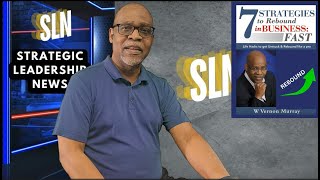
Dr. Walter V. Murray argues leaders should be judged on decision quality, not outcomes, because good processes can still fail and bad ones sometimes get lucky. He uses Rumsfeld's framework of known unknowns and unknown unknowns to show where decisions go blind, then presents his REBOUND framework to help leaders recover from strategic failures.
Chapters
Welcome to another episode of the Strategic Leadership News, SLN. SLN, Strategic Leadership News, is a podcast that provides insights and information, tools and tactics to help C-level leaders and senior managers of small to mid-sized organizations achieve maximum strategy acceleration. Each episode is designed to help C-level leaders and senior managers reach their strategic goals faster and more efficiently than their competition. In each episode, Dr. Walter V. Murray, a leading strategic leadership expert, author, and trainer, pulls back the curtain on current news stories, current events, trends, and policies to uncover insights and information to help leaders and managers in small to medium organizations create and accelerate their strategy implementation so they can outcompete their competition. Now here is Dr. Walter V. Murray with today's episode of SLN: Strategic Leadership News.
So you, you probably heard me say the quality of your leadership is determined by the quality of your decisions. But that needs to be parsed a little bit because if you look at decisions, if you qualify decisions or assess, evaluate decisions based on outcomes and only outcomes, then that's not necessarily always a true statement that quality of your leadership is determined by the quality of your decision because it has to take into consideration not just decisions as outcomes but decisions as a decision-making process. This coming week, I'll be doing a workshop for some CEOs and C-level execs talking about decision-making and strategy. One of the things that we want to parse out and sort of dive into is the fact that the outcomes of your decision-making process don't always line up with your decision-making process. What does that mean? So for example, you could utilize all the best practices in decision-making, decision algorithms, cost of decisions, permanent versus long-term decision-making. You could take into consideration all the decision-making best practices and still end up with a bad outcome. Now, the chances that you end up with a bad outcome are lower significantly when you use good decision-making processes. But good decision-making processes do not guarantee a good outcome. Uh, same token is I've seen people use just lousy decision-making practices and just get lucky. All right, just get lucky. Right place, right time. And in spite of their bad decision-making process, no research, no data, no metrics, no algorithms, nothing in place, they just get lucky and end up with a good outcome. A bad decision-making process does not mean that you will always have a bad outcome, but it significantly increases the likelihood that your outcome will be just as lousy as your process. And why is that? It's because there are certain things that we call, that if you listen to Rumsfeld, it's called the Rumsfeldian concept. The things that we know we don't know, the things that we don't know that we know, but here's the kicker, the things that we don't know that we don't know.
Reports that say that something hasn't happened are always interesting to me because, as we know, there are known knowns. There are things we know we know. We also know there are known unknowns. That is to say, we know there are some things we do not know. But there are also unknown unknowns, the ones we don't know we don't know.
Yeah, I mean, you can't— it doesn't matter how fine-tuned your decision-making process is. There's always going to be things that you don't know that you don't know. That is a true blind spot. And every leader is susceptible to these blind spots, these things that they don't know that they don't know, and hence, they can't plan for it. And the key is if one of those things crops up, right, and just totally discombobulates your decision outcome. Then you have to be able to rebound from that bad outcome. And don't spend time talking about, well, I did everything right. I did this, I did this. What's wrong? Woe is me. Crying over spilt milk is not a leadership quality. Trust me on that one, right? You did all you could, did the best you could, did the research, did an algorithm, got team engagement, Good metrics. You did everything right. You got a lousy outcome. Hey, keep it moving. Reevaluate. I've got a framework to help leaders rebound from what I call strategic decision disaster, SDD, strategic decision disaster. It's called a rebound, R-E-B-O-U-N-D. That acronym means something. In fact, The title of one of my books, Rebound, Rebound. In one of my next podcasts, I'll talk about it, right? So use the best decision-making practices available to you. Learn, research, use the best decision-making processes available to you with the understanding that there are things you don't know you don't know, and you might still have a bad outcome. If you do, learn to rebound fast, have a rebound strategy. Don't cry over spilt milk, just get up and keep it going.
By the way, Dr. Murray, I want to remind the viewers that they can learn powerful decision-making principles and practices like your 4R3I decisioning algorithm. When they enroll in your Dimes Strategic Leadership Conference or your Strategic Decision Making Masterclass. I will put the registration link at the end of this podcast, wvernonmurray.com/dimesconference.
Remember to join Dr. Murray for the next episode of SLN Strategic Leadership News, and be sure to share this podcast with other C-level executives, business owners, or senior managers. Spread the news about Strategic Leadership News.