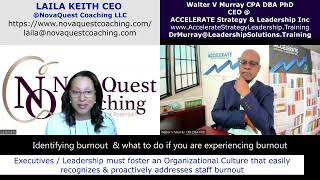
In this interview‑style conversation, Walter V. Murray hosts Leila Keith, CEO of NovaQuest Coaching, to explore the rising tide of workplace burnout, especially among mid‑career women of color. Leila cites Gallup’s 2022 State of the Global Workplace report—showing that 30% of U.S. employees feel burned out and 60% are emotionally detached—to illustrate the scale of the problem and asks why it remains under‑recognized. The dialogue uncovers a gap between employee experience and C‑suite perception, highlighting fear‑based silence, performance‑driven cultures, and lack of psychological safety as barriers to acknowledgment. Leila shares her own burnout journey, describing loss of motivation, sleep disruption, irritability, physical tension, diminished focus, and a sense of malaise, and explains how a physician’s warning prompted a six‑week recovery, therapy, and career coaching. She advocates a blended recovery model that couples mental‑health support with career coaching and regular health “check‑ups.” The conversation then shifts to practical prevention: mindfulness, awareness of thought patterns, regular self‑check‑ins, and building trust with managers. Walter adds a leadership perspective, proposing strategic engagement—regular check‑ins on people, not just projects, fostering psychological safety, and balancing performance targets with employee wellbeing. Throughout, the speakers emphasize both individual responsibility to recognize symptoms and organizational responsibility to create supportive cultures, especially for women of color navigating career milestones.
Chapters
I think this will be a really organic conversation, so I feel like we will have a good banter about, you know, back and forth about awareness, mindfulness techniques, you know, behaviors and thought processes that may not serve us, what we can do about it, and then some tips Authenticity comes from— I feel like the authenticity comes from these conversations.
So today I'm speaking with Layla. Layla is with NovaQuest Consulting. I'm going to have all her contact information later on in this video or at the bottom of this post. You'll be able to find all of that information. And so my name is Walter Murray. So this is our second conversation, and I find it really, really compelling having these conversations with Leila because she shares insights on workplace stressors, right? So Leila, tell us a little bit about some of the problems or the main issue that you target your services. What is it you try to fix or help?
Yeah, well, thanks for, uh, the conversation again, Walter, and having me on. I'm Leila Keith, and I'm the the CEO of NovaQuest Coaching. I founded NovaQuest Coaching, and after 20-plus years in corporate and experiencing burnout myself, I wanted to help women of color 30-plus to navigate career milestones, but also those women who were experiencing burnout or trying to recover from burnout or trying to not experience burnout again if they've already experienced it. So that's what led me in my, you know, 20-plus years in corporate and Fortune 500 to start my own coaching business to help and support women. And as Walter As I said, what brought us to this conversation today is the prevalence. The prevalence of workplace burnout is just soaring. And one of the things that Walter and I were talking about is, do people know they're in it when they're in it? So we wanted to talk today about how to identify burnout first and foremost. And then what do you do if you're in it? If you're in the thick of it, what are some of the techniques you can use and solves to help yourself recover from burnout? And then what can you do in being stick-to-itive in your behaviors and mindset to help you prevent getting there again. So that's why we're having this conversation today. And it's timely. I mean, there's a lot happening in the world, but I'll tell you, one of the things that also had me focus on at top of the year was Gallup's State of the Global Workplace report that they did in 2022. And the numbers were just mind-boggling to me that, one, 3 in 10 employees in the US are experiencing burnout. 3 in 10. That's what it was in 2022. So that's quite high. And it was 3 in 10 always or very often feeling burned out at work. That in itself is a high number. And then 60% of people are emotionally detached at work. And that was part of the report that was mind-boggling to me and what that can lead to.
So let me interject for a moment because those, those statistics are really mind-boggling, totally flooring me. Because if it is that prevalent, why is it not more easily recognized?
Yeah.
Because it's there all the time. It seems 30, if you say 30% of people in the workplace are suffering burnout, that's a high percentage.
Yep.
And 60% are disconnected, which is probably some form of burnout, right? If it's that prevalent, why is it not more easily recognized? What are we missing?
Yeah, great question. I think one of the things is the support system. You know, now that, you know, these reports are coming out, I think there can sometimes be a gap. And the other thing that I specialize in is executive organizational culture. So sometimes there's a gap a large gap between the actual employee experience and the perception of the employee experience by the C-suite.
Right.
The gap between— so these reports are allowing us to close the gap to see what is actually the employee experience and also providing a voice. A lot of times there's fear-based behavior and we're afraid to say, I need help. We're afraid to be reprimanded. We're afraid of underdelivering. We're afraid that this is gonna have repercussions on how we're perceived by our colleagues, by our manager. And sometimes your manager's pushing you so hard that perhaps you don't feel that you have the support to have a voice to say, I'm struggling.
Yeah, sometimes it's not recognized in the workplace because managers and leaders don't want to recognize it. Yeah, here's what I mean. Here's what I mean by that, right? Managers and leaders are under a lot of pressure to perform, right? You know, deadlines to meet, targets to, to reach. Return on investment numbers. You got stakeholders internally, external stakeholders, investors. You got all of these pressures, right, to produce results. You get so focused on results that you lose track of the employee, the team member who is supposed to help you get those results. You don't have time to stop and think about the soft science of emotional well-being. You want— you just want performance. Get me that report on my desk by Monday morning because I've got my boss breathing down my back and he's got his board of directors breathing down his back. We don't have time to think about how you feel emotionally, you know. And so I think we don't— as leaders, sometimes we just don't want to recognize it because it represents a disruption in our production workflow. No time for that. We got reports to get done, budgets to meet. And I think that's probably part of what's driving the fact that people don't recognize it. It's not like they don't recognize it. I think they do, but they don't wanna stop to address it.
Does that make sense? It could be a combination of both, right? It could be a combination and it could be the culture of the organization is performance results driven, which often, and, and by the way, burnout happens in higher likelihoods in the healthcare industry, you know, very results, sales results driven, pressure, timing, quarterly, you know, or fiscal, you know, timelines that you have to hit, goals you have to hit, KPIs you have to hit, very stressors, right, for those leaders and, you know, their support teams. And so sometimes there isn't the culture of the organization is not one that provide support for burnout. Sometimes they're unaware that that many of their employees are experiencing, but some of the onus falls on the employee also to ask for help. And sometimes by the time you're in the thick of it, it's affecting your productivity. So they're not even aware because you haven't voiced or asked for support. And so how is that being perceived, right?
So it's a two-way street.
It's a two-way street. It's— and it's— but also it's the psychological safety that the employee must be to have, to have that conversation with their boss, thereby providing a culture where employees feel psychologically safe to share if they're having some struggles with their wellbeing and balance, their work-life balance, right? So the main thing is, what does this look like? So what does we know? I know because I experienced it, but what does burnout look like, right? So one of the things is let's help people identify what it is. So, one of the things that triggered for me was the loss of motivation, feeling kind of hopeless, like no matter what I did, I was going to be in the same place every day, dreading going to work every day, not being able to sleep. It definitely can affect your sleep when your wheels are turning, easily overwhelmed. And because of that, agitation and irritability. I was snapping at my friends. My loved ones, people at work. Sometimes I felt like I didn't recognize myself, this irritability and feeling like I just was not well. I had a sense of malaise where I just wasn't feeling good. I had tension, I had headaches. I gradually was losing focus and my ability to concentrate. I had diminished pride at work. Yeah, you know, I didn't have the same gusto about my projects that I did. I was losing sight of myself and my goals. And I was feeling really drained, really, really drained.
There's a lot, there's a lot there, Leila. So, so, so it begs the question, right? If there are all of these signs that signal burnout, is it that people experience the signs but don't tag the— don't add the tag burnout to it? They, they feel all what you feel. What you, what you described. They feel lack of motivation, they feel agitated, but they don't know why. They don't know what is causing it.
I didn't put it together to realize I was burned out until my doctor said, knock it off.
Yeah.
And said, women your age— I was in my late 40s when this happened— women your age have heart attacks, strokes, cardiovascular, you know, risks You could have the higher risk for type 2 diabetes, inflammatory disease, which can also debilitate your immune system. All of these culmination of things, I didn't put it together. It was like, you're burned out, I am pulling you out, I'm pulling you out for 6 weeks to recover. He recommended also I get a therapist to talk through coping mechanisms, which I did. I think that there's a wonderful blend of finding a career coach like myself and someone who works with women and or men to help you navigate these milestones and find ways to work through a better work-life balance, but teaming up with a therapist also to deal with some of these mechanisms and techniques and stressors. You might find there are other stressors, identifying these stressors that a therapist can help you with. So it's a beautiful blend of the person helping you on the career side and the person helping you with your mental health. It's a wonderful— for me, it was a great balance. And I always recommend people to get a checkup. Like we check out— listen, we check the oil on our car, right? Every quarter, we need a checkup. So, you know, don't let it get to the point where you are in desperate need for balance in your life and wellness and wait to those isolated events. Why not have a checkup all throughout, right? So I didn't know all of those things. I didn't know I was being irritable. I knew I was stressed out and I was anxious, and that's why I wasn't sleeping. But the lack of focus and concentration and me feeling like my throat chakra, not being able to express myself, was having an impact. Not being able to effectively communicate in meetings. I didn't make the connection that all of these symptoms were burnout.
Yeah, well, you know, it's a good point because, like you said, it works, it works. It's a two-way street, right? The, the individual needs to be able to recognize those signs, put it together. But again, from my perspective, in terms of leadership and management, you know, there's a thing that we talk about, we, we talk about strategically engaging your your team members, right? And to strategically engage your team members is to be sure to put them— not just give them tasks to do and responsibilities to perform, but put them in the best position to accomplish success in the task that they have been given, right? Or the roles that they've been given. That's strategically engaging people. And I think from what I'm hearing from you is that one of the ways that we could strategically engage is when we give people roles to perform, expectations of outcomes, that we also have a piece that gives them that freedom to say, hey, I'm overwhelmed. You know, like maybe a check back the way, the same way we would check on a project progress. Let me check on you, right? So not only am I checking on how is the report coming along, how are you coming along, you know. And that way we kind of close that circle where we don't, we don't overfocus on just the report and the project and the, and the targets, but we also focus on the person who is supposed to deliver those for us. And I think that's a, that's a great lesson that you talked about. So, so managers and leaders need to be able to identify those signals and say, you know, I need to probably check in with Joe you know. Yeah, you know, and see what's going on with Joe. Forget the report, forget the, the fiscal targets and budgets. Hey Joe, hey Jeffrey, how you doing? You know.
Yeah, yeah, there's, you know, building trust with your team is critical for leaders.