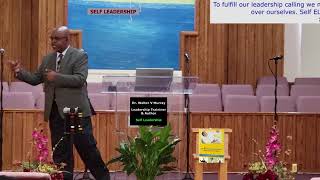
In this excerpt from Dr. Walter V. Murray’s keynote on self‑leadership, he first clarifies that the biblical phrase “subdue and have dominion” is not a license for oppression but a call to create positive change in churches, nonprofits, or businesses. He then argues that many leaders misuse this concept as a shortcut, adopting an authoritarian, “lazy” style that relies on authority rather than personal growth. Murray stresses that true dominion begins with mastering oneself. He outlines two core components of self‑leadership: (1) self‑awareness – understanding one’s own strengths, weaknesses, and motivations; and (2) self‑control – the ability to regulate emotions, thoughts, and actions, even when one has the power to act otherwise. Throughout, he urges leaders to abandon the easy, command‑and‑control approach and instead invest in the harder work of leading themselves, positioning this as essential to fulfilling their leadership calling.
Chapters
But we cannot, we dare not, if we want to fully live out the calling of leadership, we cannot afford to take the lazy, easy way out.
Let's join Dr. Walter V. Murray in a few excerpts from his keynote and training presentation on self-leadership. He is presenting to leaders in a faith-based nonprofit organization, but the principles of self-leadership are even more relevant in a corporate for-profit organization. First, he talks about a style of leadership that is based on subduing and dominating team members. Then he posits that this autocratic authoritarian leadership style may be a cop-out from having to do the hard work of self-leadership. In his presentation, Dr. Murray draws from his book, The Three Demands of Leadership, in which he writes extensively about self-leadership. He also draws from experts in the fields of emotional intelligence, organizational psychology, and leadership. Be sure to click Dr. Murray's link at the end to get information on his comprehensive and interactive online course entitled The Three Demands of Leadership. Which includes a copy of his book that contains extensive content on self-leadership. Also, Dr. Murray would love to do a leadership training or keynote address for your organization or at your next event. See his contact info at the end. Now let's listen to some excerpts from Dr. Murray's presentation.
Now let me lay out for you two foundational premises for prayerful consideration today. First, the underlying definition and interpretation of subdue and have dominion is not about subjugation and domination. I want to clear that up. The underlying definition of subdue and have dominion is not about subjugation, domination, and letting them know who's the boss around here. It is about making positive change in your church, organization, or business.
To be—
the second purpose is, this is what we're going to spend most of our time on today, Second premise, and if you have pen and paper, please take notes. The second premise of how to have dominion is that to be able to subdue and have dominion the way God intended begins with subduing and having dominion over self. The essence of self-leadership. We spend way too much time trying to subdue, have dominion, lead others, and too little time on subduing, having dominion, and leading ourselves. There are so many ways that we could be tempted to use subdue and dominion as a lazy form leadership. And I call it lazy form of leadership because it's kind of like where the parent says to the child, don't ask me no questions, just do what I say. You know, it's my way or nothing. You guys have heard that before. Hopefully you'll be told that to you, and hopefully you didn't tell that to someone else, right? Um, but, but that's a lazy form of leadership. To try to use authority as a basis to lead others is what I call the lazy form of leadership. Business owners use it a lot, managers, C-level executives, coaches, and church leaders. We were created to fulfill our leadership potential, but we cannot, we dare not, if we want to fully, uh, live out the calling of leadership, we cannot afford to take the lazy lazy, easy way out. We often choose this lazy, easy way because it's easier than subduing and having dominion over self. Working to lead myself is so much more difficult than saying, "Just do it," and depending on my authority to have them follow my directives. That's easier than, than disciplining myself to live a life that is exemplary of what I'm asking you to do. So self-leadership, we'll talk about that for the next few minutes. But to fulfill that leadership calling, you must understand how to subdue and have dominion God's way to subdue and have dominion begins with leading oneself, begins with having dominion and subduing oneself. The first element of subduing and having dominion over self is self-awareness, right? So I've done a Cliff Notes version to catch you up. Now let's talk about the second element of self-leadership. Self-control. Self-control is the ability to regulate one's emotions, thoughts, and behavior in the face of temptations and impulses, right?
It is— it's— it's—
I put it this way sometimes: self-control is the ability, the ability to say yes when you have the power to say no. It's the ability to to not exercise your power at a time when you'll be within your rights to do so.